Home/Learn/Code and permits/Bellevue plumbing permits: when you need one, what it costs, and why skipping costs more
Code
Bellevue plumbing permits: when you need one, what it costs, and why skipping costs more
City of Bellevue Development Services requires permits for most major plumbing work — water heater replacement, sewer line repair, repipes, new fixture installations, and concealed-piping alterations. Routine maintenance and like-for-like fixture swaps do not. Permits issue same-day for routine work via MyBuildingPermit.com, and a licensed plumber pulls the permit as part of the job. Skipping a required permit creates three downstream risks: insurance denial of related claims, mandatory disclosure on sale of the home with potential price reduction, and retroactive permit costs that typically run 2 to 3 times the original fee plus comprehensive inspection. This guide walks through the entire process — what requires a permit, what doesn't, how to apply, what the inspection looks like, what unpermitted work actually costs in the real world, and how to legalize work that was done without a permit in the past.
Water heater replacement (every time, regardless of fuel type or size), sewer line repair or replacement, whole-house or partial repipes, water service line replacement from meter to house, concealed piping alterations behind walls, backflow preventer installations, and any new fixture installation that adds drainage to the system.
City of Bellevue Development Services maintains the authoritative list under the Plumbing Permits section of the bellevuewa.gov website. The categories below match the city's published policy as of 2026.
Plumbing work that requires a Bellevue permit
Water heater replacement — required every time, even for like-for-like swaps of the same fuel type, size, and location
Sewer line repair, replacement, or new connection to the King County main
Side sewer installation, repair, or capping
Whole-house repipe of supply (PEX, copper, or any material change)
Partial repipe of supply or DWV (drain-waste-vent)
Water service line replacement from the city meter to the house main shutoff
Concealed piping alterations — any pipe work behind drywall or inside a wall cavity
Backflow preventer installation
Irrigation backflow preventer (separate permit from general plumbing)
New fixture installation that adds drainage (a new bathroom or kitchen)
Commercial kitchen plumbing, medical gas systems, and multifamily buildings (require plan review in addition to permit)
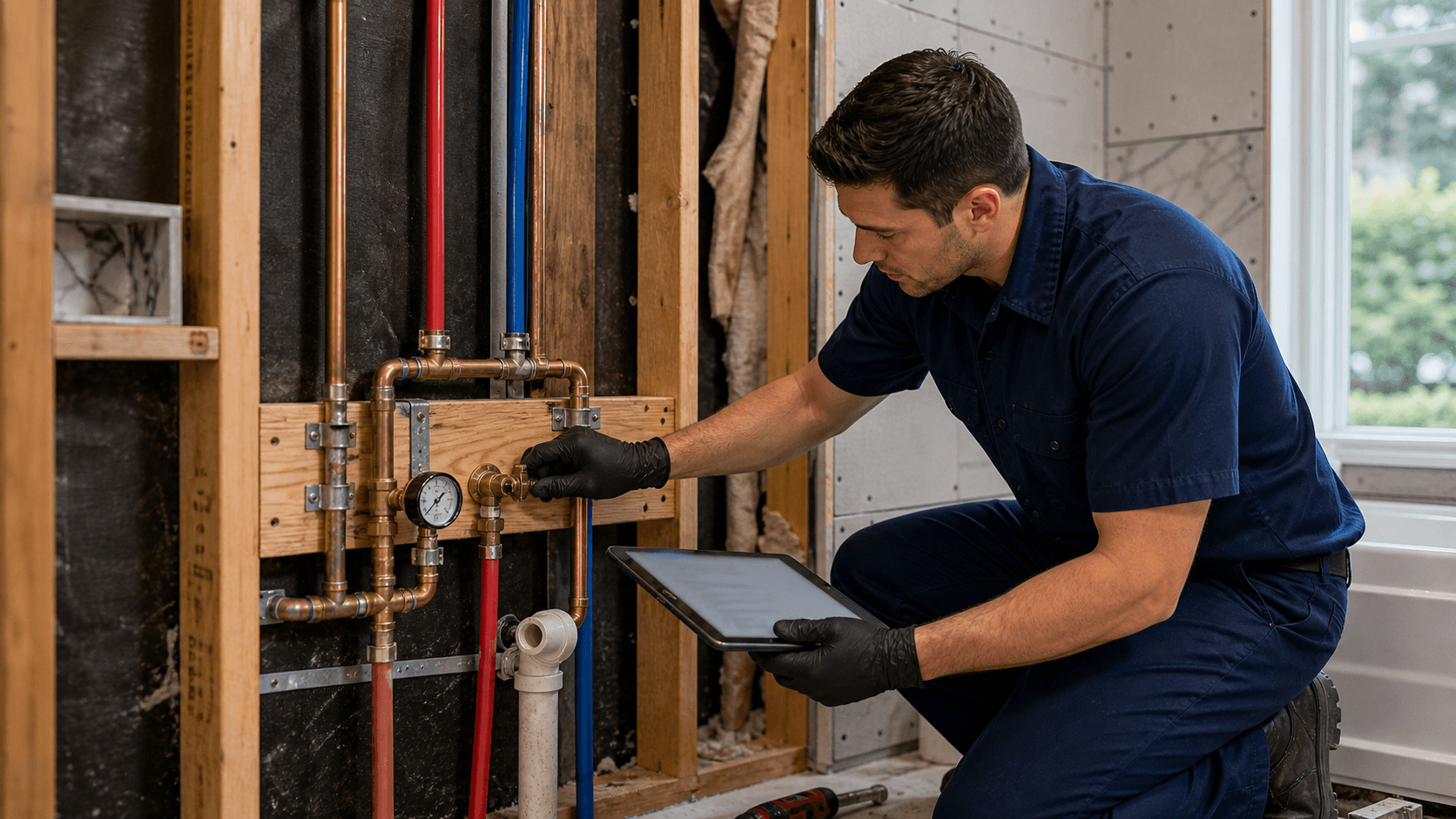
Pressure testing before cover-up is the moment to catch hidden leaks and code misses.
This happening in your home right now? A licensed plumber can talk you through the next step on the phone — 24/7, and the call is free.
In Bellevue, the homeowner owns the entire side sewer — from the foundation to the connection at the city main under the street, including the stretch beneath the sidewalk and planting strip. Repairing or replacing any part of it requires a side-sewer permit through the City of Bellevue, and the inspection closes the permit before the line goes back into service.
The ownership boundary is what surprises people: the city maintains the main, but every foot between it and your foundation — roots, bellies, cracks, the sidewalk stretch — is the homeowner's responsibility to repair and permit. "Buyers assume the city owns up to the property line, and it's just not so," says the permitting lead on our dispatch line. "The side-sewer permit is routine for us — what's not routine is discovering unpermitted sewer work at sale time."
Permitted side-sewer work also produces the paperwork that protects a resale: the closed permit and the camera footage become the line's provenance. Unpermitted sewer repairs surface exactly when a buyer's inspector pulls the permit history — see retroactive plumbing permits in Bellevue for how that gets fixed, and sewer line replacement cost for the work itself.
What plumbing work does NOT require a permit
Routine maintenance, like-for-like replacement of exposed fixtures (sinks, toilets, faucets), repairs that don't alter the piping configuration, drain cleaning, and showerhead replacement do not require a Bellevue plumbing permit.
The exemption list per Bellevue Development Services:
Plumbing work exempt from Bellevue permit requirement
Repairing or replacing a sink, toilet, or faucet, as long as the supply and drain piping is exposed (not concealed in a wall)
Cartridge or seal replacements inside an existing faucet or valve
Repairing a hose bib that's accessible without opening a wall (replacing a frost-free sillcock typically does not need a permit if the connection inside is unchanged, though check with the city if the wall needs to be opened)
Replacing gutters or downspouts (handled under a different category if at all)
Installing an outdoor hot tub filled by garden hose with no permanent supply connection
Gray-area situations worth confirming with the city before starting: replacing a water shutoff valve (sometimes considered concealed, sometimes not), replacing supply lines from the wall to a fixture (technically a concealed-piping alteration if the wall is opened), and installing an under-sink reverse osmosis filtration system (usually not required if it's a point-of-use add-on with no drain connection, required if it taps into the DWV).
When in doubt, the safest path is to call the City of Bellevue's MEP Review group at 425-452-6873 or email MEPreview@bellevuewa.gov before starting the work. The conversation takes 5 minutes and avoids the much larger cost of retroactive permitting.
Water heater replacements, repipes, and remodel rough-ins are the jobs where permits matter most.
How to apply for a Bellevue plumbing permit
Apply online at MyBuildingPermit.com (the shared portal for Bellevue and most King County jurisdictions). Routine plumbing permits not requiring plan review are issued the same day. Work that requires plan review (medical gas, commercial kitchens, multifamily 5+ units) takes 1 to 4 weeks for approval.
The application process:
Plumbing permit application steps
Create an account at MyBuildingPermit.com if you don't already have one (free).
Select City of Bellevue as the jurisdiction.
Choose 'Plumbing' as the permit type.
Fill in the project address, scope of work (e.g., 'replace 50-gallon gas water heater in garage, same location'), and contractor information if a licensed plumber is doing the work.
Pay the permit fee online via credit card or e-check.
For routine residential work (water heater replacement, faucet relocation, etc.), the permit is issued immediately after payment — you can download the permit PDF and start work the same day.
For work requiring plan review, plans are uploaded to the portal and review takes 1 to 4 weeks. The plumbing reviewer (Evan Harrison, 425-452-4573, EHarrison@bellevuewa.gov as of 2026) may request revisions before approval.
If a licensed plumber is doing the work, they almost always handle the permit application as part of the job — included in their quote, not a separate fee. This is the easier path for most homeowners. Verify on the written quote that the permit is included before signing. Our water heater repair and installation in Bellevue and sewer line repair and cedar root removal in Bellevue service pages both reflect total prices that include the City of Bellevue permit fee.
Owner-builder permits are allowed for work on your own primary residence. You don't have to hire a licensed plumber for permitted work, but you do have to follow the same code requirements and pass the same inspections. Most homeowners who pull their own permits find the inspection process intimidating; hiring a licensed plumber to do the work pays for itself in avoiding re-inspections.
Permit fees — what to expect
Bellevue plumbing permit fees are published in the city's annual fee schedule and updated each year. Typical residential permit fees run from approximately $85 for simple replacements up to several hundred dollars for whole-house repipes or sewer work. The Permit Fee Estimator at permitfeeestimator.bellevuewa.gov returns the current fee for any specific scope.
The City of Bellevue publishes a detailed Plumbing Permits fee schedule annually (the 2024 version is available as a PDF on the city's permit fees page; 2026 numbers are in the current fee ordinance). Fees scale with scope: a simple water-heater swap is the lowest tier; a full whole-house repipe or sewer-main replacement falls in a higher tier.
We don't quote specific dollar amounts here because they update annually and the fee structure includes base fees, inspection fees, and per-fixture or per-foot adjustments depending on scope. The Permit Fee Estimator is the authoritative source — enter the project scope and the estimator returns the current fee.
Three things to know about permit fees in budgeting a project:
The permit fee is paid by the homeowner — even if the plumber pulls the permit, the permit fee is line-itemed on the invoice and you reimburse the plumber for it. The plumber typically does not mark up the permit fee.
Permits are valid for 3 years from issuance, but work must START within 1 year. If the work doesn't start within the first year, the permit lapses and a new application is needed.
Plan review (when required) adds a separate review fee on top of the permit fee. For most residential work, no plan review is needed and only the base permit fee applies.
Pay the fee at application via credit card or e-check through MyBuildingPermit.com. Cash payment requires visiting the Bellevue Development Services office at the city's permit counter.
The inspection process
Plumbing inspections are scheduled by the homeowner or licensed contractor through MyBuildingPermit.com or by calling 425-452-6875. Inspections typically happen within 5 business days of request. For most residential permits, one or two inspections (rough-in and/or final) are required to close out the permit.
When inspections happen:
Rough-in inspection — before walls or floors close over the new plumbing. The inspector verifies pipe sizing, joints, supports, slope (for drainage), and code compliance. Required for any work where the piping will be hidden after construction.
Final inspection — after the work is complete and all fixtures are operational. The inspector verifies the system functions correctly, no leaks are present, and required protections (backflow, expansion tank, etc.) are installed.
Some routine work (like-for-like water heater swap) requires only a final inspection.
Scheduling: log into MyBuildingPermit.com and request the inspection, specifying preferred date and time window. The system assigns an inspector and confirms within 1-2 business days. Same-day inspections can sometimes be requested for emergency work but aren't guaranteed.
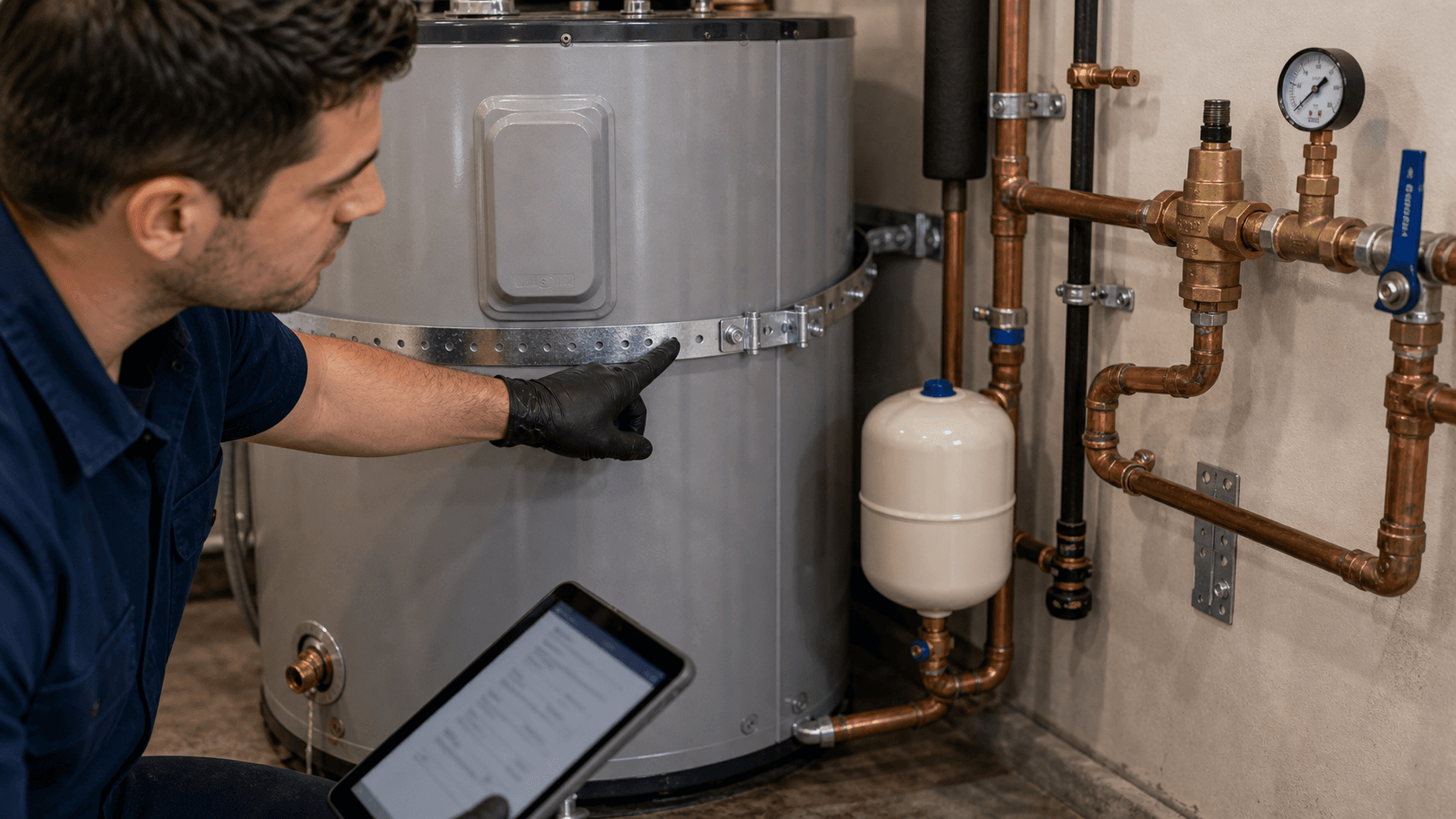
What inspectors check: water heater installations get the most-detailed inspection of any common residential plumbing permit. The inspector verifies the temperature/pressure relief valve, expansion tank, drain pan, gas line connections and venting (for gas units), seismic strapping, electrical bonding, and compliance with Washington State Energy Code. Failed water heater inspections most commonly fail for missing seismic strapping, undersized expansion tank, or improper venting.
Failed inspection: the inspector documents the issues and you have time to correct them. The re-inspection fee is typically modest, but the bigger cost is the delay and the disruption of having to re-open walls or fixtures.
The real cost of unpermitted work — what happens at sale
Washington State requires sellers to disclose any known unpermitted work on the home. Buyers can void the sale or claim damages if undisclosed unpermitted work is discovered. Even with disclosure, unpermitted plumbing typically reduces the sale price by $5,000 to $15,000 or requires the seller to retroactively permit and inspect the work at their expense.
The sale-time consequences of unpermitted work are documented and consistent across Washington real estate practice:
Home inspection finds the work. Inspectors look for the telltale signs — newer-looking plumbing in old wall cavities, fixtures relocated from the original floor plan, water heaters in unexpected locations, sewer line repairs visible in the yard. They flag suspected unpermitted work in the inspection report.
Buyer's agent demands resolution. The buyer's agent typically refuses to close until either (a) you provide proof of permit, or (b) you pull a retroactive permit and pass inspection, or (c) the price is reduced to account for the risk.
Insurance complications. Some insurance carriers refuse to write a new policy on a home with unpermitted plumbing until the work is permitted and inspected. The buyer may be unable to get a mortgage because the lender can't get insurance.
Disclosure liability. If you sell without disclosing known unpermitted work, the buyer can sue post-sale for fraud or breach of warranty. Washington courts have ruled against sellers in these cases, with damages including the cost of retroactive permitting plus the diminished property value.
Real-world cost: a $300 plumbing permit avoided in 2018 becomes a $5,000 to $15,000 problem in 2026 when you try to sell. That's a 15x to 50x return on the original fee, all going against you — and the underlying repair work that should have been permitted is already broken out in our plumber cost and pricing in Bellevue guide.
Insurance and unpermitted plumbing — the silent risk
Insurance carriers can deny claims related to unpermitted plumbing failures. A burst pipe from an unpermitted repipe job, a slab leak from unpermitted under-slab piping, or water damage from an unpermitted water heater installation can be denied as 'failure to obtain required permits' under the policy's general exclusions.
This is the most under-appreciated cost of skipping a permit. Homeowner insurance policies generally cover sudden, accidental water damage — but the coverage is conditional on the underlying work being legal. Unpermitted plumbing work fails the legality test in two ways: it violates municipal code, and it was performed without inspection.
Real-world scenario: a homeowner does an unpermitted water heater replacement themselves to save the $200 plumber fee plus the $100 permit fee. Two years later, the water heater's temperature/pressure relief valve fails, the tank ruptures, and the resulting flood causes $35,000 in damage to a finished basement. The homeowner files a claim. The insurance adjuster discovers no permit was ever pulled, no inspection was ever passed. Coverage is denied. The homeowner pays $35,000 out of pocket.
Carriers don't always enforce this aggressively — for small claims, they may pay out without investigating the permit history. For large claims (typically $5,000+), they investigate, and the permit question is one of the first they ask.
Document everything when you do permit work properly: permit number, inspection records, contractor invoices showing scope and materials, date-stamped photos before/during/after the work. Keep all of it for the life of the home. This documentation is what converts a permitted job from a cost into an asset — it protects you against future insurance disputes and future buyers' inspectors.
Retroactive permits — how to legalize old unpermitted work
Bellevue allows retroactive permits (also called 'after-the-fact permits') for work that was done without a permit in the past. The process is similar to a new permit application but typically costs 2 to 3 times the standard fee and requires comprehensive inspection — often including opening up walls or ceilings to verify hidden work.
When to consider a retroactive permit: when you're preparing to sell a home with known unpermitted plumbing work, when you're applying for new homeowner insurance and the carrier asks about permit history, or when the city has discovered unpermitted work (typically during another permitted project's inspection) and ordered correction.
The retroactive permit process:
Apply through MyBuildingPermit.com selecting 'after-the-fact' or 'retroactive' permit type.
Provide documentation of the original work — when it was done, by whom, scope, any contractor records you have.
Pay the elevated fee (typically 2-3x the standard fee, sometimes with an additional 'investigation' fee).
Submit to comprehensive inspection. For concealed plumbing, the inspector may require opening walls or ceilings to verify the work. You're responsible for the opening and restoration.
Bring the work to current code if any deficiencies are found. Code has evolved since older work was done; older installations may not meet current requirements and may need updating.
Receive the permit after the work passes inspection. The permit becomes part of the property record.
Cost reality: a retroactive permit for a basic water heater install that should have been a $100 permit when originally done can become a $500-$1,500 retroactive permit plus $1,000-$3,000 in repairs to bring the work up to current code, plus the cost of opening and restoring any walls that need to be inspected.
Worth doing? Yes, almost always, before you sell. The retroactive permit cost is typically less than the price reduction or sale-cancellation risk from undisclosed unpermitted work. It also resolves the insurance issue going forward.
For the full process — Washington Form 17 disclosure rules, what the inspector evaluates against current versus original code, real corrective-work cost ranges by scope, and the four scenarios where retroactive permitting is genuinely urgent — see our retroactive plumbing permits in Bellevue guide.
Who to contact at the City of Bellevue
Plumbing review and questions: 425-452-6873 or MEPreview@bellevuewa.gov. Inspection scheduling: 425-452-6875 or via MyBuildingPermit.com. Permit billing: 425-452-6860 or DS_Billing@bellevuewa.gov. Plumbing Reviewer Evan Harrison directly: 425-452-4573 or EHarrison@bellevuewa.gov.
The City of Bellevue Development Services office is located at the Bellevue City Hall complex on 110th Avenue NE. In-person visits work for unusual situations but online is faster for routine work.
For questions about whether a specific job requires a permit: contact MEP Review (Mechanical, Electrical, Plumbing) at 425-452-6873 or MEPreview@bellevuewa.gov before starting the work. A 5-minute conversation prevents a retroactive permit later.
For permit fees and payment questions: DS Billing Customer Service at 425-452-6860 or DS_Billing@bellevuewa.gov.
For inspection scheduling: 425-452-6875 or schedule online at MyBuildingPermit.com.
Outside of normal business hours, MyBuildingPermit.com remains accessible 24/7 for permit applications and inspection scheduling. Same-day permit issuance for routine work means a Friday afternoon application can be permitted and the work started over the weekend if needed.
Sources
Every fact in this guide cites a verifiable public source. If you find a number we got wrong, email dispatch@bellevueplumberpro.com.
Need help with this in your home? See our Water heater installation in Bellevue page for pricing, our diagnostic process, and how same-day service works across the Eastside.
Water heater replacement (every time, regardless of fuel), sewer line repair or replacement, whole-house or partial repipes, water service line replacement from the meter, and new gas lines. Routine maintenance, like-for-like fixture swaps, and repairs that don't alter piping don't need one.
QUESTION02
How do I get a plumbing permit in Bellevue?
Apply online at MyBuildingPermit.com — the shared portal for Bellevue and most King County jurisdictions. Routine plumbing permits not requiring plan review are issued the same day; your licensed plumber pulls it for you on any job that needs one.