Home/Learn/Sewer lines/Cedar and Douglas fir roots in Eastside sewer lines: signs, repair, and prevention
Sewer
Cedar and Douglas fir roots in Eastside sewer lines: signs, repair, and prevention
The Pacific Northwest combines two conditions that no other US region shares at scale: aggressive lateral root systems from western red cedar, Douglas fir, and bigleaf maple — and a housing stock heavy on pre-1980 homes still running on clay, cast iron, or Orangeburg sewer laterals. The result is a chronic, often invisible plumbing problem that costs Bellevue and Eastside homeowners millions of dollars a year in emergency calls and unnecessary full-replacement quotes. This guide explains how root intrusion actually happens, the six warning signs to watch for, what a sewer camera shows you, the four repair options ranked by cost, and the preventive maintenance schedule that keeps a problem line from becoming a crisis.
How tree roots find your sewer line in the first place
Tree roots follow a water-vapor trail. Warm wastewater inside a sewer line escapes through microscopic cracks or porous joints, and tree-root hairs detect that vapor and grow toward it.
The mechanism is well-documented across the plumbing and arboriculture literature. Sewer wastewater is warmer than surrounding soil and carries dissolved nitrogen, phosphorus, and other nutrients. Any imperfection in a buried pipe — a hairline crack, a settling joint between clay sections, a rust pit in cast iron — lets a thin trail of water vapor escape into the soil around the pipe.
Root hairs at the tip of an actively growing root are sensitive to humidity gradients. They turn toward the source. Once a single root hair finds the crack, it enters the pipe, hits the steady supply of water and nutrients inside, and begins to thicken. A root that started as the width of a human hair can become the diameter of a finger within 2 to 3 growing seasons.
The growth pattern inside the pipe matters. Roots branch into a dense fibrous mass that traps toilet paper, grease, and solids passing through the line. The pipe doesn't get blocked by the roots alone — it gets blocked by the debris the roots catch.
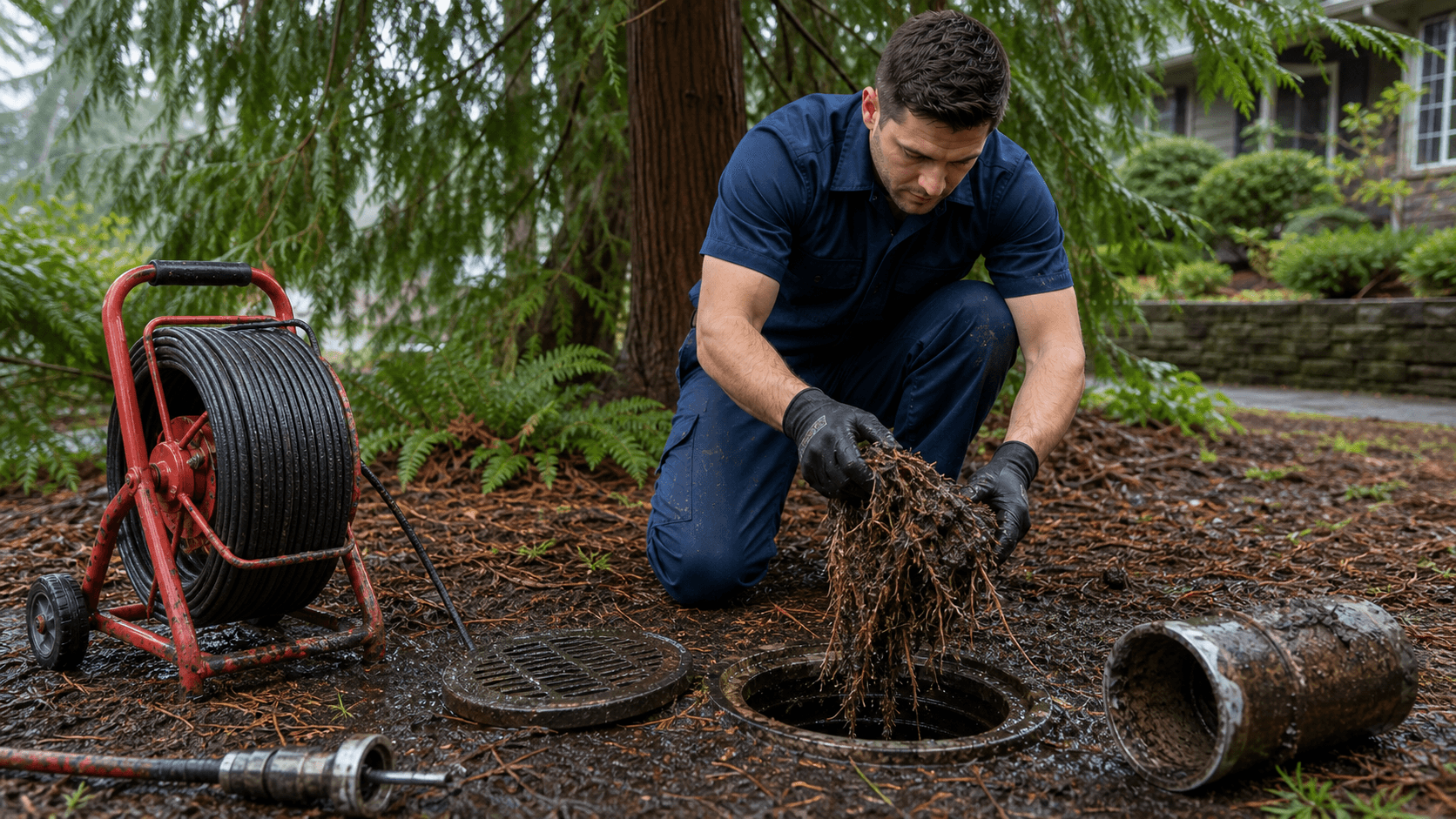
Mature cedar and Douglas fir roots often enter through small sewer-lateral joints before forming a full blockage.
This happening in your home right now? A licensed plumber can talk you through the next step on the phone — 24/7, and the call is free.
Which Pacific Northwest trees are the most aggressive?
Western red cedar, Douglas fir, bigleaf maple, and Oregon white oak have lateral root systems that extend 2 to 3 times the tree's canopy width — putting almost every mature urban Bellevue tree within reach of a typical residential sewer lateral.
Plumbing-industry sources covering Pacific Northwest service areas consistently rank western red cedar, Douglas fir, and bigleaf maple as the three most damaging species to residential sewer pipe. Oregon white oak shows up in southern PNW lists. All four share a lateral (spreading) root architecture rather than a deep taproot — which is exactly the architecture that intersects buried utility lines 4 to 8 feet underground.
The 2-to-3-times-canopy-width figure is the rule of thumb cited by multiple regional plumbing companies and arboriculture extension services. A western red cedar with a 30-foot canopy spread can have lateral roots extending 60 to 90 feet from the trunk. Most residential lots in Bellevue's older neighborhoods are 60 to 100 feet wide, meaning a single mature cedar in a neighbor's yard can reach your sewer lateral.
Conifer roots in particular keep growing year-round in the PNW's mild climate. There's no winter dormancy in coastal Washington — root growth pauses but doesn't stop. By comparison, the same tree species in the Midwest would have a 4-to-5-month dormant period during which root invasion slows. That difference is why PNW sewer-root problems progress faster than the national average.
PNW trees most associated with sewer-line damage
Western red cedar (Thuja plicata) — Bellevue's signature tree, common in Bridle Trails and West Bellevue
Douglas fir (Pseudotsuga menziesii) — the dominant conifer across the Eastside
Bigleaf maple (Acer macrophyllum) — wet, fast-growing, very aggressive root system
Oregon white oak (Quercus garryana) — less common but extremely damaging where present
Black cottonwood (Populus trichocarpa) — found in low-lying areas and stream banks
Willow (Salix species) — water-seeking, common near Lake Washington shorelines
What pipe materials are at risk in Bellevue?
Clay tile, cast iron, and Orangeburg (bituminized fiber) pipe are the three sewer materials most vulnerable to root invasion — and all three were standard in Bellevue homes built before 1980.
Bellevue's median home construction year is 1982 according to City of Bellevue Community Development data. More than half of Bellevue's housing stock was built in the 1950s and 1960s. That timing matters because municipal and residential sewer pipe material standards changed several times across those decades:
Clay (vitrified clay tile) was the dominant sewer material in the US from roughly 1880 to 1960. It's strong under compression but brittle, with joints sealed by mortar or rubber gaskets that weaken over time. Once a joint fails, root intrusion is rapid. Clay lines installed in 1950s Lake Hills or Crossroads are now 65 to 75 years old — past the typical service life.
Cast iron was used both for indoor drain-waste-vent stacks and exterior sewer laterals from roughly 1900 to 1980. Cast iron corrodes from the inside (waste acids) and the outside (soil moisture). A cast-iron sewer lateral installed in a 1965 Bellevue rancher has been corroding for 60 years. Cracks form, roots find them.
Orangeburg pipe is a special case. Made from layers of wood pulp impregnated with coal tar pitch, Orangeburg was sold as a cheaper alternative to cast iron from roughly 1940 to 1974, when the manufacturer closed. Its rated service life is 50 years under ideal conditions, but documented failures have occurred in as little as 10. Orangeburg deforms (flattens) under soil pressure long before it cracks, and the bituminous material is unusually porous to root invasion. The City of Ann Arbor's public works department documented that the majority of sewer failures in their system over a 20-year audit were Orangeburg lines failing to bedding shift, root invasion, and material deterioration.
PVC and ABS replaced bituminized pipe and cast iron in residential new construction starting in the early 1970s, with adoption complete by the early 1980s. Homes built in Bellevue after 1985 mostly have PVC sewer laterals, which are joint-sealed with solvent weld and far less vulnerable to root entry. Homes built before 1980 likely have one of the three vulnerable materials.
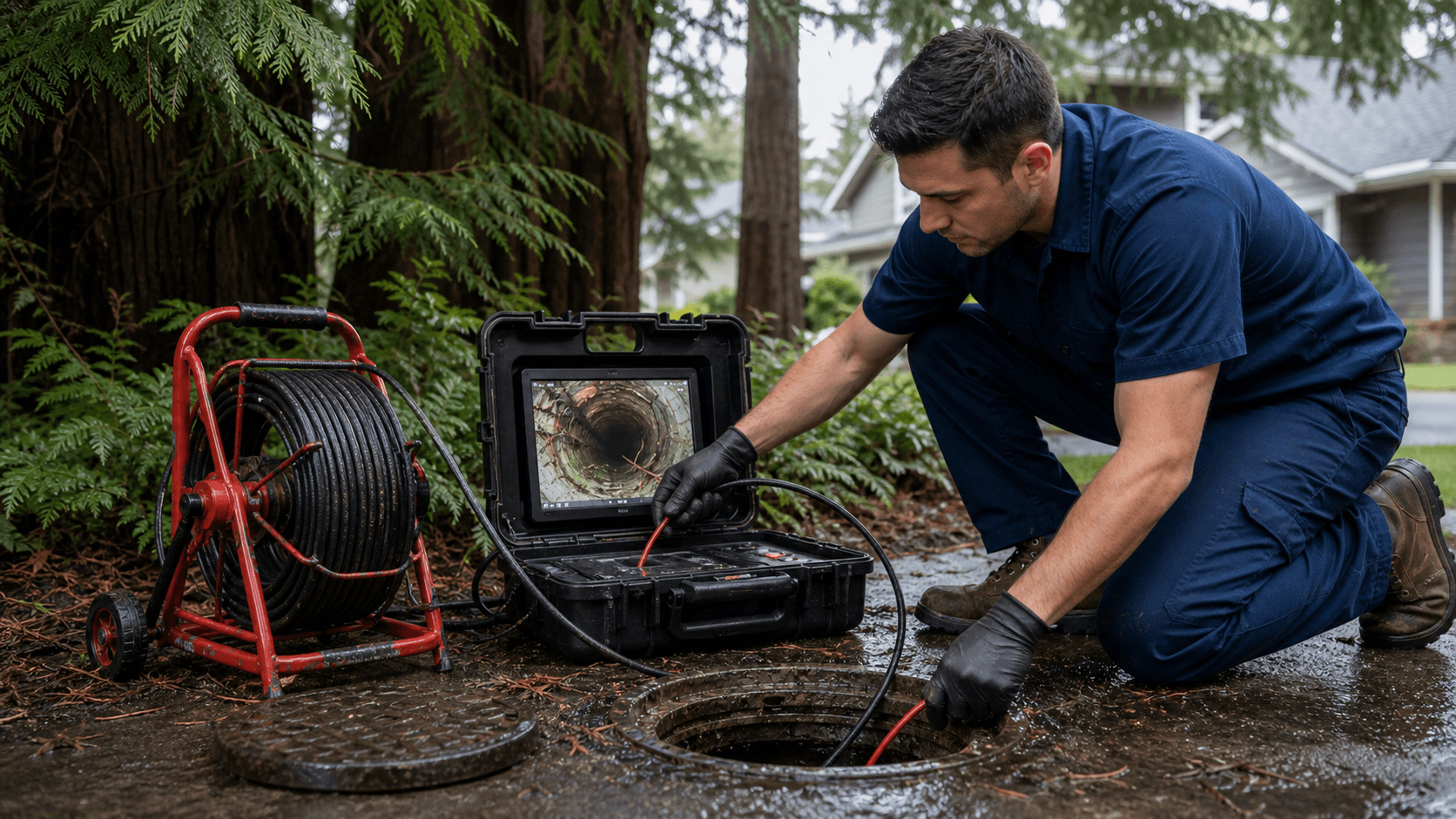
Camera footage confirms whether roots are a cleaning problem, a joint problem, or a replacement problem.
Six warning signs of active root intrusion
Slow drains across multiple fixtures, gurgling toilets when the washer drains, sewage smell in the yard, exceptionally green grass over the sewer line path, sinkholes or soft spots, and backups that worsen during heavy rain.
These six signs are documented consistently across plumbing-industry diagnostic literature. None of them are definitive on their own, but two or more together strongly suggest root invasion in the main sewer lateral rather than a localized fixture clog.
Slow drains in multiple fixtures simultaneously. A single slow drain is a local clog. Two or more fixtures (kitchen sink + shower, or all toilets at once) draining slowly means the problem is downstream of all of them — in the main line.
Gurgling toilets when another fixture drains. Air pressure in the line can't escape past a partial blockage, so it pushes back up through the nearest toilet's wax seal. A washing machine cycle making the upstairs toilet gurgle is a classic sign.
Sewage odor at the cleanout, foundation, or yard. A small leak from a cracked sewer joint releases gases that escape upward through soil. The smell is usually stronger in summer when soil is dry and porous.
Exceptionally green or lush grass over the sewer line path. Leaking sewage is high-nitrogen fertilizer. A strip of yard that's noticeably greener than the surrounding lawn — especially running straight from the foundation toward the street cleanout — is leaking sewage feeding a root mass.
Sinkholes, soft spots, or depressions in the yard. As a sewer line collapses or shifts, the soil above it settles. Walking the path of the line and finding a soft spot or a slight depression that wasn't there last year is a strong indicator.
Backups that worsen during heavy rain. Cracked or broken sewer pipe lets groundwater enter the line during storms (inflow and infiltration). The added water overwhelms an already-narrowed line, causing backups that don't happen in dry weather.
What a sewer camera inspection actually shows you
A sewer camera inspection is a $100 to $800 procedure that runs a self-leveling camera on a flexible cable through the line and shows you, on a screen, exactly where roots, cracks, bellies, or collapses are. It is the single most important diagnostic step before any major sewer repair quote.
The procedure: a plumber feeds a flexible push rod tipped with a small high-definition camera through the building's cleanout — usually a 4-inch capped pipe outside the foundation. Modern cameras include a distance counter that displays footage as the camera advances. The plumber records what's seen.
What you'll see if roots are present: a dense bushel-shaped mass of fibrous roots, often dripping water, partially or fully filling the pipe diameter. The plumber will note the location (e.g., 'roots from 14 to 17 feet from the cleanout, north side of pipe joint'). That precision matters because it determines whether the problem is a single-spot repair (cheaper) or distributed across many joints (more expensive).
What you'll see if it's something else: a cracked or collapsed section, a bellied (sagging) section holding standing water, a broken joint, an offset where two pipe sections no longer meet, or in older installations, the flattened or delaminated wall of an Orangeburg pipe. Each of these has a different repair recommendation.
Cost varies. National pricing data shows residential sewer camera inspections typically run $100 to $300. Bellevue and Eastside pricing tends toward the higher end ($295 to $395 is common) because of the higher labor rates already documented. Some companies include the camera inspection free when you proceed with a cleaning or repair.
For a deeper dive on the technology itself — self-leveling versus basic push cameras, what RIDGID and Spartan units actually capture, the home-purchase inspection use case, and how to interpret a clean-pass versus a major-findings outcome — see our sewer camera inspection in Bellevue guide.
A camera inspection is non-negotiable before agreeing to any sewer line replacement quote. A contractor who quotes a $14,000 trenchless replacement or a $22,000 open-trench dig without first running a camera and showing you the footage is selling a guess. Get a second opinion from a different company that will camera first — the full breakdown of plumber cost and pricing in Bellevue includes the red flags to watch for in a quote, and our sewer line repair and cedar root removal in Bellevue page lists the typical price ranges for each repair tier.
Four ways to clear and repair a root-invaded sewer line, ranked by cost
Mechanical cabling ($300 to $485) clears the symptom. Hydro jetting ($389 to $667 Seattle average) clears more thoroughly and cleans pipe walls. Spot repair ($2,800 to $4,800) fixes a single damaged section. Trenchless replacement ($6,000 to $12,000) or open-trench replacement ($7,000 to $25,000) replaces the entire run.
The right answer depends entirely on what the camera shows. Roots without structural damage = clear them and prevent regrowth. Roots plus a single bad joint = spot repair. Roots plus distributed damage across the run = full replacement, and trenchless first if geometry allows.
Traditional open-trench$7,000–$25,000Severe damage, bellied sections, when trenchless isn't possible.
Sewer line repair options, Bellevue 2026
Prevention — chemical and mechanical options
Foaming root killer (Dichlobenil-based products like RootX) applied annually prevents new root growth for about 12 months per treatment. Mechanical methods — preventive hydro jetting every 2 to 3 years — keep already-cleaned lines clear and remove any chemical-resistant roots.
The two preventive approaches work together, not against each other. Mechanical clearing removes the existing root mass; chemical treatment prevents the next one from establishing.
Foaming root killers expand on contact with water and coat the entire pipe wall, including the top of the pipe where copper sulfate (a much older treatment) cannot reach. RootX, the most widely used foaming product, uses Dichlobenil — a non-systemic herbicide that kills root tissue on contact without traveling up through the tree to harm the tree itself. The foam leaves a thin barrier on the pipe wall that prevents new root growth for about 12 months.
Copper sulfate, the traditional alternative, has serious limitations. It only treats the bottom of the pipe at the time of application, has no residual effect, and is increasingly restricted by local water utilities because it can damage municipal treatment systems. Plumbing-industry guidance has shifted decisively toward foaming products over the past 10 years.
Mechanical prevention — a preventive hydro jet every 2 to 3 years for homes with mature trees within reach of the sewer line — is the gold standard. It's more expensive than chemical treatment per visit but addresses both root growth and the grease and scale buildup that often accompany it.
Important caveat: chemical and mechanical preventives buy time on an aging line. They are not a substitute for replacement when the pipe material itself is failing. An Orangeburg pipe that's flattening from soil pressure won't be saved by foaming root killer — and any major replacement work needs a permit pulled through City of Bellevue Development Services, covered in our Bellevue plumbing permits guide.
The 3-year preventive maintenance schedule for high-risk Bellevue homes
Camera the line every 3 years for any Bellevue home built before 1980 with mature trees within 30 to 60 feet of the sewer lateral path. Hydro-jet preventively if the camera shows light root growth; spot-repair if it shows damage to a joint; plan replacement if it shows distributed deterioration.
The 3-year cadence balances cost against the rate at which root invasion typically progresses in PNW conditions. Faster cadences (annual inspection) make sense for homes that have already had one root-related repair. Longer cadences (5 years) are reasonable for newer PVC lines or homes without mature trees nearby.
Cost over 10 years: four camera inspections at $300 each = $1,200. Two preventive hydro jets at $500 each = $1,000. Total ~$2,200 over a decade. Compare against a single emergency call during a holiday weekend that includes after-hours dispatch, a hydro jet, and a partial repair: easily $1,500 to $3,000 for one event. Preventive maintenance pays for itself.
Add tree management to the schedule. Removing a 60-year-old western red cedar to protect a sewer line isn't usually the answer (and rarely required), but selective root pruning by a certified arborist on the side of the tree facing the sewer can reduce future invasion risk without harming tree health.
Five red flags in a sewer-line quote
Walk away from any sewer quote that proposes full replacement without camera footage, refuses to show you the footage, quotes a single fixed price for a long line without specifying the technique, pressures an immediate decision, or recommends replacement when the camera shows only root growth and no structural damage.
Full replacement without camera footage. Covered above — never agree to a $10,000+ job on the basis of a verbal diagnosis.
Refusal to show you the footage. The camera recorded the footage. If a company won't email you the recording or play it back on-site, they have a reason. Get a second opinion.
Single fixed price for a 60+ foot line without technique specification. Trenchless versus open-trench versus spot repair are three different jobs at three different price points. A quote that doesn't specify which one is being proposed is hiding something.
Pressure to decide today. 'This price is only good today' is a sales tactic, not a real pricing structure. A real sewer problem gives you at least 24 to 48 hours to get a second opinion — except for active sewage backflow into the home, which you can't safely delay.
Recommending replacement when the camera shows roots only. Roots in an otherwise structurally sound pipe = clean and prevent, not replace. If the contractor's quote escalates to replacement before exhausting cleaning and prevention options, they're optimizing their revenue, not your repair.
Sources
Every fact in this guide cites a verifiable public source. If you find a number we got wrong, email dispatch@bellevueplumberpro.com.
Cedar and Douglas fir roots in Eastside sewer lines — questions homeowners ask
QUESTION01
How do tree roots get into sewer lines?
Roots follow a water-vapor trail. Warm wastewater inside the line escapes through microscopic cracks or porous joints, root hairs detect the vapor and grow toward it, and mature roots force the joints open. Western red cedar, Douglas fir, bigleaf maple, and Oregon white oak extend lateral roots 2–3 times their canopy width — reaching almost every mature urban Bellevue sewer lateral.
QUESTION02
Which pipe materials are most vulnerable to root intrusion?
Clay tile, cast iron, and Orangeburg (bituminized fiber) — all three standard in Bellevue homes built before 1970. Modern PVC with welded joints is far more root-resistant.