Why is my outdoor faucet dripping?
Almost always a worn washer, O-ring, or packing nut — not a cracked pipe. Repairs typically run $145–$210 in Bellevue.
Outdoor faucets — also called hose bibs, sillcocks, or spigots — are among the most common minor plumbing calls in Bellevue. A drip at the spout is almost always a worn rubber washer or packing nut: a $150 repair that takes under an hour. A cracked body or leaking stem usually means replacement, and the standard upgrade is a frost-free (anti-siphon) hose bib, which protects the supply pipe from freezing during Eastside cold snaps. This guide covers the three failure types, when to repair versus replace, what a frost-free hose bib actually does, and 2026 Bellevue pricing.
Last reviewed: 2026-06-14
A dripping outdoor faucet is almost always a worn washer, O-ring, or packing nut — not a cracked pipe. The fix is a $150 repair.
Outdoor faucets operate on a simple compression valve: a rubber washer presses against a seat to stop flow. Every time you open and close the faucet, the washer compresses. Over years of use (and Bellevue's 150+ rain days per year), the washer hardens, tears, or deforms, and water starts dripping past it even when the handle is fully closed.
The packing nut is a second failure point. This is the gland fitting behind the handle that seals the valve stem as it rotates. When it loosens or its packing material compresses, water weeps around the stem itself — you'll see it dripping from the handle area rather than the spout.
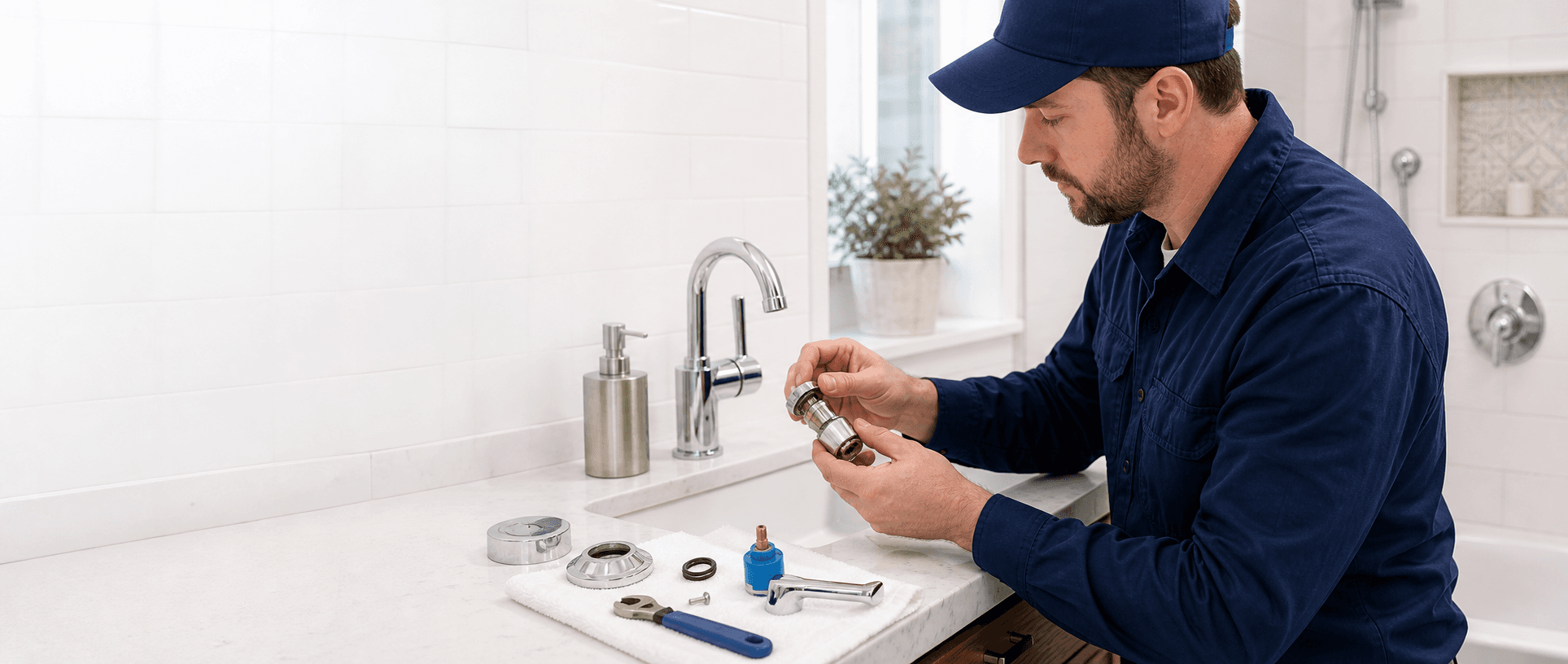
Both of these are routine repairs. A licensed plumber swaps the washer or re-packs the stem in under an hour. There is no need to open the wall or replace the faucet body.
This happening in your home right now? A licensed plumber can talk you through the next step on the phone — 24/7, and the call is free.
Call a plumberReplace when the faucet body is cracked, when freeze damage has split the interior, when the valve seat is eroded beyond resurfacing, or when the unit is a non-frost-free model in an exposed location.
Cracked bodies are the primary replacement trigger on the Eastside. Bellevue's freeze events — typically a few nights per winter that dip into the mid-20s — damage outdoor faucets when the water inside the supply pipe behind the faucet freezes and expands. The crack often appears in the body casting where the pipe connects, not on the exterior surface you can easily see. The symptom is water appearing inside the wall when the faucet is turned on.
Worn valve seats cause a drip that returns quickly after washer replacement. If we replace the washer and the faucet is dripping again within a few months, the brass seat inside the faucet body has been eroded by grit and no longer holds a seal. Resurfacing the seat (with a seat grinder) is possible on some faucets but is rarely cost-effective on an older unit.
Non-frost-free hose bibs on exterior walls with minimal insulation are candidates for proactive replacement — particularly in homes built before 1985 that used standard sillcocks rather than frost-free models. The supply pipe behind a standard sillcock holds standing water right at the wall; a frost-free model drains the pipe back into the heated envelope of the house every time you close the handle.
A frost-free hose bib moves the shutoff mechanism 8–12 inches inside the wall, so the water drains out of the exposed pipe every time you close the faucet. It prevents freeze damage without requiring you to remember to disconnect the hose each fall.
Standard outdoor faucets have their shutoff at the wall face. When temperatures drop, the water sitting in the supply pipe right behind the faucet can freeze, expand, and split the pipe or faucet body — often without any visible exterior sign until spring when you turn the water on and water appears inside the wall.
Frost-free models (also called anti-siphon or non-freeze hose bibs) have a stem that extends 8 to 12 inches into the wall. When you turn the handle off, the valve seats 8–12 inches inside the wall in the heated space, and the water in the exposed exterior section drains back through the stem into the house. No standing water in the cold zone means no freeze damage.
The catch: the faucet only drains when the hose is disconnected. A hose left attached holds water in the pipe even with a frost-free model. Disconnecting garden hoses before the first freeze is still required — but the frost-free design gives you a margin if you forget for a night or two.
Most Bellevue homes built after 1990 already have frost-free hose bibs. If yours is an older home and the outdoor faucets are standard sillcocks, replacement with frost-free models is worth doing at the same time as a repair visit.
Repair runs $145–$210. Frost-free hose bib replacement runs $285–$450.
If you have multiple outdoor faucets that need service, combining them into one visit saves a dispatch fee. Homes with older standard sillcocks often benefit from replacing all exterior faucets at once — typically two to four on a Bellevue single-family home.
2026 Bellevue residential pricing. Diagnostic fee waived if repair is booked same visit.
Washer replacement is a DIY-possible job for someone comfortable with plumbing basics. Supply pipe damage, anything inside the wall, and anti-siphon valve work should go to a licensed plumber.
Replacing a washer on a standard outdoor faucet requires shutting off the water supply to the hose bib (either at the main shutoff or at an individual shutoff valve inside), unscrewing the packing nut, removing the stem, swapping the washer, and reassembling. This is a reasonable weekend project for someone with plumbing experience and the right-size washer.
The jobs that should not be DIY: anything involving the supply pipe inside the wall, frost-free hose bib replacement (which requires cutting and sweating or pressing copper, or using push-fit fittings properly), and any situation where the faucet is leaking from a crack rather than a worn part. Improper repairs to pressurized supply lines cause the kind of water damage that runs into five figures.
Every fact in this guide cites a verifiable public source. If you find a number we got wrong, email dispatch@bellevueplumberpro.com.
Need help with this in your home? See our Faucet and fixture service in Bellevue page for pricing, our diagnostic process, and how same-day service works across the Eastside.
We dispatch for this across Downtown Bellevue, Crossroads, Newcastle, and Newport Hills — see your neighborhood page for local response times and recent jobs.
Almost always a worn washer, O-ring, or packing nut — not a cracked pipe. Repairs typically run $145–$210 in Bellevue.
A faucet that moves the shutoff mechanism 8–12 inches inside the wall, so water drains out of the exposed pipe every time you close it — preventing freeze damage without needing to disconnect hoses.
In 2026: repair runs $145–$210, and frost-free hose bib replacement runs $285–$450 per location.
When the body is cracked, freeze damage has split the interior, the valve seat is eroded beyond resurfacing, or a non-frost-free model sits in an exposed location.