Why is my faucet dripping?
The leak location tells you: a drip from the spout points to the primary seal — a worn washer or cartridge — while a leak at the base or handle points to a static seal, usually a worn O-ring.
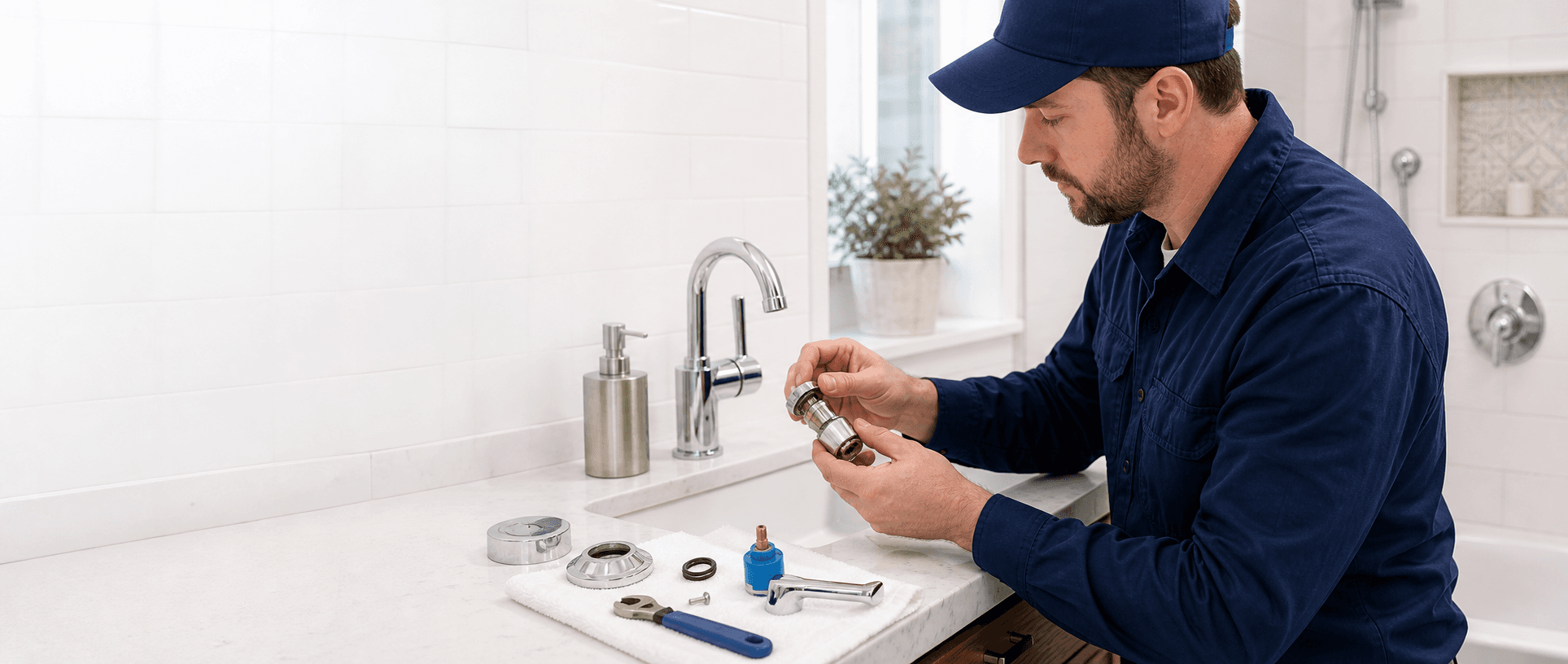
A leaky faucet is almost always a worn internal seal, and repairing it starts with identifying which of the four faucet types you have, because each is built and fixed differently. Compression faucets use a rubber washer that compresses against a seat and wears out; the three washerless designs — cartridge, ball, and ceramic disc — seal without a compression washer and fail at different internal parts. The leak location is itself diagnostic: a drip from the spout points to the primary seal (washer or cartridge), while a leak at the base or handle points to a static seal such as an O-ring. The repair is to shut the angle stops, replace the worn part — washer, O-ring, or cartridge — and clear any mineral scale on the seat. Parts are cheap: a washer under $5, O-rings $1 to $5, a cartridge $10 to $85; a professional repair averages around $270. Older Bellevue homes often have two-handle compression faucets with corroded angle stops, which complicates an otherwise simple repair.
Last reviewed: 2026-06-04
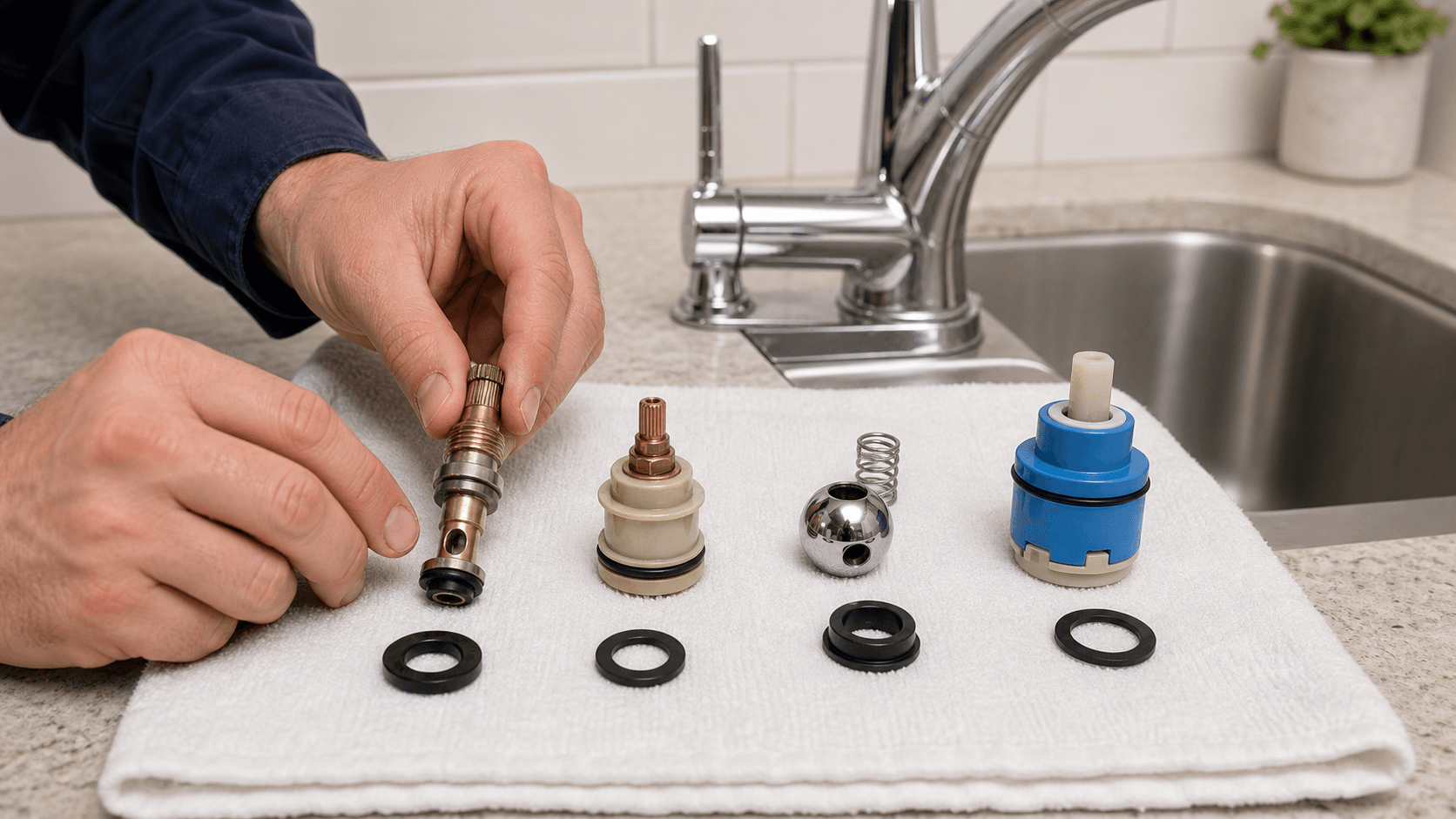
The four types are compression (a rubber washer that compresses against a seat) and three washerless designs — cartridge, ball, and ceramic disc — which seal without a compression washer.
Every household faucet is one of four designs, and the dividing line is whether it uses a compression washer. The compression faucet is the oldest type: turning the handle drives a stem down so a rubber washer compresses against a metal seat to stop the flow, and the washer is the wear part. Compression faucets almost always have two handles, one for hot and one for cold, and the handles tighten down with noticeable resistance as the washer seats — the feel that distinguishes them.
The other three types are washerless, meaning they seal without a compression washer and generally turn through a quarter-turn or smooth range rather than tightening down. The cartridge faucet uses a removable cartridge insert that moves to control flow and temperature; it can be single-handle or two-handle, and the cartridge is the part that wears. Cartridge faucets are common in modern fixtures and are among the easier washerless types to service because the whole sealing assembly comes out as one replaceable cartridge.
The ball faucet uses a single handle over a slotted metal or plastic ball that aligns with seats and springs to control flow — a design recognizable as the classic single-handle kitchen faucet with a domed cap under the handle. The ceramic disc faucet, the newest type, uses two ceramic discs that slide against each other to control water; it is durable and long-lived, and a single lever usually controls both temperature and flow. Each of these fails at a different internal part: cartridge, ball-and-springs, or disc and seals.
Knowing the four types matters because the repair differs for each. A compression faucet is fixed by replacing the rubber washer (and often the O-ring); a cartridge faucet by swapping the cartridge; a ball faucet by replacing the seats, springs, and cam; a ceramic disc faucet by replacing the seals or the disc assembly. So the first real step in any leaky-faucet repair is not buying a part but identifying which type is on the sink, which the next section covers.
This happening in your home right now? A licensed plumber can talk you through the next step on the phone — 24/7, and the call is free.
Call a plumberCount the handles and look at how they move, then open the faucet to see the internals — a compression stem and washer, a cartridge, a ball-and-springs, or ceramic discs.
The first clues are the handles and how they feel. Two separate handles that tighten down with increasing resistance as you close them, and that you can keep turning to make snug, indicate a compression faucet, because you are physically compressing a washer against a seat. A handle that turns through a smooth quarter- or half-turn with no tightening-down feel indicates one of the washerless types — cartridge, ball, or ceramic disc — which open and close without compressing anything.
Single-handle versus two-handle narrows it further. A single handle that moves up-down for volume and side-to-side for temperature is either a cartridge, ball, or ceramic disc design; a two-handle faucet that turns smoothly is usually a cartridge type, while a two-handle faucet that tightens down is compression. The classic single-handle kitchen faucet with a rounded cap beneath the lever is frequently a ball faucet, the design most associated with that look.
The definitive identification comes from opening the faucet. With the water shut at the angle stops, pull the handle and look at what controls the flow: a threaded stem with a rubber washer on the end is a compression faucet; a removable cartridge that pulls straight out is a cartridge faucet; a slotted ball sitting over springs and rubber seats is a ball faucet; and a wide cartridge containing two ceramic discs is a ceramic disc faucet. The internal part is unambiguous where the external feel can be borderline.
Identifying the type correctly is what makes the parts purchase right the first time. Each type takes a different repair kit — washers and seats for compression, a cartridge for cartridge, a seats-springs-and-cam kit for ball, a seal or disc kit for ceramic — so opening the faucet to confirm the internals before buying parts avoids the common mistake of returning the wrong kit. Once the type is known, the leak location tells you which part within that type to replace.
A drip from the spout points to the primary seal — a worn washer or cartridge; a leak at the base or handle points to a static seal, usually a worn O-ring.
Where the faucet leaks is a direct map to which seal has failed, and the first split is spout versus base. A drip from the end of the spout — water that comes out where the water is supposed to come out, but with the faucet off — is a failure of the primary seal that shuts off the flow. On a compression faucet that is the rubber washer (or the seat it presses against); on a washerless faucet it is the cartridge, ball seats, or ceramic discs that control the flow. A spout drip means the on-off seal is worn.
A leak at the base of the spout or around the handle is a different failure: a static seal, most often an O-ring. The O-rings seal the joints where the spout swivels and where the handle assembly meets the body, and when they harden or crack, water escapes around those joints rather than out the spout — so water pooling around the base of the faucet, or weeping from under the handle when the water runs, points at an O-ring rather than the primary washer or cartridge.
This split tells you which part to replace before you even open the faucet. A spout drip says replace the washer (compression) or the cartridge/seats/discs (washerless) — the flow-control seal; a base or handle leak says replace the O-rings — the static seals. The two can coexist on an old faucet, but distinguishing them keeps a repair focused on the part that is actually leaking rather than replacing everything blindly.
Mineral scale on the seat is the common complicating factor on a spout drip. Even a fresh washer will not seal against a seat that is pitted or crusted with mineral deposits, so a spout-drip repair includes cleaning or replacing the seat, not just the washer — otherwise the new washer leaks against the rough surface within weeks. Reading the leak location first, then accounting for the seat condition, is what turns the repair into a targeted part swap rather than guesswork.
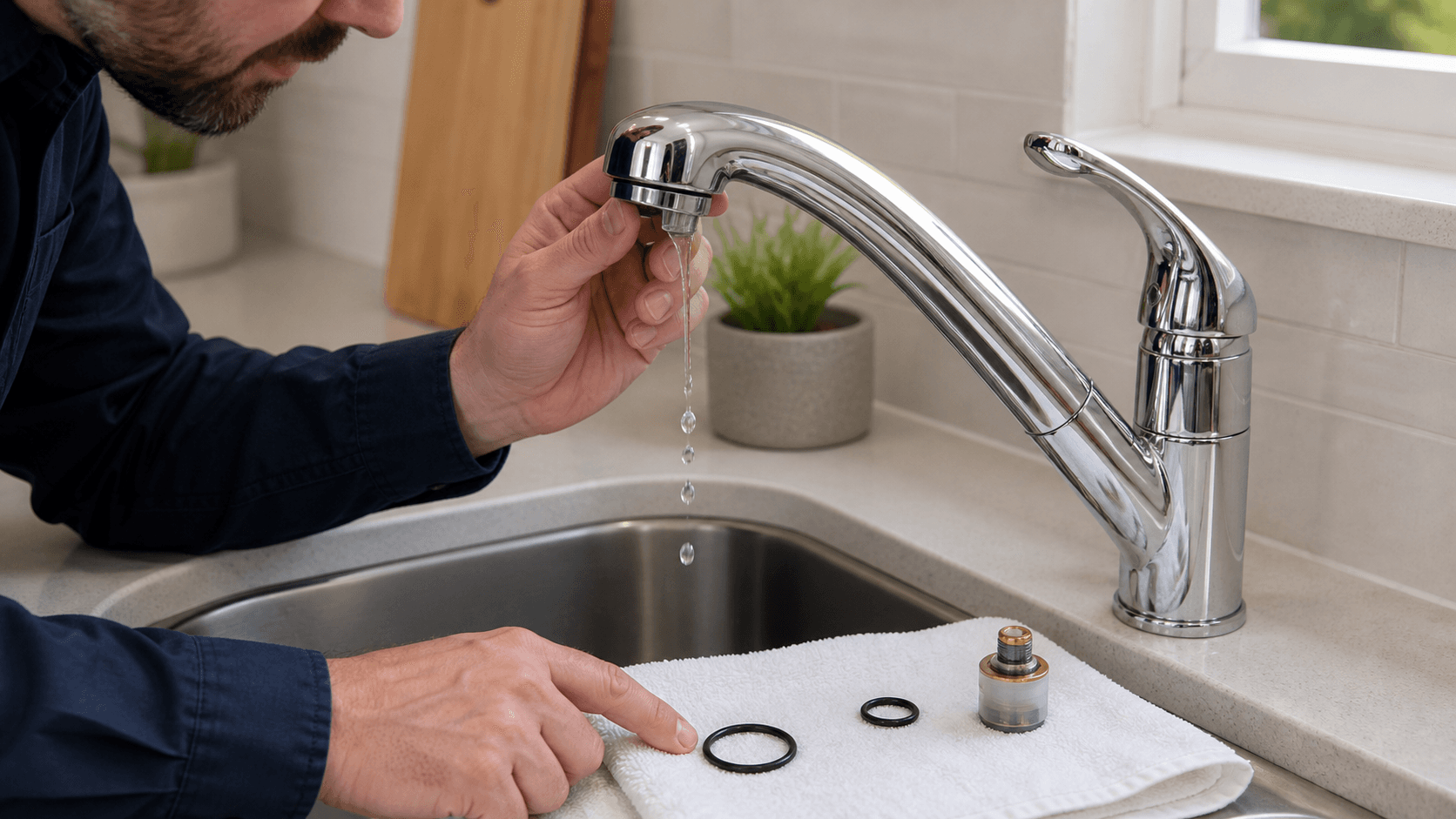
Shut the angle stops under the sink, disassemble the faucet, replace the worn washer, O-ring, or cartridge, clear any mineral scale on the seat, and reassemble and test.
Every faucet repair starts the same way: shut off the water at the angle stops — the small shutoff valves on the supply lines under the sink — and open the faucet to drain the residual pressure. Plugging the drain so small parts cannot fall in, and laying the parts out in order as they come off, makes reassembly straightforward. With the water isolated at the stops, the faucet can be taken apart without shutting down the whole house, which is the advantage of working at the fixture's own valves.
The part you replace depends on the type identified earlier. On a compression faucet, remove the stem and replace the rubber washer on its end and the O-ring on the stem, and inspect the seat the washer presses against. On a cartridge faucet, pull the retaining clip and the old cartridge and seat a matching new one. On a ball faucet, replace the rubber seats and springs and the cam-and-packing; on a ceramic disc faucet, replace the seals or the disc cartridge. The leak location guides which seal within the type gets the attention.
Clearing mineral scale is the step that makes the repair last. The seat a compression washer presses against, and the surfaces a cartridge or disc seals against, accumulate mineral deposits that prevent a new part from sealing cleanly, so the seat and sealing surfaces get cleaned — or the seat replaced if it is pitted — before the new parts go in. Skipping this is why a fresh washer sometimes leaks again within weeks: it is sealing against a rough, scaled seat rather than a clean one.
Reassembly reverses the disassembly, snugging parts firm without overtightening, and then the angle stops are reopened slowly and the faucet tested through its full range for both the original leak and any new weeping at the joints. If the angle stops themselves will not shut off, weep, or are corroded — common in older Bellevue homes — the repair has grown beyond a washer swap and is better handled as faucet and fixture repair in Bellevue, because a repair done with the house water still on is a different and riskier job.
Replace rather than repair when the seat is corroded beyond cleaning, the cartridge is mineral-seized in the body, or the faucet is old enough that replacement parts are discontinued.
Most leaky faucets are worth repairing, but three conditions tip the decision toward replacement. The first is a seat that is corroded or pitted beyond what cleaning or a replaceable-seat kit can restore: if the surface the washer or cartridge seals against is eaten away, no new seal will hold against it, and on a faucet with a non-replaceable seat that means the faucet body itself is finished. A repair that cannot get a clean sealing surface is a repair that will leak again.
The second condition is a cartridge or internal assembly that is mineral-seized into the faucet body and cannot be extracted without damaging the faucet. Years of scale can lock a cartridge in place, and forcing it can crack the body; when the part that needs replacing cannot be removed, replacement of the whole faucet becomes the practical path. This is more likely on older faucets that have never been serviced and have accumulated decades of deposits.
The third condition is parts availability. A faucet old enough that its manufacturer no longer makes the matching cartridge, seats, or stem cannot be repaired with correct parts, and a mismatched part will not seal, so a discontinued faucet often has to be replaced rather than repaired regardless of how minor the leak is. The age that makes the seal fail is the same age that makes the parts hard to find.
Weighing repair against replacement is therefore a judgment about the faucet's condition and parts, not just the leak. A modern faucet with an available cartridge and a clean seat is a clear repair; a corroded, seized, or discontinued faucet is a replacement, and the labor to fight a stuck part on an old faucet can approach the labor to install a new one. When the faucet is old and the angle stops are corroded too, replacing the faucet and the stops together as faucet and fixture repair in Bellevue is often the more durable answer than nursing a worn body back to seal.
Older Bellevue homes from before the 1970s commonly have two-handle compression faucets, and their supply lines often end at corroded angle stops that complicate an otherwise simple washer repair.
The compression faucet is the older design, and homes built before the 1970s were commonly fitted with two-handle compression faucets throughout, so much of Bellevue's older housing stock still has them. They are recognizable as the separate hot and cold handles that tighten down against a washer, and they are mechanically the simplest faucet to repair in principle — a washer and an O-ring are pennies in parts — which is part of why so many have stayed in service for decades on periodic washer swaps.
The complication in older Bellevue homes is rarely the faucet itself and more often the angle stops beneath it. The shutoff valves on the supply lines under the sink age along with everything else, and in older homes they frequently seize, weep, or are too corroded to fully close. A faucet repair depends on shutting those stops to isolate the fixture, so an angle stop that will not shut off turns a simple washer swap into a job that requires shutting down the house water and often replacing the stops as well.
The age of the supply piping compounds this. Older Bellevue homes plumbed in galvanized steel — the same piping behind the low-pressure problems in our galvanized pipe guide — often have corroded fittings right up to the angle stops, so disturbing a seized stop to repair a faucet can reveal further corrosion in the lines feeding it. What looks like a five-dollar washer repair can uncover an angle-stop and supply-line problem that is the real work.
For the homeowner this means an older compression faucet is genuinely cheap to repair when the stops cooperate, and a larger job when they do not. A faucet whose angle stops shut off cleanly is a straightforward washer-and-O-ring repair; a faucet whose stops are seized or corroded is the point where the job is better booked as faucet and fixture repair in Bellevue, because replacing a corroded angle stop with the house water on is a different task than swapping a washer.
Parts are cheap — a washer under $5, O-rings $1 to $5, a cartridge $10 to $85 — while a professional repair averages around $270, varying by faucet type and complications.
The parts for a faucet repair are inexpensive, which is what makes the DIY case attractive. A rubber compression washer costs under $5, a set of O-rings runs about $1 to $5, and a replacement cartridge runs roughly $10 to $85 depending on the faucet brand and model. A ball-faucet seats-and-springs kit and a ceramic-disc seal kit fall in a similar low range, so the materials to fix a leaking faucet rarely exceed a small handful of dollars to a few tens of dollars at most.
A professional repair averages around $270, a figure that covers the labor, the service call, and the parts, and that varies with the faucet type and any complications encountered. A simple cartridge swap on an accessible modern faucet with working stops sits at the lower end; a compression faucet with seized, corroded angle stops, a stuck cartridge, or a worn seat that has to be addressed runs higher, because the labor is in the complications more than in the seal itself. The type of faucet shifts the figure because each takes different parts and effort.
The gap between a few dollars in parts and a couple hundred in professional labor is the whole DIY-versus-pro question, and it turns on the complications. A homeowner with working angle stops, a correctly identified faucet, and a matching part can do the repair for the cost of the part; the value of the pro is in the cases where the stops are seized, the cartridge is locked in, the seat is corroded, or the faucet is old and the parts uncertain — exactly the conditions common in older Bellevue homes.
The economic read is that a clean repair is cheap either way and a complicated one is where the labor lives. A modern faucet with cooperative stops is a reasonable DIY job at parts cost; an old compression faucet with corroded stops and a scaled seat is the case where booking faucet and fixture repair in Bellevue buys a durable fix rather than a washer that leaks again against a rough seat. The cost follows the complications, not the drip itself.
A spout drip is the primary seal, washer or cartridge; a base or handle leak is an O-ring. Repair or replace turns on the seat, cartridge, and parts — and ceramic disc faucets leak least.
A drip from the spout points to the primary flow-control seal — the rubber washer on a compression faucet, or the cartridge, ball seats, or ceramic discs on a washerless one — while a leak at the base of the spout or around the handle points to a static seal, usually a worn O-ring. So the leak location tells you which part to replace before you open the faucet: spout means the on-off seal, base or handle means the O-ring. The two can occur together on an old faucet, but they are distinct fixes.
Whether to repair or replace turns on the faucet's condition. Repair when the seat is clean or replaceable, the cartridge comes out, and matching parts are available; replace when the seat is corroded beyond cleaning, the cartridge is mineral-seized into the body, or the faucet is old enough that its parts are discontinued. A modern faucet with available parts is a repair; a corroded, seized, or unsupported old faucet is a replacement, and the labor to fight a stuck part can approach the labor to install a new faucet.
There is no fixed lifespan for a faucet cartridge — you replace it by symptom rather than on a schedule. A cartridge that has begun to drip, stick, or restrict flow is at the end of its useful life regardless of age, while one that still seals and moves cleanly does not need preemptive replacement. The same logic applies to washers and O-rings: they are wear parts replaced when they leak, and on a compression faucet the washer is the part that fails first and most often.
Ceramic disc faucets generally leak least and last longest. The two ceramic discs that control the water are hard and wear-resistant, so a ceramic disc faucet is the most durable of the four types and the least prone to the seal failures that cause drips, while compression faucets — with a soft rubber washer that wears against a seat — are the most prone. Parts for any of them are cheap, but when the angle stops are corroded or the seat is gone, the job is better booked as faucet and fixture repair in Bellevue.
Every fact in this guide cites a verifiable public source. If you find a number we got wrong, email dispatch@bellevueplumberpro.com.
Need help with this in your home? See our Faucet and fixture repair in Bellevue page for pricing, our diagnostic process, and how same-day service works across the Eastside.
Related services: Leak Detection and Pipe Repair.
The leak location tells you: a drip from the spout points to the primary seal — a worn washer or cartridge — while a leak at the base or handle points to a static seal, usually a worn O-ring.
Compression (a rubber washer compressing against a seat) and three washerless designs — cartridge, ball, and ceramic disc — which seal without a compression washer.
Shut the angle stops under the sink, disassemble the faucet, replace the worn washer, O-ring, or cartridge, clear any mineral scale on the seat, and reassemble and test.
When the seat is corroded beyond cleaning, the cartridge is mineral-seized in the body, or the faucet is old enough that replacement parts are discontinued.