Home/Learn/Pipes & freezing/Galvanized supply lines in 1960s Bellevue homes: replacement timing and costs
Pipes
Galvanized supply lines in 1960s Bellevue homes: replacement timing and costs
Galvanized steel supply lines were the standard residential plumbing material in Bellevue homes built between roughly 1945 and 1970. The zinc coating that gives the pipe its name corrodes from the inside over 40 to 50 years, narrowing the pipe with rust nodules and eventually producing pinhole leaks. Bellevue's mid-century housing stock — concentrated in Lake Hills, Crossroads, and Newport Hills — is now squarely in the failure window. This guide explains how galvanized pipe fails, the six warning signs to watch for, the lead-accumulation issue the EPA flagged in 2021, what a PEX whole-house repipe costs in Bellevue in 2026, and the insurance implications of leaving original galvanized in place.
What is galvanized pipe and why was it standard for so long?
Galvanized pipe is steel pipe coated in zinc. It was the dominant residential water-supply material in the US from roughly the 1920s through the early 1960s because it was cheap, strong, available in long threaded sections, and resistant to external rust.
The technology dates to the 1830s but didn't dominate residential plumbing until after World War I, when mass-produced threaded fittings made it easy to assemble whole-house water systems on-site. By the 1940s, galvanized steel was the default supply material in new American construction. It stayed dominant through the post-war housing boom — the era during which most of Bellevue's mid-century housing stock was built.
Copper replaced galvanized in residential supply lines starting in the late 1960s, as the labor cost of soldering copper joints dropped and the long-term corrosion problems of galvanized became impossible to ignore. By the early 1970s, copper was the standard material for new construction across the Pacific Northwest. PEX (cross-linked polyethylene) joined the mix in the late 1990s and now competes with copper on cost.
Important note: galvanized pipe is still used today for non-pressure applications like gas lines, structural posts, and outdoor handrails. The material isn't obsolete — it's just no longer used for potable water supply, because the failure mode that takes 40 to 50 years to manifest is fundamentally a water-contact problem.
Galvanized supply lines usually fail from the inside out long before the exterior looks urgent.
This happening in your home right now? A licensed plumber can talk you through the next step on the phone — 24/7, and the call is free.
40 to 50 years is the documented average service life for residential galvanized water supply lines. Real-world failure has been observed as early as 25 years in homes with poor original galvanizing quality or aggressive water chemistry.
The 40-to-50-year figure appears consistently across plumbing-industry sources, home inspection guidance, and corrosion-engineering literature. It's the median lifespan, not the maximum. Documented residential failures span a 25-year band: poor galvanizing technique, hot-water lines, or aggressive water chemistry can compress life to 25 to 30 years; ideal conditions can stretch it to 60 or more.
Three factors push galvanized pipes toward the short end of their service life: water pH (acidic water dissolves zinc faster), water hardness (soft water tends toward acidic, accelerating corrosion), and temperature (hot-water lines fail before cold-water lines, because both zinc and iron corrode faster at higher temperatures). Bellevue's municipal water sits in a fairly neutral pH range (7.5–8.2 after treatment), which moderates corrosion — but the cumulative damage over 60+ years still adds up.
The math for Bellevue homeowners: a galvanized supply line installed in 1965 is now 60 years old. It's past the median service life. Even a well-installed line in good water conditions is approaching the upper bound of what zinc-coated steel can do. The question is no longer whether it will fail but when and how disruptively.
The failure mechanism — what's happening inside the pipe
Galvanized pipes fail in a predictable sequence: the zinc coating dissolves into the water, then the exposed steel rusts inward forming lumpy nodules called tuberculation, then the rust nodules narrow the pipe and the corroded steel walls develop pinhole leaks.
Stage one — zinc depletion. The zinc coating on a new galvanized pipe is roughly 0.6 to 1.0 ounces per square foot of pipe surface. Water in contact with zinc slowly dissolves it through electrolytic reaction. For typical municipal water in the PNW, the zinc layer lasts approximately 20 to 30 years before significant exposure of the steel begins.
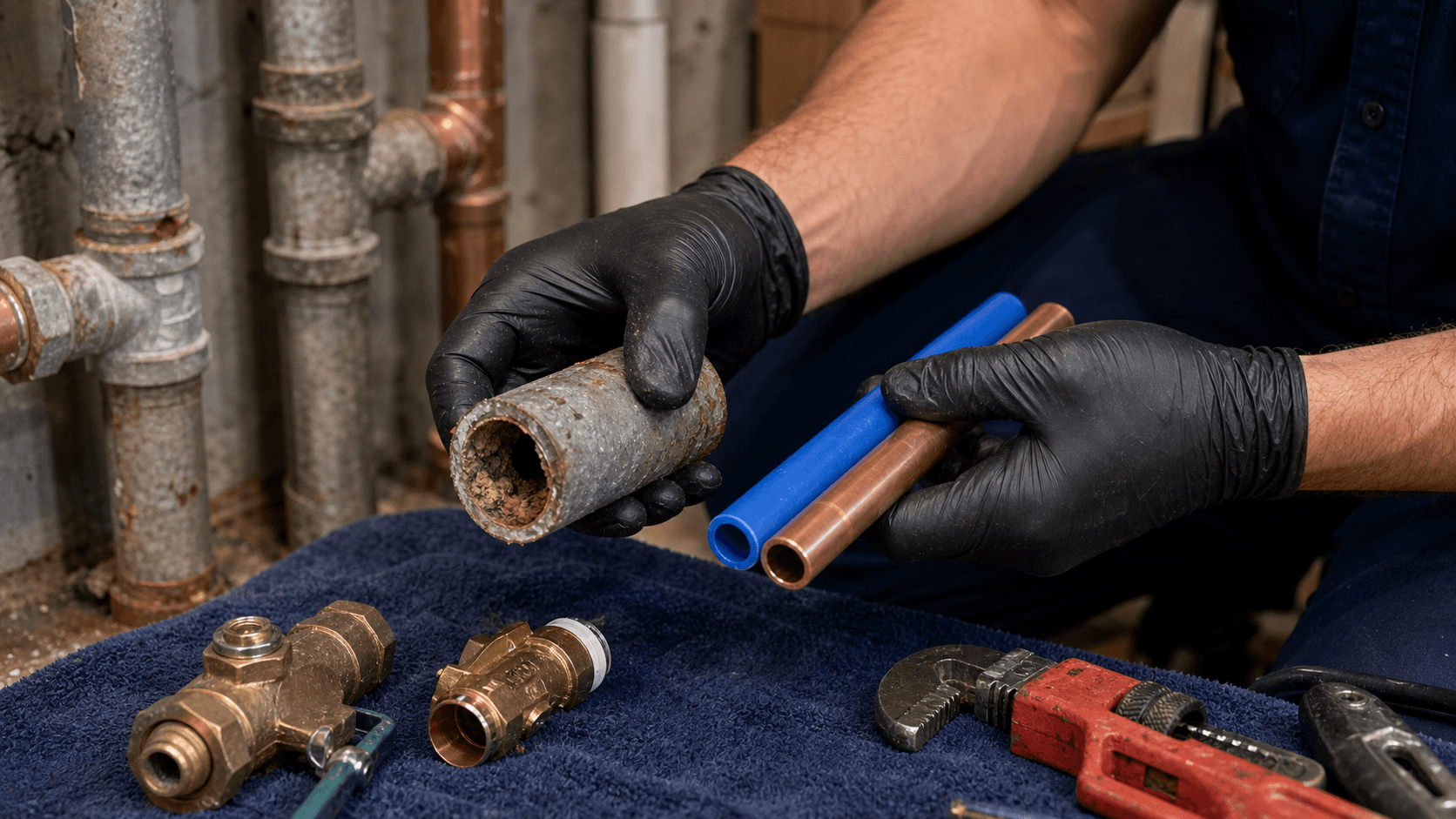
Stage two — iron corrosion and tuberculation. Once the zinc is depleted in patches, the underlying carbon steel reacts with dissolved oxygen in the water to form iron oxide — rust. The rust doesn't form a smooth layer; it builds up as bumpy nodules called tuberculation, distinctive lumpy buildups that protrude into the pipe's interior. Each nodule is essentially a microscopic battery: acidic conditions at the nodule center accelerate corrosion of the steel directly underneath.
Stage three — flow restriction. Tuberculation reduces the effective inside diameter of the pipe. A 3/4-inch pipe can lose half its flow capacity to nodule buildup before any leak occurs. Homeowners typically notice this stage first: showers go from full flow to a trickle when the dishwasher is running, upstairs taps run slower than downstairs, hot water side flows worse than cold (because hot-water galvanized fails faster).
Stage four — pinhole leaks. Eventually the acidic micro-environments under the rust nodules eat through the remaining steel wall. The leak shows up as a wet spot under a sink, a stain on a ceiling below a bathroom, or — most damagingly — a slow leak inside a wall that goes undetected for months. Pinhole leaks rarely fail loudly; they fail slowly, soaking framing and drywall until rot becomes a structural problem. Catching these early with acoustic and thermal imaging is the job of our leak detection and pipe repair in Bellevue, WA service — typically a 4-inch access panel instead of major drywall demolition.
A cut pipe section shows why pressure drops, rust flakes, and recurring leaks point toward replacement.
Six warning signs your galvanized supply lines are failing
Rust-colored water on first draw, declining water pressure throughout the house, faster failure on hot-water lines, pinhole leaks at fixtures or in walls, sediment in faucet aerators, and a noticeable taste of metal in tap water.
These signs typically appear in this order — first the discoloration, then the pressure loss, then the leaks. Catching the early signs lets you plan a repipe on your schedule. Waiting until a wall-cavity leak forces emergency action means paying for emergency rates plus water damage.
Rust-colored or brown water from cold taps after the house has been unused for several hours. The first half-gallon clears as fresher water from the meter pushes through. Severe cases produce visibly orange water that stains the sink basin.
Declining water pressure, especially at upstairs or end-of-run fixtures. A shower that used to hit full flow now barely runs when another fixture is on. Hot side flows worse than cold.
Hot-water lines fail before cold-water lines. If you see rust at the hot tap but not the cold from the same fixture, the hot-water galvanized is further along. Hot-water lines run typically 5 to 10 years ahead of cold-water lines in corrosion.
Visible pinhole leaks at exposed pipe sections — under sinks, in basements, in crawlspaces. A drip you can wipe with a finger today will be a flood in 18 months as the pinhole grows.
Sediment accumulating in faucet aerators within weeks of cleaning. The sediment is rust flakes from inside the pipe wall, breaking off and traveling with the water.
Metallic taste in tap water, particularly first thing in the morning. The iron-and-zinc dissolution is detectable on the tongue at concentrations well below EPA's secondary contaminant limit.
Which Bellevue neighborhoods are at peak failure risk?
Bellevue neighborhoods built between 1955 and 1968 are deepest in the galvanized-pipe failure window — primarily Lake Hills, Crossroads, parts of Bridle Trails, and Newport Hills in adjoining Newcastle.
City of Bellevue Community Development data shows the city's housing stock concentrated in the 1950s and 1960s, with the median construction year falling at 1982. The neighborhoods built during the 1955-to-1968 window are now in the prime galvanized-failure age range — 57 to 70 years from original installation.
Lake Hills was developed primarily between 1958 and 1968, with most single-family ranchers built using the supply-line standards of that era. Crossroads developed in two waves, with the earliest 1965-to-1975 construction now at the 50-to-60-year mark. Bridle Trails has a wider construction range (1950s through 1990s), so individual home age varies more — checking the build year via King County Parcel Viewer is the easiest way to confirm.
Newport Hills in Newcastle — technically a separate city, but built as a planned Bellevue-adjacent community in 1965-1975 — has similar galvanized supply concentration. Older waterfront homes in West Bellevue (some pre-WWII) may have already been repiped during a 1980s renovation, but homes still on original construction would have galvanized at least on hot-water lines.
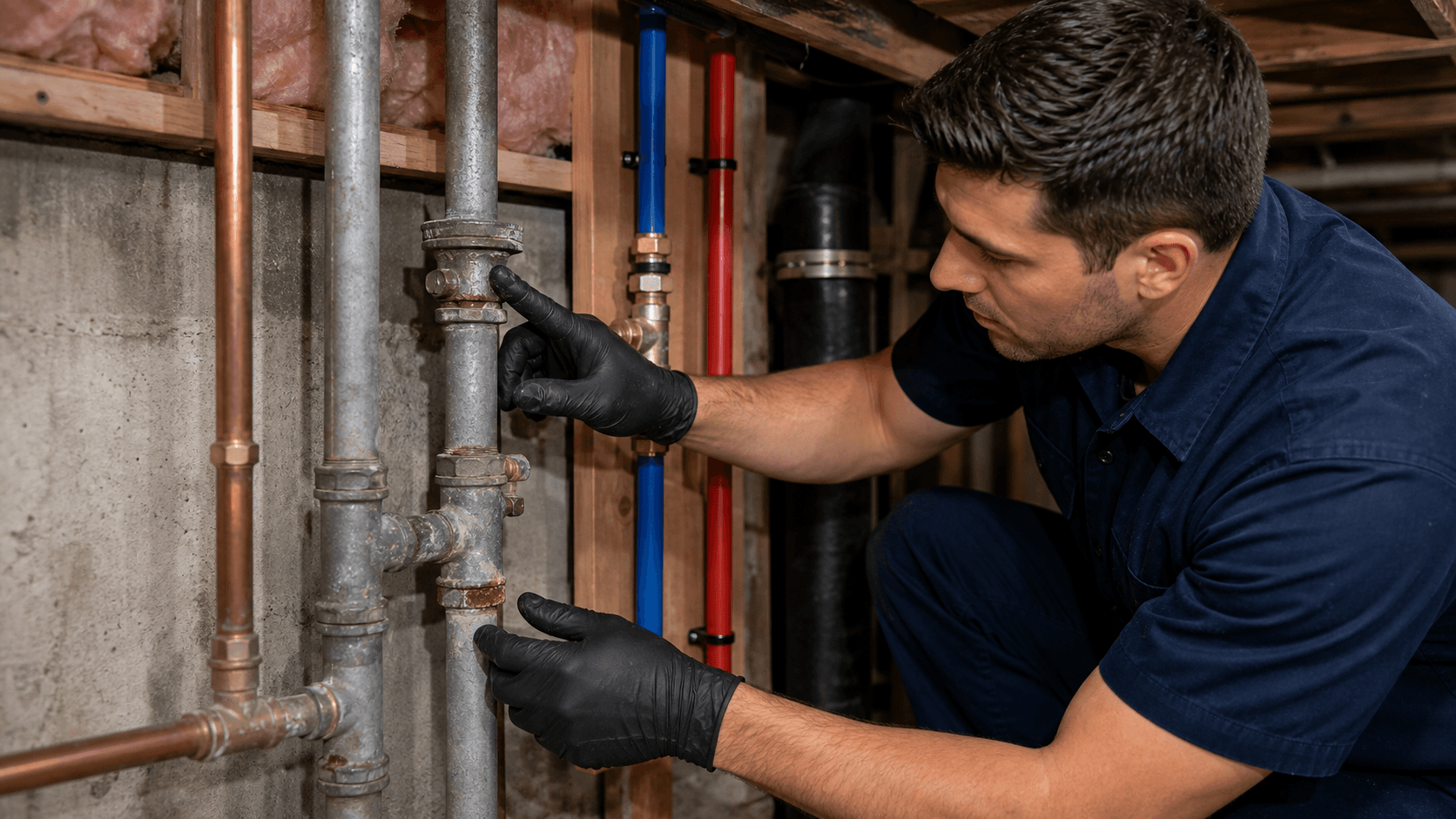
The most reliable way to confirm: check a visible section of supply pipe (under a sink, in the basement, or at the water heater). Galvanized steel looks like dull silver-gray pipe with threaded fittings, often with rust staining at joints. Copper looks orange-brown. PEX looks white, red, or blue plastic. If you can't tell, a $95 plumber service call resolves the question definitively.
The lead-accumulation concern most homeowners don't know about
Galvanized pipe itself contains no lead, but galvanized lines that were ever connected downstream of a lead service line accumulate lead in their interior scale — and that scale continues releasing lead into your tap water for years even after the upstream lead line is replaced.
This is the most-misunderstood health concern around galvanized pipe. Galvanized steel is not a lead-containing material. The lead comes from a different source: the lead service line (LSL) that may have connected your house to the municipal water main before about 1986.
Mechanism: lead in the upstream service line dissolves into water passing through. When the water hits the galvanized interior surface, the rust scale traps and adsorbs lead particles. Over decades, the scale builds up a reservoir of lead. Even after the LSL is removed or replaced, the contaminated scale in the galvanized pipe continues releasing lead into water passing through.
The EPA formally recognized this in the 2021 Lead and Copper Rule Revisions, which now treat 'galvanized requiring replacement' (GRR) — galvanized lines ever downstream of an LSL — as a similar lead-exposure risk to a lead service line itself. EPA's drinking-water lead standard remains zero MCL (maximum contaminant level), with a 15 parts-per-billion action threshold.
How this applies to Bellevue: Seattle Public Utilities and Cascade Water Alliance, which supply most of the Eastside, have largely replaced lead service mains. The remaining lead exposure risk for a Bellevue homeowner with galvanized indoor plumbing comes from (a) lead solder used in copper connections inside the home before 1986, and (b) lead-bearing brass fittings (legal at up to 8% lead until 2014). A water test for $35 to $65 confirms whether your specific home's tap water exceeds the EPA action level.
If you have young children or are pregnant, run cold-tap water for 30 seconds before drinking or cooking — this flushes the standing water that's had the most contact time with pipe scale. A point-of-use NSF/ANSI 53-certified lead-reducing filter (typical countertop or under-sink units) provides a more permanent solution if testing shows elevated levels.
Replacement options ranked by cost and risk
Three options exist. Whole-house PEX repipe costs $4,000 to $15,000+ but solves the problem completely. Partial repipe (hot-side or supply-trunk only) costs $2,500 to $6,000 and buys time. Just-in-time replacement — fixing each failure as it happens — is cheapest short-term and the most expensive over 10 years.
Whole-house PEX repipe is the gold-standard solution and what every reputable Bellevue plumber will recommend if you'll own the home for 5+ more years. PEX is rated for 25 to 50+ years of service life. The job replaces every supply line from the water heater outward, including all branches to fixtures. A typical 2,000-square-foot Bellevue home with crawlspace access requires about 10 drywall openings and 2 to 4 days of work. The work needs a permit through City of Bellevue Development Services — see our Bellevue plumbing permits guide for the application process and what unpermitted repipe work costs you at sale.
Partial repipe makes sense in specific cases: hot-water side only (where corrosion is more advanced), or replacing the supply trunk from the meter to the manifold while leaving short branches in place. It buys 5 to 15 more years on the unreplaced sections at roughly half the cost of a whole-house job.
Just-in-time replacement — fix the leak when it happens, leave the rest — is what most homeowners do because the up-front cost of a full repipe feels prohibitive. The math is rarely in favor of this approach over 10 years: each emergency repair costs $385 to $640 plus drywall and finish work, water damage in the worst cases adds thousands more, and the failure rate accelerates as more of the system ages. A homeowner who pays $300 to $600 for three to four emergency leak repairs over a decade typically also pays for water damage cleanup at least once.
OptionTypical CostService Life Added
Single pinhole leak repair$285–$6401–3 years (other lines still aging)
Hot-side only partial repipe$2,500–$4,50020–30 years on hot side
Supply trunk repipe (manifold + main runs)$4,500–$7,50020–30 years on trunk
Whole-house PEX repipe, 1,500 sq ft$4,000–$8,00025–50+ years on entire system
Whole-house PEX repipe, 2,000–2,500 sq ft$6,000–$12,00025–50+ years on entire system
Whole-house PEX repipe, 3,000+ sq ft$10,000–$16,000+25–50+ years on entire system
Whole-house copper repipe (same size)+30–60% over PEX50+ years; longer than PEX
Galvanized pipe replacement options for Bellevue homes (2026)
PEX versus copper repipe — which makes sense for a Bellevue home?
PEX wins on cost (30 to 60% cheaper than copper for the same job), installation speed (fewer fittings, no soldering), and freeze tolerance. Copper wins on service life (50+ years versus 25 to 50 for PEX), heat tolerance, and resale-perception in higher-end Bellevue homes.
PEX is the dominant residential repipe material in 2026 for sound reasons. Material cost per linear foot runs $0.40 to $2.00 for PEX versus $18.00 to $24.00 for copper. PEX bends around obstacles without fittings, dramatically reducing the labor time and the number of potential leak points (every fitting is a potential future leak). PEX expands slightly when water freezes inside it, surviving freezes that would burst copper pipe.
Copper still has advantages for specific situations. It tolerates higher temperatures (relevant only for recirculating hot-water systems, not typical residential supply). Its 50+ year service life is roughly double PEX's. Copper is recyclable at end of life. Some Bellevue real-estate listings highlight copper supply lines as a quality feature, particularly in higher-end Newport Shores or Medina-adjacent homes, though the actual market premium is modest.
The right answer for most Bellevue homeowners doing a galvanized repipe in 2026 is PEX. The cost savings are real and meaningful, the service life is more than adequate for the typical 10-to-20-year homeownership horizon, and the freeze-tolerance benefit is genuinely useful in PNW winters when uninsulated crawlspace pipes can hit freezing. Use copper for short critical runs (the connection at the water heater, exterior hose bibs that need freeze protection) and PEX for everything else.
The insurance angle — why carriers are flagging older pipe materials
Major homeowner-insurance carriers now classify galvanized, polybutylene, cast iron, and pre-2006 PEX as high-risk pipe materials. The consequences range from water-damage coverage limitations to non-renewal of the policy, especially after a claim.
Insurance carriers track water-damage claim data across millions of policies. The data shows that homes with aging galvanized supply lines and homes with polybutylene plumbing have markedly higher water-damage claim rates than homes with copper or PEX. Carriers respond with three tools: higher premiums, water-damage sub-limits (capping payouts on plumbing-related claims to a fraction of the dwelling coverage), or non-renewal of policies on homes with these materials after a claim.
What this looks like in practice for a Bellevue homeowner: a carrier reviewing your home at renewal flags the original 1965 galvanized plumbing during an inspection (whether triggered by a claim, a routine review, or a new policy application). The renewal offer comes with a higher premium, or a $10,000 plumbing-claim sub-limit, or — increasingly common after a single water claim — a non-renewal notice giving you 60 days to find a new carrier.
A pre-emptive repipe shifts the calculation. Carriers writing new policies on a Bellevue home now look favorably on documented recent repipe work. Whole-house PEX with permits and inspection paperwork can lower annual premiums by $400 to $800 versus the same home with original galvanized still in place, depending on the carrier and coverage amount. Over 10 years, the premium savings alone can offset 50 to 100% of the repipe cost.
Document everything if you repipe. Permits pulled with City of Bellevue Development Services, inspection sign-offs, contractor invoices showing scope and materials, and date-stamped photos of the work — keep all of it. When you sell the home or shop for new insurance, this paperwork is what converts the repipe from a cost to an asset.
A related concern — polybutylene pipe in 1980s and 1990s Bellevue homes
Polybutylene (PB) pipe, used in residential supply from roughly 1978 to 1995, is a separate problem from galvanized — but if you're in a 1980s or early 1990s Bellevue home (much of Sammamish, parts of Issaquah, Eastgate), you should know what it looks like and what to do about it.
Polybutylene was sold as a cheaper, easier-to-install alternative to copper. It looks like flexible gray, blue, or black plastic pipe (not the white/red/blue PEX of today). It was used heavily in PNW residential construction from 1978 until production ceased in 1995, after a wave of failures led to the 1995 Cox v. Shell Oil class-action settlement of $950 million covering 2.7 million affected homes.
The failure mechanism: chlorine and other municipal water-treatment chemicals oxidize the polybutylene from the inside, causing the pipe wall to become brittle and crack. Failures typically appear at fittings first, then progress to mid-pipe cracks. Some homes have run for 30+ years without failure; others have failed within 10. There is no reliable way to predict which.
If your home was built between 1978 and 1996 and you see gray (or sometimes blue or black) plastic supply pipe at fixtures, water heater, or in crawlspaces — that's polybutylene. Insurance carriers treat polybutylene more harshly than galvanized: many won't write a new policy without a repipe; existing policies often carry plumbing-claim exclusions or sub-limits. A whole-house PEX repipe of a polybutylene-plumbed home is the only durable solution, with identical cost ranges to a galvanized repipe.
Polybutylene deserves a full dedicated guide; this section is an introduction so you know what to look for. If you suspect polybutylene in your home, get a licensed plumber to confirm — it takes 15 minutes and resolves a significant insurance question.
How a galvanized assessment runs — and the quote that follows
Five steps: a flow/pressure check at multiple fixtures maps where the narrowing lives, a visual check at accessible pipe (water heater, crawlspace) confirms the material, water-quality clues (rusty first-draw) corroborate, the repair-versus-repipe decision is priced from the findings, and you get a written flat-rate quote naming the scope — partial branch, whole-house PEX, or staged replacement.
"Open one cleanout under a 1965 kitchen sink and the diagnosis is done," says the repipe lead on our network. "Tuberculated galvanized looks like coral — no homeowner has ever argued with the footage."
Need help with this in your home? See our Whole-house repiping in Bellevue page for pricing, our diagnostic process, and how same-day service works across the Eastside.
— Bridge to service
We dispatch for this across Crossroads, Lake Hills, and Eastgate — see your neighborhood page for local response times and recent jobs.
Galvanized supply lines in 1960s Bellevue homes — questions homeowners ask
QUESTION01
How long do galvanized pipes last?
40 to 50 years is the documented average service life for residential galvanized supply lines, with real-world failures observed as early as 25 years. Galvanized was the dominant supply material from the 1920s through the early 1960s — so original Bellevue stock is now decades past its life.
QUESTION02
How do galvanized pipes fail?
In a predictable sequence: the zinc coating dissolves into the water, the exposed steel rusts inward forming lumpy nodules (tuberculation), the effective diameter narrows, pressure drops, and pinhole leaks begin.