Home/Learn/Pipes & freezing/PEX vs copper repipe in Bellevue: which material wins for a 2026 whole-house job
Pipes
PEX vs copper repipe in Bellevue: which material wins for a 2026 whole-house job
PEX has displaced copper as the default whole-house repipe material in Bellevue homes for a clear reason: a 1,500 to 2,500 square-foot PEX repipe runs $4,000 to $10,000 in the Seattle area while the equivalent copper repipe runs $8,000 to $15,000, and the labor scope is roughly half because PEX is flexible enough to snake through wall cavities without the soldering and fitting work copper requires. The case for copper has not disappeared — exposed-pipe applications, longer manufacturer-stated lifespan, and a perception advantage on home resale all still matter — but for the median Bellevue homeowner replacing 60-year-old galvanized supply lines, PEX-A is the right answer. This guide covers the PEX-A vs PEX-B distinction (and the less-common PEX-C), how Bellevue's soft slightly-alkaline water affects both copper and PEX longevity, the actual Seattle-area cost breakdown verified against 2026 pricing data, the Bellevue plumbing permit process for a whole-house repipe, lifespan expectations versus marketing claims, and the four scenarios where copper is still worth the premium.
For a typical Bellevue whole-house repipe, PEX-A is the default. It costs 30 to 50 percent less than copper, installs in roughly half the labor hours, resists freezing damage better, and meets the 2021 UPC adopted by Washington via WAC 51-56 for both hot and cold residential supply. Copper wins in narrow cases — exposed mechanical-room runs, homes where resale-value perception matters more than cost, and installations where freeze risk is essentially zero.
Twenty years ago this decision was different. Copper had the lifespan story, the resale story, and a longer track record in residential installations. PEX (cross-linked polyethylene) was the new material, viewed skeptically by plumbers and home inspectors, and its long-term performance was unproven outside Europe (where it had been standard since the 1970s).
Today the picture has shifted. PEX has 40+ years of in-service residential data in Europe and 25+ years in the US. The cost gap has widened — copper commodity prices have stayed elevated while PEX manufacturing has scaled. Most major US plumbers have moved their default residential repipe spec to PEX. Bellevue's residential plumbing market reflects that shift: most 2010s-and-newer construction in Bellevue is PEX from the start, and most repipe jobs replacing failing galvanized or polybutylene end in PEX rather than copper.
Verified Seattle-area pricing in 2026: a copper whole-house repipe runs $8,000 to $15,000 for a standard home (1,500 to 2,000 sq ft), with copper material at $18 to $24 per linear foot installed. The equivalent PEX repipe runs $4,000 to $8,000 — roughly half the total. For larger 2,500 sq ft homes, copper hits $12,000 to $18,000 while PEX runs $8,000 to $15,000. The full landscape of Bellevue plumbing costs sits in our plumber cost and pricing in Bellevue guide.
The cost difference is real because the labor difference is real. Labor is about 70 percent of total repipe project cost, and PEX cuts labor by roughly half: the tubing is flexible enough to snake through wall cavities without cutting drywall at every joint, the connections use crimp or expansion fittings rather than soldered sweat joints, and the entire system can run from a central manifold direct to each fixture (the home-run configuration) which reduces total connection count.
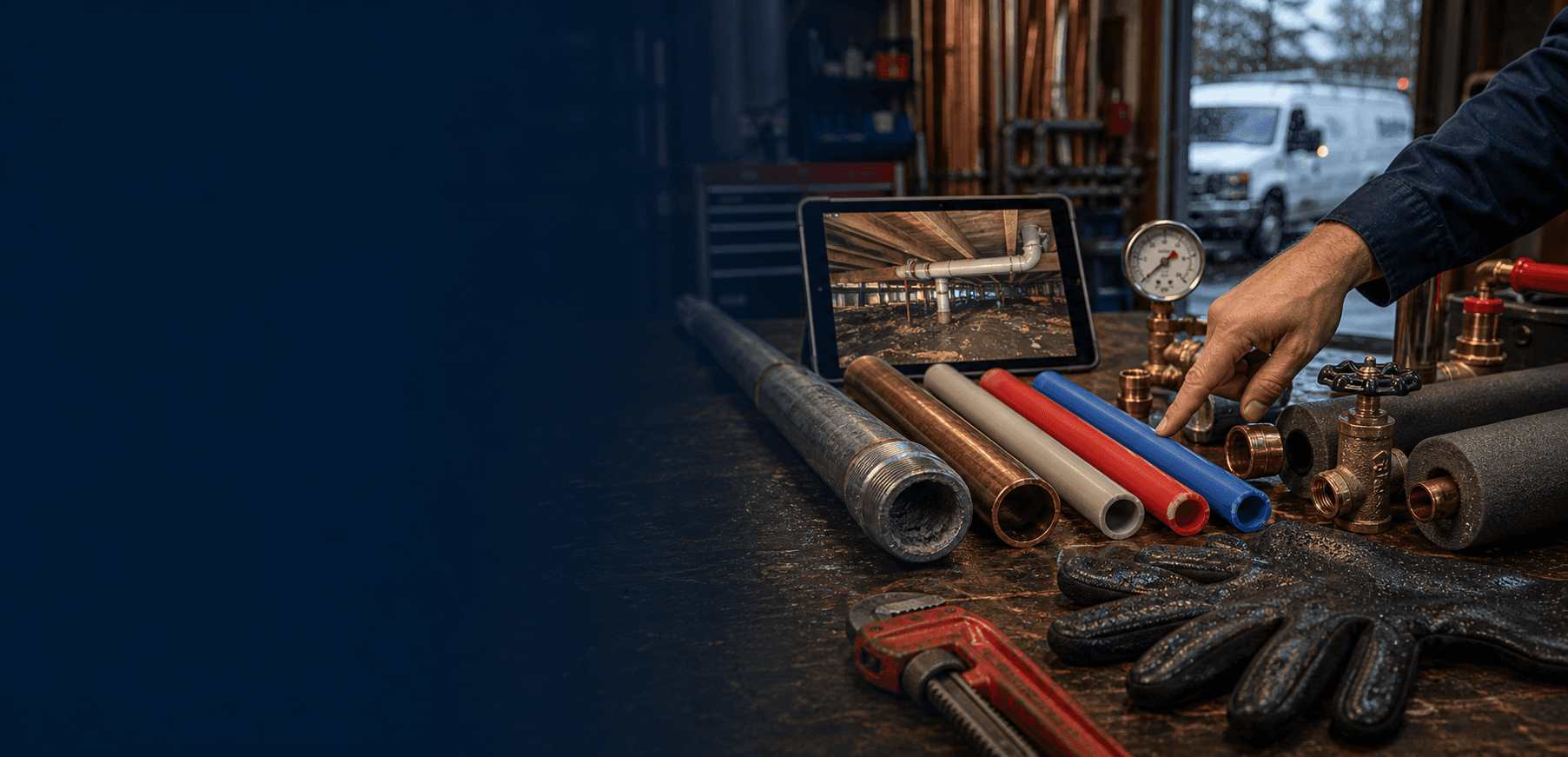
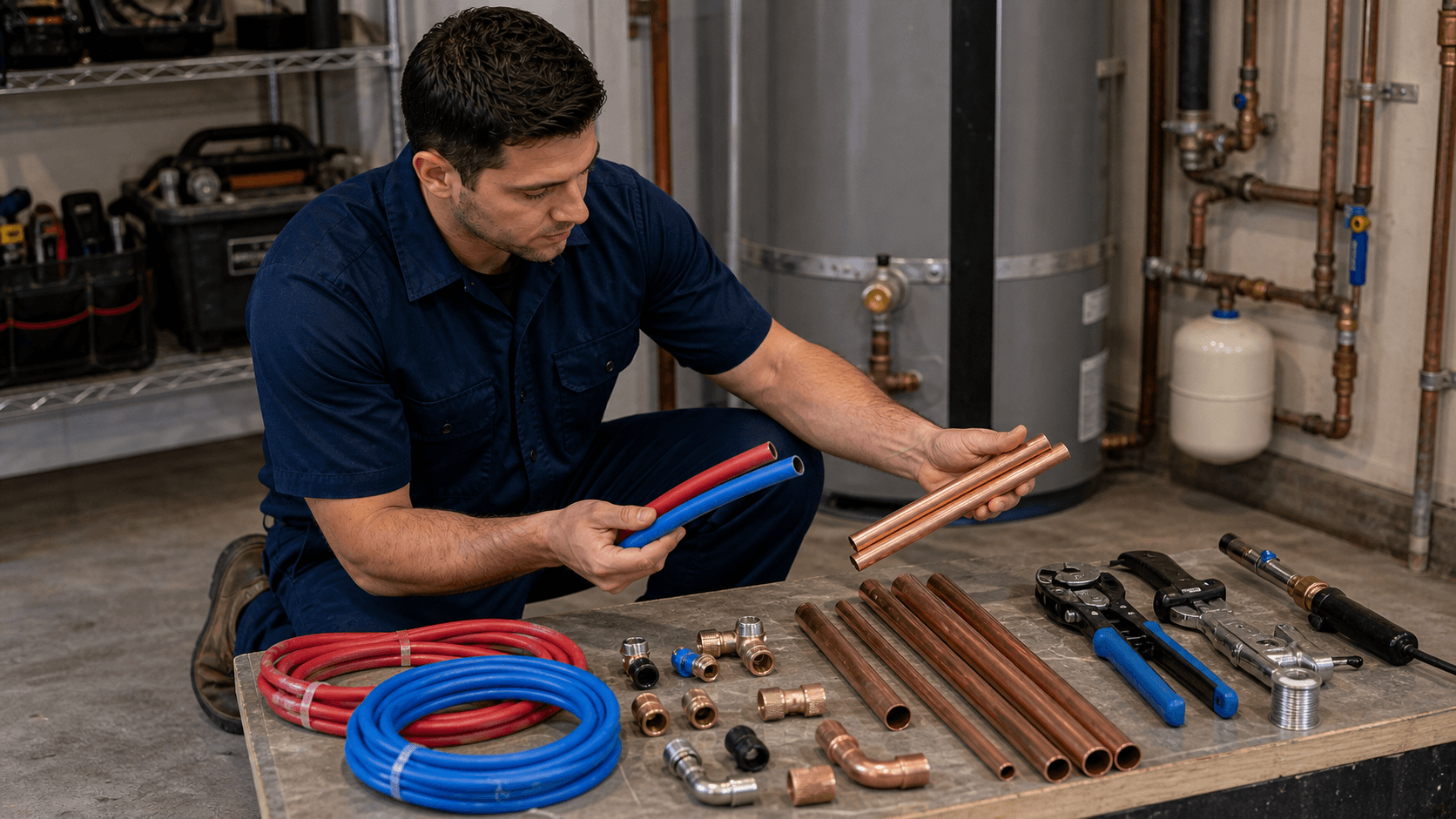
PEX and copper differ in cost, installation access, noise, durability, and repair style.
This happening in your home right now? A licensed plumber can talk you through the next step on the phone — 24/7, and the call is free.
PEX-A vs PEX-B vs PEX-C — what the letters actually mean
PEX-A (Engel method, ASTM F876) is the most flexible, has the best burst resistance, uses expansion-fitting connections, and is the dominant choice for cold-climate residential repipes. PEX-B (silane method) is stiffer, uses copper crimp rings or stainless clamps, costs slightly less, and is common in budget jobs. PEX-C (electron beam method) is the least common in residential use.
PEX-A. Manufactured using the Engel method, which cross-links the polyethylene molecules under high temperature and pressure during extrusion. The result is the highest degree of cross-linking among PEX types — the molecular structure that gives PEX its flexibility, memory, and burst resistance is most fully developed in PEX-A. The 'memory' is real: PEX-A tubing returns to its original shape after being expanded, which is why expansion-fitting connections work. The brand most plumbers associate with PEX-A in the US is Uponor (formerly Wirsbo).
PEX-B. Manufactured using the silane method, which cross-links the polyethylene after extrusion using moisture and a silane catalyst. PEX-B is stiffer than PEX-A — it bends but does not snap back to original shape — which means connections must use mechanical crimp rings (copper or stainless) or stainless steel clamps rather than expansion fittings. PEX-B is about 10-20 percent cheaper than PEX-A at material cost. Brands include Apollo, SharkBite, and Viega.
PEX-C. Manufactured using electron-beam cross-linking after extrusion. Lower cross-linking percentage than PEX-A or PEX-B; less common in residential repipe work. Not widely stocked at Pacific Northwest plumbing supply houses, so most Bellevue repipes won't use PEX-C.
The practical choice in 2026. For a cold-climate residential repipe in Bellevue, PEX-A is the right answer if the budget allows. The burst-resistance advantage is meaningful given PNW freeze events — see our frozen and burst pipes in the Pacific Northwest guide for the freeze-failure mechanism. PEX-A's flexibility also reduces installation labor on tight retrofit jobs through old wall cavities. PEX-B is acceptable and saves a few hundred dollars on a typical job. PEX-C is uncommon enough that you'd need to specifically request it.
Copper's case in 2026 — when it still wins
Copper wins in four scenarios: exposed mechanical-room runs where appearance matters, homes where resale-value perception drives the decision, plumbing in occupancies that prohibit plastic supply lines (rare in residential Bellevue but real in some commercial applications), and recirculation loops on high-temperature domestic hot water systems where PEX's temperature derating becomes relevant.
Exposed-pipe applications. PEX is rated for cold temperatures and most of the Bellevue residential temperature range, but it must be protected from UV exposure (which degrades the cross-linked polymer over time) and is generally not run as exposed-and-finished pipe. Copper accepts paint, looks intentional when exposed, and is the right answer for the visible mechanical-room riser, the laundry-room rough-in that won't be covered, or the basement utility wall run that's visible.
Resale perception. Real estate listings still use 'copper plumbing' as a feature; some home inspectors still note PEX with mild skepticism in older buyers' inspection reports even when the installation is sound. For high-end resale markets (West Bellevue, Medina, parts of Bridle Trails over $2M), the marginal $4,000-$7,000 premium for copper supply can pencil out as a marketing investment. For the median Bellevue home in the $1.2M-$1.8M range, the cost premium doesn't return in resale value.
Code-restricted applications. Some commercial and multifamily applications require copper or other metallic supply piping; some homeowners' associations write restrictive covenants on building materials. These are rare in single-family Bellevue residential but worth confirming with the HOA documents before committing to PEX.
Recirculation and high-temp domestic hot water. PEX is rated to 180°F at lower pressures and to 200°F intermittently, which covers virtually all residential hot water applications. Recirculation loops that run continuous high-temperature water (~140°F at the loop) accelerate PEX wear at the fittings. For continuous-circulation systems, copper at the recirculation segments and PEX at the branches is a common hybrid spec.
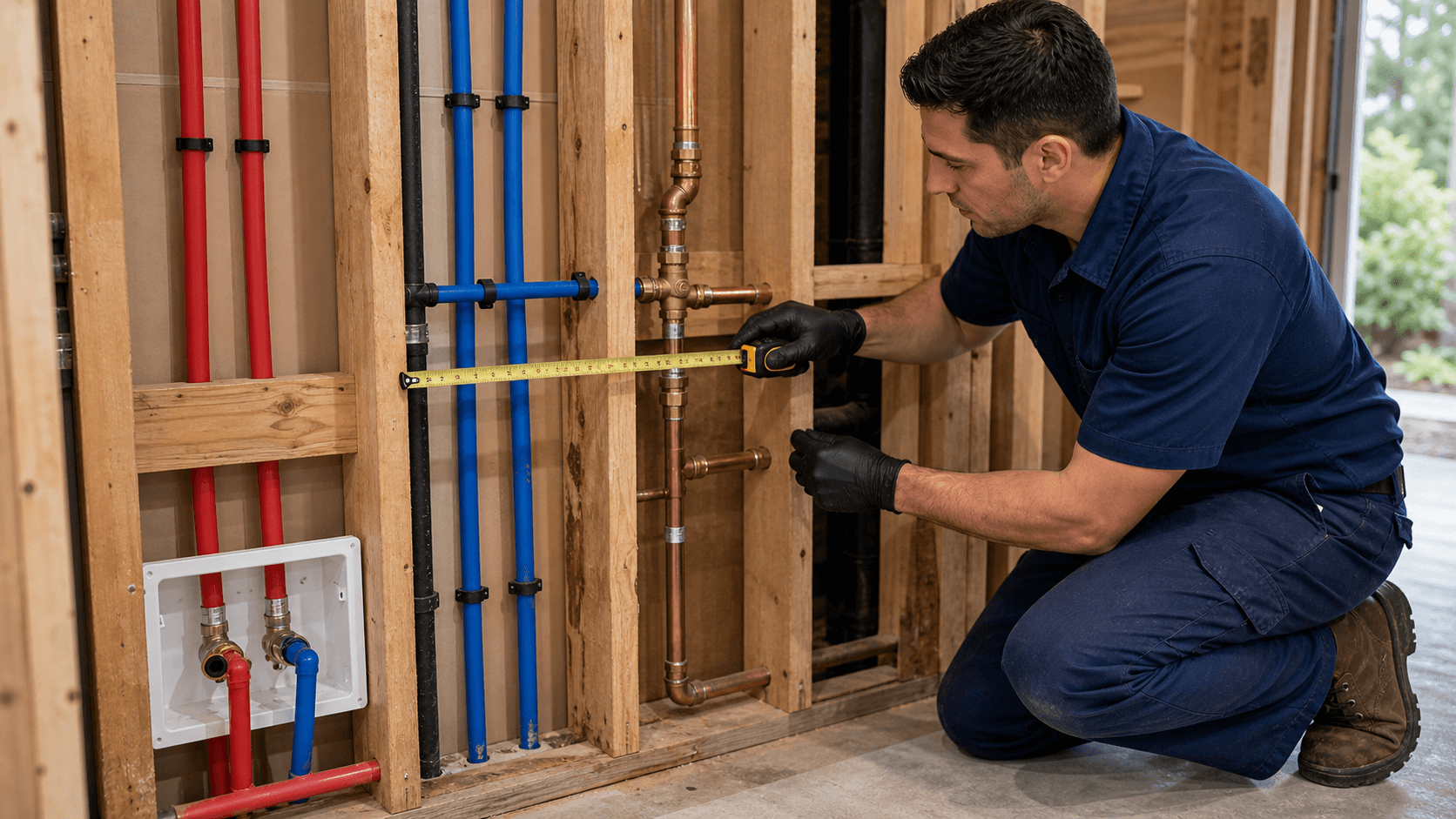
The best repipe material also depends on access, wall openings, and how the house is already plumbed.
How Bellevue's water chemistry affects both materials
Bellevue's municipal water at pH 7.5 to 8.2 and 1.50 grains per gallon hardness sits in the soft, slightly alkaline range that minimizes scale buildup on both PEX and copper — but the same soft water with chloramines used as the secondary disinfectant has been documented to accelerate copper pinhole leaks in some PNW homes. PEX is generally less affected by chloramines than copper at the disinfection levels Bellevue uses.
Bellevue's water profile, per the City of Bellevue 2024 Water Quality Report. Total hardness: approximately 25.7 mg/L calcium carbonate (1.50 grains per gallon — soft). pH: adjusted to 7.5 to 8.2 at treatment to protect plumbing. Disinfection: chloramines (chlorine plus ammonia) for the secondary disinfectant carried through the distribution system. The full water-source picture is in our Bellevue water source and treatment guide.
Effect on copper. Type III pitting — sometimes called cold-water pitting — has been documented in soft-water regions including parts of the Pacific Northwest. The chemistry is complex: pH below 6.5 attacks copper aggressively, and pH above 8 in combination with low mineral content can also produce pitting. Bellevue's pH (7.5-8.2) is on the higher edge of the safe range, and the chloramine disinfectant is a known accelerant for copper pinhole leaks in some installations. Real-world pinhole-leak rates in Bellevue copper installations from the 1970s-1990s are higher than in hard-water markets — see our galvanized supply lines in old Bellevue homes for the broader supply-line aging picture.
Effect on PEX. PEX is largely chemically inert in residential water applications. Soft slightly-alkaline water with chloramines does not measurably affect PEX-A lifespan. The exception is when high chlorine concentrations sit in dead-end branch lines for extended periods — and even then, the degradation timeline runs decades, not years. For Bellevue's normal continuous-flow residential plumbing, PEX water-chemistry compatibility is excellent.
What this means for the decision. Bellevue's specific water chemistry doesn't disqualify copper, but it does add to copper's risk side of the ledger — pinhole leaks are a documented PNW phenomenon, and a PEX repipe sidesteps that failure mode entirely. For a homeowner whose galvanized lines are failing and whose decision is what to install instead, PEX has the water-chemistry advantage in Bellevue specifically.
Real Seattle-area repipe costs in 2026
Bellevue whole-house PEX repipe: $4,000 to $10,000 depending on home size, fixture count, and access difficulty. Bellevue whole-house copper repipe: $8,000 to $18,000 on the same variables. Drywall repair and finish work, frequently quoted separately, runs an additional $1,500 to $5,000.
Equipment cost is roughly one third of total project cost; labor is roughly 70 percent. PEX-A tubing runs $0.50-$1.20 per linear foot at supply-house pricing; PEX-B about 15-20 percent less. Copper tubing (Type L is residential standard) runs $4-$7 per linear foot at 2026 commodity prices, plus fittings at $2-$8 each. A typical 1,500 sq ft Bellevue home uses 200-350 linear feet of supply tubing with 30-60 fittings, depending on layout.
Verified 2026 repipe pricing for Bellevue/Seattle area:
1,500 sq ft home, PEX-A: $6,000-$10,000 (per Seattle Repipe Specialists, 2026 published rates)
1,500 sq ft home, copper: $10,000-$15,000
2,500 sq ft home, PEX-A: $8,000-$15,000
2,500 sq ft home, copper: $14,000-$22,000
Slab home with no crawlspace access (any size): add $2,000-$5,000 for cutting and patching
Multi-story with multiple bathrooms on upper floors: add $1,000-$3,000 for vertical riser complexity
Drywall repair and paint (separately quoted in most cases): $1,500-$5,000
Bellevue plumbing permit: approximately $90 to $300 depending on scope (verify current fee via permitfeeestimator.bellevuewa.gov)
Several Seattle-area specialty contractors (Repipe Specialists, Eastside Repipe and Plumbing, Craftsman Plumbing) compete directly on whole-house repipe work and publish pricing in this range. Get three quotes for any repipe job over $6,000 — the spread between low and high bids on the same scope can be 30-50 percent.
Bellevue permits and inspection for whole-house repipe
Whole-house repipes require a City of Bellevue plumbing permit pulled by a licensed Washington plumber and a final inspection by Bellevue Development Services. The permit application goes through MyBuildingPermit.com; inspection scheduling typically runs 2 to 5 business days from request.
Permit requirement. Whole-house repipe is unambiguous permit territory — it's a major plumbing alteration affecting concealed piping behind walls. The permit must be pulled by a Washington-licensed plumbing contractor per RCW 18.106. Most reputable Bellevue plumbers include the permit fee on the project invoice and handle the application as part of the scope. Verify the plumber is pulling the permit before signing the contract; some lower-tier contractors quote without permits and expect the homeowner to handle compliance.
Application via MyBuildingPermit.com. Bellevue uses the shared Eastside permit portal at mybuildingpermit.com for routine plumbing permit applications. The plumber submits scope, pays the fee, and the permit issues — typically same-day for routine residential repipe scopes. For unusual scopes (commercial, multifamily, or homes with unique configurations), plan review may be required, adding 5-15 business days.
Inspection. After installation, a Bellevue Development Services inspector visits to verify the work meets the Washington State Plumbing Code (UPC with Washington amendments). For PEX repipes specifically, inspectors check material certifications (PEX-A vs PEX-B labels printed on the tubing), correct fitting types for the material, proper supports at code-required intervals, and adequate clearance from electrical and HVAC penetrations. For copper repipes, inspectors verify dielectric isolation at dissimilar-metal connections and proper soldering at every joint.
Inspection scheduling. Bellevue's inspection queue runs 2-5 business days from request in normal periods. Permits remain open until inspection passes; the work can be drywalled-over only after a successful rough-in inspection. The detailed permit landscape is in our Bellevue plumbing permits guide.
Lifespan expectations versus marketing claims
Manufacturer-stated lifespans are 25-50 years for PEX-A, 25 years for PEX-B, and 50-70 years for copper. Real-world Bellevue performance differs: PEX installations 20+ years old in PNW homes are performing well, copper installations 30-50 years old vary significantly by water chemistry exposure with pinhole leaks emerging in some homes at the 25-year mark.
PEX manufacturer claims and real-world data. Uponor's PEX-A is rated for 50+ years at residential conditions; SharkBite/Apollo PEX-B is rated for 25 years. The 50-year claim is supported by accelerated-aging tests but not yet validated by 50 years of field service — the longest PEX-A residential installations in the US date to the mid-1990s, so 30 years of real-world data exists. Those 30-year installations are performing well. Whether they make it to 50 is an open question.
Copper lifespan in PNW context. Copper plumbing in clean municipal water with good pH and low aggressive ions can run 60-80 years. Copper in PNW soft water with chloramine disinfection runs less — there's no precise number, but pinhole leak rates in 1970s-1990s Bellevue copper installations are higher than in equivalent installations in less-aggressive water regions. Some Bellevue homes with 30-40 year copper supply are starting to see pinhole failures; others at 50+ years are still sound.
The honest read. For a homeowner who plans to stay in their Bellevue home for 20-30 years, both PEX-A and copper will deliver service life that exceeds the ownership horizon. The difference between 30 years and 50 years of remaining lifespan is largely academic at the household-decision level. The cost-of-replacement difference at install — $4,000 to $8,000 — is concrete and immediate.
When PEX wins, when copper wins — the decision matrix
PEX wins for: budget-constrained jobs, retrofit-through-walls installations, cold-climate freeze-risk situations, homes with no resale plans in the next 5 years, and homes already on PEX who are extending or repairing. Copper wins for: exposed mechanical-room runs, high-end resale-driven decisions, and the small subset of homes with code or HOA restrictions on plastic supply.
Decision factors that favor PEX. Budget: PEX saves $4,000-$10,000 on a typical Bellevue whole-house job. Retrofit access: PEX snakes through existing walls without the cutting copper requires. Freeze resistance: PEX-A expands 3-5 times in diameter without rupturing — a meaningful safety margin during PNW cold snaps. Speed: a PEX whole-house repipe completes in 3-5 days versus 6-10 days for copper on the same scope.
Decision factors that favor copper. Appearance: copper looks intentional when exposed and accepts paint. Resale at high-end price points: some buyers in the $2M+ Bellevue market still price copper at a premium. Documented track record: copper has 80-100 years of US residential service history versus PEX's 30 years.
The hybrid answer. Many Bellevue plumbers will quote a mostly-PEX repipe with copper used only at the visible mechanical-room sections and the water-heater connections. This captures most of the PEX cost savings while preserving the copper-look in the visible areas. Hybrid repipes cost $1,000-$3,000 more than full PEX but $3,000-$8,000 less than full copper.
What about CPVC, PB, and other supply materials?
CPVC is an alternative plastic supply material used in some southern US markets but rare in Pacific Northwest installations because it becomes brittle in cold weather. Polybutylene (PB) was a 1980s-90s plastic supply material that failed catastrophically and was discontinued; if your Bellevue home still has polybutylene, replacement is essentially mandatory.
CPVC. Chlorinated polyvinyl chloride, a rigid plastic supply pipe used widely in the Southeastern US. Acceptable under WA plumbing code, but PNW plumbers rarely spec it: it lacks PEX's flexibility for retrofit work, it lacks copper's durability for exposed applications, and it becomes brittle in cold weather (a meaningful concern for Bellevue garage installations during freeze events). If a contractor offers a CPVC repipe in Bellevue, ask why — there's usually no good reason to choose it over PEX.
Polybutylene. Gray plastic supply tubing used in residential installations approximately 1978-1995. The material fails catastrophically: chlorine in municipal water attacks the polymer, embrittling it from the inside, and eventual rupture at fittings or pipe wall is virtually guaranteed at 20-30 year service life. Polybutylene was the subject of a major class-action settlement in the 1990s. Most insurance carriers will not write new policies on homes with confirmed polybutylene supply; many require replacement at sale. If your Bellevue home has polybutylene, the replacement decision is not 'whether' — it's 'when,' and the answer is usually 'before it fails.'
Galvanized steel. Standard 1900s-1960s supply material, slowly corroding from the inside out, typical service life 40-60 years. Most galvanized in Bellevue is now past its design life and is in some state of failure. The corrosion product (rust scale) reduces interior pipe diameter and contaminates the water with iron particles. Replacement is recommended in any home built before 1965 still on original galvanized supply. The full picture is in our galvanized supply line guide.
Hiring the right repipe contractor in Bellevue
Use a Washington-licensed plumbing contractor with documented residential repipe experience, written warranty on materials and labor, all-inclusive quote covering permit and drywall scope, and at least 10 verifiable Bellevue or Eastside references. The repipe specialty trade is mature in the Seattle area; trust the specialists for a job this scope.
License verification. Check WA Department of Labor and Industries license lookup at secure.lni.wa.gov/verify before signing. Confirm both individual plumber certification (Journey or Specialty) and the contractor's plumbing contractor license. The general plumbing landscape and licensing context is in our plumber cost and pricing in Bellevue guide.
Quote scope. Get the quote in writing with itemized lines for: material (specify PEX-A vs PEX-B), labor, permit fee, drywall removal scope, drywall repair scope, paint scope, water-shutoff coordination, debris removal, and warranty terms. Lump-sum quotes without itemization make change orders contentious and disputes harder to resolve.
References. Ask for at least 10 references from Bellevue or Eastside repipe customers within the last 24 months. Call at least three. Ask each: how long did the project take, was the schedule met, were there change orders, how did the drywall repair turn out, would they hire the same contractor again. This conversation takes 15 minutes per reference and catches contractor issues that don't show in license records.
Warranty. Material warranty pass-through (Uponor PEX-A typically includes 25-year limited warranty when installed by a certified installer) plus labor warranty from the contractor (typically 5-10 years on workmanship). Get both in writing.
Sources
Every fact in this guide cites a verifiable public source. If you find a number we got wrong, email dispatch@bellevueplumberpro.com.
Need help with this in your home? See our Whole-house repiping in Bellevue page for pricing, our diagnostic process, and how same-day service works across the Eastside.
PEX vs copper repipe in Bellevue — questions homeowners ask
QUESTION01
Is PEX or copper better for a Bellevue repipe?
For a typical whole-house repipe, PEX-A is the default: 30–50 percent cheaper than copper, roughly half the labor hours, and better freeze resistance. Copper wins for exposed mechanical-room runs where appearance matters, resale-perception decisions, and occupancies that prohibit plastic.
QUESTION02
What is PEX-A?
The Engel-method (ASTM F876) version of cross-linked polyethylene — the most flexible, the best burst resistance, and the type that uses expansion fittings. It's the dominant choice for cold-climate residential repipes.