Home/Learn/Pipes & freezing/Polybutylene pipe replacement: how to identify it, the lawsuit, and what replaces it
Pipes
Polybutylene pipe replacement: how to identify it, the lawsuit, and what replaces it
Polybutylene is a gray or blue plastic water-supply pipe installed in millions of homes from about 1978 to 1995 and usually stamped "PB2110." It was cheap and easy to install, but it fails: chlorine and other oxidants in municipal water attack the pipe from the inside, making it brittle and prone to flaking and cracking, and the plastic acetal fittings used with it crack as well. Because the failures are unpredictable and happen throughout a system rather than at one spot, insurers and home inspectors treat polybutylene as a liability and generally call for a full repipe rather than a patch. Two large class-action settlements once paid to replace it — Cox v. Shell, about $950 million in 1995, and a related Spencer settlement around $120 million — but the claim window closed around 2009, so homeowners discovering polybutylene now bear the replacement cost themselves. What replaces it is modern PEX or copper. In Bellevue, this matters for homes built or replumbed between 1978 and 1995, where chlorinated municipal water drives the failure and pre-sale inspections routinely flag the pipe. This guide covers identification, why it fails, the lawsuit history, whether you have to replace it, and what to repipe with.
Polybutylene is gray or blue plastic supply pipe installed about 1978 to 1995, stamped "PB2110." Chlorine in municipal water degrades it from the inside until it grows brittle and cracks, and its acetal fittings crack too.
Polybutylene is a flexible plastic pipe that was used for residential water-supply plumbing from roughly 1978 to 1995. It is typically gray, though blue versions exist, and it usually carries the stamp "PB2110" — the resin code that identifies it. During its heyday it was popular because it was inexpensive and quick to install compared with copper, and it was used widely across the United States in both new construction and replumbs during those years, ending up in millions of homes.
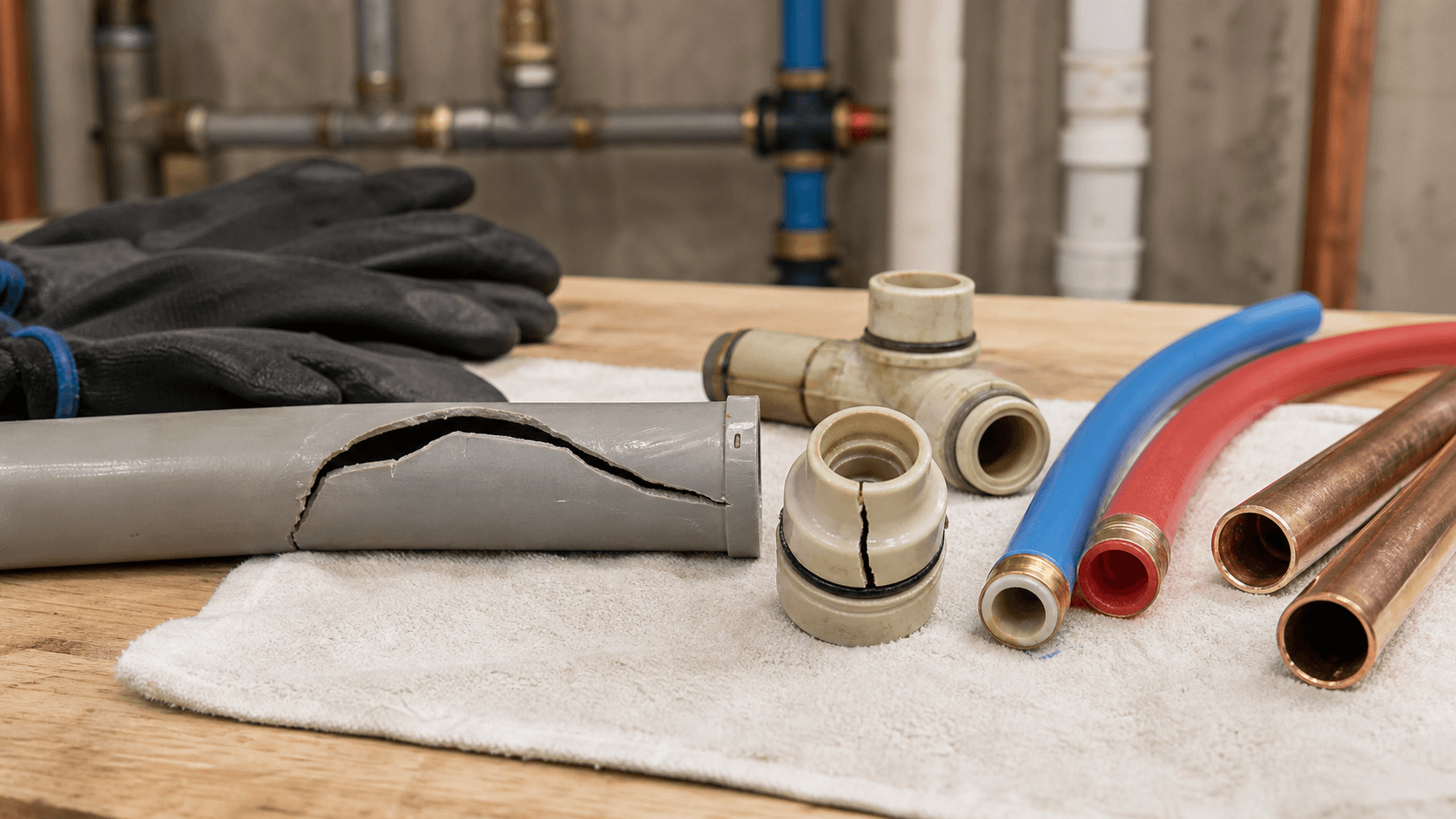
The problem is that polybutylene degrades in normal use, and the culprit is the very water it carries. Chlorine and other oxidants that municipal utilities add to disinfect drinking water attack the polybutylene from the inside, breaking down the plastic over time. The pipe loses its flexibility, becomes brittle, and develops microscopic flaking and cracking on its inner wall, which propagates until the pipe fails — often without warning and not necessarily at a visible spot.
The fittings make it worse. Polybutylene systems were frequently assembled with plastic acetal fittings, and those fittings are themselves prone to cracking and failure, so a polybutylene system has two failure points — the pipe and the connectors — both degrading under the same chlorinated water. The combination is why polybutylene gained its reputation: it is not that it leaks occasionally, but that the whole system is on a path toward unpredictable failure as the chemistry does its work.
The result is a pipe that cannot be trusted to a normal service life, even though it may look fine from the outside. Polybutylene that has been carrying chlorinated water for decades is brittle on the inside whether or not it has leaked yet, and a system can fail at the pipe or at a fitting, anywhere along its length, with little warning. That unpredictability — failures scattered through the system rather than confined to one identifiable weak point — is the core of why it is treated the way it is.
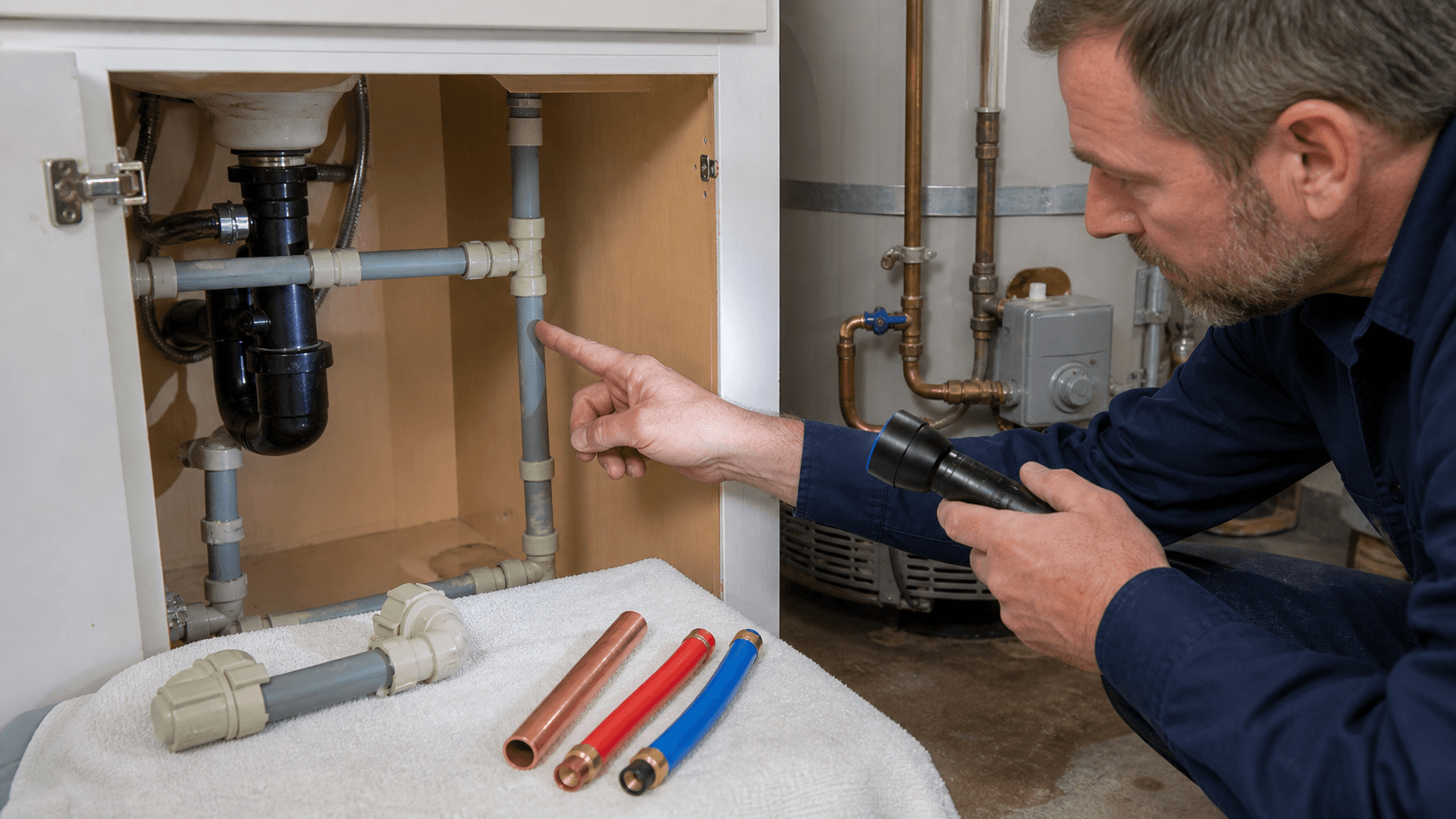
Polybutylene identification starts at exposed supply runs, fixture stub-outs, and the water heater.
This happening in your home right now? A licensed plumber can talk you through the next step on the phone — 24/7, and the call is free.
Look for gray or blue plastic pipe, usually half-inch to one-inch, stamped "PB2110," at the water heater, where the main enters, at the meter, and at fixture stub-outs under sinks and behind toilets.
Identifying polybutylene is usually a matter of looking in the right places, because the pipe is distinctive once you know what to look for. It is plastic, most often gray (sometimes blue, occasionally black for the buried service line), flexible, and typically half-inch to one-inch in diameter for residential supply. The clinching detail is the stamp: polybutylene supply pipe is generally marked "PB2110" along its length, and that code is the most reliable single identifier.
The best places to look are where supply pipe is exposed. Check at the water heater, where the hot and cold lines connect; at the point where the main water line enters the house; near the water meter; and at the fixture stub-outs — the short lengths of pipe coming out of the wall under sinks, behind toilets, and at the washing machine connection. In a home with an unfinished basement or crawlspace, runs of the pipe may be visible overhead as well.
Seeing gray or blue plastic pipe in those spots, especially with the "PB2110" stamp, is strong evidence the home is plumbed with polybutylene — though it is worth confirming throughout, because a home can have a mix if it was partially replumbed. Polybutylene is sometimes confused with other plastics, but the color, the flexibility, and above all the stamp distinguish it; PEX, the modern flexible plastic that replaced it, is marked differently and is usually red, blue, or white.
The age of the home is a useful prompt for where to look. A house built, or significantly replumbed, between 1978 and 1995 is exactly the era in which polybutylene was installed, so an inspection of the supply lines is worth doing on any home from that window. Finding it is the first step; what to do about it follows, but a home of the right age with gray or blue "PB2110" pipe at the water heater and stub-outs almost certainly has polybutylene to deal with.
Is there still a polybutylene lawsuit I can claim?
No. Cox v. Shell settled for about $950 million in 1995 and a related Spencer settlement around $120 million, but the claim window closed around 2009 — so owners now bear the replacement cost.
There was a time when polybutylene replacement could be funded by a class-action settlement, but that time has passed. The major case, Cox v. Shell Oil, produced a settlement of roughly $950 million in 1995 — one of the largest property-damage class actions of its era — created to compensate homeowners for replacing failing polybutylene systems. A related settlement, often referred to in connection with the Spencer case, added on the order of $120 million more for certain claims.
Those settlements paid out for a defined period, but they were not open-ended. The claim window for the polybutylene settlements closed around 2009, after which no new claims could be filed. That means the funds that once helped homeowners pay to replace polybutylene are no longer available, and the legal avenue that existed in the 1990s and 2000s is closed to anyone discovering the pipe today.
The practical consequence is straightforward and important: a homeowner who finds polybutylene now bears the cost of replacing it themselves. There is no active fund to claim against and no manufacturer program still paying for repipes, so the expense of a replacement falls on the owner. This is part of why polybutylene is such a significant find during a home purchase — the buyer inherits both the pipe and the eventual cost of dealing with it, with no settlement to offset it.
It is worth being skeptical of any service that claims to still file polybutylene settlement claims, given that the window closed around 2009. The realistic posture for a homeowner today is to treat polybutylene as a current liability to plan and budget for, not as a potential claim to recover on. The money question is no longer whether a settlement will pay for the repipe but how and when to do the replacement that insurers and inspectors increasingly expect.
Polybutylene failures are system-wide, so replacement usually beats patching one spot.
Do I have to replace polybutylene?
Practically, yes. Because failures are unpredictable and happen throughout the system rather than at one spot, insurers and home inspectors treat polybutylene as a liability and generally call for a full repipe rather than a patch.
Strictly, no law forces a homeowner to rip out polybutylene that has not failed — but in practice the pressure to replace it is strong and comes from several directions. The fundamental reason is the nature of the failure: polybutylene degrades throughout the system and fails unpredictably, at the pipe or at a fitting, anywhere along its length. That means there is no single weak spot to patch and no reliable way to know which section will go next, so spot repairs do not solve the underlying problem.
Insurance is the most concrete pressure. Many insurers treat polybutylene as a known liability and may decline to write a policy on a home that has it, charge more, or require its replacement as a condition of coverage. Because a homeowner needs insurance, an insurer's refusal or condition effectively forces the repipe regardless of whether the pipe has leaked yet — the carrier is pricing in the unpredictable system-wide failure that defines the material.
Home inspectors and the resale market apply the same pressure. A pre-sale inspection routinely flags polybutylene, and a flagged repipe becomes a negotiating point or a deal condition, with buyers reluctant to take on a known future expense and a known insurance problem. So even a homeowner content to live with their pipe runs into it at the point of sale, where the pipe depresses value or has to be replaced to close.
Given all that, the realistic answer is that polybutylene is treated as a replace-it material rather than a maintain-it one. The combination of unpredictable, system-wide failure, insurer reluctance, and inspection flags means a full repipe is the expected resolution, not a series of patches. Planning that replacement on your own timeline — before a failure, an insurance problem, or a sale forces it — is generally the better position, and it is the kind of supply-line work handled as leak detection and pipe repair in Bellevue.
What replaces polybutylene?
A full repipe in modern PEX or copper. PEX is the flexible, freeze-tolerant plastic that succeeded polybutylene; copper is the rigid, long-proven metal. Both are durable in chlorinated municipal water in a way polybutylene is not.
Replacing polybutylene means a repipe of the home's water-supply lines in a modern material, and the two standard choices are PEX and copper. PEX — cross-linked polyethylene — is the flexible plastic that effectively succeeded polybutylene, but it is a fundamentally different and more durable material, engineered to resist the chlorine attack that destroys polybutylene and to tolerate freezing better than rigid pipe. Copper is the long-established rigid metal option, proven over many decades of service.
PEX has become the common choice for repipes for several reasons. It is flexible, so it can often be routed through walls and ceilings with less demolition than rigid pipe, it resists the oxidant degradation that doomed polybutylene, and it handles freeze-thaw stress better than copper because it can expand somewhat rather than splitting. For a whole-house repipe out of polybutylene, PEX usually offers a faster, less invasive, and cost-effective path while solving the chlorine-failure problem that prompted the work.
Copper remains a valid and durable alternative, with its own strengths — a very long track record, rigidity, and resistance to the kinds of damage that affect plastics — though it costs more and is more labor-intensive to install. The choice between PEX and copper for a given home comes down to budget, the routing and demolition involved, and homeowner preference, and the tradeoffs are laid out in our PEX versus copper guide.
Whichever material is chosen, the point of the repipe is the same: to get the home off a material that fails unpredictably under chlorinated water and onto one that does not. Both PEX and copper are durable in the municipal water that destroys polybutylene, so either ends the system-wide failure risk and the insurance and resale problems that come with the old pipe. A polybutylene repipe in PEX or copper is supply-line work handled as leak detection and pipe repair in Bellevue.
The Bellevue angle: chlorinated water and pre-sale inspections
Polybutylene matters most for Bellevue homes built or replumbed 1978 to 1995. Chlorinated municipal water drives the failure, and pre-sale inspections in the Eastside market routinely flag the pipe as a repipe condition.
For Bellevue and the Eastside, polybutylene is a concern concentrated in a specific slice of the housing stock: homes built, or significantly replumbed, between 1978 and 1995. That window matches both the era polybutylene was installed and a period of substantial growth and renovation in the area, so a meaningful number of local homes from those years can have it. A homeowner or buyer dealing with a house from that range has reason to check the supply lines specifically for gray or blue "PB2110" pipe.
The local water supply is exactly the kind that drives polybutylene failure. Bellevue is served by chlorinated municipal water, and it is the chlorine and other oxidants in that treated water that attack polybutylene from the inside, making it brittle and crack-prone over time. There is nothing unusual about Bellevue's water in this respect — it is properly disinfected drinking water — but disinfected municipal water is precisely what polybutylene cannot tolerate, so the local supply ensures the pipe degrades on schedule.
The resale market is where the issue most often comes to a head. The Eastside is an active, high-value housing market with thorough pre-sale inspections, and a home inspection routinely identifies and flags polybutylene as a defect, because inspectors know the failure history and the insurance implications. A flagged polybutylene system becomes a negotiating point or a condition of sale, and buyers commonly require a repipe or a price adjustment before closing on an affected home.
So for a Bellevue homeowner, the practical reality is that polybutylene from the 1978-to-1995 window, sitting in chlorinated municipal water, is both degrading and likely to surface at the next sale. Addressing it proactively — confirming whether the home has it, and planning a PEX or copper repipe on your own timeline rather than under the pressure of a failure or a pending sale — is the stronger position, and the repipe is handled as leak detection and pipe repair in Bellevue.
Common questions about polybutylene pipe
Look for gray or blue "PB2110" pipe at the water heater and stub-outs; it was used 1978 to 1995; chlorine degrades it; the lawsuit window closed around 2009; insurers push a full PEX or copper repipe.
You know you have polybutylene by finding gray or blue flexible plastic pipe, usually half-inch to one-inch and stamped "PB2110," at the water heater, where the main enters, at the meter, and at fixture stub-outs under sinks and behind toilets. It was installed in homes built or replumbed between roughly 1978 and 1995, so a house from that era is the prompt to look. The "PB2110" stamp is the most reliable identifier, since the pipe can otherwise be confused with other plastics.
Polybutylene fails because the chlorine and oxidants in municipal water attack it from the inside, making the plastic brittle and prone to flaking and cracking, while its acetal fittings crack as well — so failures happen unpredictably throughout the system rather than at one spot. No, you generally cannot still claim the lawsuit: Cox v. Shell settled for about $950 million in 1995 and a related Spencer settlement around $120 million, but the claim window closed around 2009, so the cost now falls on the homeowner.
Practically, yes, you have to replace it, even though no law compels it for unfailed pipe. Because the failures are system-wide and unpredictable, insurers often decline, surcharge, or condition coverage on its removal, and home inspectors flag it at resale — so a full repipe, not a patch, is the expected resolution. Spot-fixing one leak does nothing about the rest of a system that is degrading everywhere, which is why the whole-house repipe is the standard answer.
What replaces polybutylene is a full repipe in modern PEX or copper, both of which are durable in the chlorinated municipal water that destroys polybutylene. PEX is the flexible, freeze-tolerant, chlorine-resistant plastic that succeeded it and is the common repipe choice; copper is the rigid, long-proven metal alternative, with the tradeoffs covered in our PEX versus copper guide. Does insurance cover replacing it? Usually not as a claim — carriers more often treat it as a condition of coverage than a covered loss. A polybutylene repipe is handled as leak detection and pipe repair in Bellevue.
Sources
Every fact in this guide cites a verifiable public source. If you find a number we got wrong, email dispatch@bellevueplumberpro.com.
Need help with this in your home? See our Whole-house repiping in Bellevue page for pricing, our diagnostic process, and how same-day service works across the Eastside.
Look for gray or blue plastic supply pipe, usually half-inch to one-inch, stamped "PB2110" — at the water heater, where the main enters, at the meter, and at fixture stub-outs under sinks. It was installed roughly 1978 to 1995.
QUESTION02
Is there still a polybutylene lawsuit settlement?
No. Cox v. Shell settled for about $950 million in 1995, but the claim window closed around 2009 — owners today bear the full replacement cost themselves, typically a whole-house PEX repipe.