Home/Learn/Water quality/Hard water in Bellevue and the Eastside: hardness, effects, softener payoff
Water quality
Hard water in Bellevue and the Eastside: hardness, effects, softener payoff
Bellevue municipal water tests at approximately 25.7 mg/L calcium carbonate, or 1.50 grains per gallon. That puts it firmly in the SOFT classification by US Geological Survey and Water Quality Association standards. The Cedar and Tolt River watersheds that supply most of the Eastside produce water in the 20-to-60 ppm range — soft to the low end of moderately hard. Well-water areas in parts of Sammamish and Issaquah run slightly to moderately hard (55-68 mg/L). The honest answer for most Bellevue homeowners: you do not need a whole-house water softener, and the marketing claims that you do are usually wrong. This guide explains what hardness actually does to water heaters and fixtures, why Eastside hardness levels are at the low end of US averages, when a softener does make economic sense, and the alternatives (filtration, point-of-use treatment) that may serve your specific situation better. If you do decide to soften, our [water softener installation cost calculator](/tools/water-softener-installation-cost-calculator/) estimates the install for Eastside homes.
How hard is Bellevue's water — the verified numbers
Bellevue's municipal water averages 25.7 mg/L (about 1.50 grains per gallon) of calcium carbonate hardness. That's SOFT by US Water Quality Association and US Geological Survey classification standards.
Hardness is measured in two units: milligrams per liter (mg/L) of calcium carbonate equivalent, and grains per gallon (gpg) where 1 grain = 17.1 mg/L. Both are reported by water utilities and softener equipment makers; converting between them is just multiplication.
The water-hardness classification system used by the US Water Quality Association and US Geological Survey:
Bellevue municipal water at 25.7 mg/L (1.50 grains/gallon) sits comfortably in the SOFT category, well below the moderately-hard threshold. This is exceptionally low hardness by US standards. The national US drinking water average is approximately 120 mg/L (7 grains/gallon) — five times harder than Bellevue's water.
The two source watersheds — Cedar River (serving Enatai, Somerset, Woodridge, and Meydenbauer neighborhoods of Bellevue) and Tolt River (serving most other Bellevue areas) — produce raw water in the 20-to-60 ppm CaCO3 range. After treatment and minor pH adjustment, the delivered hardness varies slightly month-to-month but stays in the soft-to-low-moderate range year-round.
Other Eastside municipal water served by Cascade Water Alliance or Seattle Public Utilities pulls from the same two source watersheds and has comparable hardness. Kirkland, Redmond, and most of Bellevue, Issaquah, and Sammamish on municipal connections are all in this soft-water range.
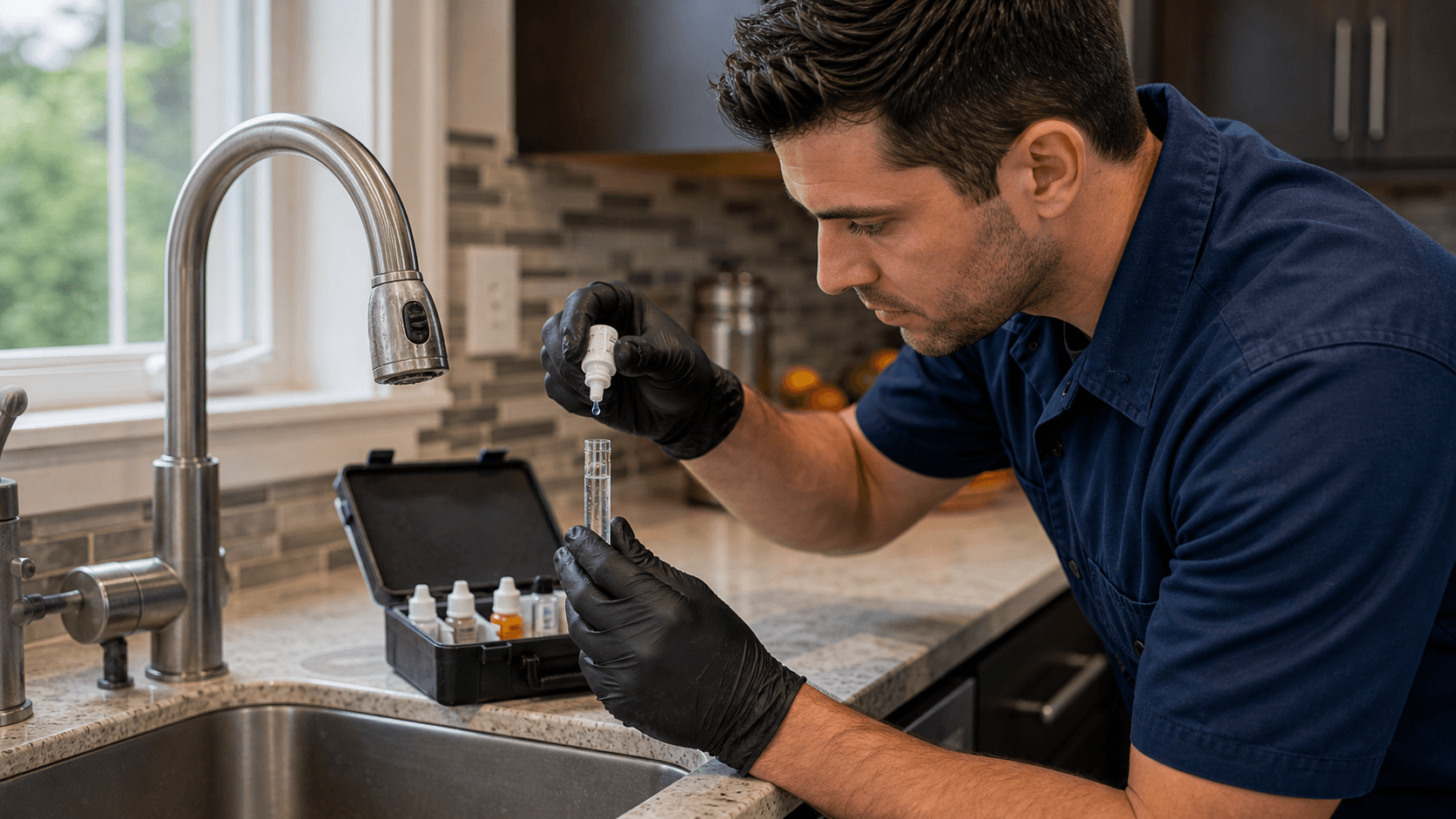
A simple hardness test separates real mineral-scale issues from guesses based on taste or spotting alone.
This happening in your home right now? A licensed plumber can talk you through the next step on the phone — 24/7, and the call is free.
Where Eastside water actually gets harder — wells, not city water
Private wells and small water districts in rural Sammamish, Issaquah, and Woodinville pull from groundwater rather than the Cedar/Tolt rivers. Documented hardness in these systems runs 55 to 68 mg/L (3.2-4.0 grains/gallon) — slightly to moderately hard, but still well below US averages.
King County data on the Northeast Sammamish Sewer and Water District documents two distinct hardness levels in well water: wells in the Evans Creek Valley test at 55 mg/L (slightly hard), while wells on the plateau test at 68 mg/L (moderately hard). Both are higher than Bellevue municipal water, but neither approaches the hardness levels that cause significant scale problems.
Other Eastside well-water situations: parts of rural Sammamish, the eastern edges of Issaquah outside city water service, parts of Woodinville's wine country side, and isolated rural Bellevue properties on private wells. If your home was built on agricultural land or in a developed-since area outside city water service, check your water source — you may be on a well rather than municipal. The source-water breakdown for Bellevue and the Eastside is in our where Bellevue's water comes from guide.
How to find out: your water bill is the fastest indicator. If you receive a bill from City of Bellevue Utilities, Cascade Water Alliance, or another municipal/CWA-affiliated provider, you're on municipal water at Bellevue's soft hardness. If you have no water bill, you're on a private well. Small water districts (NE Sammamish, Sahalee, Issaquah Creek) sit between the two — they're providers, but they typically pull from local groundwater rather than the Cascade rivers.
If you suspect well water, a basic hardness test from any hardware store costs $10-$20 and tells you your specific number. Water Quality Association laboratories will do a more comprehensive panel for $50-$150 that also tests for iron, manganese, pH, and bacteria.
What hardness actually does to water heaters and appliances
Hardness affects appliances proportionally to its level. At Bellevue's 1.50 grains/gallon, scale buildup is slow and modest — most homeowners notice nothing for 8 to 10 years. At 5+ grains/gallon (above moderately-hard threshold), scale builds fast enough to materially shorten water heater life and reduce dishwasher and washing machine efficiency.
The mechanism: when hard water is heated, dissolved calcium and magnesium carbonates precipitate out of solution and deposit on hot surfaces. Inside a water heater, that means a layer of mineral scale forms on the heating element (electric) or tank bottom (gas), insulating it from the water.
Documented effects at higher hardness levels (relevant to private well users, not Bellevue municipal):
Energy efficiency loss. Scale layers as thin as 1.5mm on a water heater heating element can increase energy consumption by 12 to 30%. The element runs hotter and longer to compensate.
Water heater lifespan reduction. The Water Quality Association has documented water heater failure in as few as 6 years in hard water areas, compared to the 8-12 year normal lifespan. Most of the reduction comes from accelerated tank corrosion at scaled-over areas.
Tankless heat exchanger damage. Tankless units have narrow passages where any scale buildup hits performance fast. Without descaling, tankless lifespan can drop from 20 years to 12 — the full decision guide for [tankless vs storage water heaters in Bellevue](/learn/water-heaters/tankless-vs-storage-bellevue/) covers when each option wins given Eastside water chemistry and household draw patterns.
Appliance efficiency. Dishwashers and washing machines use 30 to 50% more detergent in hard water. Heating elements in dishwashers scale up over time, reducing their drying performance.
Visible deposits. White crusting on faucet aerators, shower heads, fixtures, and tile grout. Glass shower doors etch permanently from minerals deposited as water dries.
At Bellevue's actual hardness (1.50 grains/gallon), these effects are present but modest. A typical Bellevue tank water heater fails at 10-12 years from anode rod consumption and tank corrosion — same as any city. Tankless units in Bellevue benefit from annual descaling but don't need the 6-month descaling cycle marketing suggests. Dishwashers and washing machines run at near-published efficiency.
The marketing trick to watch for: water-softener salespeople often quote hardness in 'parts per million' (mg/L) rather than grains per gallon because the number sounds bigger. 23.5 'parts per million' sounds significant. The same value expressed as 1.50 grains per gallon sounds appropriately small. Both numbers are correct; the framing is the deception.
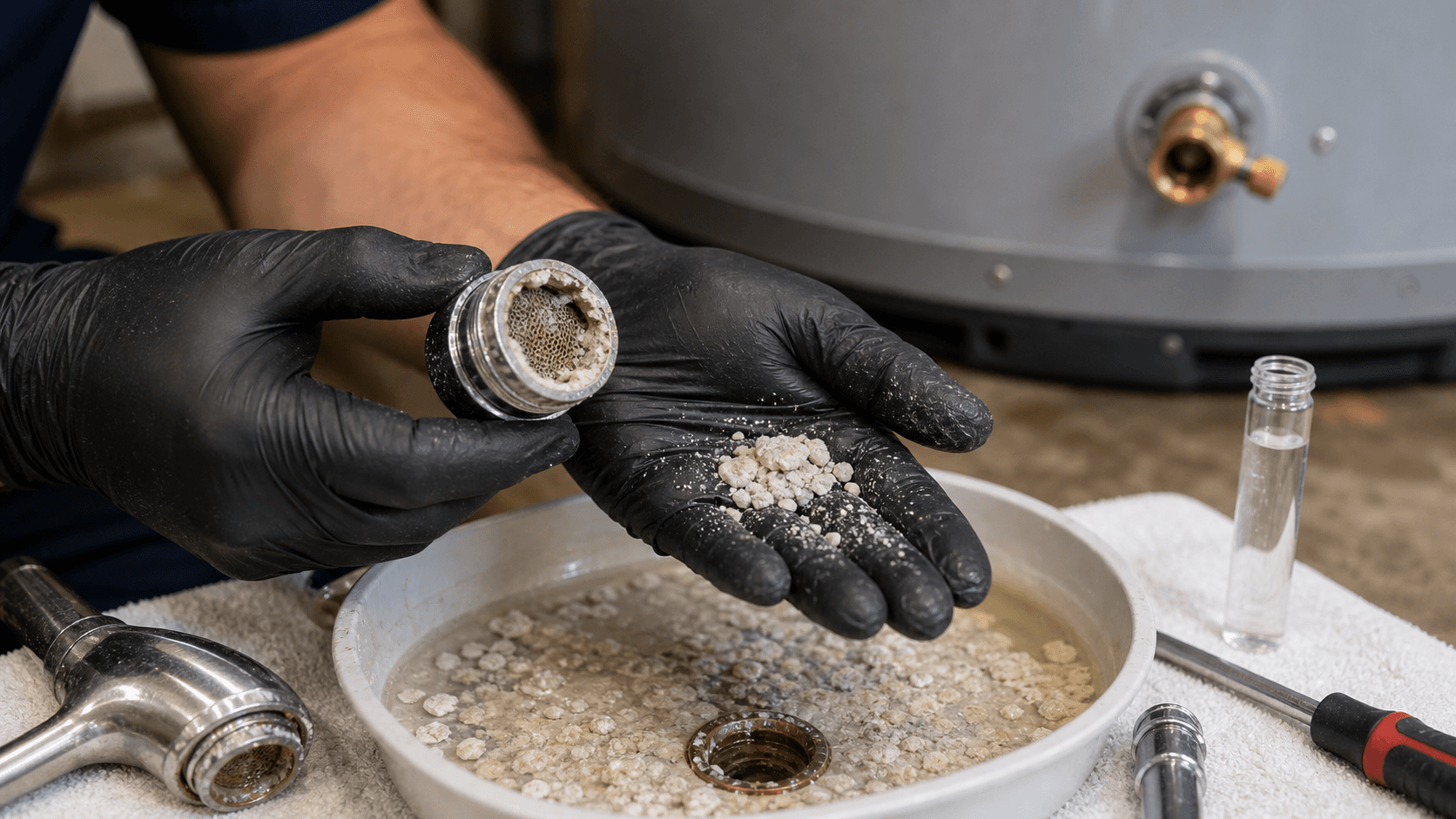
Mineral buildup at aerators and water-heater drains is the practical signal that hardness is affecting fixtures.
When a whole-house water softener actually pays for itself
A whole-house water softener pays back its cost in 5 to 8 years if you're on well water hardness of 5+ grains/gallon. On Bellevue's 1.50 grains/gallon municipal water, the payback window typically exceeds 20 years — beyond the softener's own service life. Softeners are rarely cost-effective for Bellevue municipal customers.
Softener costs in 2026 (Seattle metro range):
Salt-based ion-exchange softener (the standard type): $1,200-$3,800 for equipment, $500-$3,000 for installation. Total typical installed cost: $2,000-$5,000.
Salt-free conditioner (template-assisted crystallization): $500-$3,000 equipment, similar installation. Doesn't actually remove hardness, just changes how minerals behave — limited effectiveness for water heater scale prevention.
Magnetic or electronic descaler: $200-$600 equipment, minimal installation. Effectiveness is contested in the plumbing-industry literature; many independent tests show no measurable benefit.
Ongoing costs for salt-based: $30-$80 per year in salt, electricity for the regeneration cycle, and water consumed during regeneration (a softener uses about 50-75 gallons per regeneration cycle).
Payback calculation for Bellevue municipal water: at 1.50 grains/gallon, a softener removes a small amount of hardness from soft water. The savings come from slightly extended appliance life (5-10% gain on tankless and water heaters), slightly reduced detergent use (5-15%), and aesthetic improvements (less fixture deposits). For a typical household, those savings total maybe $50-$100 per year. A $3,000 softener pays back in 30-60 years — longer than the softener will last.
Payback calculation for well-water households at 5-7 grains/gallon: the same softener now removes meaningful hardness. Energy savings on water heating run $50-$150/year. Appliance life extension adds another $100-$200/year amortized over their lifespan. Detergent savings $50-$100/year. Total: $200-$450/year, payback in 7-15 years. Worth doing if you'll own the home that long.
The honest answer for most Bellevue municipal customers: skip the softener. If a hardness-related issue annoys you (shower door etching, fixture deposits), spot solutions are cheaper and more targeted. A point-of-use filter at the kitchen sink for drinking water costs $30-$200. A regular dishwasher rinse-aid eliminates spotting. A squeegee on the shower door after every shower prevents etching.
Spot solutions when full softening isn't worth it
For Bellevue homeowners who want to address specific hardness annoyances without the full cost of a whole-house softener: point-of-use filters at the kitchen sink, dishwasher rinse-aid for spotting, shower-door squeegee for glass etching, and routine water heater maintenance (annual flush) address the issues at a fraction of the softener cost.
Point-of-use filter at kitchen sink. A countertop or under-sink filter ($30-$200) reduces hardness, chlorine, and sediment at the tap where you drink and cook. Doesn't affect anything else in the house, but solves the actual taste-and-cooking concern most homeowners have. NSF/ANSI 53-certified filters are the right specification.
Dishwasher rinse-aid. Spotting on glasses is a hardness artifact. Liquid rinse-aid ($5-$10 per bottle, lasts months) eliminates it without changing your water. Most dishwasher manufacturers include rinse-aid dispensers in the door.
Shower-door squeegee. A $5 squeegee used after every shower prevents glass etching far more effectively than a softener — and doesn't add salt to your wastewater.
Annual water heater flush. Drain a few gallons from the bottom drain on your tank water heater once a year. Removes sediment and slows the corrosion that actually kills tanks. Free if you DIY, $95-$150 if a plumber does it.
Annual tankless descaling. If you have a tankless, follow the manufacturer's annual descaling procedure. DIY costs about $30 in vinegar or descaling solution; plumber service runs $150-$250. Annual cadence is appropriate for Bellevue's soft municipal water; semi-annual for well-water households.
What about health — is softened water bad for you?
Standard salt-based softeners add small amounts of sodium to softened water — relevant only for people on strict sodium-restricted diets. The American Heart Association notes that softened water can add 12-300 mg of sodium per liter depending on the original hardness, which is small relative to dietary sources but worth noting for those on medical sodium restrictions.
A salt-based softener works by ion exchange: calcium and magnesium ions in the water are swapped for sodium ions from the softener's salt reservoir. The water becomes 'softer' (no calcium/magnesium to form scale) but slightly higher in sodium.
For most homeowners, this is irrelevant. The amount of sodium added by softening Bellevue-level water is trivial — at 1.50 grains/gallon, the sodium increase is roughly 15 mg/liter, less than is in a single saltine cracker. Even at 7 grains/gallon, the increase is 60 mg/liter — still small compared to the 1,500-2,300 mg recommended daily sodium intake.
For people on strict sodium-restricted medical diets (typically 1,000-1,500 mg/day for severe hypertension or heart-failure patients), the recommendation is either potassium-chloride softener salt (works the same way but adds potassium instead of sodium, with comparable health profile) or a separate non-softened cold water tap at the kitchen sink for drinking and cooking.
Some homeowners also note that softened water 'feels different' — slightly slippery in the shower. This is a real perception; soft water doesn't strip soap as efficiently as hard water, so soap residue lingers longer on skin. Some people prefer it; some don't.
The honest recommendation for Bellevue homes
If you're on Bellevue municipal water (Cedar or Tolt River source), you don't need a whole-house softener. Spot solutions handle the minor hardness annoyances at 5% of the cost. If you're on private well water with documented hardness above 5 grains/gallon, a softener can pay back in 5-10 years and is worth considering.
Three questions to answer before spending money on water treatment:
What's your actual water source? Municipal Bellevue/CWA water is soft. Private well water varies widely.
What hardness number does a test show? Get an actual measurement, not a marketing-pitch estimate. Hardware-store test strips for $10 tell you within 10%.
What problem are you actually trying to solve? Spotting on glassware, dry skin, fixture deposits, shorter water heater life — different problems have different solutions.
If a water-treatment salesperson tries to sell you a whole-house softener for Bellevue municipal water without first showing you a hardness test result from your home, you're being upsold. Walk away. The honest math doesn't support the purchase.
Sources
Every fact in this guide cites a verifiable public source. If you find a number we got wrong, email dispatch@bellevueplumberpro.com.
Need help with this in your home? See our Water heater repair in Bellevue, WA page for pricing, our diagnostic process, and how same-day service works across the Eastside.
— Bridge to service
We dispatch for this across Redmond, Kirkland, and Somerset — see your neighborhood page for local response times and recent jobs.
Hard water in Bellevue and the Eastside — questions homeowners ask
QUESTION01
Is Bellevue water hard or soft?
Soft. Bellevue's municipal water averages about 1.50 grains per gallon of calcium carbonate — well under the ~3.5 gpg USGS threshold for soft water. Scale builds so slowly here that most homeowners notice nothing for 8 to 10 years.
QUESTION02
Is Eastside well water hard?
Outside the city system, yes — private wells and small districts in rural Sammamish, Issaquah, and Woodinville pull groundwater with documented hardness around 3.2–4+ grains per gallon, moderate enough to matter for tankless descaling and dishwasher performance.