What is a backflow preventer?
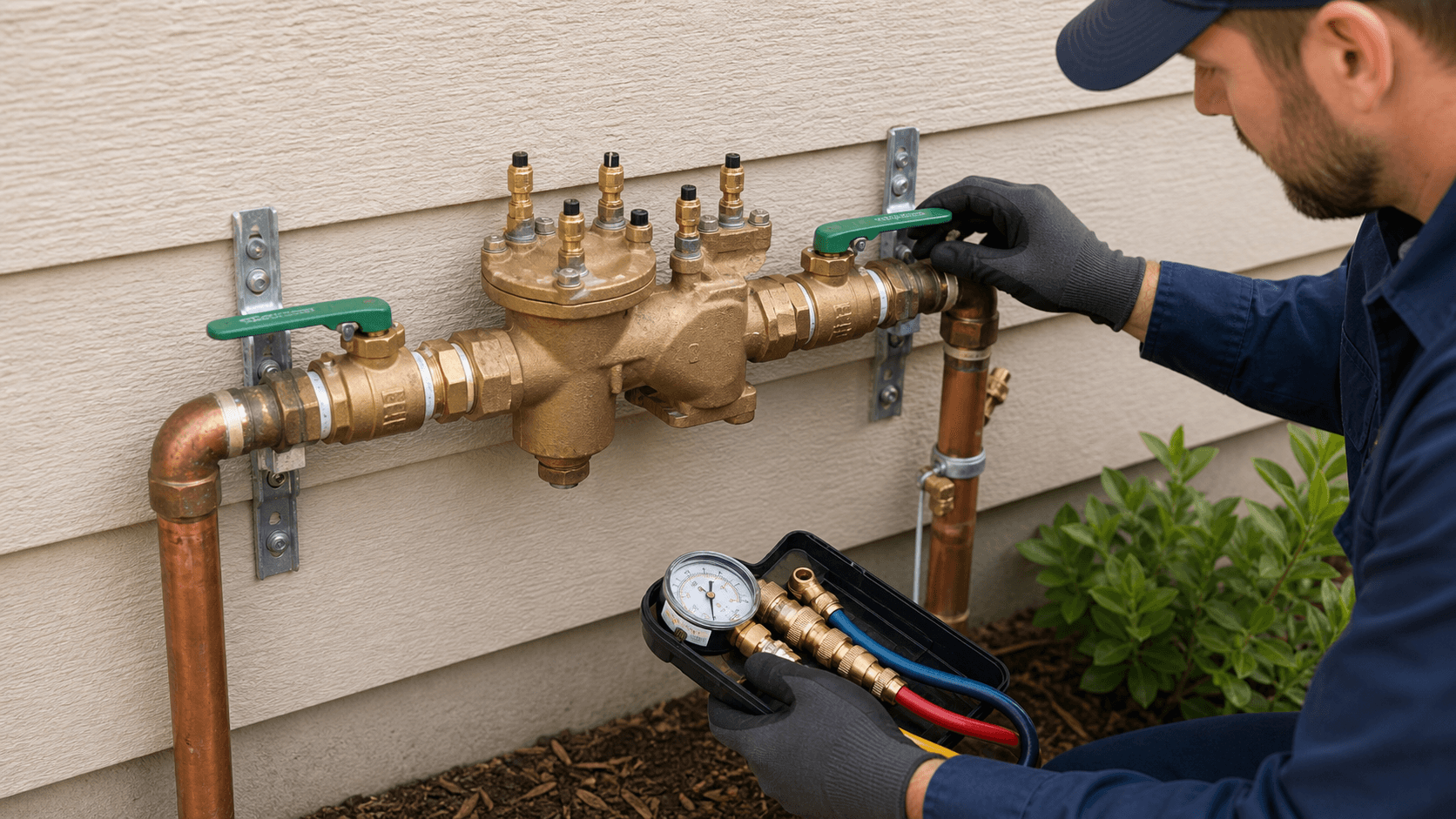
An assembly that stops contaminated water from being siphoned back into the public drinking-water supply through a cross-connection — required on irrigation systems, boilers, and other hazard connections.
A backflow preventer is an assembly that stops contaminated water from being drawn back into the public drinking-water supply through a cross-connection, and the framework behind it traces to the federal Safe Drinking Water Act of 1974. In Washington the central rule is mandatory annual testing: under WAC 246-290-490, subsection 7(b), an approved backflow assembly must be tested at the time of installation, repair, or relocation and at least annually thereafter, and the City of Bellevue's water utility tracks due dates and can shut off water for non-compliance. Only a state-certified Backflow Assembly Tester (BAT) — certified under WAC 246-292-034 through Washington Certification Services at Green River College — may perform the test; it is not a DIY task and not a default general-plumber duty, so a homeowner arranges the test and a certified BAT performs it. The common assemblies are the reduced-pressure (RPZ) assembly, the double-check valve assembly, and the pressure-vacuum breaker, matched to the hazard level. Common triggers are irrigation sprinklers, fire-sprinkler systems, and commercial connections. This guide covers what the device is, the annual-testing law, who can test, assembly types, hazard matching, what triggers a requirement, the compliance logic, and the test fee.
Last reviewed: 2026-06-04
A backflow preventer is an assembly that stops contaminated water from being siphoned back into the public drinking-water supply through a cross-connection; the framework traces to the Safe Drinking Water Act of 1974.
A backflow preventer is a mechanical assembly installed on a water line to keep water flowing in one direction only — from the public supply into the property — and to block it from reversing back into the drinking-water system. Backflow is the unwanted reversal of flow, and it happens when the pressure relationship that normally pushes water into a building flips, allowing water that has been used or exposed to contaminants to be drawn or pushed back toward the potable supply. The preventer's job is to stop that reversal at the cross-connection where it could occur.
A cross-connection is the point that creates the risk: any actual or potential connection between the potable water supply and a source of contamination. An irrigation system in contact with soil and fertilizer, a boiler with treatment chemicals, a commercial process line — each is a place where non-potable water meets the drinking-water system, and each is a cross-connection that a backflow preventer is installed to protect. Cross-connection control is the broader discipline of finding these connections and protecting them.
Backflow occurs by two mechanisms, and the assembly is designed to stop both. Back-siphonage happens when supply pressure drops — a main break, heavy fire-flow demand, or a nearby hydrant use — creating a suction that can pull contaminated water back through a cross-connection. Backpressure happens when a downstream system, such as a pump or boiler, produces a pressure higher than the supply and pushes its water back toward it. A proper assembly holds the line against whichever mechanism the situation can produce.
The regulatory framework behind all of this traces to the federal Safe Drinking Water Act of 1974, which established the protection of public drinking-water supplies as national policy and led to the state and local cross-connection-control programs that require and govern backflow assemblies today. In Washington that framework is implemented through the state's administrative code and the local water purveyor's program, which together make backflow prevention a legal requirement rather than an optional safeguard — the subject of the next sections.
This happening in your home right now? A licensed plumber can talk you through the next step on the phone — 24/7, and the call is free.
Call a plumberYes. Under WAC 246-290-490, subsection 7(b), an approved backflow assembly must be tested at installation, repair, or relocation and at least annually thereafter — and Bellevue's utility can shut off water for non-compliance.
Annual testing is the law in Washington, not a recommendation. WAC 246-290-490 governs cross-connection control for public water systems, and subsection 7(b) requires that an approved backflow prevention assembly be tested at the time it is installed, repaired, or relocated, and at least once a year thereafter. The annual interval is a regulatory minimum tied to the fact that these assemblies have internal seals and check mechanisms that can wear and fail silently, so the test verifies each year that the assembly still actually stops backflow.
The reason the rule is annual is mechanical. A backflow assembly relies on spring-loaded checks and, in the case of a reduced-pressure assembly, a relief valve, and those moving parts can wear, foul, or stick over time without any outward sign that protection has been lost. A test pressurizes the assembly and confirms each check holds and the relief valve operates, which is the only way to know the device is still doing its job — hence the requirement to test it every year rather than install it and forget it.
Enforcement runs through the local water purveyor, which in Bellevue is the city's water utility. The utility maintains a cross-connection-control program that tracks which connections have assemblies, when each was last tested, and when the next annual test is due, and it notifies customers of upcoming or overdue tests. Because the purveyor is responsible to the state for the integrity of its system, it has real enforcement authority — including the ability to shut off water service to a connection whose required backflow test is overdue and not brought current.
For a property owner the practical meaning is a recurring obligation with a hard deadline. An assembly is not a one-time install; it carries an annual test that must be performed and the results reported to the utility, and missing it risks a shutoff. Keeping the test current each year, performed by the right person and reported to the City of Bellevue, is what keeps the connection compliant — and arranging it through water main repair in Bellevue ties the assembly to the supply line it protects.
Only a state-certified Backflow Assembly Tester (BAT) may test one — certified under WAC 246-292-034 via Washington Certification Services at Green River College. It is not a DIY task or a default general-plumber duty.
Testing a backflow assembly is a restricted activity in Washington: only a certified Backflow Assembly Tester, or BAT, may legally perform the required test. The certification is established under the state's administrative code — WAC 246-292-034 governs the BAT certification — and it exists because a valid test requires both specialized test equipment and the trained judgment to interpret the readings and confirm each check and relief valve is performing to standard. A test by an uncertified person does not satisfy the requirement.
The certification path runs through Washington Certification Services, administered at Green River College, which provides the examination and credential for backflow assembly testers in the state. A BAT must pass that certification to be recognized by water purveyors as qualified to test assemblies and report results, and the purveyor's program will only accept test reports from a credentialed tester. The credential is what links a valid test to the regulatory system that tracks and enforces it.
This is explicitly not a do-it-yourself task. The required test is not something a homeowner can perform with household tools, both because it needs calibrated test gear and because only a certified tester's report is accepted by the utility — a homeowner checking the assembly themselves does not produce a compliant test. The owner's role is to arrange the test on schedule, not to perform it.
It is also not a default duty of any general plumber. While some plumbers hold the BAT certification, holding a plumbing license does not by itself make someone a certified backflow tester, so the test must be arranged with someone who specifically holds the BAT credential. The clean division of roles is that the property owner arranges the annual test and a state-certified BAT performs it and files the report. Coordinating that, alongside any work on the supply line itself, is handled through water main repair in Bellevue.
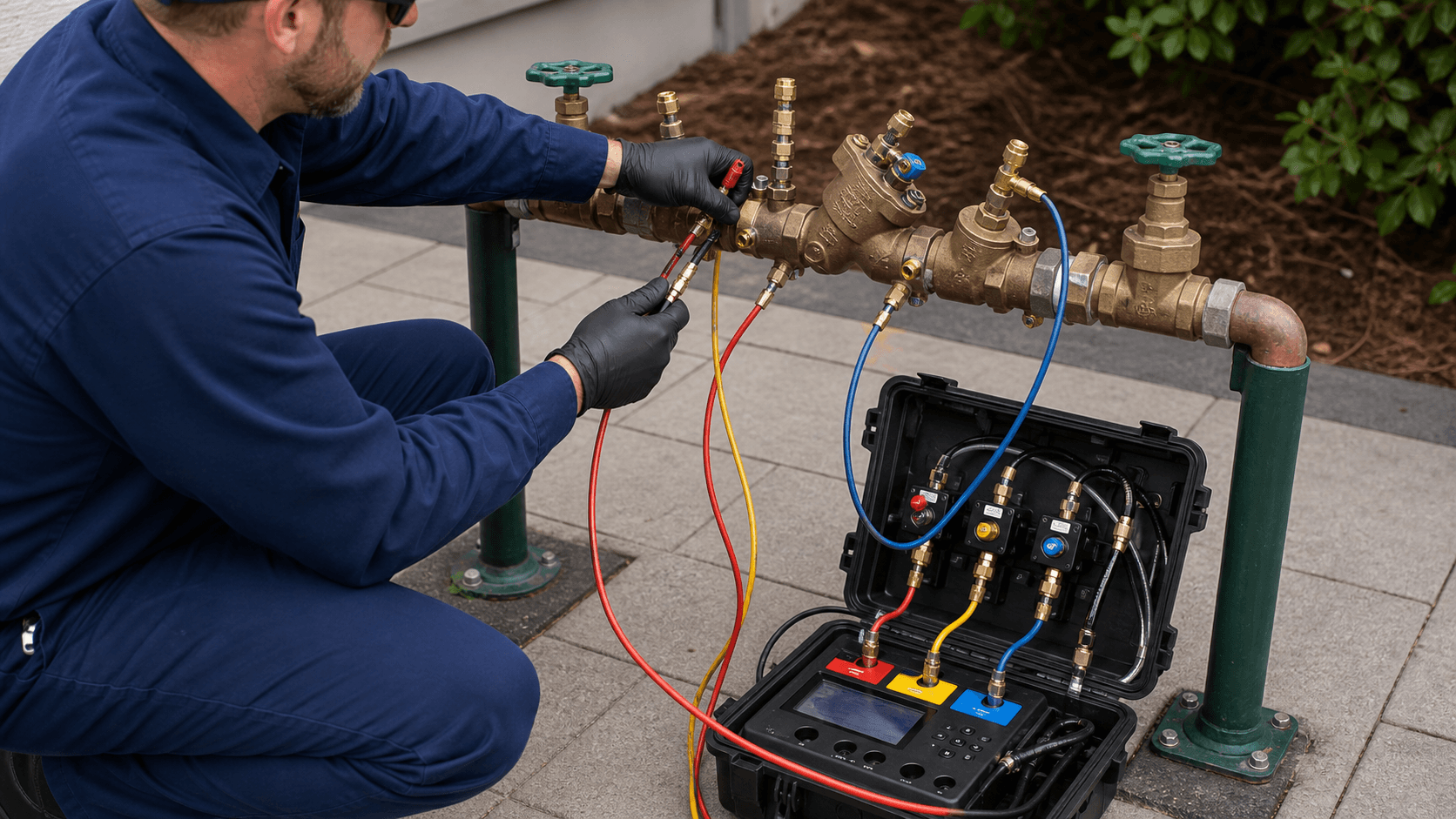
The three common assemblies are the reduced-pressure (RPZ) assembly, the double-check valve assembly, and the pressure-vacuum breaker — each offering a different level of protection for a different hazard.
The most protective common assembly is the reduced-pressure principle assembly, the RPZ — also called the reduced-pressure backflow assembly, or RPBA. It uses two independent spring-loaded check valves with a relief valve in a chamber between them held at a reduced pressure; if either check fails, the relief valve opens and dumps the zone to atmosphere rather than letting backflow pass. That fail-safe relief is what makes the RPZ the assembly approved for the highest-hazard connections, where the consequence of backflow is most severe.
The double-check valve assembly, or DCVA, is the next step down in protection. It uses two independent spring-loaded check valves in series but has no relief valve to dump the middle zone, so it relies on the two checks alone to hold the line. That makes it appropriate for lower-hazard connections where the substance that could backflow is objectionable but not a serious health threat. A double-check detector assembly (DCDA) is a metered variant used on fire systems where flow needs to be monitored.
The pressure-vacuum breaker, or PVB, works on a different principle, using a check valve together with an air-inlet valve that opens to break a vacuum and admit air, stopping back-siphonage. It is a common and economical choice for irrigation systems, but it protects only against back-siphonage, not backpressure, so it is limited to applications where backpressure cannot occur and where it can be installed above the highest downstream outlet. Its narrower protection is the tradeoff for its lower cost on suitable connections.
Choosing among the three is not a matter of preference but of matching the assembly to the hazard and the conditions — the degree of hazard, and whether backpressure as well as back-siphonage is possible. That matching is governed by the cross-connection rules and is the subject of the next section, because installing too little protection for the hazard is a compliance failure and installing the wrong type for the conditions does not protect at all.
A high health hazard requires an air gap, a reduced-pressure (RPZ/RPBA) assembly, or a reduced-pressure detector assembly; a low hazard also allows a double-check valve assembly.
Washington's cross-connection rules match the required protection to the degree of hazard, drawing the central line between a high health hazard and a low health hazard. A high health hazard is a cross-connection where backflow could carry something that could cause illness or death — sewage, chemicals, process water, or other serious contaminants. A low health hazard is one where backflow would be objectionable or a nuisance but not a serious threat to health. The hazard classification dictates which assemblies are acceptable.
For a high health hazard, the acceptable protection is limited to the most robust options: an air gap, a reduced-pressure principle backflow assembly (RPBA/RPZ), or, where flow detection is needed, a reduced-pressure detector assembly. These all provide the fail-safe protection — the physical break of an air gap or the relief-valve dump of a reduced-pressure assembly — that high-hazard connections require, because the consequence of a failure there is too severe to rely on checks alone.
For a low health hazard, the rules also permit the less robust options. A double-check valve assembly (DCVA), or a double-check detector assembly (DCDA) where detection is needed, is acceptable on a low-hazard connection, in addition to the high-hazard options. The double-check's two checks are sufficient where the substance that could backflow is objectionable rather than dangerous, which is why it is allowed at the low-hazard level but not at the high-hazard level.
The practical consequence is that the assembly cannot be chosen on price alone — it has to be chosen on the hazard the connection presents. Putting a double-check on a high-hazard connection is non-compliant and unsafe, while putting an RPZ on a low-hazard connection is acceptable but more than required. Determining the hazard level correctly is the first step in specifying the right assembly, and getting that determination and the install right is part of water main repair in Bellevue.
Common triggers are lawn or irrigation sprinkler systems, fire-sprinkler systems, and commercial connections — each creates a cross-connection between the potable supply and a possible source of contamination.
The most common residential trigger is a lawn or irrigation sprinkler system. An irrigation system connects the potable supply to piping that is in contact with soil, fertilizer, and pesticides, and its outlets can sit below grade where contaminated water could be siphoned back if supply pressure drops — a textbook cross-connection. That is why adding an in-ground sprinkler system typically requires a backflow assembly, commonly a pressure-vacuum breaker or a double-check, sized to the hazard.
Fire-sprinkler systems are a second common trigger. A fire-suppression system holds water standing in its piping, sometimes for long periods and sometimes with additives, and that stagnant or treated water is a cross-connection to the potable supply that must be isolated with a backflow assembly — often a double-check detector assembly that also lets the utility detect flow. The fire system's need for guaranteed water and the utility's need to protect the main both run through that assembly.
Commercial and industrial connections are the broadest trigger. Restaurants, medical and dental facilities, car washes, boilers, cooling systems, and process lines all create cross-connections between the potable supply and contaminants ranging from food waste to chemicals, and these high-hazard connections generally require the most protective assemblies. A commercial property typically has multiple connections to assess, each classified by hazard and protected accordingly under the purveyor's program.
What unites the triggers is that each creates a cross-connection — a point where the drinking-water supply meets a possible contaminant — and the cross-connection-control program requires that point be protected. A property owner adding any of these systems should expect a backflow requirement to come with it, and the assembly then carries the ongoing annual-test obligation. Identifying which connections need protection and installing the right assembly is part of water main repair in Bellevue.
Look for a brass assembly with test cocks near the irrigation, fire, or main connection; then check with the City of Bellevue's water utility, which tracks each assembly's annual test due date.
The first question is whether the property even has an assembly, and it is usually answerable by looking. A backflow assembly is a brass-bodied valve assembly with two shutoff valves and a row of small test cocks, installed at the connection it protects — near where an irrigation system tees off, on a fire-sprinkler riser, or on the main service for a commercial connection. An RPZ also has a relief-valve port that may drip. Finding such an assembly means the property has backflow protection in place at that point.
The second question is whether its required test is current, and that is tracked by the purveyor. The City of Bellevue's water utility maintains the cross-connection-control records for its system, including which connections have assemblies and when each is due for its annual test, and it sends notices when a test is coming due or has lapsed. A property owner unsure of their status can check with the utility, which holds the authoritative due dates, rather than relying on memory of when the assembly was last tested.
An overdue assembly is the compliance gap to close, because the annual test is mandatory and the utility can act on a lapse. If the records show a test is past due — or if the owner finds an assembly they have no test record for — the corrective step is to arrange a test with a certified BAT and have the result reported to the utility, bringing the connection current. Doing so before the utility escalates to a shutoff is the point of staying ahead of the due date.
The logic, then, runs in two steps: confirm an assembly exists at each cross-connection that needs one, and confirm each assembly's annual test is current with the City of Bellevue. A property with a sprinkler, fire, or commercial connection and no assembly has a missing-protection problem; a property with an assembly but a lapsed test has a compliance problem. Sorting both — finding the connections and getting the assemblies tested and current — is handled alongside water main repair in Bellevue.
The City of Bellevue Utilities publishes the current fee schedule for its cross-connection-control program; rather than a fixed quote, check the city's published fees and the certified tester's charge for the annual test.
The cost of a backflow test in Bellevue is best taken from the authoritative source rather than a generic figure, because it has two parts and one of them is set by the city. The City of Bellevue Utilities administers the cross-connection-control program and publishes its current fee schedule, which is where any program or administrative fees tied to the assembly and its testing are listed. Checking that published schedule gives the accurate, current city-side cost rather than an estimate.
The second part of the cost is the certified tester's charge for performing the annual test, which is a service fee set by the BAT, not by the city. That charge covers the tester's time, calibrated equipment, and the filing of the test report, and it varies by tester. Because only a certified BAT can perform the test, the tester's fee is a necessary part of the annual cost, separate from any city program fee.
Treating the cost as two components — the city's published program fee and the tester's service charge — is the accurate way to understand it, and it is why a single flat number is misleading. A property owner budgeting for the obligation should look at the City of Bellevue Utilities fee schedule for the program side and get the tester's quote for the service side, which together make up what the annual compliance actually costs.
Because the test is mandatory and recurring, the cost is best understood as an annual line item rather than a one-time charge. Keeping the assembly tested each year by a certified BAT, with the city's published fees checked for the current program cost, is what keeps the connection compliant and avoids the far larger cost and disruption of a water shutoff for a lapsed test. Arranging the test and any related supply-line work runs through water main repair in Bellevue.
Yes, annual testing is required in Washington; only a certified BAT can test; sprinklers, fire systems, and commercial connections trigger one; RPZ outranks double-check; and a lapsed test risks a shutoff.
Yes, backflow testing is required every year in Washington — under WAC 246-290-490, subsection 7(b), an approved assembly must be tested at installation, repair, or relocation and at least annually thereafter. It is the law, enforced by the local water purveyor, and the City of Bellevue's water utility tracks each assembly's due date and can shut off water service to a connection whose required test is overdue, so the annual test is a hard obligation rather than a recommendation.
Only a state-certified Backflow Assembly Tester (BAT) may test a backflow preventer — certified under WAC 246-292-034 through Washington Certification Services at Green River College — so it is neither a DIY task nor an automatic duty of any general plumber. A backflow assembly is typically required when you add a lawn or irrigation sprinkler system, a fire-sprinkler system, or a commercial connection, because each creates a cross-connection between the drinking-water supply and a possible contaminant.
An RPZ outranks a double-check in protection: the reduced-pressure (RPZ/RPBA) assembly adds a relief valve that dumps the middle zone if a check fails, which is why it — along with an air gap — is required for high health hazards, while a double-check valve assembly is permitted only for low hazards. Choosing between them is set by the hazard classification, not by preference or price, and using a double-check on a high-hazard connection is non-compliant.
If you do not test, the utility can shut off your water, because a lapsed required test is a compliance failure the purveyor is obligated to act on. And yes, a sprinkler or irrigation system generally needs a backflow preventer, since it connects the potable supply to soil and fertilizer through below-grade outlets. A water-powered sump backup that taps the potable supply can raise the same cross-connection issue — see our sump pump battery backup guide. To arrange a certified BAT and any supply-line work, start with contact us or book water main repair in Bellevue.
Every fact in this guide cites a verifiable public source. If you find a number we got wrong, email dispatch@bellevueplumberpro.com.
Need help with this in your home? See our Water main repair in Bellevue page for pricing, our diagnostic process, and how same-day service works across the Eastside.
Related services: Sewer Line Repair and Replacement.
An assembly that stops contaminated water from being siphoned back into the public drinking-water supply through a cross-connection — required on irrigation systems, boilers, and other hazard connections.
Annually at minimum. Under WAC 246-290-490, an approved assembly must be tested at installation, repair, or relocation and at least annually thereafter — and only a state-certified Backflow Assembly Tester (BAT) may perform the test.