Home/Learn/Code and permits/Retroactive plumbing permits in Bellevue: how to legalize unpermitted work without delaying a sale
Code
Retroactive plumbing permits in Bellevue: how to legalize unpermitted work without delaying a sale
Retroactive plumbing permitting is the process of legalizing plumbing work that was completed without the required City of Bellevue permit at the time of installation. It comes up most often during real estate transactions, when a buyer's home inspector flags an obviously newer water heater or repipe with no permit history. Washington's Seller Disclosure Statement (Form 17, mandated by RCW 64.06.020) requires the seller to disclose any improvements made without required permits, which means the issue cannot simply be hidden. The City of Bellevue accepts retroactive permit applications through MyBuildingPermit.com using the same process as new work, but with two important differences: the inspector evaluates already-completed (sometimes concealed) work against current code, not the code in effect when the work was done, and the fees typically run 2-3x the original permit cost. This guide covers the full process — what triggers a retroactive permit, how to apply, what the inspector actually looks at, what to do when previously concealed work needs to be exposed for inspection, the four scenarios where legalizing old work is genuinely urgent, and the cases where leaving it alone is the right call.
Retroactive permitting is the process of obtaining a City of Bellevue plumbing permit and inspection for work that was completed in the past without the required permit — typically a water heater replacement, repipe, sewer repair, or bathroom addition discovered during a real estate transaction or insurance claim.
Cities including Bellevue accept retroactive permit applications under the same code and through the same portal (MyBuildingPermit.com) used for new work. The mechanical process is identical — you apply, pay the fee, and a city inspector visits the property to verify the installation meets the 2021 Uniform Plumbing Code (UPC) adopted by Washington via WAC 51-56 and Bellevue amendments. What differs is timing, fees, and how the inspector handles work that is already concealed behind drywall or buried in a wall cavity.
Two things to understand at the start. First, there is no general statute of limitations on a city's authority to require a permit for past work. A water heater installed in 1998 without a permit can still be flagged in 2026 and a permit can still be required. Second, the inspector evaluates the existing work against the code currently in effect — not the code in effect when the work was originally done. A 1998 water heater without seismic strapping was code-compliant when installed, but it will fail a 2026 inspection because seismic strapping was added to the Uniform Plumbing Code adoption in Bellevue years later.
Most retroactive permits in Bellevue are not the homeowner's idea. They are triggered by an external event: a buyer's inspector during a home sale, an insurance claim where the carrier discovers unpermitted work during the investigation, an enforcement action initiated by a complaint, or — less often — a homeowner who decides to add more work to a system and wants the whole installation legalized in one pass.
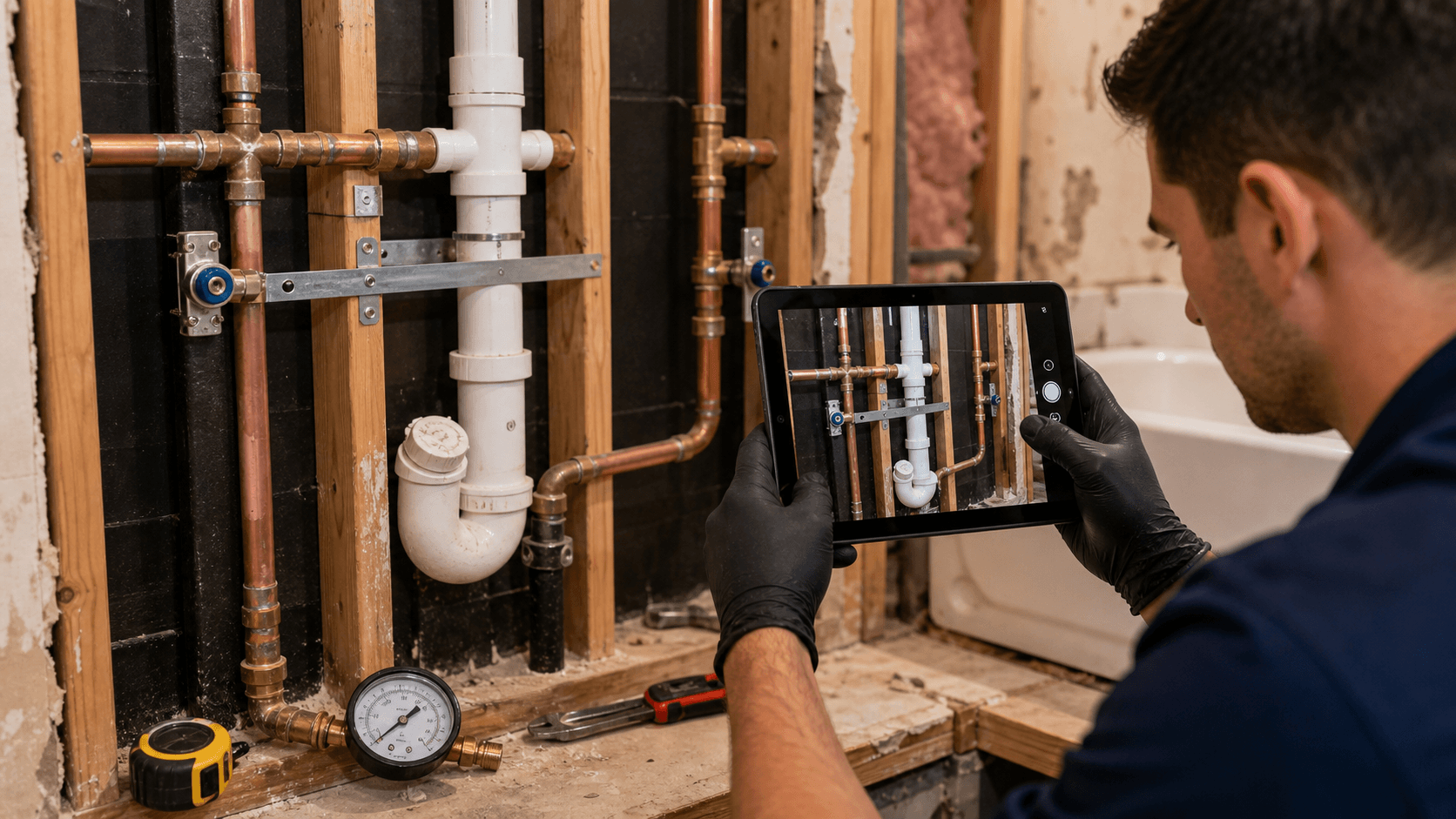
Retroactive permit work often starts by exposing enough plumbing to document what was installed.
This happening in your home right now? A licensed plumber can talk you through the next step on the phone — 24/7, and the call is free.
Four scenarios trigger retroactive permitting in Bellevue: a real estate sale where the buyer's inspector flags unpermitted work, an insurance claim where the carrier investigates and discovers it, an enforcement action initiated by a neighbor complaint or visible from the street, or a homeowner pulling a permit for new work and discovering the city has no record of related prior work.
Real estate is by far the most common trigger in Bellevue. King County has one of the most rigorous home inspection cultures in the country, and most buyers' inspectors will note any water heater, sewer line repair, or repipe that appears newer than 5 years old and check for permit records on the Bellevue permit search portal. When the records come up empty, the buyer's agent typically writes the disclosure into the inspection response letter and asks the seller to legalize the work before close.
The pricing context matters here. A retroactive permit run as part of a real estate transaction usually costs 2-3x the normal permit cost, with timing pressure that can drive total cost higher. Our plumber cost and pricing in Bellevue guide covers the underlying labor and material rates for any corrective work that the inspection turns up.
Triggers for retroactive permitting in Bellevue:
Real estate transaction — buyer's inspector identifies newer plumbing without permit history; buyer's agent requests permit closure as a condition of closing
Insurance claim — carrier investigating a leak, fire, or water damage claim discovers related work was unpermitted; coverage may be denied or claim payout reduced
Code enforcement — a complaint to City of Bellevue Code Compliance, a visible-from-street violation (e.g., a sewer cleanout above-grade where one shouldn't be), or post-disaster inspections
Self-initiated — homeowner pulling a new permit for additional work discovers no permit exists for prior work; city requires the prior work to be legalized before the new permit issues
Refinance or appraisal — less common, but lenders and appraisers occasionally flag unpermitted improvements affecting the home's appraised value
Washington Form 17 and the disclosure rule
Washington's Seller Disclosure Statement (Form 17, mandated by RCW 64.06.020) requires the seller to disclose to the buyer any alterations, additions, or improvements made to the property without required permits — sellers cannot legally conceal unpermitted work during a residential sale.
RCW 64.06.020 — the Washington statute governing residential real property disclosure — requires sellers of most residential real property to deliver a completed Seller Disclosure Statement (commonly called Form 17) to the buyer. The form has a structured section on improvements, and one of the specific questions asks whether any alterations, additions, or improvements have been made to the property without the necessary permits.
The seller's options on Form 17 are 'Yes,' 'No,' or 'Don't know.' Answering 'No' when unpermitted work exists is a misrepresentation that exposes the seller to post-close legal action by the buyer. Answering 'Don't know' is technically permitted when the seller genuinely doesn't know — for example, when the seller bought the home from someone else and is unaware of any unpermitted improvements done by prior owners — but it does not absolve the seller of disclosure if they later become aware.
The buyer's recourse if the answer was 'No' but the work was unpermitted: damages, rescission of the sale in extreme cases, and (in practice) a credit at closing to cover retroactive permitting costs. This is why most Bellevue residential sales now include either a buyer credit for known unpermitted items or a seller commitment to legalize the work before close — agents have learned that the cleanest path is to deal with the issue during the transaction rather than after.
Form 17 is not the only disclosure mechanism. King County's recorded permit history is a public record searchable on the city portal. A buyer's agent will routinely run a permit search on every property under inspection. Hiding unpermitted work during a sale rarely succeeds even before Form 17 — but the form provides the statutory teeth.
Clear photos, measurements, and pressure-test evidence make retroactive review less speculative.
How to apply for a retroactive permit in Bellevue
Apply through MyBuildingPermit.com using the same process as a new plumbing permit, with the licensed plumber who will perform any corrective work as the permit holder, and specify in the application notes that the work has already been completed and the permit is being obtained retroactively.
MyBuildingPermit.com is the shared permit application portal used by Bellevue, King County, and most other Eastside jurisdictions. The application form has a free-text description field where the applicant explains the scope of work. For retroactive applications, the description should include the date the work was originally performed (approximate is fine), the contractor who did the work if known (often unknown for older installs), and a clear statement that the permit is being obtained retroactively for work already in place.
Retroactive permit application steps in Bellevue:
Engage a licensed Washington plumber (verify license via WA Department of Labor and Industries) to walk the property and identify what needs to be permitted and what corrective work the inspection is likely to require
Plumber applies on MyBuildingPermit.com under their license, listing the property owner and noting the retroactive nature in the work description
City of Bellevue Development Services reviews the application and assesses fees — typically the standard permit fee plus an investigation fee of 100-200% of the base fee, depending on jurisdictional policy and scope
Owner or plumber pays fees (within 30 days of issuance in most cases) and the permit issues
Inspection is scheduled, typically 1-5 business days out depending on city workload
Inspector evaluates the work in place; if it fails, a correction notice is issued and a re-inspection scheduled after corrections are made
On successful final inspection, the permit closes and the record updates in the city's permit history
The licensed-plumber requirement is the part homeowners often try to skip. Washington's licensing law (RCW 18.106) requires that most plumbing work — including any work for which a permit is required — be performed by a licensed plumber. Retroactive permits do not waive this requirement. If the original work was done by an unlicensed person (the prior homeowner's brother-in-law, for instance), the city may still issue the retroactive permit, but the inspector will scrutinize the work more closely and any required corrections must be made by a licensed plumber.
What the inspector actually looks at
The inspector evaluates the installed work against the current 2021 Uniform Plumbing Code (UPC) and Bellevue amendments — including any code changes adopted since the work was originally installed — and issues a correction notice for any item that does not meet current code, regardless of whether it was compliant at the time of installation.
Most retroactive plumbing inspections in Bellevue are focused inspections on specific scopes — a water heater replacement, a sewer repair, a bathroom addition, a repipe. The inspector evaluates the elements of that scope against 2021 UPC requirements as adopted by Washington (WAC 51-56) and the City of Bellevue. The common evaluation items by scope:
What inspectors check by scope (Bellevue, 2026):
Water heater — T&P relief valve and discharge piping termination, seismic strapping anchored to studs, expansion tank on the cold supply, drain pan and discharge for raised installations, dielectric unions or flex connectors, accessible shutoff valve, combustion air for gas units, condensate routing for heat-pump units
Sewer line repair — proper bedding, correct slope (typically 1/4 inch per foot for 4-inch pipe), approved pipe and fittings, accessible cleanouts, proper depth, no offsets or bellies, connection to King County main using approved methods. Where prior camera footage is available — see our [sewer camera inspection guide](/learn/sewer/camera-inspection-bellevue/) — it can substantially shorten the inspection timeline
Repipe — approved materials (PEX-A, PEX-B, copper, CPVC by application), correct sizing, proper supports and fastening intervals, accessible shutoff valves, dielectric isolation between dissimilar metals, freeze protection for exterior walls
Backflow preventer — correct device type for the application, proper installation height, accessible for annual testing, annual test record on file
Bathroom addition — drainage venting per 2021 UPC, fixture trap arms, water supply sizing, GFCI protection on receptacles, exhaust fan vented to exterior
When concealed work needs to be exposed. The inspector cannot evaluate a wall-concealed repipe without seeing the pipes. For retroactive repipes, the city has three typical options: accept manufacturer-rated PEX installations on visual inspection at accessible points (manifold, water heater, fixture rough-ins) without requiring drywall removal; require partial drywall removal at strategic points to expose representative pipe runs; or require a pressure test demonstrating system integrity. Which option applies depends on the work scope, the available documentation (prior contractor's invoices, material certifications), and the specific inspector's judgment.
When the work fails. A correction notice lists each item that does not meet code. Corrections must be made by a licensed plumber, the work re-inspected, and the permit closed. For minor corrections (missing seismic strap, wrong T&P discharge termination), the cost is typically $200-$600 and a few hours. For substantial corrections (sewer line at wrong slope, repipe with wrong support intervals), the cost can be thousands and the correction may require re-doing significant portions of the original work.
Real costs of retroactive permitting in Bellevue
Expect $250 to $800 in permit and investigation fees alone for routine scopes, plus $300 to $2,500 for any corrective work the inspector requires, plus $300 to $1,000 for plumber time managing the application and inspection coordination — total typical range $850 to $4,300 for a residential water heater or focused sewer permit.
The fee structure has three components. The base permit fee (what a normal new-work permit would have cost) — typically $90-$200 for routine residential plumbing in Bellevue. An investigation fee charged because the city is being asked to permit completed work rather than inspecting work as it progresses — typically 100-200% of the base fee, so an additional $90-$400. And the licensed plumber's time managing the application, walking the inspector through the work, and coordinating any corrections — typically $300-$1,000 depending on scope and complexity.
Corrective work costs are scope-specific. The single most common retroactive scenario in Bellevue — a water heater replaced 5-15 years ago without a permit — usually fails inspection on at least one item (seismic strapping, T&P discharge, or expansion tank). The corrections run $200-$600 and a half-day of plumber time.
Typical total retroactive permitting cost by scope (Bellevue, 2026):
Water heater retroactive permit (clean pass): $400-$900
Water heater retroactive permit (typical corrections required): $850-$1,800
Sewer line spot repair retroactive permit (clean pass with prior camera footage): $500-$1,200
Sewer line replacement retroactive permit (no prior records, possible corrective work): $1,500-$5,000+
Whole-house repipe retroactive permit (PEX or copper, with corrections): $2,000-$6,000
Bathroom addition retroactive permit: $1,200-$4,000 (substantially higher if drywall removal required for inspection)
Timing pressure inflation. Retroactive permits driven by a real estate transaction often cost more than the ranges above because the seller is operating under a 14-30 day window before closing. Plumbers prioritize same-week work over flexible scheduling, and expedited inspections (when the city offers them) add to the cost. Sellers who can negotiate a 30-45 day extension on closing will typically save 15-30% on the total project versus a rushed 10-day timeline.
The case for legalizing voluntarily. Voluntary retroactive permitting — done before a sale or claim forces the issue — costs the same on the city side but typically 30-50% less on the plumber side, because there is no timing pressure and the homeowner can shop quotes, schedule corrective work over weeks rather than days, and avoid expedited fees. The catch is most homeowners do not realize the work was unpermitted until a transaction surfaces it.
Insurance implications of unpermitted work
Homeowners insurance carriers do not categorically deny claims because of unpermitted work, but they do investigate causation — if unpermitted plumbing work caused or contributed to the loss, the carrier may deny the specific claim, reduce the payout, or non-renew the policy at the next renewal.
The insurance angle is more nuanced than is sometimes claimed. Most major homeowners insurance policies do not have a blanket exclusion for damage related to unpermitted work. What they have is a causation requirement: the insurer pays for sudden and accidental damage to covered property. If a water heater installed without a permit, missing the seismic straps required by code, falls during an earthquake and ruptures the supply line, the carrier may argue that the loss was caused by the failure to install the strapping (which would have been required and inspected under a permit). In that case, the carrier may deny the claim or reduce the payout under the maintenance or wear-and-tear exclusion.
What carriers typically do in practice. Investigate the cause of loss for any claim over $5,000. Order public-records searches as part of large-loss investigations, which surfaces missing permits. Pay claims where the cause is clearly unrelated to the unpermitted work (the unpermitted bathroom addition is in the basement, the loss is roof damage from a windstorm — no connection, claim is paid). Deny or reduce claims where the cause clearly connects to the unpermitted work (the unpermitted water heater install failed and caused water damage to the floor below). Some carriers non-renew policies after a permit-related claim denial, which forces the homeowner into the WA Fair Plan or a non-standard carrier with higher premiums.
The practical takeaway. Unpermitted work is not a guaranteed claim denial, but it adds a path the carrier can use to investigate and contest a claim. Legalizing major unpermitted work (water heater, sewer, repipe) before a major claim event removes that path. For minor unpermitted items — a single bathroom fixture swap, a kitchen sink replacement — the insurance exposure is generally negligible.
Four scenarios where retroactive permitting is genuinely urgent
Four scenarios make retroactive permitting an immediate priority: an active real estate sale with a closing date inside 60 days, a pending insurance claim where the carrier has opened an investigation, a planned major renovation that will require pulling new permits, and a discovery during a refinance appraisal where the lender has flagged unpermitted improvements.
Scenario 1 — active sale. The buyer's inspector has flagged the work, the buyer's agent has put the request in writing as a condition of closing, and the seller has 14-30 days to legalize. This is the most common urgent scenario. The retroactive permit application goes in immediately, a licensed plumber walks the property within 2-3 days, corrective work begins within a week, and the inspection closes the permit before the closing date. Cost runs at the high end of the typical range, but the alternative — a buyer credit of $5,000-$15,000 at close, or a failed transaction — is worse.
Scenario 2 — pending insurance claim. The carrier has opened an investigation on a loss event (typically water damage from a plumbing failure), and the adjuster has either explicitly asked about permit history or ordered the public-records search that will surface the missing permit. Legalizing the work mid-claim does not retroactively fix the causation issue if the unpermitted work caused the loss, but it does demonstrate good faith and can shift the negotiation. Consult both the licensed plumber and a public-adjuster or attorney before deciding on timing.
Scenario 3 — major renovation in the planning stage. The homeowner is planning a kitchen or bath remodel that will require new permits, and the project plumber discovers the existing water heater or repipe is unpermitted. The city typically will not issue the new permit until the old work is legalized, so the retroactive permit becomes a prerequisite. The benefit of doing it as part of a larger renovation is plumbers can fold corrective work into the larger project, reducing trip charges and coordination costs.
Scenario 4 — refinance with appraisal-driven flag. Less common but increasingly seen in 2025-2026 as appraisers run permit searches on subject properties. The lender requires unpermitted improvements to be either legalized before close or excluded from the appraised value. Timing varies — refinances are typically less time-pressured than purchase transactions, giving the homeowner 30-60 days to legalize.
When retroactive permitting is not the right move
Retroactive permitting is the wrong move when the work in question is minor and code-compliant, when corrective costs would exceed 30% of the home's plumbing system value, when the homeowner has no plans to sell or refinance for 10+ years and the work is genuinely safe as installed, and when the original work is so substandard that full removal and re-installation under a new permit is cheaper than retroactive legalization plus corrections.
Minor work, code-compliant. A single fixture swap done by a competent homeowner, fully visible, clearly meeting current code — the upside of a retroactive permit is marginal, and the downside is a $300-$500 fee for paperwork that won't change the work's status meaningfully. Most cities including Bellevue do not pursue retroactive permitting for minor fixture-level work that does not surface during transactions or claims.
Corrective costs dominate. If the inspection-driven corrective work would exceed the cost of removing the original installation and starting over with new work under a fresh permit, redoing the work is the better path. This comes up most often with poorly-done DIY repipes — when the existing system has wrong materials, undersized lines, no shutoff valves, and improper supports, the corrective scope approaches the cost of a fresh repipe anyway.
Long time horizon, safe work. A water heater installed 12 years ago without a permit, in clear violation of nothing except the permit requirement itself (proper strapping, T&P discharge, expansion tank all in place), in a home the owner intends to live in for another 20 years — the practical case to legalize is weak. The work is functioning, the city is unlikely to surface it, and the cost of voluntary legalization is not recouped by any near-term benefit. For homeowners who intend to sell eventually, addressing it 12-18 months before listing is the optimal timing.
Genuinely substandard work. When the existing installation is dangerously substandard — improperly grounded electrical on a water heater, cross-connected potable and irrigation supply, a sewer line installed at a back-slope — the right answer is full removal and replacement under a new permit, not retroactive legalization. The cost is higher but the outcome is correct, and a buyer or insurer will not later challenge work done under a current permit.
How to verify your home's permit history
Search the City of Bellevue permit records online via the city's permit search portal, request a Permit History Report from Bellevue Development Services for $25-$50, or pull King County Assessor records to cross-reference improvement timelines with permit history.
Three sources cover most residential permit research in Bellevue. The City of Bellevue online permit search (linked from the Development Services page on bellevuewa.gov) shows permits issued from the early 2000s forward; older permits exist on microfiche and require a records request. The Bellevue Permit History Report, requested through Development Services for a modest fee, is the comprehensive document title companies and home inspectors rely on — it lists all permits of record for the address, with dates, scopes, and inspection statuses. King County Assessor records (kingcounty.gov/depts/assessor) document recorded improvements over time and can be cross-referenced against the permit list to identify work that happened without a corresponding permit.
Practical workflow for a homeowner considering selling in 18-24 months. Pull the Bellevue Permit History Report. Walk the home with a licensed plumber, comparing the report against visible installations — newer water heater, evidence of a sewer repair (a patched area of yard or driveway), bathroom additions, exterior plumbing changes. For any installation that is clearly newer than the most recent permit of record for that scope, decide whether to pursue voluntary retroactive permitting now or to disclose the issue on Form 17 at sale time. Voluntary now is usually cheaper and removes the buyer-credit negotiation later.
When you simply do not know. The 'Don't know' option on Form 17 is genuinely available to sellers who acquired the home without knowing what prior owners did. If the home has had three or four owners over 40 years, the current seller may legitimately not know whether the 1998 bathroom addition was permitted. The disclosure rule is about what the seller knows or reasonably should know, not about exhaustive forensic research. That said, a Permit History Report is cheap insurance and most listing agents in Bellevue now order one as a matter of course before listing.
Working with the right plumber on a retroactive job
Use a Washington-licensed plumber with specific experience navigating Bellevue Development Services and MyBuildingPermit.com applications — retroactive permitting requires comfort with the city's process, the ability to advocate for the existing work where it meets intent if not letter of current code, and the project management skill to coordinate inspection and corrective work within tight transaction timelines.
The licensing piece is non-negotiable. Verify the plumber's Washington license via the Department of Labor and Industries lookup tool. Unlicensed contractors cannot pull permits in their own names and cannot perform code-required corrective work on a retroactive job — using one creates the same disclosure problem the retroactive process is trying to solve.
Beyond licensing, the practical skills that matter for retroactive work: familiarity with the City of Bellevue's specific permit workflow and inspectors (each city differs in process details and inspector preferences); willingness to write detailed scope descriptions in the application that proactively address known issues; comfort walking inspectors through completed work and advocating where existing installations meet code intent even if construction details differ from current practice; and project-management discipline to handle the application, corrective work, and re-inspection inside transaction timelines.
The conversation to have at the first walk-through. Ask the plumber to identify each item that is likely to fail inspection and to give a written estimate of corrective work for each. Ask about the city's typical inspection scheduling window in the current week — sometimes the inspection queue is 2 days, sometimes 5-7 — so you can plan backwards from your closing date. And ask explicitly whether the plumber has done retroactive permits in Bellevue specifically (not 'somewhere in King County'); local familiarity shortens the timeline.
For emergency-timeline retroactive work — a sale closing in 10-14 days where the inspector flagged a water heater on day 1 — the cost premium is real, similar to the after-hours work covered in our emergency plumber cost in Bellevue guide. Plumbers will move work to accommodate the timeline, but expect to pay 20-40% above their normal-schedule rate.
Sources
Every fact in this guide cites a verifiable public source. If you find a number we got wrong, email dispatch@bellevueplumberpro.com.
Retroactive plumbing permits in Bellevue — questions homeowners ask
QUESTION01
What is a retroactive plumbing permit?
The process of obtaining a City of Bellevue permit and inspection for work completed in the past without the required permit — typically triggered by a home sale, an insurance investigation, or a discovery during other work. It often requires opening walls so the inspector can see what was done.
QUESTION02
Do I have to disclose unpermitted plumbing work when selling?
Yes. Washington's Seller Disclosure Statement (Form 17, mandated by RCW 64.06.020) requires disclosing alterations and improvements made without permits — buyers' inspectors flag the mismatches, and the disclosure protects you legally.