Emergency plumber cost in Bellevue: dispatch fees and after-hours rates
When you call an emergency plumber in Bellevue at 2am, you pay three things on top of the actual repair: a dispatch fee, an after-hours hourly multiplier, and emergency-priced parts pulled from truck inventory instead of a supply house. The same repair that costs $300 at 10am on Wednesday costs $450 to $600 on Saturday night, and up to $900 on a holiday. This guide breaks the emergency bill into its component pieces with verified 2026 numbers, explains exactly when the surcharge windows kick in, covers what homeowner insurance does and does not pay for, and lists the calls where holding until business hours is the right call versus the calls where waiting costs catastrophically more than the after-hours premium.
An emergency plumber bill in Bellevue stacks three charges on top of the underlying repair: an after-hours dispatch or service-call fee ($150 to $400), an hourly rate multiplier of 1.5 to 3 times standard pricing depending on the time, and emergency-priced parts (typically 20 to 40 percent above supply-house cost because the plumber pulls from truck inventory).
Emergency plumber pricing is the standard daytime rate plus three stacked layers — an after-hours dispatch fee, a time-of-day hourly multiplier, and parts pulled from truck inventory at marked-up pricing. Standard daytime plumber service in Bellevue runs $150 to $200 per hour with a service-call fee of $75 to $200 (often credited toward the repair); the emergency version of the same job multiplies outward from that baseline. Every layer is explainable, and every layer should be quoted before the truck rolls.
Emergency service stacks three additional cost layers on top of that base.
Layer one: the after-hours dispatch fee. Industry data shows the standard service-call fee jumps to $200-$400 for emergency dispatches. This is the cost just to send a truck — it gets charged whether you proceed with the repair or not, though many reputable shops credit the fee toward the work if you book the repair.
Layer two: the hourly multiplier. Weeknight after-hours (typically 6pm to 7am) runs 1.5 times the standard hourly rate. Weekend calls run 2 times. Holiday calls can run 2 to 3 times. That means a $175 standard hourly rate becomes $260 weeknight evenings, $350 weekends, and up to $525 on Thanksgiving or Christmas.
Layer three: emergency-priced parts. Supply houses close at 5pm. After-hours plumbers carry common parts in their trucks but at higher markups than supply-house wholesale. A $30 supply-house valve might bill at $45-$60 from truck inventory. Across a repair using $200 in parts, that's an extra $40-$80.
Total emergency-call cost in Bellevue typically runs $300 to $1,200+ depending on severity and the specific surcharge time. The breakdown of underlying labor and material costs is documented in our plumber cost and pricing in Bellevue guide — emergency pricing inherits those base numbers and adds the three layers above.
Emergency pricing reflects timing, risk, and immediate containment needs when water is actively spreading.
This happening in your home right now? A licensed plumber can talk you through the next step on the phone — 24/7, and the call is free.
What 'after-hours' actually means — the surcharge windows
Most Bellevue plumbing companies define after-hours as 6pm to 7am on weekdays, all day on weekends, and all federal and state holidays. Some shops use stricter cutoffs (5pm) and some have additional late-night windows (after 10pm) at higher multipliers.
There is no single industry standard for emergency time windows. Each plumbing company defines its own surcharge schedule. Verify the specific windows before agreeing to dispatch — the difference between 5pm and 7pm matters when you're calling at 5:30pm.
Typical surcharge windows used by Bellevue plumbing companies
Weekday business hours (typically 7am to 5pm or 6pm). Standard rates apply.
Weekday evenings (5pm or 6pm to 10pm). After-hours rate, 1.5 times standard hourly.
Weekday late nights (10pm to 7am). After-hours rate, often 2 times standard. Some shops have an additional 'overnight' tier from midnight to 5am.
Saturday and Sunday (full day). Weekend rate, 1.5 to 2 times standard. Sundays sometimes run higher than Saturdays at certain shops.
Federal holidays (New Year's Day, Memorial Day, Independence Day, Labor Day, Thanksgiving, Christmas). Holiday rate, 2 to 3 times standard.
Washington State holidays (occasionally added, varies by shop). Same rate as federal.
Two practical tips: First, ask for the surcharge schedule in writing before the truck is dispatched. A reputable company will text it or email it. Second, the cutoff time matters — calls placed at 4:55pm typically still bill at daytime rates if the dispatcher records the call time before the 5pm cutoff. Calls placed at 5:05pm bill after-hours even if the plumber arrives at 6pm.
The dispatch fee — what it is, when it's waived
The dispatch fee covers the cost of sending a truck and a plumber to your address before any repair work begins. Standard dispatch fees run $75 to $200 during business hours and $150 to $400 for after-hours calls. Reputable shops waive or credit the dispatch fee toward the cost of the repair if you proceed with the work — but some shops charge it separately on top of the repair, so confirm this point before dispatch.
Three things to clarify with the dispatcher before the truck rolls:
What is the exact dispatch fee amount for this call?
Is the fee credited toward the repair if you proceed, or charged separately?
Does the fee include the diagnostic time (typical 30 minutes to 1 hour on-site), or does the hourly clock start the moment the plumber arrives?
Most shops that bill the dispatch fee separately from the repair are using it as a quote-shopping deterrent. The implicit message: 'It will cost you $300 just to get another quote, so book us now.' That's a sales tactic worth recognizing. Even in genuine emergencies, getting a second quote from a different company often saves $150 to $400 on the total bill — the second shop's dispatch fee is recovered many times over by the lower repair total.
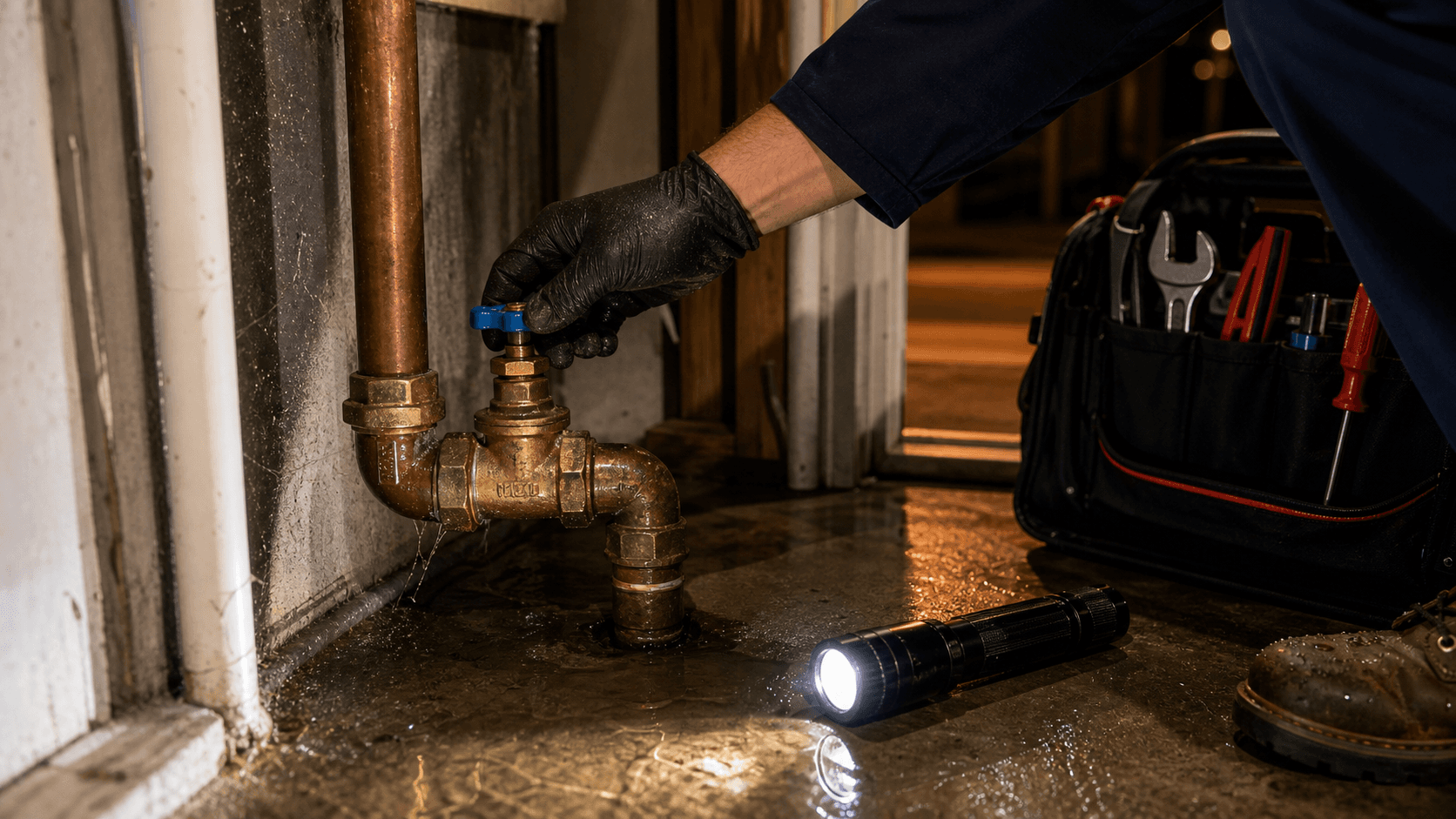
Closing the main shutoff quickly is the fastest way to reduce damage before the repair begins.
The hourly multiplier — 1.5×, 2×, 3× explained
Most plumbing companies use a tiered hourly-rate system: standard daytime rate (1×), evening/weeknight rate (1.5×), weekend rate (2×), and holiday rate (2× to 3×). The multiplier applies to the hourly labor portion of the bill, not to fixed-price parts or to the dispatch fee.
How the math plays out on a real Bellevue repair:
Standard hourly rate in Bellevue: $175 per hour (mid-range of the published $150-$200 band).
A typical burst-pipe repair takes 2 hours of on-site work plus 30 minutes of diagnostic.
Daytime cost: 2.5 hours × $175 = $437.50 in labor.
Add the dispatch fee ($150-$400) plus parts ($100-$400 depending on the repair complexity), and the same physical repair ranges from $700 daytime to $1,800+ on a holiday. The repair itself is identical — only the timing changed.
This is also why a typical Bellevue holiday call — an 11pm cold-snap burst pipe on a sub-freezing January night, say — lands at the upper end of this pricing band. The repair itself is straightforward; the timing is what makes it expensive. The full context for the weather pattern that produces these calls is in frozen and burst pipes in the Pacific Northwest, which documents the January 2024 cold snap that produced over 120 burst-pipe calls in Seattle alone over a single weekend.
Do plumbers charge more on weekends and holidays?
Yes. In Bellevue and nationally, weekend plumbing calls typically bill at 1.5 to 2 times the weekday rate, and holiday calls at 2 to 3 times — plus an after-hours dispatch fee. A repair that costs $400 in weekday labor runs roughly $600 to $800 on a Saturday and $800 to $1,200 on a major holiday.
The weekend premium exists for the same reason overtime pay exists: the plumber answering a Saturday call is either working a scheduled weekend rotation at premium pay or being pulled in on an off day. Most Bellevue shops, ours included, structure it as a rate multiplier rather than a flat surcharge — 1.5× for Saturday daytime, 2× for Saturday night and Sunday, with the multiplier applying to labor, not parts. Parts cost the same on Sunday as they do on Tuesday.
Holidays are the top of the scale. Thanksgiving, Christmas Eve and Day, and New Year's typically bill at 2× to 3× labor across the industry. It's also when burst-pipe and water-heater failures cluster — holiday cooking loads disposals and drains, houses full of guests stress water heaters, and the late-December cold snaps hit frozen pipes. The worked examples later in this guide show real holiday math on a Bellevue burst-pipe call.
Two things to check before accepting any weekend quote: whether the multiplier applies to the whole bill or labor only (labor-only is the honest structure), and whether the dispatch fee is waived if you book the repair (ours is). A shop that multiplies parts and keeps the dispatch fee on top of a booked repair is double-dipping — that's a red flag worth a second phone call even on a Sunday.
The practical takeaway: if the problem isn't actively spreading — a slow drip, a running toilet, one slow drain — booking the first weekday slot saves 30 to 50 percent versus a weekend dispatch. If water is moving where it shouldn't be, the weekend premium is cheap compared to what another 12 hours of water damage costs. The decision framework for that call is in our after-hours plumbing in Bellevue: call or wait guide.
Why the same repair costs 2 to 3 times more at 2am
The premium reflects three real costs: paying the on-call plumber overtime, parts pulled from truck inventory instead of supply-house wholesale, and the opportunity cost of dispatching during low-call-volume hours when one job locks up a truck and tech for the whole night.
Plumbers on emergency call rotation typically earn time-and-a-half or double-time during after-hours windows under their employment terms. Salaried plumbers get equivalent comp time. The company has to cover this cost in the customer rate.
Supply houses (the wholesale distributors plumbers use for parts) close at 5pm on weekdays and are closed weekends and holidays. Emergency calls require parts from truck inventory — the same parts but at retail markup rather than wholesale. A common shutoff valve costs the plumber $12 wholesale during business hours and $20-$30 if pulled from truck stock.
Opportunity cost matters too. A daytime dispatch can be optimized — one truck does 3-5 jobs across an 8-hour shift. A 2am emergency call ties up the truck and the plumber for the entire night, often producing only one billable job. The company has to recover the night's fixed costs from that one call.
None of these costs are arbitrary markup. They reflect real operating economics. The honest framing for the homeowner: emergency pricing isn't a scam, it's the cost of having a plumber available at 2am Christmas morning. The question is whether the call genuinely cannot wait until business hours.
When waiting until morning saves you money
If the leak is contained (water shut off at the main or a local valve, no active spreading) and the damage is not actively compounding, waiting until business hours typically saves 30 to 50 percent versus calling immediately.
Five common situations where holding until 7am is the right call:
Calls where waiting until 7am saves money
A slow drip from a single fixture that you can contain with a bucket or rag.
A clogged drain in one fixture (kitchen sink, bathroom sink) that doesn't affect any other fixture and doesn't risk overflow.
Hot water heater not heating — annoying but not damaging. Cold showers for one night beats the holiday surcharge.
A water-pressure issue that doesn't involve visible leaking.
A fixture that won't shut off but where you can shut off the supply at a local valve (under-sink valve, toilet supply line).
When waiting costs more than the emergency premium
If water is actively spreading, sewage is backing up, or you cannot shut the water off at the main, the cost of waiting almost always exceeds the after-hours premium. Water damage compounds by the hour; the $400 emergency surcharge is trivial against $10,000 of avoidable drywall and flooring repair.
Five situations where the after-hours premium is the cheaper option:
Calls where the emergency premium is the cheaper option
Active flooding from a burst pipe that you cannot stop at the main shutoff valve.
Sewage backing up into showers, tubs, or floor drains — health hazard plus damage that compounds by the hour.
Active leak into wall cavity or ceiling that's growing visibly. Drywall and framing damage scale with time exposed to water.
Total loss of water across the entire house in winter conditions (frozen line or burst service line at risk of freezing further).
Water heater leaking from the bottom of the tank (different from 'not heating') — tanks rupture and release 40 to 75 gallons within minutes.
How insurance interacts with emergency plumber bills
Homeowner insurance typically covers the water damage caused by a sudden, unexpected event like a burst pipe, but not the plumbing repair itself. You pay the plumber out of pocket; insurance pays for the resulting drywall, flooring, and contents damage. Coverage is conditional on having taken reasonable precautions, and unpermitted plumbing work can void coverage on damage tied to that work.
The standard homeowner policy split — verified across major US carriers (Travelers, Allstate, Progressive, GEICO):
Covered: water damage to the structure (drywall, flooring, framing) from a sudden plumbing failure.
Covered: damaged contents and personal property (furniture, electronics, clothing) up to policy limits.
Covered: temporary lodging if your home is uninhabitable during repair.
Not covered: the plumbing repair itself (the pipe, valve, fixture that failed). This is the plumber's bill.
Not covered: slow leaks or damage from neglected maintenance (e.g., a slow drip ignored for months that eventually rots framing).
Not covered or conditionally covered: frozen-pipe damage if you didn't take reasonable precautions (heat off in vacant home, no winterization).
Conditional coverage: damage tied to unpermitted plumbing work. If a burst pipe traces to an unpermitted repipe, carriers can deny the claim. The full implications of unpermitted work are covered in our [Bellevue plumbing permits](/learn/code-and-permits/when-you-need-one/) guide.
Practical implication: the $1,200 emergency plumber bill is yours to pay. The insurance claim covers the $8,000 or $40,000 of water damage to drywall, hardwoods, and contents that the burst pipe produced. Your deductible (typically $1,000 to $5,000) applies to the damage claim, not the plumber bill.
Document everything. Photos of the active leak before any cleanup. Photos of the source (the burst section of pipe, the failed fixture). The plumber's invoice with the date and time of dispatch. Photos of damage to floors, ceilings, walls, contents. Receipts for emergency mitigation (towels, tarps, fans, dehumidifiers). Submit the claim within 24-48 hours.
Real Bellevue emergency-call cost example: Saturday afternoon burst supply line
$610 total bill for a 1.5-hour Saturday-afternoon kitchen-sink supply-line repair, versus approximately $340 for the same job at 10am Wednesday — an 80% premium for the timing alone.
Saturday 2pm. The kitchen sink hot-water supply line failed under the cabinet, spraying for 10 minutes before the homeowner found the under-sink shutoff and stopped the flow. Repair scope: 1.5 hours including diagnostic, replace both supply lines, replace one corroded under-sink shutoff valve.
Parts: 2 supply lines at $35 each + 2 shutoff valves at $25 each = $120
Subtotal: $895; less dispatch credit -$250 = $645 final
Same repair at 10am Wednesday: approximately $340 (no dispatch surcharge, 1× hourly rate)
Real Bellevue emergency-call cost example: Christmas Eve burst pipe
$2,159 total plumbing bill for a 3-hour Christmas Eve cold-snap burst-pipe repair plus $12,000-$45,000 of resulting water damage (covered by insurance minus deductible). The same plumbing repair scheduled the next business day would have run about $745.
Christmas Eve 11pm. Crawlspace supply line cracked during the cold snap, with 4 hours of water before the homeowner located and closed the main. Repair scope: 3 hours including freeze-locate, careful thaw, cut-and-couple PEX repair, insulation of remaining vulnerable runs.
Plus water damage to drywall, insulation, framing, hardwood floors: $12,000-$45,000 (homeowner insurance claim, minus deductible)
Same plumbing repair at 9am the next business day: approximately $745 (controlled assessment, no holiday multiplier)
Real Bellevue emergency-call cost example: Sunday water heater rupture
$2,685 total bill for a Sunday-evening 50-gallon water heater rupture and same-day replacement, versus $1,895 for the identical install scheduled during business hours — a $790 premium driven primarily by weekend hourly multipliers and after-hours parts markup.
Sunday 8pm. The 12-year-old 50-gallon gas water heater ruptured at the bottom of the tank, releasing all 60 gallons into the utility closet and adjacent laundry room before the homeowner closed the main. Same-day replacement was justified to restore hot water and gas-line safety.
Parts: 50-gallon gas tank ($800 retail vs $550 wholesale) + expansion tank + flex connectors + drain pan + permit = $1,250
Haul-away and disposal of old tank: $85
Total emergency bill: $2,685
Same installation scheduled at 8am Wednesday: $1,895 (standard installed price, no surcharges, supply-house wholesale parts)
Five questions to ask before the truck is dispatched
Before agreeing to dispatch, get five answers in writing or by text: the exact dispatch fee, whether it's credited toward repair, the exact hourly rate including any multiplier for the current time, whether parts are at-cost or marked-up from truck inventory, and what the total estimated bill range is for this type of call.
These five questions take 2-3 minutes to ask and protect against the worst pricing surprises:
What is the dispatch fee for this call? (Get the specific dollar amount, not a range.)
Is the dispatch fee credited toward the repair if I proceed?
What is the hourly rate at the current time? (Confirms which surcharge tier applies.)
How are parts priced — at supply-house cost plus markup, or at truck retail?
Based on what I've described, what's the estimated range for the full bill?
If a dispatcher refuses to answer any of these or insists on dispatching before discussing price, that is a signal worth heeding. A reputable Bellevue plumbing company has its surcharge schedule documented and can quote a confident estimated range for common emergency call types over the phone. Vague answers correlate with vague bills.
For genuinely urgent calls where every minute counts, you may need to dispatch first and confirm pricing on arrival before any work begins. Use a written quote on arrival, signed before work starts. Our process for emergency plumbing in Bellevue: rates, response, and process calls follows exactly this pattern: dispatch first when needed, written flat-rate quote on the tablet before any cutting or repair begins, no surprises on the final bill.
Sources
Every fact in this guide cites a verifiable public source. If you find a number we got wrong, email dispatch@bellevueplumberpro.com.
Emergency plumber cost in Bellevue — questions homeowners ask
QUESTION01
How much does an emergency plumber cost in Bellevue?
An emergency bill stacks three layers on the underlying repair: an after-hours dispatch fee of $150 to $400, an hourly multiplier of 1.5× to 3× depending on the time, and marked-up parts from truck inventory. A repair that costs $400 in weekday labor typically runs $600 to $800 on a Saturday.
QUESTION02
What counts as after-hours for a plumber?
Most Bellevue shops define after-hours as 6pm to 7am on weekdays, all weekend, and all holidays — some start at 5pm, and some add a higher tier after 10pm. Ask for the exact multiplier for your specific time window before the truck rolls.
QUESTION03
Should I wait until morning to call a plumber?
If the water is shut off at the main or a local valve and nothing is spreading, waiting typically saves 30 to 50 percent. If water is actively spreading, sewage is backing up, or you can't find the shutoff, waiting costs far more than the emergency premium — water damage compounds hourly.
QUESTION04
Does homeowners insurance cover emergency plumber bills?
Insurance typically covers the resulting water damage from a sudden event — not the plumbing repair itself. In one documented Bellevue case, a Christmas Eve burst pipe cost $2,159 to repair out of pocket while the $12,000–$45,000 of water damage was covered minus the deductible.