Home/Learn/Cost and pricing/Bellevue water damage insurance claims: carriers, adjuster, and documentation
Cost
Bellevue water damage insurance claims: carriers, adjuster, and documentation
Water damage from plumbing failures is the most common homeowners insurance claim category in the United States — and one of the most often partially denied. The line between a covered claim and a denied claim usually comes down to two distinctions: was the failure sudden and accidental (typically covered) or gradual and ongoing (typically excluded), and was the underlying plumbing in a condition the policy treats as reasonably maintained. This guide covers what a Washington State homeowners policy actually pays for water damage, the adjuster process timeline (typically 2 to 14 days from claim filing to first payment), the documentation that maximizes the claim outcome, restoration company direct-billing arrangements, depreciation and actual-cash-value versus replacement-cost-value treatment, subrogation when a third party is responsible, and the Washington-specific options when the carrier denies a claim that should have been covered.
What a Washington homeowners policy actually covers
Standard Washington homeowners insurance (HO-3 policy, the most common form) covers sudden and accidental water damage from plumbing failures and pays for water damage to the home, damaged personal property, and the cost of cleanup and drying. Standard policies exclude gradual leaks, sewer or drain backup (unless a rider was purchased), flood (which is a separate FEMA program), and damage from long-deferred maintenance.
The HO-3 form is the most common homeowners policy in Washington. It's an open-perils form for the dwelling (covers everything except specifically excluded causes) and named-perils for personal property (covers only the specifically listed causes). Water damage from plumbing failures is one of the named perils for personal property and is generally covered for the dwelling unless an exclusion applies.
What's covered. A pipe bursts behind a wall and floods the kitchen. A water heater fails and dumps 50 gallons across the basement floor. A washing machine supply line ruptures while running and runs water for hours before the homeowner notices. Each of these is sudden and accidental water damage from an internal plumbing system — covered under HO-3.
What's not covered. A bathroom shower has been slowly leaking through a failed grout joint for two years and the subfloor is now rotted — excluded as gradual damage and a maintenance issue. A sewer line backs up and floods the basement — excluded under standard HO-3 unless a sewer/drain backup rider was added. The home is on a slope and groundwater enters during heavy rain — excluded as flood, which requires NFIP (National Flood Insurance Program) coverage.
Coverage limits and structure. Dwelling coverage (Coverage A) covers the structure itself up to the policy limit (typically the rebuild cost of the home). Personal property (Coverage C) is usually 50-70 percent of dwelling coverage, sometimes sublimited for certain item categories. Additional living expenses (Coverage D, also called loss of use) covers the cost of staying elsewhere if the home is uninhabitable during repairs — typically 20-30 percent of dwelling coverage with a time limit of 12-24 months.
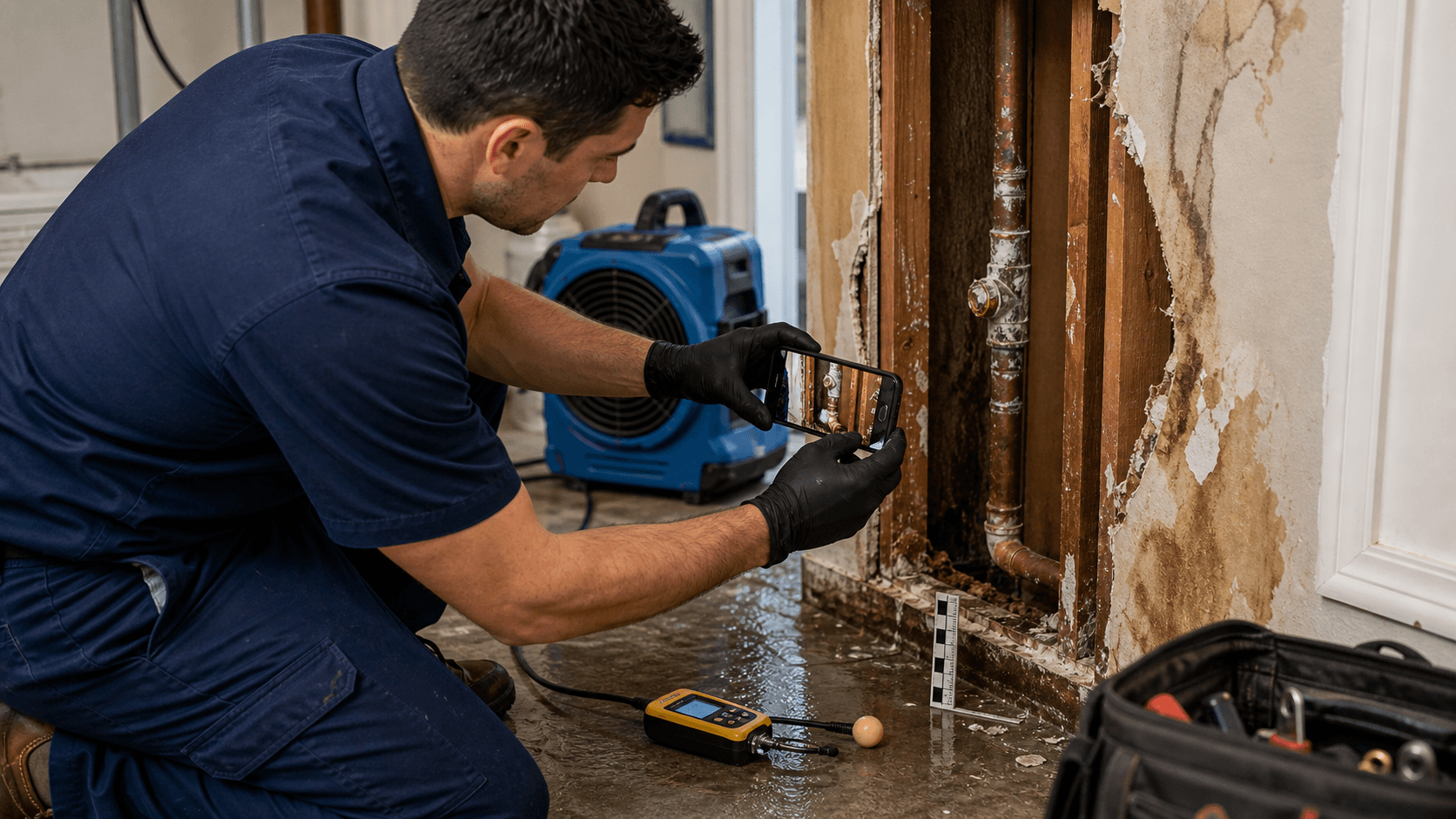
Insurance claims are stronger when the failure, repair, moisture readings, and affected materials are documented.
This happening in your home right now? A licensed plumber can talk you through the next step on the phone — 24/7, and the call is free.
The sudden-and-accidental versus gradual-leak distinction
The single most-litigated phrase in homeowners water-damage claims is 'sudden and accidental.' Sudden means abrupt — the failure happened at a specific moment, not over months or years. Accidental means unintended — not deliberate, not foreseeable, and not the result of neglected maintenance. Failures that meet both tests are typically covered; failures that fail either test are typically excluded.
What 'sudden' actually means. Insurance language distinguishes between a sudden burst (a pipe that was sound yesterday and burst today) and a gradual leak (a fitting that has been weeping slowly for months or years). A pipe that bursts during a cold snap is sudden. A bathroom supply line that has been dripping into a vanity cabinet for 18 months and finally rotted the floor is gradual. The adjuster's job is to determine which category the loss falls into — based on the physical evidence at the scene, the homeowner's description, and the plumber's diagnosis.
The 'within 14 days' rule. Many policies include language about water damage from leaks that occur 'within 14 days' or similar — meaning a leak that started and was discovered within a 14-day window. Leaks that have been ongoing for longer are treated as gradual, even if the discovery is recent. This is why prompt notification matters: a leak discovered today and reported today is presumptively recent; a leak discovered today but with evidence of months of damage is presumptively gradual.
Maintenance exclusions. Standard policies exclude damage from 'wear and tear,' 'deterioration,' 'inherent vice,' and 'neglect.' The interpretation in practice: if the failed component was at end of life and the homeowner reasonably should have known or replaced it, the carrier can argue the loss was foreseeable maintenance, not sudden accident. A 30-year-old galvanized supply line that fails is gray area — see our galvanized supply line guide for the lifecycle context the carrier will be evaluating.
The mixed-cause scenario. The most common contested claim: a fitting fails (sudden) but the resulting water damage is worse because of pre-existing issues (gradual). Example: a supply line bursts during a freeze (sudden), but the wall it floods has had a slow grout leak in the adjacent shower for years (gradual). The carrier may cover the burst damage but exclude the rot from the grout leak. Documentation of when each part of the damage occurred is what separates these claims at adjustment.
Sewer backup specifically. Standard HO-3 excludes sewer or drain backup unless a specific rider was purchased. Sewer/drain backup riders cost roughly $40-$80 per year for $5,000-$25,000 of coverage. In Bellevue's older neighborhoods (Bridle Trails, West Bellevue, Lake Hills, Crossroads — areas with mid-century housing stock and PNW cedar root issues), the sewer backup rider is materially worth the premium. Without it, a sewer backup that destroys a finished basement is a $30,000-$80,000 out-of-pocket loss.
The first call to the carrier — what to say and what not to say
Report the claim within 24-48 hours via the carrier's 24/7 claims line, give an honest factual summary, request the claim number and the adjuster's contact information, ask whether emergency mitigation services are pre-approved, and document the conversation in writing immediately afterward. Don't speculate about cause, don't admit fault, and don't accept any offer to settle on the first call.
Reporting timing. Most policies require notification 'as soon as reasonably possible' — typically interpreted as within 24-48 hours of the loss event. Delays past that window can be cited by the carrier as a reason to reduce or deny the claim, on the theory that the delay made it harder to investigate or allowed damage to worsen. Make the call early. Reporting does not commit you to filing a claim — you can choose to withdraw or not pursue if the damage turns out to be minor and the deductible would exceed the payout.
What to say on the first call. State the date and time of the loss, the source if known (burst pipe, water heater failure, etc.), the approximate scope of damage, what mitigation has been started, and ask for the adjuster's contact information. Provide a callback number where you can be reached. Stay factual.
What not to say. Don't speculate about why the failure happened (the plumber will diagnose that). Don't admit fault or pre-existing conditions ('the pipe was old, it was bound to happen eventually' is the kind of statement that can be used to argue gradual deterioration). Don't accept any settlement offer on the first call — the adjuster hasn't seen the damage yet and any offer at that stage is preliminary.
Document the conversation. Immediately after the call, write down: who you talked to, the claim number assigned, what they told you about next steps, the adjuster's name and contact info, and whether emergency mitigation services are pre-approved. Keep this in the same folder as your photos and other claim documents.
Emergency mitigation pre-approval. Most carriers will pre-approve emergency mitigation up to a stated dollar limit ($5,000-$10,000 is common) without requiring the adjuster to visit first. Confirm this on the first call so the restoration company can begin work immediately. Without pre-approval, you're advancing the mitigation cost yourself and seeking reimbursement, which the carrier may later dispute.
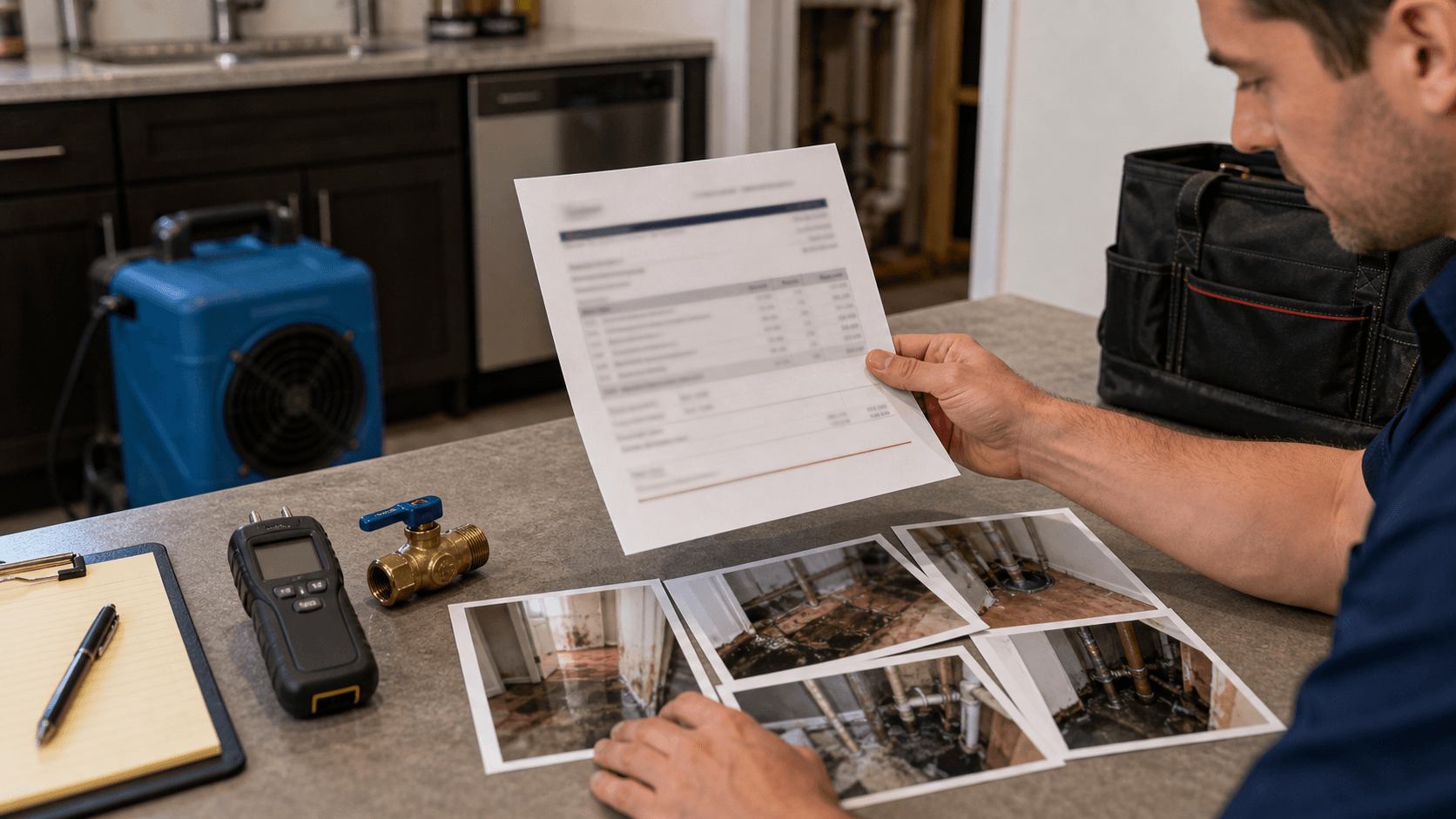
Photos, invoices, readings, and failed parts help explain the timeline to the adjuster.
The adjuster visit and the claim timeline
The adjuster typically visits 2-7 days after the claim is filed, inspects the damage, takes photos, reviews receipts and plumber documentation, and prepares an estimate. First payment for emergency mitigation is often released within 7-14 days of the visit; final settlement typically takes 30-90 days depending on scope and any disputes.
Scheduling the adjuster visit. After the initial claim report, the carrier assigns an adjuster within 1-3 business days. The adjuster contacts you to schedule the inspection, typically 2-7 days out. For very large losses, the carrier may dispatch within 24 hours; for smaller losses or remote areas, the wait can be longer.
What the adjuster does on site. They walk the entire affected area, photograph all damage from multiple angles, measure damaged surfaces (square footage of drywall, flooring, ceiling), inventory damaged personal property, review the plumber's invoice and diagnosis report, and ask questions about the timeline of the failure. The visit typically runs 60-120 minutes for a moderate loss.
Independent vs. staff adjusters. Most carriers use a mix of staff adjusters (employed by the carrier) and independent adjusters (contractors who work for multiple carriers on a per-claim basis). For homeowners purposes, the distinction is minor — both have similar authority on routine claims. For very large claims (over $50,000-$100,000), a public adjuster (hired by the homeowner, paid as a percentage of the settlement) can be worth considering. Public adjusters typically take 8-15 percent of the settlement and are most useful on complex or contested claims.
The estimate. After the visit, the adjuster prepares an itemized estimate using construction-cost software (Xactimate is the industry standard). The estimate covers dwelling damage (drywall, flooring, painting, etc.), personal property damage, and additional living expenses if applicable. You receive a copy and can dispute specific line items.
Payment timing. Most carriers release emergency mitigation funds within 7-14 days of the adjuster visit (a 'first check' covering immediate mitigation costs). The remainder is paid as work is completed and invoices are submitted, or as a single settlement check for the estimated repair cost. Total claim resolution from filing to last check is typically 30-90 days for routine claims, longer for disputed claims or large losses requiring multiple inspections.
Communication during the process. Keep written records of every communication with the adjuster. Confirm verbal agreements in follow-up email. Note dates, names, and what was agreed. This documentation matters if the claim is later disputed or if the adjuster changes mid-claim (which happens, especially on large claims).
Documentation that maximizes the claim outcome
The single most-impactful homeowner action during a claim is thorough documentation: photos of every damaged item before mitigation, photos during mitigation, the licensed plumber's written diagnosis and invoice, the restoration company's scope and invoice, receipts for every emergency expense, and a written timeline of the loss event. Carriers pay claims that are well-documented and dispute claims that aren't.
Documentation checklist for a Bellevue water-damage claim:
Photos of every damaged item, room, surface — multiple angles, in good light, before mitigation removes evidence
Photos during mitigation — drying equipment in place, removed drywall, exposed framing
Photos after mitigation, before repair work begins
Photos at each stage of repair work
The licensed plumber's written diagnosis identifying the source, the failure mode, the cause, and the repair scope
The plumber's invoice with line-item costs
The restoration company's signed scope of work, invoice, and equipment-rental records
Receipts for any emergency purchases — fans, dehumidifiers, temporary plumbing fixtures
Receipts for hotel, rental car, restaurant meals if displacement is needed (loss of use coverage)
Written timeline: when the failure was discovered, when the shutoff was operated, when the plumber arrived, when mitigation started
Personal property inventory with approximate values — written within days of the loss while memory is fresh
Pre-loss photos if available (real estate listing photos, holiday photos showing rooms in normal condition)
The plumber's diagnosis is the most-leveraged single document. A written diagnosis that clearly states the failure was sudden — 'pipe burst at fitting due to freeze event,' 'water heater tank ruptured at base seam,' 'supply line failed at compression fitting' — locks in the sudden-and-accidental classification before the adjuster has a chance to push gradual. A vague diagnosis ('water observed from supply piping') leaves the door open for the adjuster to characterize the cause.
Pre-loss photos are surprisingly valuable. Many homeowners have photos of rooms in normal condition from holidays, real estate listings, or remodel documentation. These photos establish the pre-loss state of the property and help defend against carrier arguments that damage was pre-existing. Save a 'pre-loss baseline' photo set of every room in your home; refresh it every 2-3 years.
Working with restoration companies — scope, billing, and the plumber's role
Restoration companies handle the drying, drywall removal, mold prevention, and reconstruction after a water-damage event. Most work on direct-bill arrangements with major carriers — meaning the restoration company invoices the carrier directly rather than the homeowner paying out of pocket. The plumber and the restoration company are different trades; coordinating them is the homeowner's responsibility unless one is engaged through the other.
What restoration companies do. The water-damage restoration industry follows the IICRC S500 standard, which defines categories of water damage and the appropriate response. They deploy commercial-grade dehumidifiers and air movers, remove wet drywall and flooring, treat exposed framing with antimicrobial agents, monitor moisture levels, and document the drying process. After drying is complete, they handle reconstruction — replacing drywall, flooring, paint, and trim.
Direct billing. Most major restoration companies in the Seattle area (ServPro, ServiceMaster, Restoration 1, Rainbow International, plus regional specialists) have direct-billing relationships with major carriers (State Farm, Allstate, Liberty Mutual, USAA, Farmers, Pemco, Mutual of Enumclaw, and others). Direct billing means the company invoices the carrier; the homeowner is responsible only for the deductible. Confirm direct-billing arrangement at the first call to the restoration company — if they don't direct-bill your carrier, you're paying out of pocket and seeking reimbursement.
Choosing a restoration company. The carrier often has 'preferred' restoration vendors. You're not required to use them — you can choose your own — but using a carrier-preferred vendor streamlines the direct-billing process. If you choose your own, confirm they'll direct-bill before they start work. Three quotes is not standard for restoration; the carrier wants emergency mitigation started immediately, so 'lowest of three quotes' is not how this trade works.
The plumber/restoration handoff. The plumber's job is to fix the source — stop the water, repair the pipe, replace the failed component. The restoration company's job is to deal with the resulting damage — drying, demolition, reconstruction. Both have to operate in coordination. In practice, the plumber finishes first (usually within 1-2 days of the event); the restoration company is on-site for 5-14 days of drying followed by reconstruction work that can take 2-8 weeks. Homeowners coordinate the schedule unless they're using a single 'one-stop' provider that does both trades.
Depreciation, ACV vs. RCV, and what 'replacement cost' actually means
Homeowners policies pay damaged property as either Actual Cash Value (ACV — replacement cost minus depreciation) or Replacement Cost Value (RCV — full replacement cost without depreciation). RCV policies pay in two stages: the ACV upfront, and the depreciation 'holdback' after the homeowner completes repairs and submits receipts. Knowing which type you have determines whether you receive 60 percent or 100 percent of repair cost.
ACV vs RCV by example. A 15-year-old kitchen floor is damaged. Replacement cost is $4,000. ACV (with 40 percent depreciation) is $2,400. RCV is $4,000, but paid in two checks: $2,400 immediately as ACV, and the $1,600 depreciation 'recoverable' after the homeowner completes the repair and submits the receipt.
Which type your policy is. RCV is the modern standard for dwelling coverage on most policies. Personal property is more varied — some policies cover personal property at ACV by default, with RCV available as a rider. Check your declarations page for both Coverage A (dwelling) and Coverage C (personal property). The difference can be thousands of dollars on a large claim.
The depreciation recovery process. After the adjuster's estimate, you receive the ACV portion of the payment. You complete the repairs and submit final invoices showing actual cost. The carrier reimburses up to the original estimate (capped at the policy limit). If actual cost exceeds the estimate, you may need to submit a supplemental claim with supporting documentation.
Depreciation disputes. Carriers and homeowners often dispute the depreciation percentage applied to specific items. The depreciation rate should reflect actual condition, not just age — a well-maintained 15-year-old floor depreciates differently from a poorly-maintained one. Photos showing pre-loss condition are the homeowner's strongest argument for lower depreciation. Per the emergency plumber cost guide, the carrier's depreciation on plumbing components is usually less contested than on finish surfaces because plumbing components have well-documented service lives.
Holdback strategy. Some homeowners stop after receiving the ACV check, accepting the loss as their share. RCV policies provide the full repair value only if you actually complete the repairs. If you intend to live with partial damage or do partial repair, you're leaving the depreciation portion on the table. For most claims over $5,000, completing the repairs and collecting the depreciation makes financial sense.
Claim impact on premiums and the carrier non-renewal risk
A single water-damage claim typically increases the homeowner's premium by 9-20 percent at the next renewal. Two claims in five years can trigger non-renewal by the current carrier and difficulty finding replacement coverage. The decision to file a small claim should factor this in — the deductible plus a 3-year premium increase often exceeds the claim payment for losses under $5,000.
Premium increase math. After a water-damage claim, the homeowner's risk profile changes in the carrier's underwriting model. The typical premium increase is 9-20 percent at the first renewal after the claim, persisting for 3-5 years before reverting. For a $1,800 annual premium, that's $160-$360 per year for 3-5 years — $480-$1,800 in cumulative increase.
Small-claim economics. A $3,500 claim minus a $1,500 deductible nets $2,000 in payment. If the resulting premium increase costs $1,200 over three years, the net benefit is $800 — and that's before considering the increased non-renewal risk. The break-even point for filing varies by deductible and carrier, but as a rule of thumb, claims under $3,000-$5,000 may not be worth filing if you can self-pay.
Non-renewal triggers. Carriers vary in their non-renewal practices, but two water claims in a 3-5 year period often triggers non-renewal. Once non-renewed, the homeowner enters the non-standard market (Lloyd's of London, surplus-lines carriers, or — in extreme cases — the Washington FAIR Plan). Premiums in the non-standard market run 1.5-3x standard market rates.
Washington Office of the Insurance Commissioner. If a carrier non-renews you or denies a claim that should have been covered, the OIC accepts complaints and investigates. Washington's bad-faith standards are reasonably strong for consumers — the carrier owes a duty of good faith and fair dealing, and breaches can be cited in litigation. The OIC complaint process is free and online: insurance.wa.gov.
Public adjusters and attorneys. For large claims where the carrier's offer is substantially below the actual damage, hiring a public adjuster (8-15 percent of settlement) or a coverage attorney can be worthwhile. Public adjusters work the claim itself; attorneys come in when the claim is denied or substantially disputed. The threshold for hiring outside help is usually claims over $30,000-$50,000 where the carrier's offer is more than 30 percent below the actual loss.
When the carrier denies a claim that should have been covered
Denied claims aren't always final. The first step is requesting the denial in writing with specific policy language cited. If the denial is based on disputed facts (was it sudden or gradual?), additional documentation from the plumber and restoration company may resolve the dispute. If the denial is based on a policy interpretation, an OIC complaint or coverage attorney is the next step.
Get the denial in writing. Verbal denials don't create a paper trail. Request a formal written denial citing the specific policy section the carrier relies on. Most carriers will provide this within 30 days of request. The written denial is the document everything else builds on.
Address factual disputes first. If the carrier characterized the loss as gradual when it was sudden, the response is more evidence: a more detailed plumber's diagnosis, additional photos showing the freshness of the damage, witness statements from neighbors or family members about the timeline. Many denied claims are reversed at this stage when the homeowner provides additional documentation.
Address coverage disputes second. If the disagreement is about what the policy covers (rather than what happened), the conversation moves to policy interpretation. Get a copy of the full policy (the declarations page is not enough — you need the full policy form). Read the relevant sections. Many policy disputes turn on a phrase that can be reasonably read either way; the principle in Washington courts is that ambiguous policy language is construed in favor of the insured.
File an OIC complaint. The Washington Office of the Insurance Commissioner has a formal complaint process. File online at insurance.wa.gov. The OIC investigates and can apply regulatory pressure on the carrier — they don't directly decide your claim, but they can flag bad-faith conduct that influences the carrier's behavior. The complaint process is free.
Hire a coverage attorney. For substantial disputes (claims over $30,000-$50,000 with significant denied portions), a coverage attorney is the right escalation. Most coverage attorneys work on contingency for plaintiff cases, meaning no upfront cost. Washington bar referral services connect homeowners with attorneys; first consultations are typically free.
Sources
Every fact in this guide cites a verifiable public source. If you find a number we got wrong, email dispatch@bellevueplumberpro.com.
Bellevue water damage insurance claims — questions homeowners ask
QUESTION01
Does homeowners insurance cover plumbing leaks?
A standard Washington HO-3 policy covers sudden and accidental water damage from plumbing failures — the resulting damage, not the plumbing repair itself. Gradual leaks and long-term deterioration are excluded.
QUESTION02
What does 'sudden and accidental' mean in a water damage claim?
Sudden means the failure happened at a specific moment, not over months. It's the single most-litigated phrase in water-damage claims — a burst supply line qualifies; a pipe that corroded and seeped for a year usually does not.
QUESTION03
How do I file a water damage insurance claim?
Report within 24–48 hours via the carrier's claims line, give an honest factual summary, get the claim number and adjuster contact, and document everything with photos before cleanup begins.