How much does sewer line replacement cost?
Roughly $50 to $250 per linear foot nationally. On the Eastside, trenchless replacement typically runs $6,000 to $12,000, open-trench $7,000 to $25,000, and a single-section spot repair $2,800 to $4,800.
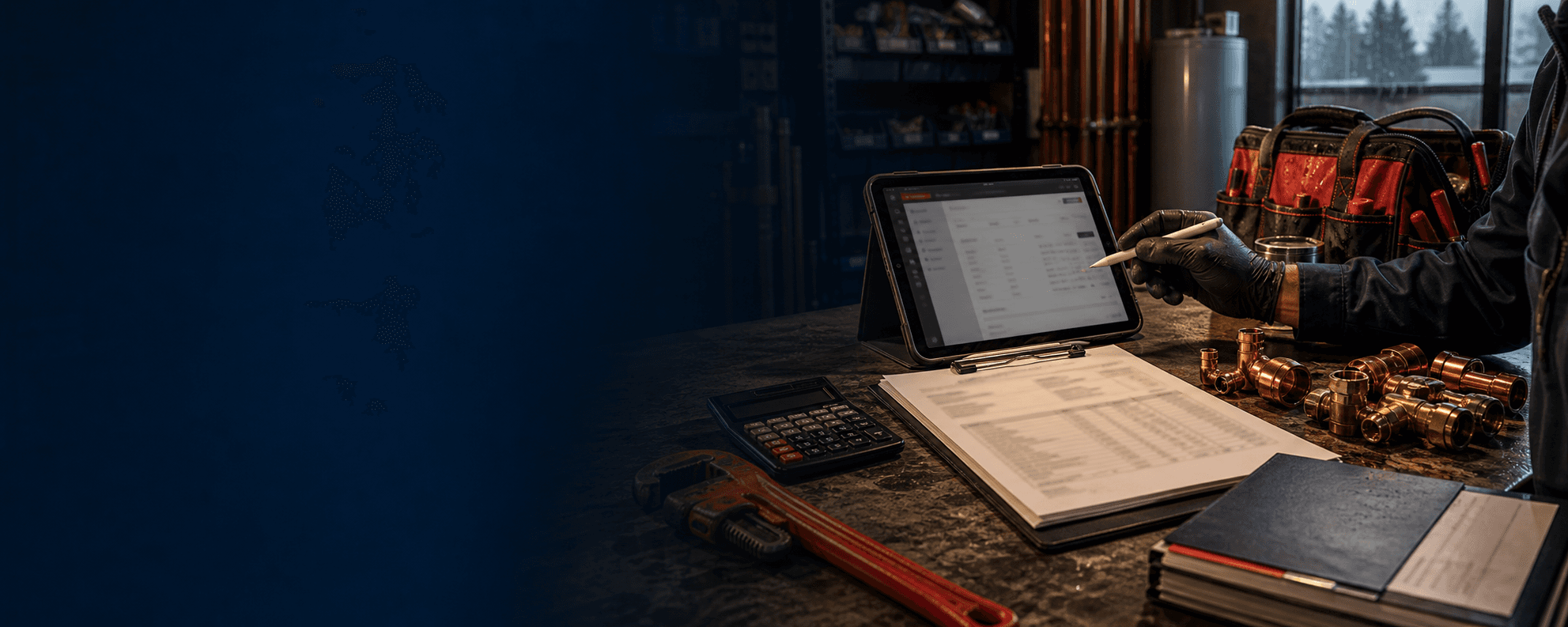
Sewer line replacement is one of the largest plumbing expenses a homeowner faces, and the price swings widely with method, length, depth, and how much the surface has to be restored. Nationally the work runs about $50 to $250 per linear foot, per Angi. On the Eastside, the practical ranges are roughly $6,000 to $12,000 for trenchless replacement, $7,000 to $25,000 for open-trench, and $2,800 to $4,800 for a spot repair of a single damaged section. Trenchless methods — pipe bursting and cured-in-place lining — cost more per foot than digging but usually less in total, because the swing cost in any sewer job is surface restoration: the lawn, driveway, patio, or landscaping that an open trench tears up and has to be rebuilt. The one non-negotiable before any replacement quote is a camera inspection; a contractor who quotes a full replacement without showing you footage is guessing. In Bellevue the work needs a side-sewer permit and the right licensed contractors, and the dominant local cause of failure is cedar and Douglas fir root intrusion into aging laterals. This guide breaks down the costs, the methods, the cost drivers, the permit picture, and the Eastside root angle.
Last reviewed: 2026-08-22
About $50 to $250 per linear foot nationally. On the Eastside, trenchless typically runs $6,000 to $12,000, open-trench $7,000 to $25,000, and a single-section spot repair $2,800 to $4,800.
Sewer line replacement is the removal or re-lining of the side sewer — the homeowner-owned pipe that runs from your foundation to the city main under the street, including the stretch beneath the sidewalk and planting strip. Cost is best understood at two scales: a national per-foot rate and the realistic total ranges for an Eastside job. Nationally, the work runs about $50 to $250 per linear foot according to Angi, and that wide band already tells you the price depends heavily on the specifics — the low end is a shallow, straightforward run, the high end a deep line under hardscape with heavy restoration. Multiply by a typical residential lateral length and you arrive at totals in the thousands to tens of thousands.
For Bellevue and the Eastside specifically, the practical total ranges are the more useful numbers. A trenchless replacement — pipe bursting or cured-in-place lining — typically runs about $6,000 to $12,000. A traditional open-trench replacement, where the line is dug up and replaced, runs about $7,000 to $25,000. A spot repair, which fixes a single damaged section rather than the whole run, runs about $2,800 to $4,800. These are the figures this site uses for Eastside work, and they bracket the great majority of residential jobs.
The reason the ranges are so broad is that no two sewer jobs are the same. The length of the lateral, how deep it is buried, how much of it is damaged, whether the soil and access are easy or hard, and above all how much surface has to be restored afterward all move the number within these bands. A short, shallow trenchless reline of an otherwise intact pipe sits near the bottom; a long, deep open-trench replacement under a driveway and mature landscaping sits near the top.
What matters most for a homeowner is not memorizing a single number but understanding what determines where a given job lands, so a quote can be judged rather than just accepted. The sections that follow break down trenchless versus open-trench, the specific factors that drive the cost up or down, why a camera inspection has to come first, when a spot repair beats a full replacement, the Bellevue permit picture, and the Eastside root cause that puts so many laterals on the replacement list in the first place.
This happening in your home right now? A licensed plumber can talk you through the next step on the phone — 24/7, and the call is free.
Call a plumberTrenchless (pipe bursting or cured-in-place lining) replaces the pipe with little digging; open-trench digs the whole line up. Trenchless costs more per foot but often less in total, because restoration is the swing cost.
The two ways to replace a sewer line differ mainly in how much of your yard they destroy to do it. Open-trench replacement is the traditional method: the line is excavated along its full length, the old pipe removed, new pipe laid, and the trench backfilled. Trenchless replacement does the job through small access points instead of a continuous trench — either pipe bursting, which pulls a new pipe through the old one while fracturing the old pipe outward, or cured-in-place lining (CIPP), which inserts a resin sleeve inside the existing pipe and cures it into a new pipe within the old.
On a per-foot basis, trenchless methods cost more than digging, because the equipment and materials are more specialized. But on a total-job basis, trenchless is often cheaper, and the reason is restoration. An open trench tears up everything above the line — lawn, driveway, patio, walkways, mature landscaping — and all of that has to be rebuilt afterward, which can cost as much as the pipe work itself. Trenchless needs only small access pits, so it leaves the surface largely intact and skips most of that restoration bill.
Restoration is therefore the swing cost that usually decides which method is cheaper overall. A line running under bare lawn that is cheap to re-sod may be no more expensive to open-trench than to reline; a line running under a concrete driveway, a paved patio, or expensive landscaping is far cheaper trenchless, because not having to demolish and rebuild that surface saves thousands. The more valuable and harder to restore the surface above the line, the more trenchless pulls ahead on total cost.
Trenchless is not always possible, though, and that is the catch. Pipe bursting and lining need a line whose geometry and condition allow it — a reasonably straight run without severe collapses, sharp offsets, or back-pitched bellied sections that lining cannot correct. When the camera shows a line too damaged or too poorly graded for a trenchless method to work, open-trench becomes the necessary choice despite the higher restoration cost. The camera inspection is what determines which path a given line can take.
Length, depth, the amount of root or structural damage, bad joints, soil and access difficulty, and above all surface restoration — the lawn, driveway, or patio that an open trench tears up and has to rebuild.
Several factors move a sewer replacement within its broad range, and length and depth are the most basic. A longer lateral means more pipe, more labor, and more linear feet at the per-foot rate; a deeper line means more excavation, more shoring, and harder access to the pipe. A short, shallow lateral is near the bottom of the range; a long lateral buried several feet down runs toward the top simply because there is more material to move and more pipe to replace.
The condition of the existing line is the next driver. A line with a single bad joint or one cracked section may need only a spot repair, while a line with distributed damage — multiple bad joints, widespread root intrusion, a bellied or collapsed section, deteriorated Orangeburg — needs a full replacement and may rule out the cheaper trenchless methods. The more extensive and the more structural the damage the camera reveals, the more the job costs, because more of the line has to be replaced and the method options narrow.
Soil and access conditions add or subtract cost in ways that are easy to overlook. A line under loose, easy-to-dig soil with clear access is cheaper to work than one under rock, a high water table, or a tight side yard a machine cannot reach; the harder the dig and the more obstructed the access, the more labor and equipment time the job takes. These site factors do not change the length of pipe but can substantially change what it costs to get to it.
Surface restoration is the single biggest swing, and it is why the same length of pipe can cost wildly different amounts. Replacing a line under bare lawn means re-grading and re-seeding; replacing one under a driveway, patio, retaining wall, or established landscaping means demolishing and rebuilding all of it. That restoration can rival the cost of the pipe work, which is exactly why trenchless — minimizing surface disruption — so often wins on total cost when valuable hardscape sits above the line.
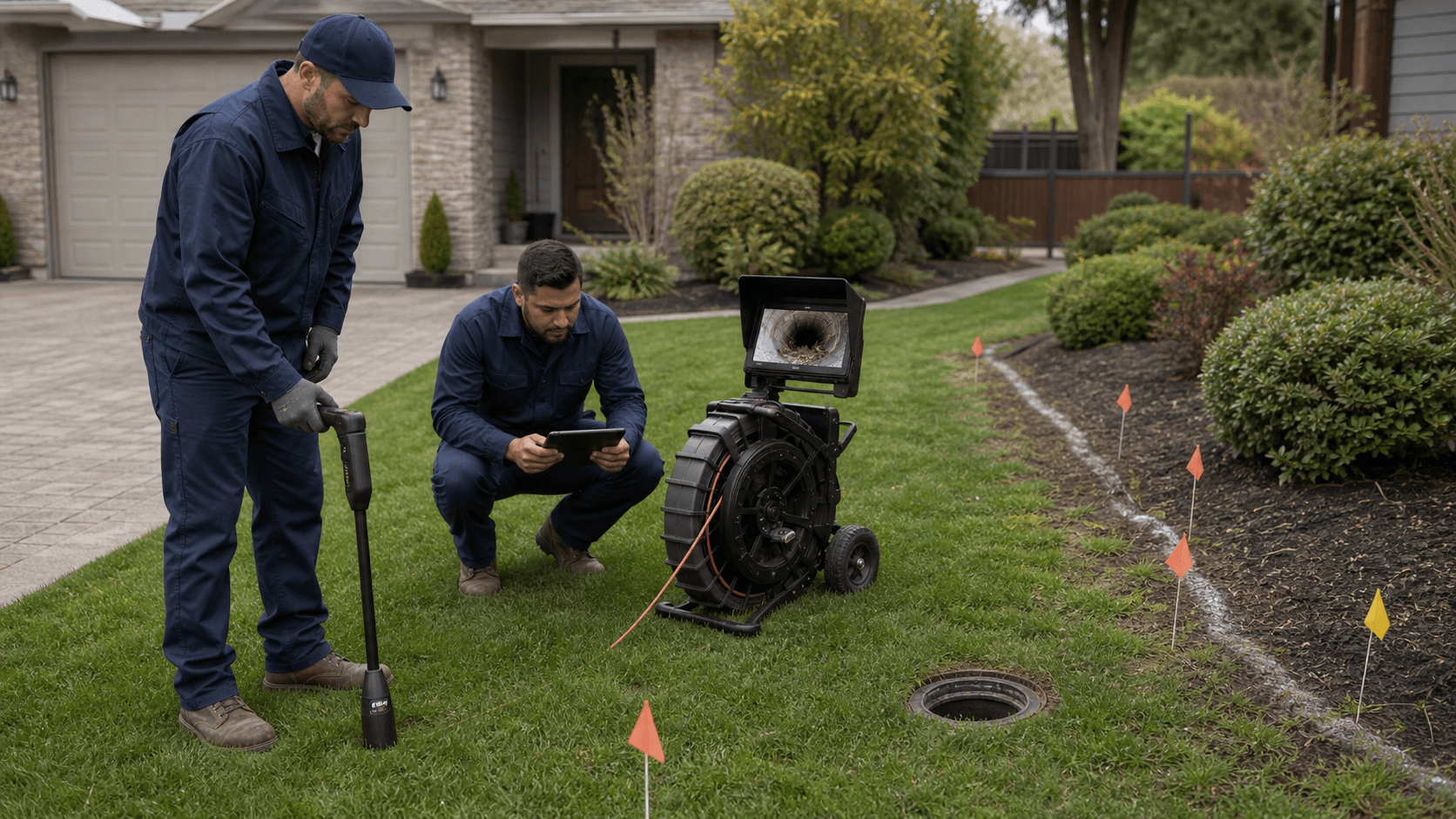
Pipe bursting pulls a conical steel bursting head through the old pipe behind a hydraulic winch, fracturing it outward while dragging fused HDPE pipe in its wake. Cured-in-place lining inverts a resin-saturated felt liner through the old pipe and cures it with hot water or steam into a seamless new pipe. Open-trench uses an excavator and new PVC/ABS laid at grade.
"A replacement quote without footage is a guess with a bigger number," says the sewer lead on our dispatch line. "The camera picks the method, the method picks the equipment, and the equipment is what you're actually paying for."
Trenchless equipment is why trenchless costs more per foot — and why it skips most of the restoration bill that makes open-trench totals climb.
Five steps: a pre-quote camera inspection with locator, a flat-rate written quote naming the method and footage, the City of Bellevue side-sewer permit, the replacement itself (one to three days depending on method and length), and the city inspection that closes the permit.
What the project looks like:
A properly replaced PVC or HDPE lateral needs almost nothing — a camera check at year 2 to confirm grade and joints, then every 5 or so years. Lines with mature cedars or firs still within root reach benefit from an enzymatic root-inhibitor foam on an 18–24 month cycle; nothing flushable and no grease, ever.
The maintenance picture inverts after replacement: the old line failed because of roots and joints, and the new materials eliminate both failure modes. The remaining risks are grade (bellies from soil settlement) and what goes down the drain. Our sewer line cleaning guide has the interval detail, and cedar roots in Eastside sewer lines explains why the tree side of the risk doesn't disappear just because the pipe is new.
Never accept a full-replacement quote without a camera inspection. A contractor who quotes thousands of dollars of replacement without showing you footage of the actual damage is guessing — or selling you more than you need.
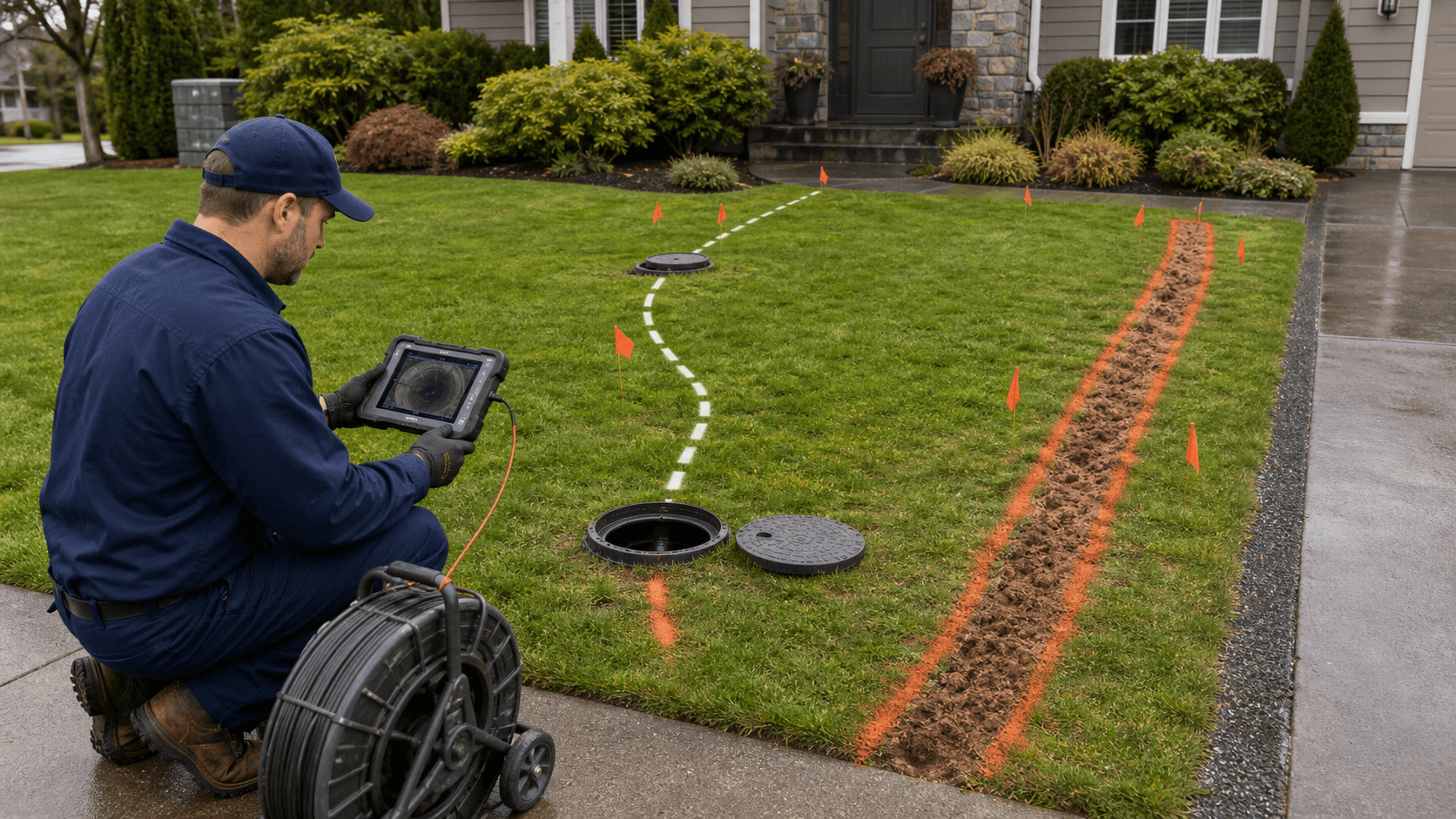
The most important rule in sewer line pricing is that a camera inspection comes before any replacement quote, every time. A sewer line is buried and invisible, so the only way to know what is actually wrong with it — roots, a cracked joint, a bellied section, a collapse, or simply a dirty but sound pipe — is to run a camera through it and look. A quote written without that footage is, by definition, a guess about a pipe nobody has seen inside.
This matters because the difference between what the camera might show spans the entire price range. The same symptoms can come from roots in an otherwise sound pipe (a cleaning, a few hundred dollars), a single bad joint (a spot repair, a few thousand), or distributed failure (a full replacement, many thousands). A contractor who skips the camera and jumps to a full-replacement quote is either guessing high or steering you toward the most expensive option without evidence that you need it.
A camera inspection also gives you the footage to judge the quote and to get a meaningful second opinion. When you can see the roots, the crack, or the belly on the screen, and the plumber notes the location and extent, you can match the recommended repair to the actual damage — and a second company can review the same evidence rather than starting blind. What a camera inspection shows and how to read it is covered in our sewer camera inspection guide.
The practical safeguard is simple: insist on seeing the footage before agreeing to any major sewer work, and treat a refusal to camera-first or to share the recording as a red flag. A reputable plumber cameras the line, shows you what is wrong, and recommends the least invasive repair that actually fixes it. A replacement quote with no footage behind it is the clearest sign that you are being asked to pay for a guess, and the right response is to get a quote from a company that will inspect first.
A spot repair fixes a single damaged section for about $2,800 to $4,800; a full replacement redoes the whole run. The camera decides: localized damage means spot repair, distributed damage means replacement.
Not every failing sewer line needs to be replaced end to end, and the choice between a spot repair and a full replacement is one of the biggest cost decisions in the job. A spot repair targets a single damaged section — one cracked joint, one root-invaded spot, one broken length — and leaves the rest of the otherwise-sound line in place. On the Eastside that runs about $2,800 to $4,800, a fraction of a full replacement, which is why it is the right answer when the damage is genuinely localized.
A full replacement is warranted when the damage is distributed rather than confined to one spot. A line with root intrusion at many joints, multiple cracks, a bellied or collapsed section, or a deteriorating pipe material like Orangeburg that is failing along its length cannot be saved by patching one section, because the next failure is already developing elsewhere. Replacing the whole run — trenchless if the geometry allows, open-trench if not — is the durable fix when the line is failing as a whole.
The camera inspection is what decides between the two, which is another reason it has to come first. The footage shows whether the damage is one discrete section or scattered along the line, and that distinction maps directly onto the price: localized damage means a spot repair, distributed damage means a replacement. A homeowner who has seen the footage can tell whether a replacement quote is justified by widespread damage or whether a spot repair would actually solve the problem.
The risk to watch for is a replacement recommended when the camera shows only localized damage or roots in a sound pipe. Roots in an otherwise structurally intact line should be cleaned and prevented, not replaced; a single bad joint should be spot-repaired, not used to justify redoing the whole run. When a quote escalates to full replacement without distributed structural damage to back it up, it is optimizing the contractor's revenue rather than your repair, and a footage-backed second opinion is worth getting.
Yes — replacing a side sewer in Bellevue requires a side-sewer permit and the proper licensed and registered contractors. The permit and inspection are part of a legitimate job, not optional add-ons.
Replacing or repairing a sewer line in Bellevue is permitted work, not something a homeowner or contractor can simply do unannounced. The line from the house to the public sewer is the side sewer, and work on it requires a side-sewer permit through the City of Bellevue, along with the proper licensed and registered contractors to perform it. The permit exists because the side sewer connects to the public system, and the city has an interest in seeing that the connection and the work meet code.
The contractor side matters as much as the permit. Side-sewer work generally calls for a licensed plumber and, for the excavation and connection to the public main, a contractor registered to do side-sewer work — the specific registrations are how the city ensures the people digging up and reconnecting a sewer are qualified and accountable. A legitimate quote includes pulling the permit and arranging the required inspection, and a contractor who proposes to skip the permit is cutting a corner that can leave you with unpermitted, uninspected work.
The permit and inspection are protections for the homeowner, not bureaucratic friction. The inspection confirms the new line is properly graded, correctly connected, and bedded so it will not sag or fail prematurely, and a permitted, inspected sewer replacement is documented work that holds up at resale and with insurers. Unpermitted sewer work, by contrast, can become a problem when a home is sold or when a later failure raises questions about who did the work and whether it was done right.
Permit fees vary and are set by the city, so the right move is to confirm the current side-sewer permit requirements and cost with the City of Bellevue directly rather than relying on a fixed figure. What is consistent is that the permit and the proper licensed and registered contractors are part of doing the job correctly. A compliant sewer replacement that includes the permit, the right contractors, and the inspection is handled as sewer line repair and replacement in Bellevue.
On the Eastside, the dominant cause of sewer line failure is cedar and Douglas fir root intrusion into aging clay and cast-iron laterals — which is why replacement comes up so often here.
The reason sewer line replacement comes up as often as it does on the Eastside is not random wear; it is a specific local combination of old pipe and aggressive trees. Much of Bellevue's housing stock predates 1980 and runs on clay, cast-iron, or Orangeburg laterals that are now decades past their best years, and the region's mature western red cedars and Douglas firs have lateral root systems that actively seek out the small flaws in those aging pipes. The result is a chronic root-intrusion problem that drives a large share of the sewer work in the area.
Roots turn a small flaw into a failing line over time. A root hair finds a crack or loose joint, grows in, and thickens into a fibrous mass that both blocks the pipe and widens the very crack it entered through, while catching debris into a clog. Cleaned but not addressed, the roots regrow; left long enough, the cracking and the repeated intrusion compromise the pipe structurally until cleaning no longer holds and replacement becomes the answer. The biology and the warning signs are detailed in our cedar and fir root intrusion guide.
Whether a root-affected line needs replacement or just maintenance depends on the pipe's condition, which is why the camera and the cleaning method matter. Roots in a structurally sound pipe can often be cleared and prevented rather than replaced, and the choice between cabling and jetting them is covered in our hydro jetting versus cabling guide. It is when the roots have come with distributed cracking, bad joints, or a deteriorating pipe material that the line moves onto the replacement list.
For an Eastside homeowner pricing a sewer replacement, the root angle is the context that explains both the diagnosis and the cost. A camera that shows roots plus distributed damage in an old clay or Orangeburg lateral is the common path to a replacement quote here, and the choice of trenchless or open-trench then turns on the line's geometry and what sits above it. The whole job — diagnosis, method, permit, and the work itself — is handled as sewer line repair and replacement in Bellevue.
In Bellevue, trenchless typically runs $6,000 to $12,000 and open-trench $7,000 to $25,000; trenchless is usually cheaper overall; the per-foot rate is $50 to $250; you need a permit; camera first.
In Bellevue, a sewer line replacement typically runs about $6,000 to $12,000 trenchless and $7,000 to $25,000 open-trench, with a single-section spot repair around $2,800 to $4,800. Where a given job lands depends on the length and depth of the line, how much of it is damaged, the soil and access, and above all how much surface — lawn, driveway, patio, landscaping — has to be restored afterward. The national per-foot rate behind those totals is about $50 to $250 per linear foot, per Angi.
Yes, trenchless is usually cheaper overall even though it costs more per foot, because the swing cost in any sewer job is surface restoration. Trenchless replacement works through small access pits and leaves the lawn, driveway, and landscaping largely intact, so it skips the demolish-and-rebuild bill that an open trench creates. The more valuable and harder to restore the surface above the line, the more trenchless pulls ahead — though it is only possible when the line's geometry and condition allow pipe bursting or lining.
Yes, you need a permit to replace a sewer line in Bellevue: a side-sewer permit and the proper licensed and registered contractors, with an inspection as part of the job. The permit and inspection protect the homeowner by confirming the line is correctly graded and connected, and permitted work holds up at resale and with insurers. Permit fees are set by the city and vary, so confirm the current requirement and cost with the City of Bellevue rather than assuming a fixed figure.
What makes a sewer replacement expensive is length, depth, the extent of damage, hard soil or access, and surface restoration — and a camera inspection should always come before any replacement quote, because it is the only way to know what is actually wrong. A contractor quoting a full replacement without showing you footage is guessing; insist on seeing the camera footage and get a footage-backed second opinion. Whether insurance covers it depends on your policy — many exclude gradual wear and tear like root damage, so check your specific coverage. The job is handled as sewer line repair and replacement in Bellevue.
Every fact in this guide cites a verifiable public source. If you find a number we got wrong, email dispatch@bellevueplumberpro.com.
Need help with this in your home? See our Sewer line repair and replacement in Bellevue page for pricing, our diagnostic process, and how same-day service works across the Eastside.
Related services: 24/7 Emergency Plumbing, and Water Heater Repair and Replacement.
Roughly $50 to $250 per linear foot nationally. On the Eastside, trenchless replacement typically runs $6,000 to $12,000, open-trench $7,000 to $25,000, and a single-section spot repair $2,800 to $4,800.
More per foot, but often less in total. Surface restoration — the lawn, driveway, or patio an open trench destroys and rebuilds — is the swing cost, and trenchless avoids most of it with two small pits instead of a full dig.
If the damage is localized, yes — a spot repair fixes one section for $2,800 to $4,800. Distributed damage across the run means full replacement. The camera footage decides which situation you're in.
Always. Never accept a full-replacement quote without seeing camera footage of the actual damage — a contractor quoting thousands without footage is guessing, or selling more than you need.