Home/Learn/Sewer lines/Sewer camera inspection cost in Bellevue: what it shows, what you pay, and when you need one
Sewer
Sewer camera inspection cost in Bellevue: what it shows, what you pay, and when you need one
A sewer camera inspection runs a self-leveling video camera on a fiberglass-reinforced push rod through your sewer lateral and shows you exactly what's inside — root intrusion, cracks, bellies, offsets, collapses, or deteriorated Orangeburg pipe. In Bellevue, a residential inspection costs $250 to $400 and takes 15 minutes to an hour. The technology has been standard since RIDGID introduced the first SeeSnake in 1996, and modern systems include distance counters and sonde locators that let the plumber mark the exact spot above ground where a problem sits. This guide explains what the camera actually finds, what an inspection costs in the Eastside in 2026, when it's essential (real-estate purchase, before any major repair quote, recurring backups), and how to use the findings to make an honest repair decision instead of accepting an inflated quote.
A sewer camera inspection is a 15-to-60 minute procedure where a plumber pushes a fiberglass-reinforced cable tipped with a waterproof self-leveling video camera through your sewer line, records the footage, and locates any problem to within a few feet using an above-ground sonde locator.
The camera head is small (around 1 to 1.5 inches diameter for residential work) and waterproof. It feeds through a flexible push rod up to 325 feet long, navigates 90-degree bends, and sends a live video signal back to a monitor at the operator's end. Modern systems record digitally to USB or upload to cloud storage for the homeowner to keep.
Two pieces of information come back: the video footage itself (showing exactly what's inside the pipe), and the precise location of any defect — both depth below ground and distance from the cleanout. Distance counters built into the push rod track footage automatically; sonde locators above ground pick up a signal from the camera head and let the operator mark the exact spot in your yard where, say, a root mass sits 14 feet from the cleanout at 6 feet deep.
That precision changes the repair conversation. Instead of vague quotes about replacing the whole line, you get a quote for fixing the specific defect at the specific location — usually a fraction of the cost. The full diagnostic-first methodology and what to do with the findings is covered in our cedar and Douglas fir roots in Eastside sewer lines guide.
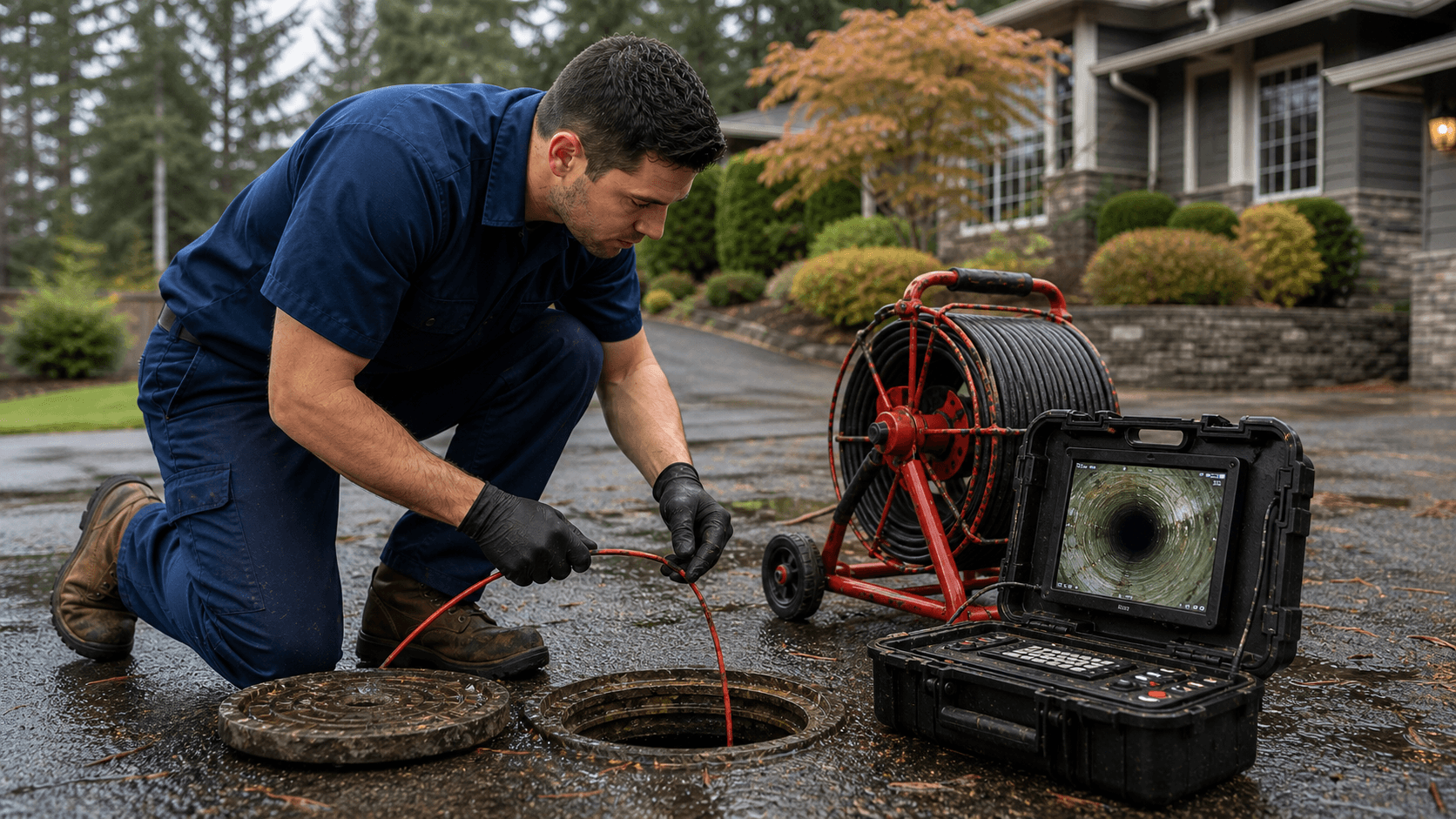
A sewer camera shows pipe material, slope, roots, breaks, and blockage location before quoting repair.
This happening in your home right now? A licensed plumber can talk you through the next step on the phone — 24/7, and the call is free.
What a sewer camera inspection costs in Bellevue (2026)
A residential sewer camera inspection in Bellevue costs $250 to $400 in 2026, with $300 being the typical median. Homes without an accessible cleanout add $175 to $750 because the plumber has to create access first.
National data and Seattle-area service providers consistently put the residential range at $250-$400 for a straightforward inspection through an existing cleanout. The variation reflects three factors:
Access point. A 4-inch exterior cleanout (the most common access) keeps the cost low. Pulling a toilet to access from inside, or opening the roof vent to drop the camera, adds $100 to $300 in labor.
Line length. Most residential sewer laterals run 40 to 80 feet from house to street main. Longer runs (waterfront lots, deep setbacks) take more time and reach the upper end of the price range.
Distance covered. Some plumbers price per-foot beyond a base; others price flat for the typical residential run. Confirm structure before booking.
Add-on services. Pulling a written report with footage on USB or cloud: usually included. Marking defect locations in the yard with paint: usually included. Recommending repair scope: included. Locating the line entirely (mapping the whole path): may add $100-$200.
Two cost contexts worth knowing. First, sewer scope as a real-estate-purchase add-on bundled with a home inspection runs cheaper — $100 to $250 — because the inspector is already on-site. Second, emergency camera inspection (called specifically for a 2am backup) inherits the after-hours multipliers documented in our emergency plumber cost in Bellevue guide; a routine $300 inspection can become $600+ at 11pm Sunday.
The cost-versus-value math is straightforward. A $300 camera inspection prevents the much-larger downside of agreeing to a $14,000 sewer replacement quote that turns out to be unnecessary. We document the full pricing context for sewer-line work in our plumber cost and pricing in Bellevue guide.
The technology — push rod, camera, locator, distance counter
Modern sewer cameras combine four components: a fiberglass-reinforced flexible push rod (up to 325 feet), a waterproof self-leveling camera head (1 to 1.5 inches diameter), an electronic distance counter built into the rod, and a 512 Hz sonde transmitter in the camera head that an above-ground locator can pick up.
The industry-standard residential systems are RIDGID SeeSnake (introduced 1996, refined continuously) and Spartan Tool. Both follow the same architecture; the differences are in image quality, ergonomics, and field repairability.
Push rod. Fiberglass-reinforced cable, typically 100 to 325 feet long depending on the system. Stiff enough to push the camera through 80+ feet of pipe; flexible enough to navigate 90-degree bends and 45-degree wyes. Wear-resistant outer jacket survives gravel, sediment, and rough cast-iron interiors.
Camera head. Waterproof to at least IP68, with LED ring lighting around the lens (the inside of a sewer line is pitch-dark). Self-leveling — the image stays upright regardless of how the camera rotates inside the pipe. Older systems used mechanical self-leveling (weighted gimbal); RIDGID introduced digital self-leveling in 2023, eliminating moving parts that wear over time and producing a more stable image.
Distance counter. An optical or magnetic counter built into the reel measures push rod payout to the foot. The footage displays in the corner of the video. When the plumber notes 'root mass at 14 feet from cleanout,' the 14 feet is read directly off this counter.
Sonde locator. The camera head broadcasts a 512 Hz radio signal. A handheld receiver above ground picks up the signal and points to the camera's location. This lets the plumber mark the exact spot in your yard — usually with marking paint — where a defect sits. For a spot repair, the excavator now knows where to dig: 14 feet from the cleanout, in a 3-foot diameter, at 6 feet deep. No more 30-foot exploratory trenches.
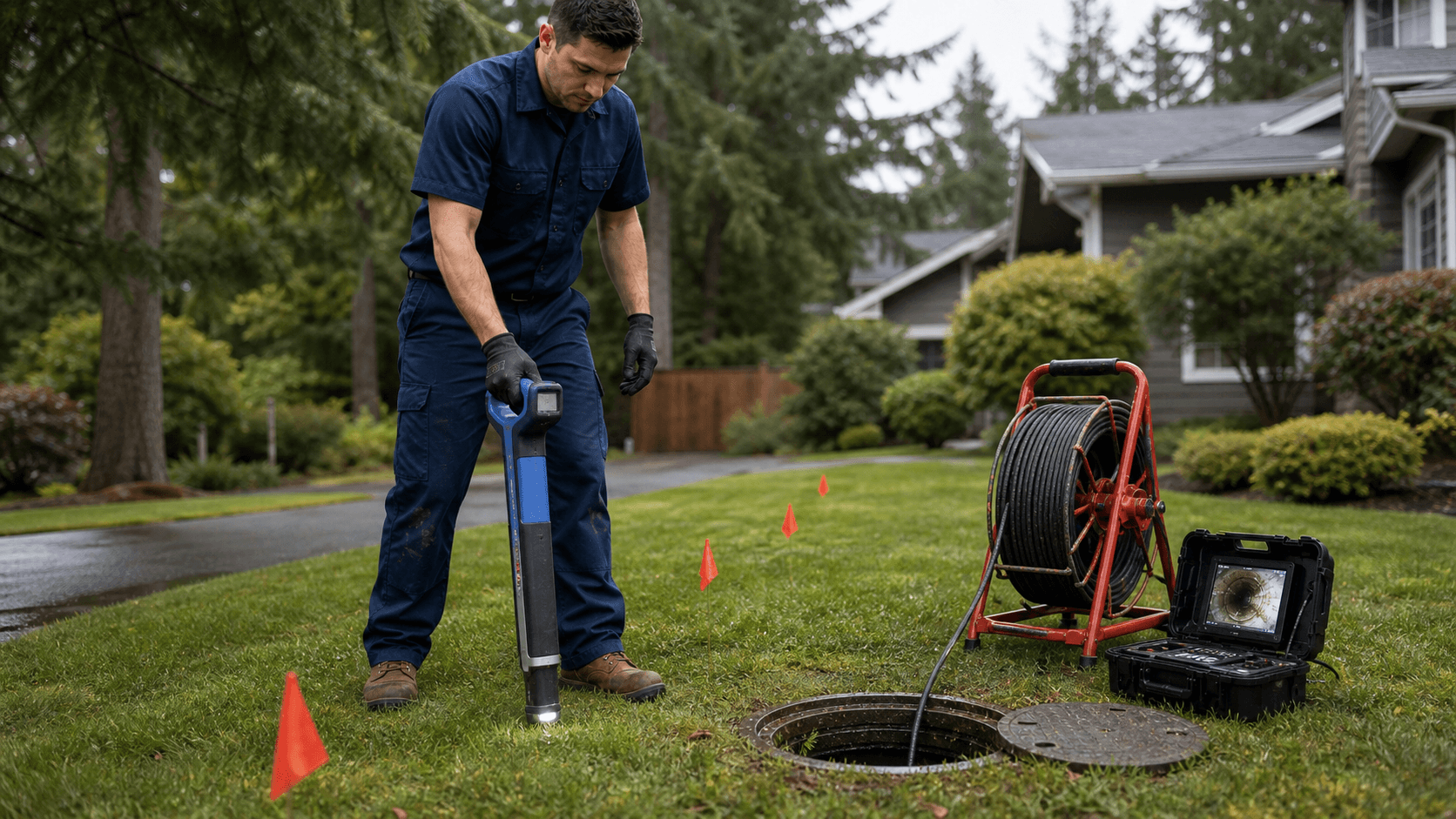
Locating the lateral above ground connects camera footage to the exact repair area outside.
What a sewer camera inspection actually reveals
Six distinct categories of finding: root intrusion, cracks and breaks, bellied or sagging sections, offset joints, deteriorated Orangeburg pipe, and foreign-object blockages. Each has a different repair recommendation and a different price point.
The plumber narrates the video as the camera advances. You see exactly what they're seeing on the monitor and can ask questions in real time. Six categories of defect appear most often in Eastside sewer laterals:
Six categories of finding in a typical Bellevue sewer inspection
Root intrusion. White or tan filaments hanging from joints, hair-like mats filling part of the pipe diameter, or full root balls blocking flow. The single most common finding in pre-1985 Bellevue homes with mature trees. Repair options: cabling for small, hydro-jetting for moderate, spot repair if the root entered through a structural failure rather than just a joint.
Cracks and breaks. Hairline cracks around joints in clay or cast-iron pipe. Larger breaks where soil pressure or root force has fractured a section. Repair: spot repair via excavation, or trenchless pipe lining (CIPP) if the crack pattern is suitable.
Bellied or sagging sections. A low spot where the pipe has settled below the original grade line, holding standing water and accumulating sediment. Soil settlement over decades causes most bellies. Repair: only excavation can fix the grade — lining doesn't address it.
Offset joints. A visual 'step' where pipe sections no longer align. Earth movement, root pressure, or installation errors create these. Small offsets (under 1 inch) can sometimes be cleaned and monitored; larger offsets accelerate failure.
Orangeburg pipe deterioration. Orangeburg is the bituminized fiber pipe used in residential construction from the 1940s through the early 1970s. It deforms (flattens, ovalizes) and ultimately fails. Once Orangeburg is identified, replacement is the only durable answer — it can't be lined or repaired.
Foreign object blockages. Toys, wet wipes (despite the 'flushable' label), construction debris from previous renovations, or — rarely — collapsed pipe sections themselves blocking flow.
Six situations where camera inspection is essential
Pre-purchase real estate due diligence, before any sewer-line repair quote, after a backup that affects multiple fixtures, every 3 years for homes with mature trees within 50 feet of the line, after major landscape work near the sewer path, and any time the seller can't produce documentation of past sewer work.
These six situations represent the highest return on the $300 inspection cost:
Pre-purchase due diligence. Sewer replacement can cost $7,000 to $25,000 — easily the most expensive single repair a buyer can inherit. A $300 camera scope before closing is the cheapest insurance available.
Before any sewer-line repair quote. As documented elsewhere on this site, contractors who quote a $14,000 replacement before running a camera are guessing. Insist on footage before agreeing to any major sewer scope.
After a backup affecting multiple fixtures. A clogged kitchen sink is a local problem. Slow drains across the whole house plus gurgling toilets plus sewage odor at the cleanout means the issue is in the main lateral — camera first.
Periodic preventive inspection. For homes with mature western red cedar, Douglas fir, or bigleaf maple within 50 feet of the sewer line path, a camera every 3 years catches root growth before it becomes a backup.
After major landscaping or excavation work. Heavy equipment crossing the sewer path, deep tree-planting, or driveway resurfacing can crack pipe. A post-work camera confirms damage or peace of mind.
Unknown sewer history. If you bought the home recently and the seller couldn't produce records of past sewer work, the camera tells you exactly what's down there.
Pre-purchase camera inspection — why Bellevue and Seattle-area buyers should always require one
Seattle and King County guidance explicitly recommends side-sewer inspections before buying a property. About two-thirds of Seattle-area sellers share home inspection reports with buyers; about half share sewer reports. Buyers who don't have one done themselves inherit unknown liability — including replacement bills that exceed the typical home inspection budget by 30 to 100 times.
Seattle and King County side sewers are privately owned. The property owner — not the city — is responsible for the lateral pipe from the house to the connection at the city main. That responsibility transfers to the buyer at close. Any defect that exists pre-close becomes the buyer's problem the moment ownership changes hands.
A sewer scope is typically added to a standard home inspection for $100 to $250 because the inspector is already on-site. The inspector or a sub-contracted plumber runs the camera, records footage, writes a brief report, and identifies any defects. The findings then become a negotiation lever: the buyer can request the seller repair the issue before close, credit the repair cost, or reduce the sale price.
Industry data on what gets shared: about two-thirds of Seattle-area home sellers proactively share a home-inspection report with buyers, and roughly half include a sewer-scope report alongside the home inspection. If a seller shares a sewer report from the past 6-12 months, that's usually trustworthy. If no sewer report exists, the buyer should order one as part of their inspection contingency window.
The cost-benefit calculation: a $200-$400 pre-purchase sewer scope versus an inherited $14,000 sewer line replacement post-close. The downside scenario happens often enough in Bellevue's mid-century housing stock — Lake Hills, Crossroads, Bridle Trails, West Bellevue — that skipping the inspection is the financial mistake most agents recommend against.
How the inspection works — what to expect on the day
The plumber arrives with a camera reel and locator, accesses your sewer line through an exterior cleanout (or, if no cleanout, through a toilet or roof vent), pushes the camera through while narrating the findings, marks any defect location in the yard with paint, and gives you a recorded copy of the footage plus a written summary. The whole visit takes 30 to 90 minutes including setup and breakdown.
Step-by-step on the day:
Locate the cleanout. Most Bellevue homes have an exterior cleanout — a 4-inch capped pipe visible on the side of the house, in a flower bed, or near the foundation. The plumber removes the cap.
If no cleanout exists. A plumber can run the camera from inside the house by pulling a first-floor toilet (adds about 30 minutes) or dropping the camera down the roof vent stack (requires roof access and adds $100-$200).
Push the camera through. The plumber feeds the rod manually, watching the monitor. The camera reaches the city main at the curb under most residential configurations — typically 40 to 80 feet of line.
Narration. The plumber describes what they see as they see it. You watch the same monitor. Ask questions in real time; this is the most valuable 15 minutes you'll spend on your sewer.
Defect location. If a problem appears, the plumber notes the distance on the counter and uses the locator to find the spot in your yard. Marking paint goes down at the surface position.
Documentation. A USB stick or cloud link with the full video. A written summary with recommendations. Pricing for any recommended repair, separately, on request.
What you should NOT see on the day: pressure to commit to a major repair before you've reviewed the footage privately. The plumber's job is to show you what's there. Your job is to take the documented findings, consider them overnight if any major repair is recommended, and get a second opinion from a different company before agreeing to anything north of $5,000.
"The footage leaves with the homeowner — always," says the camera lead on our dispatch line. "An inspection you can't re-watch or share with a second opinion isn't documentation; it's a sales prop."
Self-leveling cameras — why the technology matters for clear footage
Self-leveling cameras keep the image upright regardless of how the camera body rotates inside the pipe. Without self-leveling, the footage spins as the camera tumbles through bends, making it nearly impossible to identify a defect's position (top of pipe versus bottom). Modern digital self-leveling, introduced by RIDGID in 2023, eliminates the moving mechanical parts that wear out over time.
Older self-leveling systems used a weighted gimbal — gravity kept a weight at the bottom of the camera assembly, which mechanically rotated the lens to stay upright. The mechanism worked, but the weight created friction wear on the bearings over thousands of hours of use, and the image had a slight back-and-forth swing as the weight settled at each angle.
Digital self-leveling reads the camera's orientation electronically and rotates the displayed image in software. No moving parts, no wear, no swing — and a perfectly steady image regardless of pipe orientation. This matters for diagnosis: when looking at footage of, say, a crack in the pipe wall, you need to know whether the crack is at 12 o'clock (top), 6 o'clock (bottom), or 3 o'clock (side). Position determines repair urgency. A bottom-of-pipe crack is the most concerning because it's at the wear line where waste flows.
If you're booking a camera inspection in 2026 and want the best image quality, ask whether the company uses digital self-leveling (RIDGID's TruSense or equivalent) or older mechanical systems. The cost is the same; the image quality difference matters when you're trying to decide on a five-figure repair.
DIY camera rentals — when they make sense and when they don't
Hardware stores like Home Depot rent residential sewer cameras for $80 to $200 per day. DIY rental makes sense for landlords with multiple properties, contractors doing periodic inspections, or homeowners with technical skill willing to learn the system. For a one-time pre-purchase inspection or troubleshooting a backup, hiring a professional is faster, cheaper, and produces a documented report.
Three reasons DIY usually doesn't make economic sense for a single inspection:
Cost math. A $150 DIY rental for one day plus your time (typically 2-3 hours including pickup, learning the system, the inspection itself, and return) versus a $300 professional inspection in 45 minutes with a documented report. The professional wins on time-value.
Interpretation. The camera shows you the pipe interior, but interpreting what you see — distinguishing a hairline crack from a discoloration mark, an offset joint from a normal section transition — takes experience. A professional plumber's interpretation is what makes the inspection useful.
Documentation. A professional gives you a written report, USB footage, and a license number. Those become evidence in real-estate negotiations, insurance claims, or future-buyer disclosures. A DIY phone-recorded video doesn't carry the same weight.
DIY can make sense for: a landlord managing multiple Bellevue rental properties who wants to inspect sewer lines annually across all of them; a contractor doing renovation work and wanting to verify pipe condition before quoting; or a sophisticated homeowner who has multiple sewer concerns over time and is willing to invest in learning the equipment. For everyone else, the $300 professional inspection is the right call.
What to do with the inspection findings
Three possible outcomes: no significant findings (file the footage for future reference), minor findings requiring cleaning or monitoring (schedule a hydro-jet or set a 2-year follow-up), or major findings requiring repair (get a second opinion before agreeing to any quote above $5,000).
Outcome 1 — Clean line. The camera shows clear pipe with no significant defects. File the footage and the report somewhere you can find it. The inspection becomes documentation of the line's condition at that date, useful for future buyers if you sell the home, and a baseline if you do a follow-up inspection in 3-5 years.
Outcome 2 — Minor findings (cleaning or monitoring). Light root intrusion at a joint, modest sediment accumulation, or small pipe-wall deposits. Recommended action is usually hydro-jetting ($389-$667 in the Seattle area per Angi's 2026 data) and a follow-up camera in 2-3 years to track progression. The pricing context for both inspection and the cleaning work is documented in our plumber cost and pricing in Bellevue guide.
Outcome 3 — Major findings (repair recommended). A break, a collapsed section, a deeply bellied pipe, severe Orangeburg deterioration, or root intrusion that's caused structural damage. The plumber will quote a repair — spot repair ($2,800-$4,800), trenchless replacement ($6,000-$12,000), or full open-trench replacement ($7,000-$25,000+). Before agreeing to any quote above $5,000, get a second opinion. Show the second plumber the footage from the first inspection; they should be able to confirm or challenge the diagnosis based on the same video. Two independent quotes on the same footage from different companies is the best protection against an inflated repair recommendation.
In all three outcomes, the camera inspection has done its job: replaced guessing with documentation. Keep the footage; pass it to the next owner if you sell.
Sources
Every fact in this guide cites a verifiable public source. If you find a number we got wrong, email dispatch@bellevueplumberpro.com.
Sewer camera inspection cost in Bellevue — questions homeowners ask
QUESTION01
How much does a sewer camera inspection cost in Bellevue?
$250 to $400 for a residential inspection in 2026, with about $300 the typical median. Homes without an accessible cleanout add $175 to $750 because the plumber has to create access first — through a pulled toilet or roof vent.
QUESTION02
What does a sewer camera inspection show?
Six categories of finding: root intrusion, cracks and breaks, bellied (sagged) sections, offset joints, deteriorated Orangeburg pipe, and foreign-object blockages. Each carries a different repair recommendation and price point.
QUESTION03
Do I need a sewer inspection before buying a home in the Bellevue area?
Yes. Seattle and King County guidance explicitly recommends side-sewer inspections before purchase, and only about half of area sellers share a sewer report — so buyers who skip it are usually flying blind on a five-figure liability.
QUESTION04
How does the camera locate the problem in my yard?
A 512 Hz sonde transmitter in the camera head is tracked by a surface locator, marking the defect's position to within a few feet — an electronic distance counter on the rod records how far out it sits.