Home/Learn/Sewer lines/Sewer smell in the house: causes, dangers, and how a plumber finds the source
Sewer
Sewer smell in the house: causes, dangers, and how a plumber finds the source
A sewer smell in the house means the barrier that normally keeps drain gases out of your living space has failed somewhere. The drainage system is supposed to be sealed from indoor air by water-filled traps and vented to the roof, so when sewer gas reaches your nose, one of a short list of seals has broken: a P-trap that has dried out in a little-used drain, a toilet's wax ring that no longer seals to the floor, a plumbing vent stack that is blocked or cracked, a cracked drain or sewer line, or a missing cleanout cap. The gas itself is mostly hydrogen sulfide and methane; hydrogen sulfide is detectable by smell at concentrations as low as about 0.0005 ppm, far below any danger level, but it deserves respect — NIOSH sets an immediately-dangerous-to-life-or-health level of 100 ppm and OSHA a 20 ppm ceiling, and methane is flammable between 5 and 15 percent in air. This guide walks each cause, the danger question, how a plumber isolates the source, and the Bellevue cedar-and-fir-root angle when the smell is outdoors.
A sewer smell means the seal between the drains and your air has broken — a dry P-trap, a failed toilet wax ring, a blocked or cracked vent, a cracked line, or a missing cleanout cap.
A house should never smell like sewer, because the entire drainage system is designed to be sealed off from indoor air. Every fixture has a P-trap that holds a small plug of water, and that water seal is the barrier that keeps the gases in the drain and sewer from rising back into the room. The system is also vented to the roof so air can move as water drains without sucking those traps dry. When you smell sewer gas indoors, it means that sealed-off system has sprung a leak into your living space at one specific point.
The leak is almost always one of five things, and they sort by location. A dry P-trap in a drain you rarely use lets gas rise straight up through an empty trap. A failed wax ring under a toilet lets gas escape around the base where the toilet meets the floor. A blocked or cracked vent stack disrupts the airflow that keeps traps full, and a cracked drain or sewer line leaks gas into the walls, crawlspace, or soil. A missing cleanout cap leaves an open hole straight into the drain line.
Where the smell is strongest is the first clue to which of these you have. A smell that comes from one drain points at that fixture's trap; a smell around a toilet points at its wax ring; a smell that fills a bathroom or follows the weather points at the vent; a smell in the yard points at a cracked line in the ground. Tracking down which seal has failed is the whole job, because each one has a different and usually inexpensive fix once it is identified.
The reason it matters to find the actual source rather than mask it is that sewer gas is a symptom of an open path, not an odor problem to spray over. An air freshener does nothing about a dried trap or a cracked vent, and a persistent indoor sewer smell can also be the first sign of a more serious problem in the buried line. The sections below take each cause in turn, then cover how a plumber isolates the source and the Bellevue root angle when the smell is coming from outside.
Sewer odor means one of the drain system seals has opened to indoor air.
This happening in your home right now? A licensed plumber can talk you through the next step on the phone — 24/7, and the call is free.
At the trace levels you usually smell, no — odor appears around 0.0005 ppm, far below harm. But respect it: NIOSH calls 100 ppm immediately dangerous and methane is flammable from 5 to 15 percent.
Sewer gas is a mixture, and the two components that matter most are hydrogen sulfide and methane. Hydrogen sulfide is the source of the rotten-egg smell, and the human nose is extraordinarily sensitive to it — it is detectable by odor at concentrations as low as about 0.0005 parts per million, which is far, far below any level that could harm you. That sensitivity is protective: in most household sewer-smell situations, the fact that you can smell it at all means the concentration is a tiny fraction of anything hazardous.
The numbers that define real danger are much higher and worth knowing for context. NIOSH sets the immediately-dangerous-to-life-or-health level for hydrogen sulfide at 100 ppm, and OSHA sets a ceiling limit of 20 ppm that should not be exceeded. A cruel feature of hydrogen sulfide is olfactory fatigue: at high concentrations, around 100 ppm, it deadens the sense of smell so the warning odor disappears even as the danger rises. That is why a strong sewer smell that suddenly fades is not reassurance — in an enclosed space it can be the opposite.
Methane is the other concern, and its hazard is different. Methane is colorless and odorless and is flammable in air between roughly 5 and 15 percent by volume, so in the rare case of a large gas accumulation in a confined, unventilated space, the risk is not just toxicity but ignition. For an ordinary household drain smell this is not the scenario at play, but it is the reason sewer gas should be ventilated rather than allowed to build up in a closed basement or crawlspace.
For a typical home, then, the honest answer is that a faint, intermittent sewer smell is unpleasant and points at a seal to fix, not an emergency. But the smell is also a signal that an open path exists, and if you feel dizzy, nauseated, or headachy in a room with a strong sewer odor, the right response is to ventilate the space, open windows, and leave it until the air clears. Persistent or strong odors, especially in a low or enclosed area, are worth taking seriously and tracing to their source rather than living with.
A dry P-trap in an unused drain
The most common cause: the 2-to-4-inch water seal in a P-trap evaporates from a drain you rarely use, opening a direct path for sewer gas. Run water to refill it.
The single most common reason a house develops a sewer smell is a dry P-trap, and it is also the easiest to fix. A P-trap is the U-shaped bend under every sink, tub, shower, and floor drain, and it holds a plug of water — typically a couple to a few inches deep — that physically blocks gas from rising up the drain into the room. That water seal works only as long as the water is there, and in a drain that goes unused for weeks, the water simply evaporates, leaving the trap empty and the path open.
This is why sewer smells so often appear in specific, predictable places: a guest bathroom that nobody uses, a basement floor drain, a laundry sink, a rarely-run shower, or a fixture in a vacant or seasonally-empty home. The drain itself is fine and the trap is intact; it has just dried out. The tell is that the smell is localized to that one fixture and gets stronger the longer the drain sits unused, and weaker right after any water goes down it.
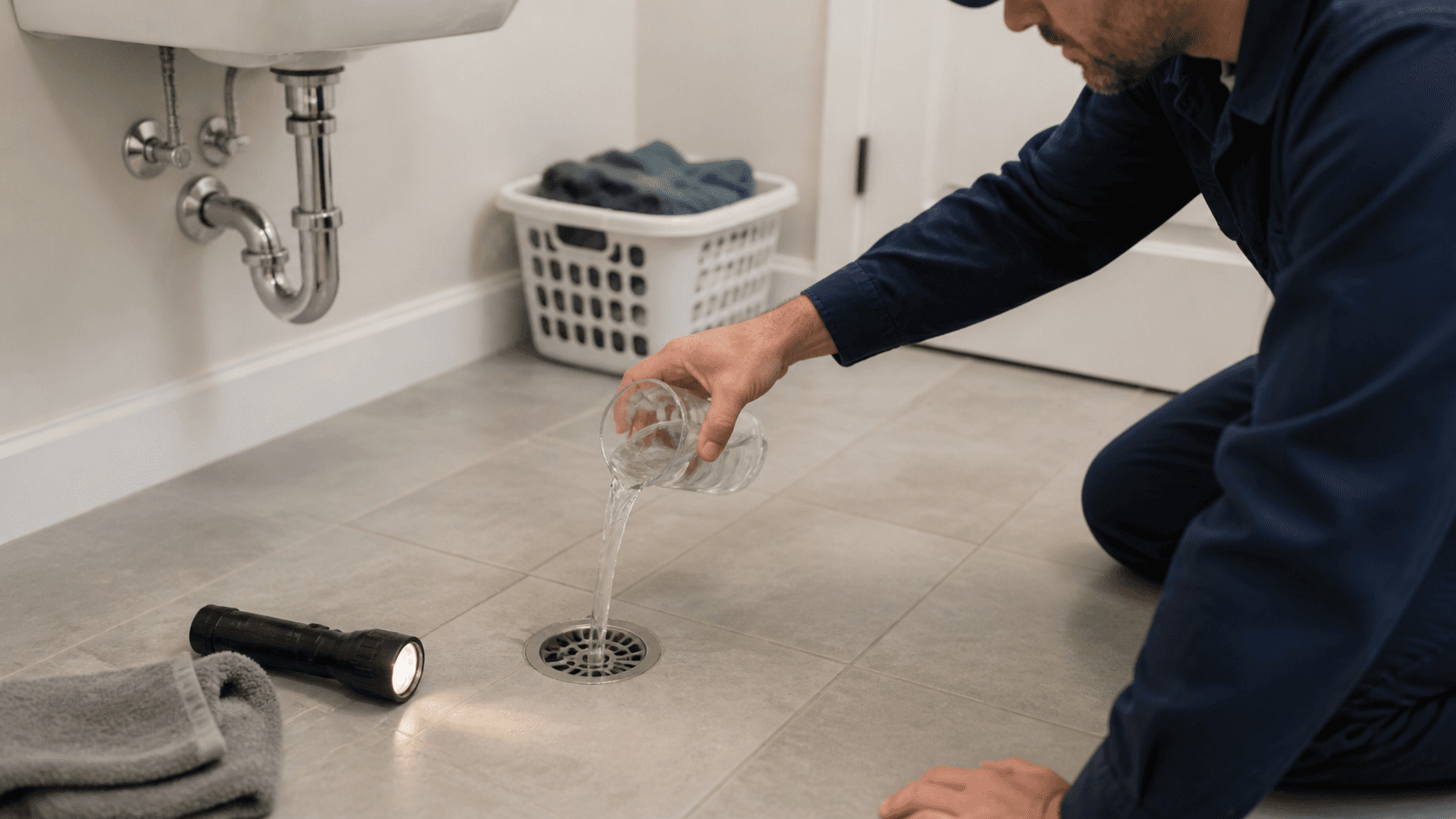
The fix is to put water back in the trap. Running the faucet or pouring a quart or two of water down the drain refills the seal and stops the smell, often within minutes. For a fixture that will sit unused for a long time — a vacation home, a rarely-used floor drain — pouring a small amount of mineral oil in after the water slows evaporation, because the oil floats on the water seal and keeps it from drying out for months instead of weeks.
Because this cause is so common and so harmless, it is always the first thing to check before assuming a worse problem. If running water in the suspect drain makes the smell go away and it only comes back when the drain sits unused again, the trap was simply dry and the case is closed. If the smell persists even with a freshly filled trap, or comes from a fixture in regular use, the cause is elsewhere — a wax ring, a vent, or the line itself — and the search moves on.
A dry trap is the simplest sewer-smell fix: restore the water seal.
A failed toilet wax ring
If the smell is strongest at a toilet's base, the wax ring sealing it to the floor flange has failed, letting gas escape around the bottom — often with slight rocking or floor staining.
A toilet does not connect to the drain through a trap you can see; its trap is built into the porcelain, and the toilet sits on top of a closet flange in the floor with a wax ring compressed between them to seal the joint. That wax ring is what keeps both water and sewer gas from escaping where the toilet meets the floor. When the wax ring fails — from age, from the toilet shifting, or from a poor original install — the seal opens and sewer gas leaks out around the base of the toilet.
The signature of a failed wax ring is a smell that is clearly strongest right at floor level around a particular toilet, rather than from a drain opening. It often comes with other clues: a toilet that rocks slightly when you sit on or shift it, a faint water stain or softening of the floor around the base, or a smell that worsens just after a flush as gas is pushed out around the broken seal. Unlike a dry trap, running water does not fix it, because the leak is at the floor connection, not in an evaporated seal.
A rocking toilet is the most useful warning sign, because movement is what breaks and re-breaks a wax seal. A toilet that is not solidly bolted down, or one set on an uneven or deteriorating floor, flexes the wax ring every time it is used until the seal fails. Once that happens, the gap also lets small amounts of water weep out at each flush, which is what causes the floor staining and, over time, can rot the subfloor beneath the toilet.
Replacing a wax ring means pulling the toilet, removing the old wax, checking the flange, setting a new ring, and resetting and re-bolting the toilet so it sits solid and level. It is a routine job, but it has to be done correctly so the new seal compresses evenly and the toilet does not rock again. A toilet that smells at its base, rocks, or shows staining is pointing at its wax ring, and resetting it on a fresh seal is the fix.
A blocked or cracked vent stack
Plumbing vents let drains breathe through the roof. A blocked or cracked vent disrupts that airflow, and the resulting suction siphons P-traps dry — so several traps lose their seal at once.
Every drainage system is vented, usually through one or more pipes that run up through the roof, and those vents do something most homeowners never think about: they let the drains breathe. When water rushes down a drain, it needs air to follow behind it, and the vent supplies that air from outside. Without a working vent, draining water creates suction in the pipes, and that suction pulls the water seals straight out of the P-traps — siphoning them dry and opening every affected trap to sewer gas.
This is why a vent problem produces a different and broader symptom than a single dry trap. A blocked vent — clogged with leaves, a bird nest, frost, or debris — or a cracked vent inside a wall makes draining one fixture noisily gurgle and can pull the seals out of traps elsewhere in the house. The smell may seem to come from several fixtures at once, or to appear right after a big drain event like a bathtub emptying or a washing machine discharging, because that is when the suction is strongest.
A cracked vent inside a wall adds its own twist: the crack can leak sewer gas directly into the wall cavity and then into the room, so the smell appears near the wall rather than at a fixture. This is harder to spot than a roof-vent blockage because nothing is visibly wrong, and it often takes a plumber to trace. Gurgling drains, traps that keep going dry for no obvious reason, and smells that follow heavy drain use are the pattern that points at the vent rather than at any single fixture.
Because a vent fault can dry multiple traps and mimic several problems at once, it is a common reason a sewer smell resists the easy fixes. Refilling traps helps only until the next big drain event siphons them empty again. Clearing a blocked vent stack from the roof, or finding and repairing a cracked vent in a wall, restores the airflow that keeps the traps full on their own — which is the real cure when the smell keeps coming back across several fixtures.
A cracked sewer line in the yard
If the smell is outdoors near the foundation or yard, a cracked sewer line is leaking gas into the soil. In Bellevue, that crack is often where cedar or fir roots have entered the lateral.
When the sewer smell is outdoors — at the foundation, over the lawn, or near a cleanout — rather than at an indoor fixture, the source is usually the buried sewer line itself. A cracked or broken sewer lateral leaks gas (and a little wastewater) into the surrounding soil, and that gas escapes upward through the ground, especially in dry weather when the soil is porous. A yard smell is therefore a different and more serious signal than an indoor trap problem, because it points at the line that carries everything to the sewer.
In Bellevue and across the Eastside, the most common reason that buried line cracks is tree-root intrusion. The mature western red cedars and Douglas firs that define the region have aggressive lateral root systems that seek out the warm, nutrient-rich vapor leaking from any small flaw in an older clay or cast-iron sewer lateral. Once a root finds a crack or a loose joint, it grows in and widens it, and the cracked joint that lets the roots in is the same flaw that lets gas out into the soil — which is the full mechanism covered in our cedar and fir root intrusion guide.
A yard smell from a cracked line rarely travels alone. It usually comes with the other signs of an aging, root-invaded lateral: slow drains across multiple fixtures, gurgling toilets when the washer drains, a strip of unusually green grass over the line's path where leaking wastewater fertilizes it, or backups that worsen during heavy rain. Any of these alongside a yard smell strengthens the case that the buried line, not an indoor seal, is the problem.
Confirming a cracked or root-invaded line means looking inside it, which is why a camera inspection is the right next step rather than guesswork — our sewer camera inspection guide covers what the footage shows. A camera locates the crack, the root mass, or the broken joint precisely, which determines whether the fix is a cleaning, a spot repair, or a replacement. An outdoor sewer smell that comes with multiple drain symptoms is best handled as sewer line repair and replacement in Bellevue once the camera has shown what is actually wrong.
How a plumber finds the source of a sewer smell
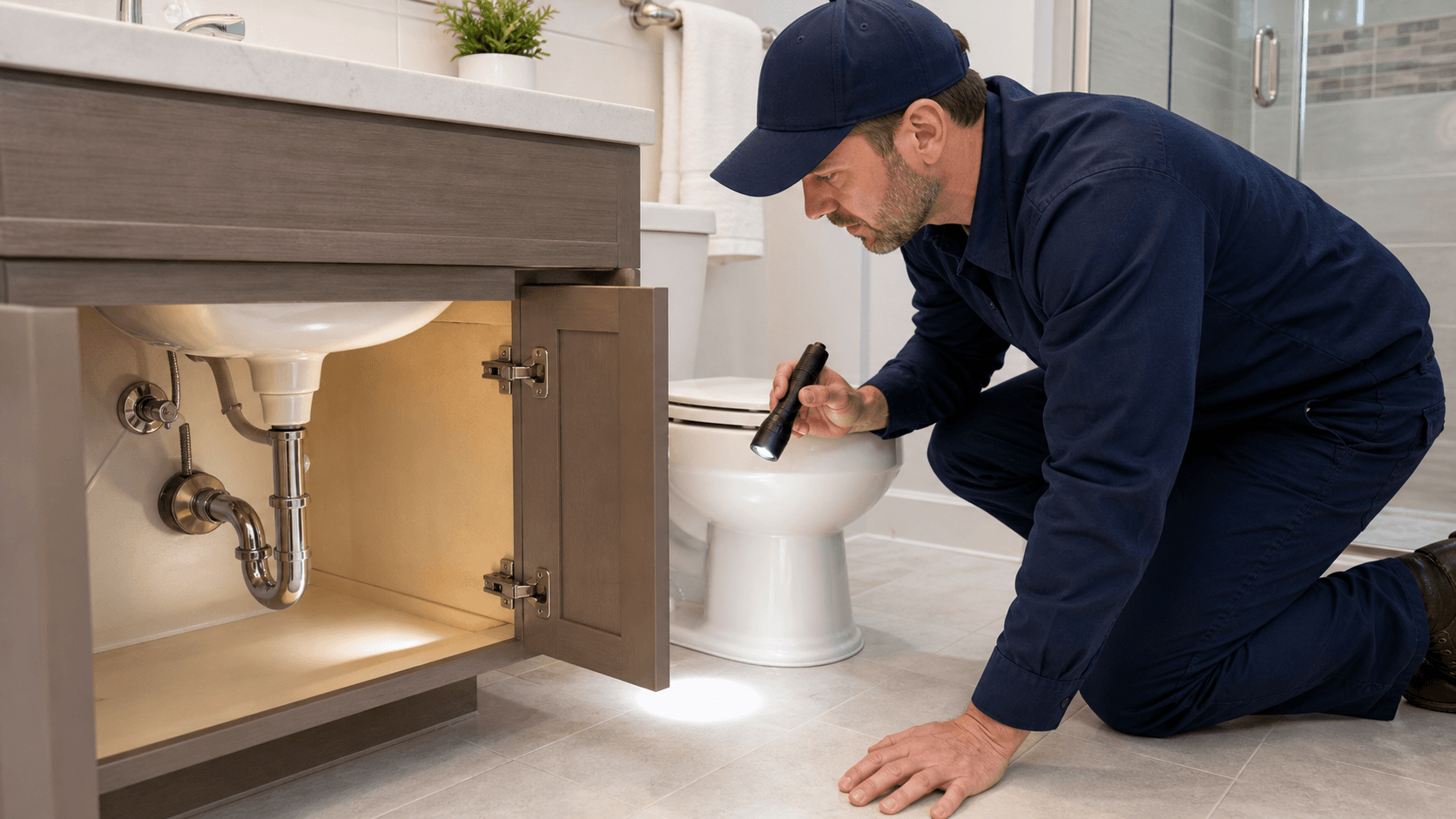
A plumber works from the symptom outward: check traps and the toilet base first, then test the vents, and if those are sound, camera the line. Where the smell is strongest narrows it before any test.
Finding a sewer smell is a process of elimination that follows the same logic as the causes, from cheapest and most common to the buried line. The first pass is the traps: a plumber checks each fixture for a dry P-trap, refilling the suspect ones and noting whether the smell clears, because a dried trap is both the most likely cause and the fastest to rule in or out. At the same time the toilets are checked for a failed wax ring — looking for rocking, staining, and a smell concentrated at the base.
If traps and wax rings are sound, attention turns to the venting and the system as a whole. A plumber may check the roof vents for blockages and look for the pattern that points at a vent fault — traps that keep siphoning dry, gurgling on heavy drain use, smells near walls. Where the smell is strongest is used throughout to narrow the search: a one-fixture smell, a toilet-base smell, a whole-room or weather-linked smell, and an outdoor smell each point at a different part of the system before any tool comes out.
When the indoor seals are all accounted for and the smell points outdoors or at the main line, the diagnostic becomes a camera inspection of the sewer lateral. A self-leveling camera fed through the cleanout shows exactly where a crack, a broken joint, or a root mass sits, and how far from the cleanout it is. That footage is what turns a vague yard smell into a precise location and a specific repair, and it is the step that separates a real diagnosis from a contractor guessing at a replacement.
The reason a plumber works in this order is cost and likelihood: most sewer smells are a dry trap or a wax ring, both cheap fixes, and only a minority trace to the vent or the buried line. Starting with the simple, common causes and escalating only when they are ruled out keeps a homeowner from paying for a camera inspection or line work when a quart of water in a floor drain would have solved it — while still catching the serious cases that genuinely need it.
Common questions about a sewer smell in the house
A smell that comes and goes is usually a drying trap; it is rarely dangerous at the levels you smell; a wax ring smells at the toilet base; a washer-linked smell points at the vent.
If the sewer smell comes and goes, the most likely cause is a P-trap that keeps drying out in a little-used drain — the smell appears as the water seal evaporates and disappears whenever water goes down the drain and refills it. Running water in guest bathrooms, basement floor drains, and laundry sinks usually settles it, and a little mineral oil in a rarely-used drain keeps the seal from drying again. An intermittent smell tied to which fixtures you use is a trap problem far more often than anything serious.
No, a sewer smell is usually not dangerous at the levels you can smell, because hydrogen sulfide is detectable by odor at about 0.0005 ppm — thousands of times below the 100 ppm NIOSH calls immediately dangerous and the 20 ppm OSHA ceiling. The smell is a signal to find and fix an open seal, not normally a health emergency. That said, if a strong odor makes you feel dizzy or nauseated, ventilate the space and leave until it clears, and do not treat a strong smell that suddenly fades as reassurance.
Yes, a dry trap is the single most common cause of a sewer smell, and a failed wax ring is the next thing to suspect when the smell is strongest right at the base of a toilet — especially if that toilet rocks or shows staining at the floor. The two are easy to tell apart: a dry trap smells at a drain opening and clears when you run water, while a wax-ring leak smells at floor level around the toilet and does not clear with water because the seal is at the flange, not in the trap.
If the smell gets worse when the washing machine or bathtub drains, the cause is most likely the vent: a big slug of draining water creates suction that a blocked or cracked vent cannot relieve, so it siphons the traps dry and pulls gas back into the house. And yes, a strong, persistent sewer smell can make you feel unwell — headache, nausea, dizziness — which is the body's signal to ventilate and step out. A yard smell that comes with multiple slow drains points at a cracked, often root-invaded line and is handled as sewer line repair and replacement in Bellevue.
Sources
Every fact in this guide cites a verifiable public source. If you find a number we got wrong, email dispatch@bellevueplumberpro.com.
Need help with this in your home? See our Sewer line repair and replacement in Bellevue page for pricing, our diagnostic process, and how same-day service works across the Eastside.
Sewer smell in the house — questions homeowners ask
QUESTION01
Why does my house smell like sewer?
The seal between your drains and the air has broken: a dry P-trap, a failed toilet wax ring, a blocked or cracked vent, a cracked line, or a missing cleanout cap. The most common is a dry trap in a drain you rarely use — run water to refill it.
QUESTION02
Is sewer gas in the house dangerous?
At the trace levels you usually smell, no — odor appears around 0.0005 ppm, far below harm. But respect it: NIOSH calls 100 ppm immediately dangerous, and methane is flammable in concentration. Persistent smell means a real breach worth finding.