Last reviewed: 2026-08-22
How often should a Bellevue homeowner clean their sewer line?
Every 18–24 months if you have large cedars, firs, or maples within 20 feet of the lateral. Every 5–7 years for newer PVC laterals with no nearby trees. Every 2–3 years for homes with clay or cast-iron laterals built before 1980.
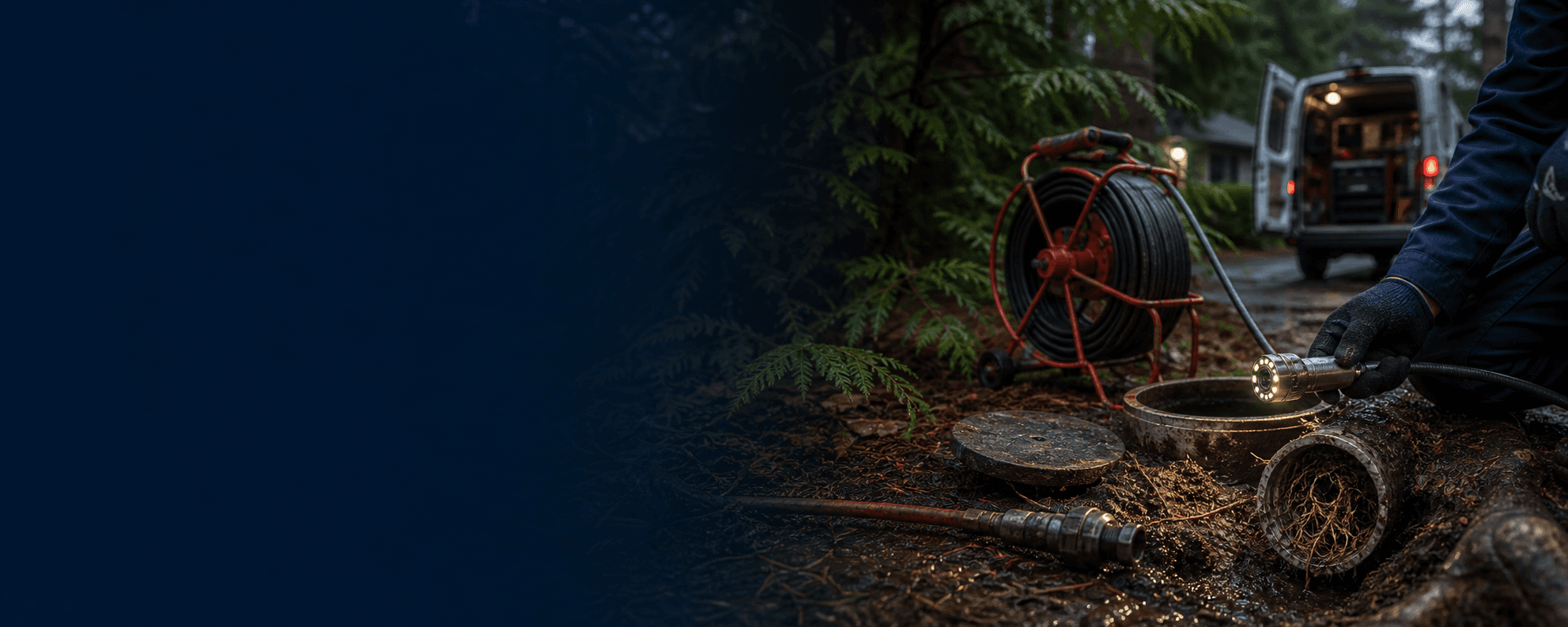
Sewer line cleaning is the mechanical clearing of the main waste line between the house and the street — the homeowner-owned side sewer — by rotating cable (snaking) or high-pressure water jetting, usually followed by a camera run to confirm the pipe wall's condition. The Eastside is hard on sewer laterals. Cedar, Douglas fir, and Big-leaf maple roots are drawn to the moisture at sewer joints and cracks, and they grow fast. A root mass that is a minor clearing on one cleaning can block the line entirely 18 months later if conditions are right. If your property has mature trees within 20 feet of the sewer line path — and most Bellevue lots do — a camera inspection after cleaning confirms whether root growth has returned and how fast.
Homes built before 1980 often have vitrified clay laterals with bell-and-spigot joints every few feet. These joints are the entry points for roots and the sections that offset as soil settles. Clay pipes in good condition last decades, but they need more frequent cleaning than PVC because of the joint frequency and the material's rougher interior surface, which catches grease and debris.
A useful heuristic: if you've had one main-line backup, clean every 18–24 months and get a camera after each cleaning. If you've had two or more backups in five years, the lateral likely has structural damage that periodic cleaning is masking — a camera inspection and repair quote is more appropriate than another cleaning cycle.
This happening in your home right now? A licensed plumber can talk you through the next step on the phone — 24/7, and the call is free.
☎Call a plumberCabling vs. hydro-jetting: which method is right?
Cable for a single soft clog or a first-time backup. Hydro-jet for root masses, hardened grease over a long run, or any recurring clog that has been cabled before. Camera before jetting on pipes older than 30 years.
Mechanical cabling (also called snaking or rodding) sends a rotating steel cable through the line to punch through or pull out a blockage. It is fast, relatively inexpensive ($189–$345 for a main line), and appropriate for soft clogs — paper accumulation, small root intrusion in an otherwise healthy pipe, a grease clog in a short run. The limitation: cabling creates a channel through the blockage but doesn't necessarily clear the pipe wall, so grease and root stubble remain and the clog returns faster.
Hydro-jetting uses pressurized water at 3,500–4,000 psi through forward-cutting and rear-scouring nozzles to strip the pipe wall clean. It removes root masses, hardened grease coatings, and scale across the full pipe diameter. The result lasts significantly longer than cabling for root and grease situations. Cost runs $595–$1,200 for a residential main line. The pre-condition: we camera the line first if the pipe is old or the blockage is recurring, because jetting pressure can blow joints on deteriorated clay or perforate rusted cast iron.
The full decision matrix — including how to read a camera report to choose the right method — is in our hydro jetting vs cabling in Bellevue guide.
What does sewer line cleaning cost in Bellevue (2026)?
Main-line cabling runs $345. Hydro-jetting runs $595–$1,200. Camera inspection is $245–$345 and is included in maintenance packages.
ServicePriceNotes
Main-line cabling (single visit)$345Clears soft blockages; up to 100 feet
Hydro-jetting (residential main line)$595–$1,200Dependent on line length and access; includes rear-flush nozzle
Camera inspection$245–$345Run before jetting on older pipes; after cleaning to confirm clearance
Annual maintenance plan (cable + camera)Contact for quoteScheduled cleaning every 18 months with camera included
2026 Bellevue residential pricing. After-hours emergency rates are 1.5–3x.
What happens during a sewer line cleaning visit?
The plumber accesses the main cleanout, runs the cable or jetting hose through the line, and confirms clearance. A camera run after cleaning shows what the pipe wall looks like and whether any structural issues need repair.
The main cleanout is the starting point — typically a 4-inch capped pipe accessible at the exterior of the home, in the basement near the foundation wall, or in the garage. If your home doesn't have an accessible cleanout, one can be added during the service visit (add $285–$450 to the job).
After the line is cleared, a camera run through the cleaned pipe confirms the blockage is gone and shows the current condition of the pipe wall — joint integrity, any cracks or offsets, and whether root growth has re-entered through existing entry points. This information determines the recommended cleaning interval and whether any repair is needed.
Who owns the line — and the cleaning schedule that follows
The homeowner owns the entire side sewer from the foundation to the city main under the street — cleaning it, and any eventual repair, is the owner's responsibility. The cleaning schedule then follows the pipe material and tree exposure: roots near the lateral every 18–24 months, pre-1980 clay or cast iron every 2–3 years, clean PVC every 5–7 years.
"Two backups in five years isn't a cleaning problem — it's a structural one," says the drain lead on our dispatch line. "At that point the camera is the next visit, not the cable."
Lateral conditionCleaning intervalWhy
Mature trees within 20 ft of the lineEvery 18–24 monthsRoots regrow into joints on a cycle
Pre-1980 clay or cast ironEvery 2–3 yearsFrequent joints and rough interior catch debris
PVC, no nearby treesEvery 5–7 years or as neededWelded joints, smooth bore
2+ backups in 5 yearsCamera now, not another cleaningStructural damage that cleaning masks
Maintenance schedule by condition, 2026. The City of Bellevue maintains only the main under the street — everything to it is the homeowner's line.
Sources
Every fact in this guide cites a verifiable public source. If you find a number we got wrong, email dispatch@bellevueplumberpro.com.
We dispatch for this across Downtown Bellevue, Crossroads, Factoria, Eastgate, Somerset, and Newport Hills — see your neighborhood page for local response times and recent jobs.
Related services: Drain Cleaning and Clog Removal.
Related guides