Home/Learn/Drains and clogs/Hydro jetting vs cabling in Bellevue: which one actually fixes it (and which one is overkill)
Drains
Hydro jetting vs cabling in Bellevue: which one actually fixes it (and which one is overkill)
Mechanical snaking (cabling) and hydro jetting are not interchangeable. Snaking punches a channel through a clog and works well for soft single-point blockages — hair in a shower, food in a kitchen line, a single-fixture problem in a modern PVC drain. Hydro jetting clears the full pipe diameter at 3,500 to 4,000 psi, shearing roots and grease coatings off the pipe wall — but it can also blow joints on aged clay or perforate corroded cast iron. The right answer for your Bellevue home depends on the clog type, the pipe material, the pipe age, and what the camera shows. This guide breaks the decision into a matrix you can apply to any quote, walks through the 6-year cost math on a typical recurring main-line clog, and lists the five red flags that mean a hydro-jet quote is wrong. Cabling pricing and hydro-jet pricing throughout this guide reflect 2026 Bellevue residential rates verified against the cost-and-pricing breakdown in our [plumber cost and pricing in Bellevue, WA: hourly rates, flat-rate jobs, and emergency surcharges](/learn/cost-and-pricing/plumber-rates-bellevue/) guide.
The short answer: cable for symptoms, jet for causes (and pipe age can flip it)
Cable a single soft clog. Jet a recurring or root-driven clog after a camera confirms the pipe can take 4,000 psi. If the camera shows pre-1960 clay with bad joints, deteriorated Orangeburg, or rust-pitted cast iron, neither tool alone is the right answer — those lines need step-down pressure jetting, spot repair, or CIPP lining instead.
The mistake most homeowners make is treating cabling and jetting as the same service at different price points. They aren't. They do different mechanical things to the pipe interior, and the right choice depends on what the camera shows is actually happening inside your sewer lateral.
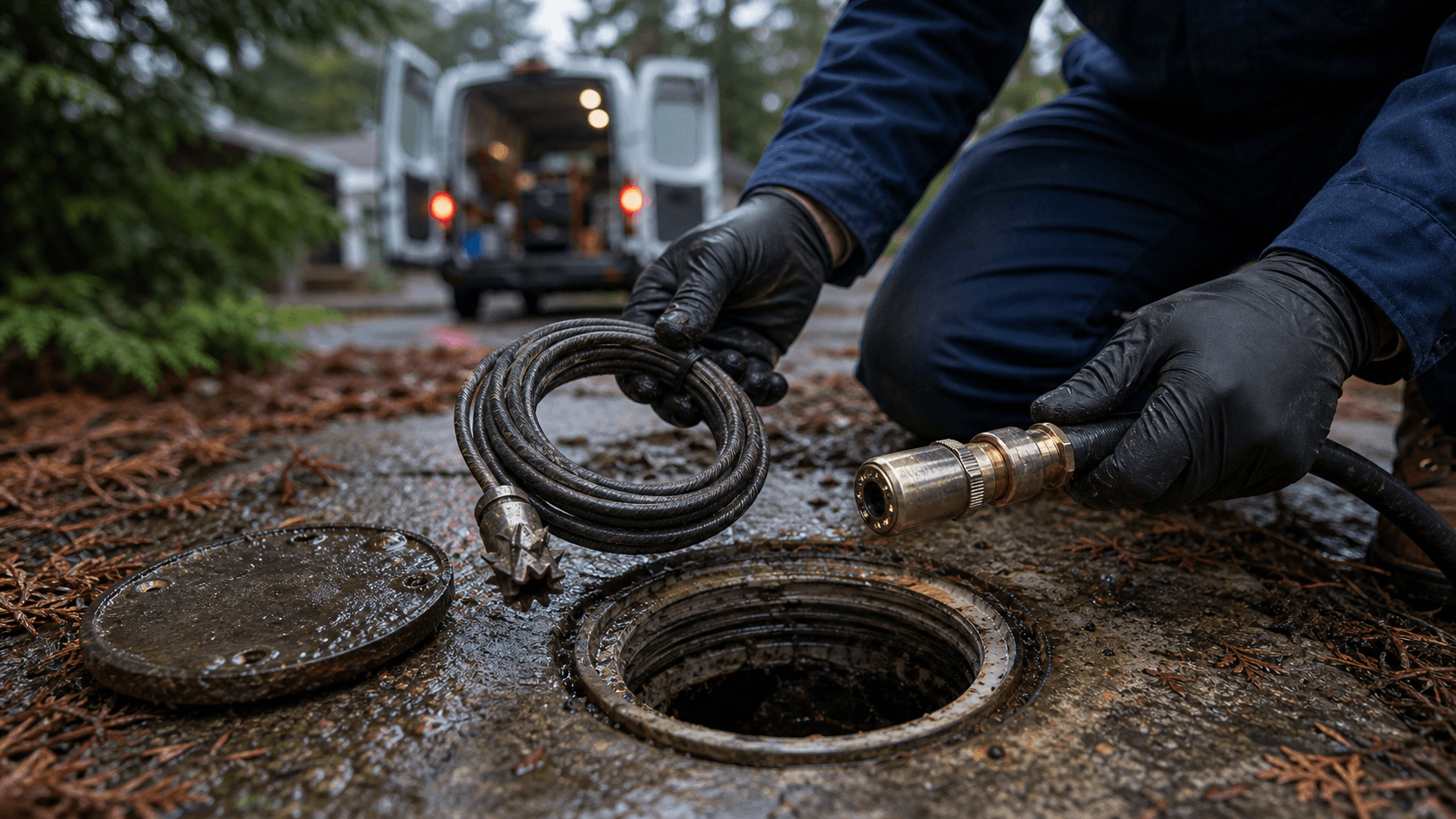
Cabling spins a flexible cable through the line at 600 to 800 rpm with a cutter head that breaks up whatever is blocking flow. The clog clears; water passes again. But the cable creates a channel through the obstruction — not a clean pipe wall. Whatever was bonded to the pipe interior (grease film, root mass remnants, mineral scale) is still there. The clog re-forms as new debris catches on the residue.
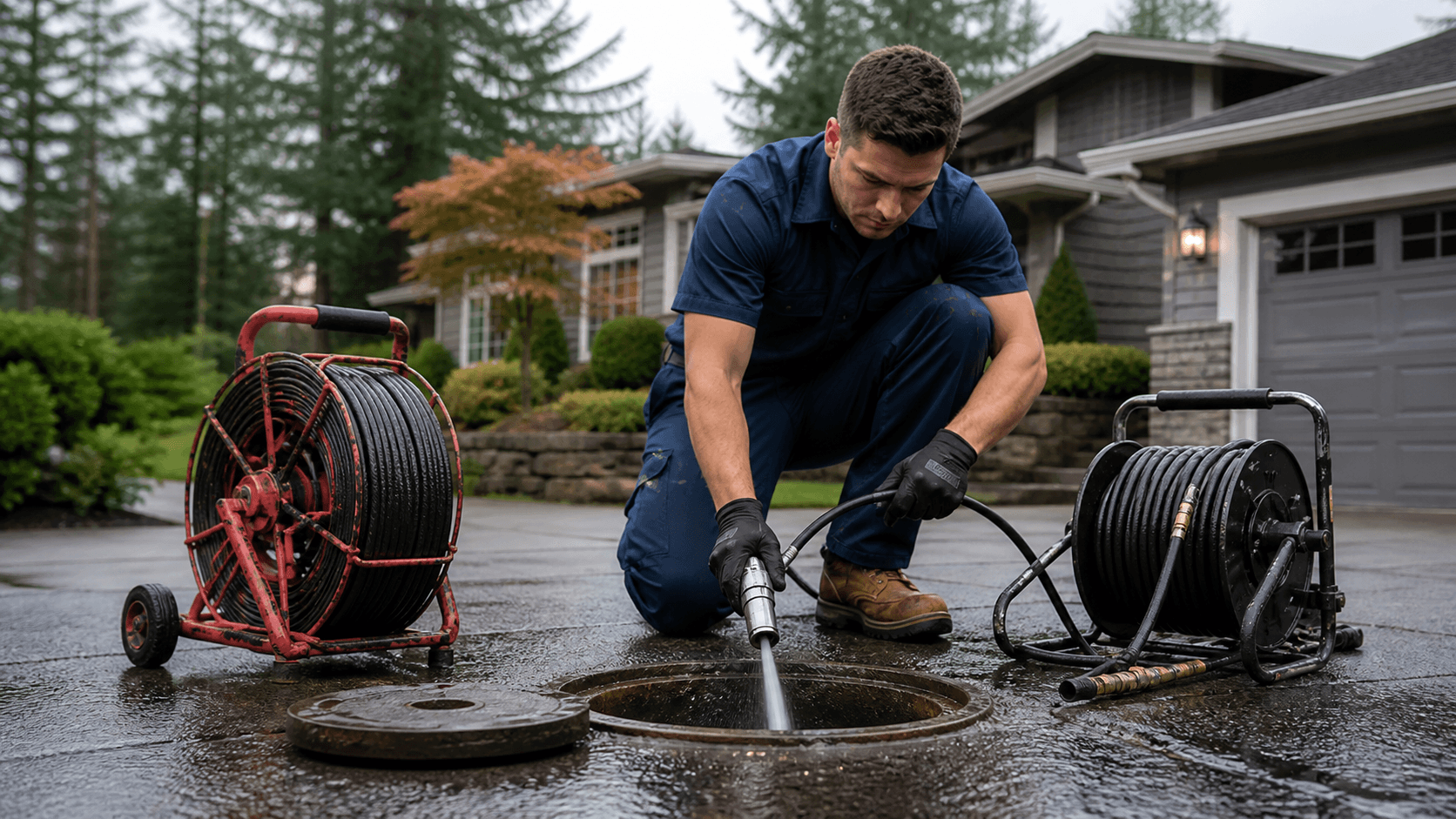
Hydro jetting clears the full diameter. A 3,500 to 4,000 psi water stream with forward-cutting and rear-facing scour nozzles shears the bonded material off the pipe interior. The pipe is cleaner after the jet than at any point since installation. Re-accumulation to the pre-clean state takes months to years instead of weeks.
The price difference reflects this: cabling at $189 to $345 (single drain or main line through cleanout) versus jetting at $595 to $1,200 (single branch or main lateral). On a one-time soft clog, the price difference buys nothing because there's nothing on the pipe wall to scour. On a recurring root-and-grease clog, the price difference buys you 18 to 36 months between service calls instead of 4 to 8.
Cabling and hydro jetting solve different drain problems; the right tool depends on what the camera shows inside the pipe.
This happening in your home right now? A licensed plumber can talk you through the next step on the phone — 24/7, and the call is free.
The decision matrix: clog type by pipe material by pipe age
There are eight clog types you'll encounter in a Bellevue home and three pipe-material conditions that change the right answer. The matrix below maps every common combination to the right tool. Use it as a sanity check against any quote you receive — if your quote contradicts the matrix, ask why.
The matrix collapses to four decision rules in practice. Soft clogs in healthy modern pipe (PVC, ABS, or post-1985 cast iron) cable. Recurring or hardened clogs in healthy modern pipe jet. Any clog in clearly deteriorated pipe gets either step-down-pressure jetting (2,500 psi or less) or mechanical cabling — never full-pressure jet. Orangeburg pipe means stop the cleaning conversation and start the replacement conversation.
Bellevue clog × pipe matrix
Hair and soap (shower, bath) in modern PVC: cable ($189). Jet is overkill; no pipe-wall scour value.
Single food clog (kitchen, 3 to 8 feet in) in modern PVC: cable ($189). Same logic.
Recurring grease (kitchen branch, soap+FOG bonded to walls) in any material: jet ($595). Cable does not remove the wall coating.
Root mass in PVC or healthy cast iron main lateral: jet ($795 to $1,200) plus root inhibitor. Cable removes the symptom, leaves the root structure.
Root mass in pre-1960 clay with deteriorated mortar joints: cable cautiously OR full repair. Standard-pressure jet risks blowing joints.
Root mass in rust-pitted pre-1970 cast iron: cable, or step-down 2,500 psi jet. Standard pressure can perforate.
Any clog in Orangeburg pipe: replace the line. Jetting and cabling both accelerate the inevitable collapse.
Foreign object (toy, wet wipe, construction debris): cable plus camera retrieval. Jetting pushes the object deeper.
Mineral scale and tuberculation in aging cast iron drain stack: step-down 2,500 to 3,000 psi jet. Restores partial diameter.
Belly or sag in horizontal drain run holding standing water: neither. The belly is a grade problem; only spot excavation fixes it.
Why pipe age changes the answer (Bellevue housing-stock specifics)
Bellevue's median home construction year is 1982 according to City of Bellevue Community Development data. More than half the housing stock was built in the 1950s and 1960s — putting most older neighborhoods into the pipe-material window where standard hydro jetting pressure is too aggressive. Lake Hills, Crossroads, Bridle Trails, Newport Hills, and Somerset are the neighborhoods where pre-jet camera assessment matters most.
Sewer pipe material standards changed several times between 1900 and 1990. Each transition created a cohort of Bellevue homes with a specific pipe age and material. Knowing which cohort your home falls into is the first input to the cabling-vs-jetting decision — even before the camera goes down the line.
1900 to 1960: clay tile (vitrified clay) was the dominant residential sewer material. Strong under compression but brittle, with mortar or gasket joints that weaken with age. A clay lateral in a 1955 Lake Hills home is now 71 years old. Pipe itself usually intact; joints are the failure point. Standard-pressure jet can separate a softened mortar joint cleanly — and once a joint is open, you've converted a treatable root intrusion into a $7,000 spot excavation.
1900 to 1980: cast iron was used for both indoor drain stacks and exterior sewer laterals. Corrodes from the interior (wastewater acid) and exterior (soil moisture). Interior tuberculation reduces effective diameter from the original 4 inches to closer to 3 in worst spots. The deciding factor for jetting is wall thickness — a camera estimates this by looking at how deep the rust pits go and whether external groundwater seepage is visible inside the pipe.
1940 to 1974: Orangeburg pipe was sold as a cheaper alternative to cast iron. Made from wood pulp impregnated with coal tar pitch. Rated for 50 years under ideal conditions; documented failures in 10 years are common. Deforms (flattens) under soil pressure before it cracks. There is no safe jetting pressure for failed Orangeburg. Once identified on camera, the conversation moves immediately to replacement options — covered in our cedar and Douglas fir roots in Eastside sewer lines guide.
1972 to 1985: PVC and ABS replaced cast iron in residential new construction. Solvent-welded joints, far less vulnerable to root entry. Standard-pressure hydro jet handles these lines without issue.
1985 to present: PVC, ABS, and HDPE throughout. Modern materials, modern joint integrity, no jetting concerns.
Bellevue neighborhood pipe-age cohorts
Lake Hills (built 1953-1970): heavy cast iron and clay. Camera before jet, every time.
Crossroads (built 1958-1972): mid-century galvanized and cast iron. Same.
Bridle Trails (built 1950-1980, mature cedars throughout): clay and Orangeburg pockets. Root pressure is high; camera shows whether pipe can take full pressure.
Newport Hills (built 1960-1985): cast iron transition era. Material varies house-to-house — camera is non-negotiable.
Somerset (built 1968-1990): mixed cast iron and early PVC. Upper sections include the Orangeburg-era cohort.
Factoria, Eastgate (varied 1965-2010): mixed material. Standard assessment workflow applies.
Downtown Bellevue and post-1990 builds throughout: PVC, full-pressure jet safe.
A cable head breaks through a blockage; a jetting nozzle scours the pipe wall. That difference matters most on recurring grease and root calls.
The 6-year cost math on a recurring main-line root clog
Cabling at $345 every 18 months over a 6-year window is $1,380 across 4 service calls. A single hydro jet at $995 plus a maintenance jet at month 36 ($495) plus an enzymatic foam root inhibitor at month 48 ($120) is $1,610 across 3 service calls. The cash difference is $230 over 6 years; the practical difference is one fewer backup event in your kitchen and one fewer plumber visit blocking your driveway.
The cabling-as-band-aid trap is the most common Bellevue drain-cleaning misallocation we see. A homeowner with a 1968 Lake Hills home and a mature cedar in the parking strip gets a $345 cable every 18 months for three cycles, pays $1,035 total, has a kitchen backup at month 47, pays another emergency-rate $485 ($1,520 total), and only then considers the jet conversation. By then the same $1,610 jet-plus-maintenance plan would have caught the root mass before the second backup.
The math becomes more decisive when emergency surcharges are involved. The cable cost above assumes business-hours scheduling. A weekend or after-hours backup adds the after-hours multiplier from our emergency plumber cost in Bellevue guide — typically 1.5x to 2x. A single emergency cable at $345 × 2x = $690. A single emergency jet at $1,200 × 2x = $2,400. The premium on emergency jetting is real, but the alternative (cabling repeatedly at emergency rates) closes the gap fast.
The cost math flips entirely on a clog that does not actually need either intervention. Cabling a one-time soft clog at $189 versus jetting the same clog at $595 means you paid $406 for zero durable benefit — the jet scours a pipe wall that had nothing on it. The decision rule is whether the camera shows pipe-wall residue (jet) or a clean upstream and downstream pipe with a localized obstruction (cable).
Red flags in a Bellevue drain-cleaning quote (cabling or jetting)
Five patterns mean the quote is wrong, regardless of which tool is proposed: no camera diagnostic before quoting, recommended maintenance interval shorter than 12 months for residential, unbundled fees for camera + service + report, no mention of pipe age or material in the assessment, and refusal to show camera footage on the spot. Any of these and get a second opinion.
No camera before quoting. The clog-clearing tool — cable or jet — should be selected based on what the camera shows. Quoting a $1,000 hydro jet without first running a camera and showing you the footage is selling a guess. Quoting a $345 cable without a camera is acceptable only for a known single-point clog (e.g., a homeowner reports they dropped a toy down the toilet). For recurring or main-line issues, the camera is the first $295 of the diagnostic, not an upsell.
Maintenance interval shorter than 12 months. The published industry guidance for residential sewer-lateral jetting maintenance is 18 to 36 months. 12 months is appropriate for the most aggressive root cases in the worst-case Bellevue pipe (deteriorated cast iron with mature cedar at the curb). 6-month intervals indicate the contractor is monetizing the relationship rather than solving the underlying problem — which usually means the line needs spot repair or replacement, not more cleaning.
Unbundled pricing. The legitimate price components for a sewer-line cleaning visit are: equipment cost, labor (1 to 3 hours), water consumption (negligible for jetting), and the camera. Splitting these into a $295 camera fee plus a $695 service fee plus a $150 'documentation fee' is a pricing pattern that lets a contractor quote a low headline number and then add line items at the bill. Ask for one total number in writing before authorizing work.
No pipe-age or material assessment in writing. The quote should include what the camera saw: 'Main lateral, 4-inch PVC, no structural issues, root mass at 18 feet from cleanout'. That tells you the contractor identified the material before recommending the tool. A quote that says 'recommend hydro jetting, main line' with no detail cannot be evaluated against the matrix above.
Camera footage withheld until later. Modern jetting and cabling rigs record digital footage that can be played back on a phone or tablet during the diagnostic visit. The plumber should walk you through what's on the screen while the camera is still in the pipe — pointing at the clog, the pipe material, the joint condition. If the answer is 'we'll send you the video tomorrow' or 'the footage stays at the office,' the diagnostic is being optimized for sales rather than for your decision. Reputable Bellevue plumbers show you the footage at the truck before they leave.
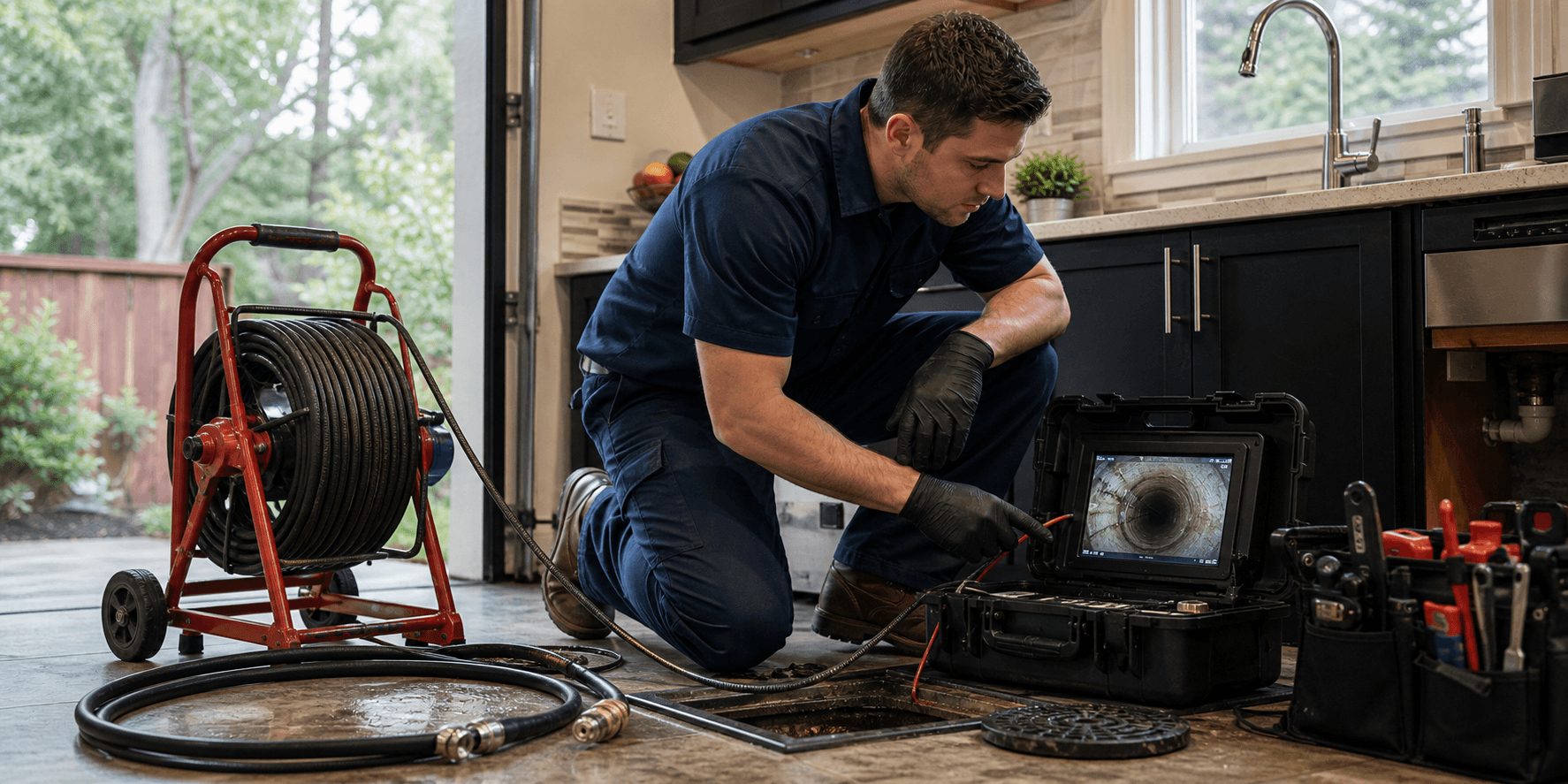
For main-line or recurring clogs, a camera diagnostic should come before the quote so pipe material, age, and joint condition are visible.
Questions to ask before authorizing either service
Six questions filter out the bad quotes regardless of which tool is recommended — they cover pipe material, pipe age and condition, pressure appropriateness, maintenance interval, the contingency if cleaning reveals damage, and the total bundled price. The full list is below. Answers should be specific and in writing; vague answers (or refusal to put answers in writing) mean the contractor is asking you to authorize on trust rather than diagnostic.
These six questions filter out the bad quotes regardless of which tool is recommended. The answers should be specific and in writing — vague answers (or refusal to put answers in writing) means the contractor is not confident in the diagnostic and is hoping you authorize on trust. Trust is not the right basis for a $1,000 plumbing decision.
The 'what happens if the cleaning reveals damage' question is the most important one and the most commonly skipped. A hydro jet pass sometimes exposes a crack or belly that was masked by the clog. The reputable answer is: 'We stop, show you the camera footage, and quote the repair separately before doing any additional work.' The bad answer is: 'We just keep going and bill for whatever we do.' Get the answer up front.
On the maintenance interval question — a contractor recommending 6-month intervals is either monetizing the relationship or has identified an underlying structural problem they haven't told you about. Either way, ask the follow-up: 'Why so frequent? What's wrong with this line specifically?' The honest answer will be one of: 'Aggressive cedar at the parking strip, root regrowth is unusually fast here' (acceptable; documented in cedar-root guide), 'The pipe has a bad joint that's catching debris' (the line needs spot repair, not more cleaning), or no answer (the recommendation is wrong).
Six questions before authorizing $300+ drain work
What pipe material and age did the camera reveal?
Is the proposed cleaning tool (cable or jet) appropriate for that material and age?
Was full standard pressure or step-down pressure assessed?
What is the recommended maintenance interval, and why that interval specifically?
What happens if cleaning reveals damage that requires separate repair?
What is the total bundled price for camera + service + footage report?
When neither cabling nor jetting is the right answer
Three scenarios where the right answer is repair rather than cleaning: Orangeburg pipe (replace the line, every time), a belly or sag in a horizontal run (only excavation can correct grade), and a sewer lateral with multiple bad joints in pre-1960 clay (CIPP lining or full replacement). Cleaning these lines kicks the can; repair stops the recurring cost.
Orangeburg is the easy case. Once the camera identifies the bituminized-fiber wall pattern (it looks soft, sometimes ovalized, with characteristic delamination), the conversation moves to replacement. A plumber who proposes jetting Orangeburg is either inexperienced or selling you a billable that will fail. Replacement options are trenchless (pipe bursting or CIPP if structure permits) or open-trench, covered in our Bellevue trenchless sewer repair page.
Bellies in horizontal runs are the next case. A belly is a low spot in the pipe where grade has settled below the original 1/4-inch-per-foot fall. Water pools in the belly; solids accumulate in the pooled water; the line clogs at the same spot every time. Neither cabling nor jetting fixes the grade. The pipe drains through the belly during the clean and re-collects sediment within weeks. Only excavating to the belly section and re-laying with proper grade actually solves it.
Multiple bad joints in pre-1960 clay are the third case. If the camera shows root intrusion at three or four different joints along the lateral, the underlying problem is that the joints have failed across the run, not that one specific joint has roots. Spot-repairing one joint solves 25 percent of the problem; the next joint fails 18 months later. CIPP lining the entire run (creating a continuous epoxy-saturated felt liner inside the existing pipe) seals all joints at once and adds 50 years of service life. The cost is higher than a single cleaning visit but lower than four spot repairs over the next decade.
If you've been quoted cleaning on a line that fits one of these three patterns, the second-opinion call is worth the time. A different contractor camera-ing the same line and recommending repair instead of cleaning is the structural test of which assessment is honest. The cheap cleaning today plus the inevitable major repair in 18 months is more expensive than the major repair today.
Sources
Every fact in this guide cites a verifiable public source. If you find a number we got wrong, email dispatch@bellevueplumberpro.com.
Need help with this in your home? See our Drain cleaning and clog removal in Bellevue page for pricing, our diagnostic process, and how same-day service works across the Eastside.
— Bridge to service
We dispatch for this across Downtown Bellevue, Factoria, and Eastgate — see your neighborhood page for local response times and recent jobs.
Hydro jetting vs cabling in Bellevue — questions homeowners ask
QUESTION01
Should I cable or hydro-jet my drain?
Cable a single soft clog. Jet a recurring or root-driven clog — after a camera confirms the pipe can take 4,000 psi. If the camera shows pre-1960 clay with bad joints, deteriorated Orangeburg, or rust-pitted cast iron, step-down pressure or cabling is the safer call.
QUESTION02
Why do so many Bellevue drains need jetting instead of cabling?
Bellevue's median home was built in 1982 and more than half the housing stock dates to the 1950s and 1960s — so most older neighborhoods run cast iron or clay drains whose interior condition (tuberculation, root intrusion) needs scouring, not just a hole punched through.
QUESTION03
Is hydro jetting worth the extra cost over cabling?
Run the math: cabling at $345 every 18 months over 6 years is about $1,380 across 4 calls. A single $995 hydro jet plus a $495 maintenance jet at month 36 (with enzymatic root foam) typically costs less and keeps the line clear between them.