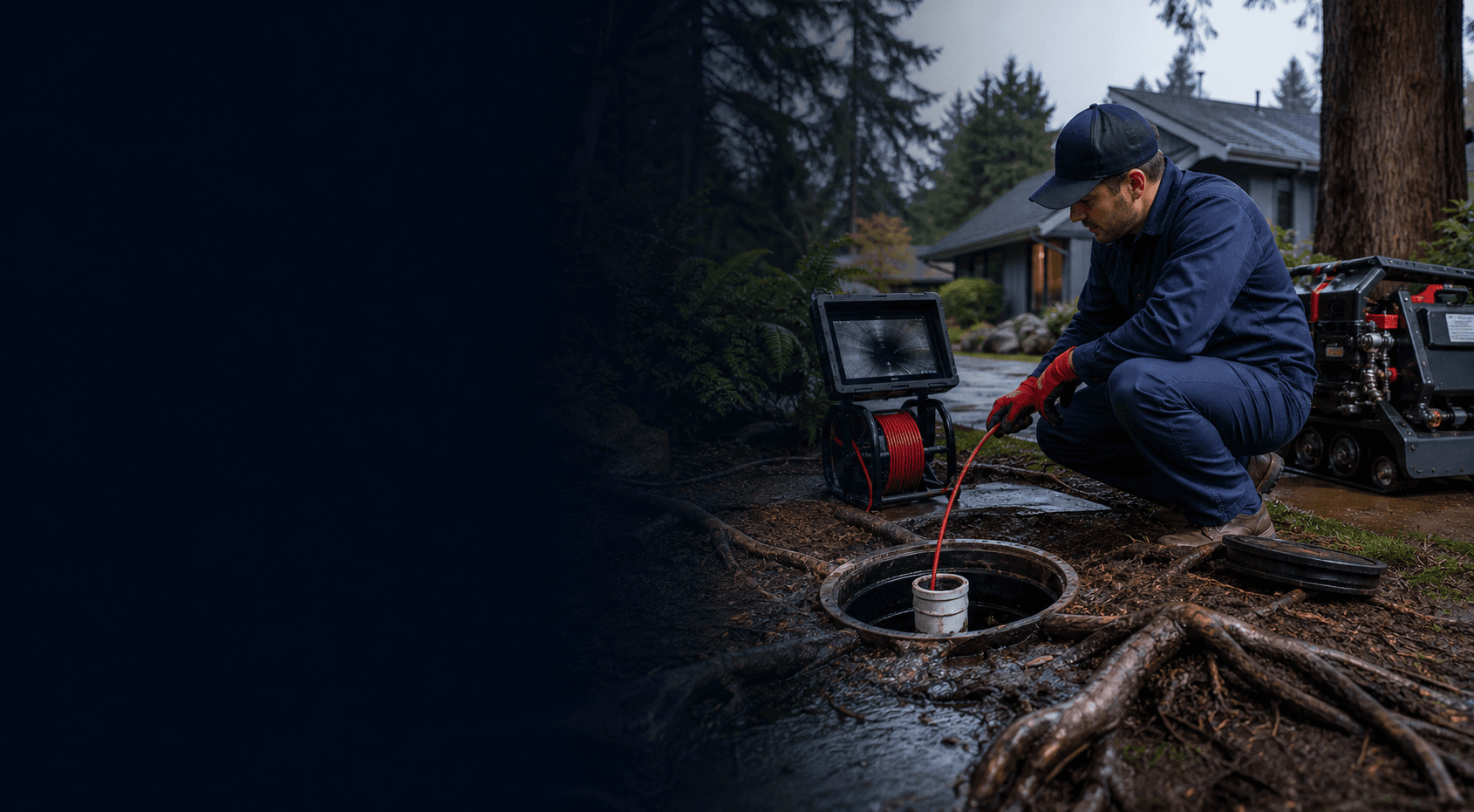
Bellevue trenchless sewer repair: CIPP lining and bursting
Trenchless sewer repair and replacement in Bellevue covers two main methods — cured-in-place pipe lining (CIPP) and pipe bursting — that rebuild failing sewer laterals without excavating the entire run. For Bellevue homes with mature western red cedars, Douglas firs, and established landscaping, trenchless typically saves $5,000 to $10,000 in restoration costs compared to open-trench replacement, completes in 1 to 2 days instead of 3 to 5, and uses HDPE or epoxy-resin materials with 50 to 100-year rated service life. The full pattern of cedar and Douglas fir roots in Eastside sewer lines explains why root intrusion is the dominant Bellevue sewer failure mode; sewer camera inspection in Bellevue: what it shows, what it costs, and when you need one explains the diagnostic that drives the trenchless-versus-dig decision. If sewage is backing up right now, our 24-hour and 24/7 emergency plumber in Bellevue, WA line dispatches the nearest tech.
What we fix
- Pipe lining (CIPP) for cracked clay or cast-iron sewer laterals with intact geometry
- Pipe bursting for collapsed or severely damaged Orangeburg — pulls new HDPE through the old line's path
- Spot repair (trenchless single-point) for isolated breaks in otherwise sound pipe
- Cedar and Douglas fir root removal during trenchless install — bursting head clears, lining encapsulates
- Restoration of side-sewer connections to the King County main
- City of Bellevue Development Services permit and inspection coordination
How we work
Camera inspection first.
Every trenchless quote starts with a full camera survey from cleanout to city connection. Footage decides the method — lining versus bursting versus spot — and the homeowner sees the same footage we see before any quote is written.
Method selection.
Match the pipe condition to the right method. Intact-but-cracked clay = lining. Collapsed Orangeburg = bursting. Single isolated break = spot repair. We quote the appropriate method, not the most expensive one.
Access pits and pre-clean.
Two small pits (typically 3 by 4 feet) at the start and end of the lateral. Hydro-jet the existing line clean so the new pipe or liner installs cleanly.
Install, inspect, and backfill.
CIPP liner inverted and steam-cured in 2 to 4 hours, or HDPE pulled through the burst head in 4 to 8 hours. City of Bellevue inspection at point of repair before any backfill.
Cost of trenchless sewer repairin Bellevue (2026)
Real prices for our most common trenchless sewer repair jobs in Bellevue. Every quote is flat-rate and written on a tablet before we start.
If a contractor quotes a full open-trench replacement before they have shown you camera footage, get a second opinion. We see contractors quote $18,000 dig jobs on Bridle Trails sewer lines that camera shows are 80 percent lineable for $9,500. The diagnostic is $345 — the savings are often $5,000 to $10,000.
What trenchless sewer repair actually means
Trenchless sewer repair rebuilds a failing underground sewer pipe without excavating the entire run. Two main methods dominate residential work: pipe lining (CIPP), where a resin-coated liner is inserted into the existing pipe and cured in place to form a new pipe-within-a-pipe; and pipe bursting, where a head is pulled through the old pipe to fracture it outward while simultaneously pulling new HDPE pipe into the same path.
The general principle: instead of digging a 60-foot trench across the yard to remove and replace an old sewer lateral, trenchless methods use the existing pipe's path. Access pits at the start (typically at the cleanout near the house) and end (where the lateral meets the city main) are typically 3 by 4 feet each. The rest of the yard — trees, shrubs, lawn, driveway, hardscape — remains undisturbed.
The two dominant methods are CIPP lining and pipe bursting, plus a less-common third option (spot repair) for isolated breaks. Slip lining (a smaller-diameter pipe pulled through the old pipe) is occasionally used but reduces flow capacity below code minimums for most residential applications, so it's rarely the right answer for a Bellevue sewer lateral.
Trenchless is not always the right answer. Severely damaged Orangeburg pipe sometimes cannot host CIPP lining; bellied or sagging pipe cannot be fixed with any trenchless method because the problem is grade, not material; pipe under building foundations needs careful evaluation. The exclusions section later in this guide covers when trenchless does not work.
The diagnostic — why every trenchless quote starts with a camera
A sewer camera survey ($345) is non-negotiable before any trenchless quote. Camera footage determines pipe material, condition, slope, root-intrusion locations, lateral connections, and which trenchless method (or open trench) is appropriate. Quotes given without camera footage are guesses at best and sales pitches at worst.
The standard procedure: a CCTV sewer camera mounted on a self-propelled crawler or push-rod system is inserted through the cleanout at the building and pushed or driven all the way to the city main connection. Footage is recorded continuously, with a distance counter and a separate locator wand that surface-pinpoints each notable feature. The homeowner watches the same footage we see during the inspection — no editing, no surprises, no 'trust us, you need replacement.'
What the camera tells us: pipe material (clay, cast iron, PVC, Orangeburg — visually distinct), pipe condition (cracks, root intrusion, scaling, corrosion, bellies, collapse points), pipe slope (camera tilt indicates gradient changes), lateral connection points (where bathroom or kitchen drains tie in), and depth from the surface (the locator wand provides this).
Why this matters for trenchless: a $9,000 CIPP lining is the right quote when camera shows intact-but-cracked clay with cedar roots at three joints. A $13,000 pipe burst is the right quote when camera shows collapsed Orangeburg. A $4,200 spot repair is the right quote when camera shows one isolated break in 60 feet of otherwise sound pipe. Without the camera, contractors have no basis for selecting method — and the temptation to default to the most expensive option (full open-trench replacement) is real and common.
We see this pattern repeatedly in Bellevue: a homeowner calls us for a second opinion after another contractor quoted $18,000 to $25,000 for full replacement on a sewer they never camera'd. About 60 percent of those second-opinion cases turn out to be $7,000 to $13,000 trenchless candidates. The camera fee ($345) is the cheapest insurance policy in residential plumbing.
Method 1 — CIPP pipe lining
CIPP (cured-in-place pipe) lining inserts a fabric tube saturated in epoxy resin into the existing sewer pipe, then steam-cures or UV-cures the resin to form a hardened plastic pipe-within-a-pipe. The new lined surface is typically about 1/4-inch thick, hydraulically smoother than the original pipe, root-resistant, and carries a 50-year manufacturer warranty.
How it works step-by-step: hydro-jet the existing pipe clean (1 to 2 hours), measure the run length precisely, prepare the felt liner with two-part epoxy resin, invert the liner into the pipe using compressed air or water pressure (it goes in inside-out and turns rightside-out as it deploys), then cure for 2 to 4 hours using steam or hot water. Final step: reopen any lateral connections (the liner covers them initially) using a robotic cutter operated from inside.
Best applications: clay pipe with cracking and root intrusion, cast iron with surface corrosion, pipe joints that have separated but where the pipe segments themselves are intact, any pipe diameter 4 to 8 inches.
Strengths: faster than bursting (often single-day completion), no equipment-pulling forces in the soil, doesn't disturb surrounding utilities. Resin surface is hydraulically smoother than original cast iron or clay, improving flow capacity slightly. Permits root-resistance for the lifespan of the liner.
Limitations: the lined pipe has slightly reduced internal diameter (about 5 to 10 percent reduction). On already-undersized pipes this can matter; on standard 4-inch Bellevue laterals it does not. Cannot fix sagging — if the existing pipe has a belly, the liner conforms to the same shape. Cannot fix severe collapse where there is nothing intact for the liner to host against.
Method 2 — pipe bursting
Pipe bursting pulls a conical bursting head through the existing sewer pipe, fracturing the old pipe outward into the surrounding soil while simultaneously pulling new high-density polyethylene (HDPE) pipe into the same path behind the head. The result is a brand-new HDPE pipe — sometimes larger diameter than the original — in the same path without surface excavation.
How it works: dig two access pits (start and end of run), set up the bursting machine at the end pit, thread a steel cable through the existing pipe back to the start pit, attach the bursting head and the new HDPE pipe to the cable at the start, then pull everything through hydraulically. The bursting head shatters the old pipe outward as it advances; the HDPE follows immediately behind. Total run time for a 60-foot residential lateral: typically 2 to 4 hours of actual pulling, 4 to 8 hours total including setup and finish work.
Best applications: collapsed or severely damaged Orangeburg, fractured cast iron beyond what lining can host, situations where you want to upsize the replacement pipe (going from 4-inch to 6-inch, for example) without trenching the whole run.
Strengths: handles damaged pipe that lining cannot host, results in full-strength new HDPE pipe (not a liner-within-a-pipe), 100-year material rating, allows diameter upsize.
Limitations: requires larger access pits than lining, more equipment-intensive, slightly more expensive. Cannot pass through major lateral connections without separate manual cuts and rejoins. Forces from the bursting head can affect nearby utilities — gas lines, water mains, electrical conduit within 5 feet of the bursting path need attention and sometimes hand excavation to verify clearance.
When trenchless works — the four conditions
Trenchless requires four conditions to be present: the existing pipe must be intact enough to host the lining or guide the bursting head; pipe geometry (slope, depth, bend radius) must fit within the equipment's tolerances; access points must exist at the start and end of the run; and the failure pattern must be appropriate for one of the methods (cracking, root intrusion, surface corrosion — yes; complete collapse, severe sagging, foundation conflict — no).
Pipe condition: CIPP lining requires the existing pipe to be at least 70 percent structurally intact along the run length, because the liner uses the old pipe as a host. If the old pipe has collapsed completely in segments, the liner has no support and cannot cure properly. Pipe bursting is more tolerant — it can work through partially-collapsed pipe because the bursting head is forcing its way through and pulling new pipe behind. But severely collapsed or compressed pipe (often Orangeburg) sometimes requires dig anyway.
Geometry: most trenchless equipment handles pipe diameters from 3 to 8 inches, depths up to 15 feet, runs up to 200 feet from a single access pit. Slope changes within the run are usually fine. Sharp 90-degree bends require careful planning — bursting heads have a minimum bend radius around 18 to 24 inches depending on equipment. Bellevue residential sewer laterals almost always fall within trenchless equipment's working range.
Access points: trenchless needs a small pit at each end of the run. The downhill end is usually the connection to the city main — easy. The uphill end is typically the cleanout at the building. If the cleanout doesn't exist or sits in an inaccessible location (under finished hardscape, inside a finished basement), a new access pit needs to be excavated. This adds 4 to 6 hours of pit work but doesn't change the trenchless-versus-dig decision.
Failure pattern compatibility: cracking, root intrusion, hairline fractures, surface corrosion, joint failures — all good trenchless candidates. Complete pipe collapse, sagging (belly) where the gradient has changed, pipe directly under a building foundation — these often require partial or full dig.
When trenchless can't fix it — the real exclusions
Trenchless cannot fix five specific conditions: severely sagging or bellied pipe (the grade is wrong, not the pipe), completely collapsed pipe with no remaining structure to host any method, pipe under building foundations where access is impossible, pipe with extremely tight bends below equipment minimum radius, and certain lateral-connection configurations that require manual cutting and rejoining.
Sagging or bellied pipe: this is the most common trenchless exclusion. When a sewer pipe has settled in a low spot, water doesn't drain properly even if the pipe itself is intact. Neither CIPP lining nor pipe bursting fixes this — the liner conforms to the existing sag, and the burst head pulls new pipe through the same low spot. The only fix is to dig, re-establish proper grade, and replace. Camera footage clearly shows bellies (water sits in the low spot, the camera floats through).
Complete collapse: if the existing pipe is completely flattened or pushed apart by soil pressure or root mass, CIPP has nothing to line and the burst head has nothing to follow through. Some severe Orangeburg collapses fall in this category. Open trench is the only option.
Pipe under building foundation: if the sewer lateral runs directly under a building (some older Bellevue homes with finished basements have this), neither trenchless method can be deployed because access at the building end is blocked. The fix involves rerouting the sewer around the building or partial demolition for access — both significant scope changes.
Tight bends and lateral connections: 90-degree bends with radius below 18 to 24 inches can't accommodate a bursting head. Rare in residential laterals but occasionally seen in older Bellevue homes with creative original plumbing. Multiple lateral connections (kitchen and bathroom drains tying into the main lateral at separate points) add work to both methods and can push the economics toward open trench.
Why most Bellevue sewer problems are trenchless candidates
Bellevue's dominant sewer failure modes — cedar and Douglas fir root intrusion in clay or cast iron, cracking from settling soil, joint failures in 50 to 60-year-old pipe — are exactly the failure types trenchless methods handle well. Roughly 80 percent of the sewer-line work we quote in Bellevue is trenchless-eligible based on camera findings.
The cedar root intrusion pattern documented in our cedar-roots guide is a textbook trenchless candidate. Root intrusion enters at joints or hairline cracks; the pipe surrounding the intrusion is typically intact. CIPP lining encapsulates the cracked joint and seals it permanently, with the new resin surface resisting future root entry. Pipe bursting clears the roots entirely and replaces the line with HDPE — also root-resistant.
The pipe-material mix in Bellevue housing favors trenchless. Clay (1950s-60s installs): excellent lining candidate, cracking pattern is host-compatible. Cast iron (1900s-1980s): lineable if structurally intact, burstable if not. PVC (post-1985): rarely fails, but spot repair if it does. Orangeburg (1950s-1970s): more variable — about half the Bellevue Orangeburg installs we camera are burstable, half need dig.
Soil and slope conditions are favorable. Bellevue's mostly clay-loam soil holds pipe alignment well; the major exception is steep hillside lots in Somerset, Newport Hills, and parts of Bridle Trails where post-construction settling produces bellies. Those need dig regardless of method. Flat or moderately-sloped lots — the majority of Bellevue residential — are trenchless-friendly.
Bridle Trails, West Bellevue, and Crossroads see the highest trenchless rates in our work — mature trees, 1960s-70s clay or cast-iron lines, intact-but-cracked failure pattern. These are also the neighborhoods where trenchless saves the most in landscape restoration. A $14,000 trenchless install versus a $22,000 open trench plus $4,000 in yard restoration plus $8,000 in tree removal and replacement (a $34,000 open-trench total) is the realistic financial picture.
Cost comparison — trenchless versus open trench
A typical 60-foot residential sewer lateral runs $11,000 to $22,000 by open trench versus $7,000 to $14,000 by trenchless — a $4,000 to $10,000 direct savings on the install itself. The larger savings is in restoration costs avoided: trees, lawns, hardscape, driveways, and irrigation lines that don't need to be torn up.
Open-trench economics: $11,000 to $22,000 for the pipe work plus restoration. In Bellevue with mature landscaping, restoration typically adds $2,000 to $8,000 (lawn replacement, hardscape repair, plant replacement). If trees need to come out, add $3,000 to $15,000 per significant tree depending on size and City of Bellevue permit requirements. Realistic total open-trench scope: $14,000 to $45,000 on a Bridle Trails or West Bellevue lot with mature trees.
Trenchless economics: $7,000 to $14,000 for the install, $0 to $1,500 for the small access-pit restoration (lawn patch and reseed). Realistic total trenchless scope: $7,500 to $15,500. Direct savings of $6,500 to $30,000 for the same final outcome.
The math gets more dramatic when the property has hardscape — driveways, patios, retaining walls — directly over the sewer line. Cutting and re-pouring a concrete driveway adds $4,000 to $12,000 to an open trench job. Trenchless avoids the entire issue.
Where open trench actually wins financially: when the pipe is severely collapsed and bursting won't work, when there's no feasible access pit at the building end (some Bellevue homes have the lateral entering directly under a finished basement floor), or when you're already excavating for an addition or basement remodel and can include the sewer work at marginal cost.
Permits, warranty, and lifespan
Trenchless sewer work in Bellevue requires the same City of Bellevue Development Services side-sewer permit as open-trench work. Inspection happens at the point of repair before backfill. CIPP liners carry a 50-year manufacturer warranty; HDPE pipe from pipe bursting is rated for 100-year service life. Both methods deliver service life comparable to or longer than a fresh open-trench replacement.
City of Bellevue permits: any sewer-lateral repair touching the side sewer requires a permit through Bellevue Development Services. The application is handled by the contractor (us); the homeowner signs. Permit fee is typically $250 to $450 depending on scope. Inspection happens during the install at the point of repair — the inspector verifies the work before we backfill the access pits.
King County connection: where the side sewer connects to the King County main, separate King County coordination may be required. We handle this when applicable — typically a phone confirmation and photographic documentation of the connection.
CIPP liner warranty and lifespan: major manufacturers (Insituform, Perma-Liner, NuFlow) warrant the liner material for 50 years from install. Real-world service life on properly-installed CIPP is approaching that mark — the technology has been deployed since the late 1970s and original installs from the early 1980s are still in service. The resin-cured surface is impervious to roots, doesn't oxidize, doesn't scale.
HDPE pipe from pipe bursting: HDPE has a 100-year material rating in soil burial applications. The pipe itself is chemically inert, doesn't corrode, doesn't scale, doesn't host root intrusion. Real-world service life expectations are at the upper end of any sewer pipe material currently available.
Workmanship: the 50 to 100-year warranty applies to the material. Installation workmanship (joints, transitions, connections) varies by contractor — we warrant our trenchless installs for 10 years on workmanship, in addition to the manufacturer material warranty.
Sources
Every fact in this guide cites a verifiable public source. If you find a number we got wrong, email dispatch@bellevueplumberpro.com.
- NASSCO (National Association of Sewer Service Companies) — trenchless method standards
- Insituform / Aegion — CIPP lining technology and 50-year warranty
- Perma-Liner Industries — manufacturer specifications and installation reference
- ASTM F1216 — Standard Practice for Rehabilitation of Existing Pipelines and Conduits by the Inversion and Curing of a Resin-Impregnated Tube
- ASTM F1962 — Standard Guide for Use of Maxi-Horizontal Directional Drilling and Pipe Bursting
- City of Bellevue Development Services — Side-sewer permit requirements
From our guides
Deeper background on the issues this service addresses:
- Cedar and Douglas fir roots in Eastside sewer lines: signs, repair, and prevention
- Sewer camera inspection cost in Bellevue: what it shows, what you pay, and when you need one
- Bellevue plumbing permits: when you need one, what it costs, and why skipping costs more
Full overview of sewer line repair and replacement in Bellevue — pricing, process, what we fix, and how same-day service works.