Kitchen drain clogs in Bellevue: grease, FOG, dishwasher discharge
Hot grease cools to a hard wax-like coating inside horizontal kitchen drain runs. Combined with dishwasher discharge that often pushes grease-laden water back through a sink without an air gap, and pre-1980 cast iron drain stacks that catch debris on internal corrosion, the kitchen is the single most common recurring-clog location in Bellevue homes. This guide explains the chemistry of FOG (fats, oils, grease), why dishwasher discharge backs up into sinks in older Eastside kitchens, the specific failure pattern in Lake Hills and Crossroads cast iron drains, what enzymatic maintenance actually does versus what Drano does (briefly: do not pour Drano in it), and when a single cable from the cleanout solves the problem versus when a recurring clog signals something structural. Cabling and hydro jetting pricing throughout reflect 2026 Bellevue residential rates from the [Drain Cleaning and Clog Removal in Bellevue](/services/drain-cleaning/) service page.
The short answer: hot grease, a long horizontal drain, and a dishwasher
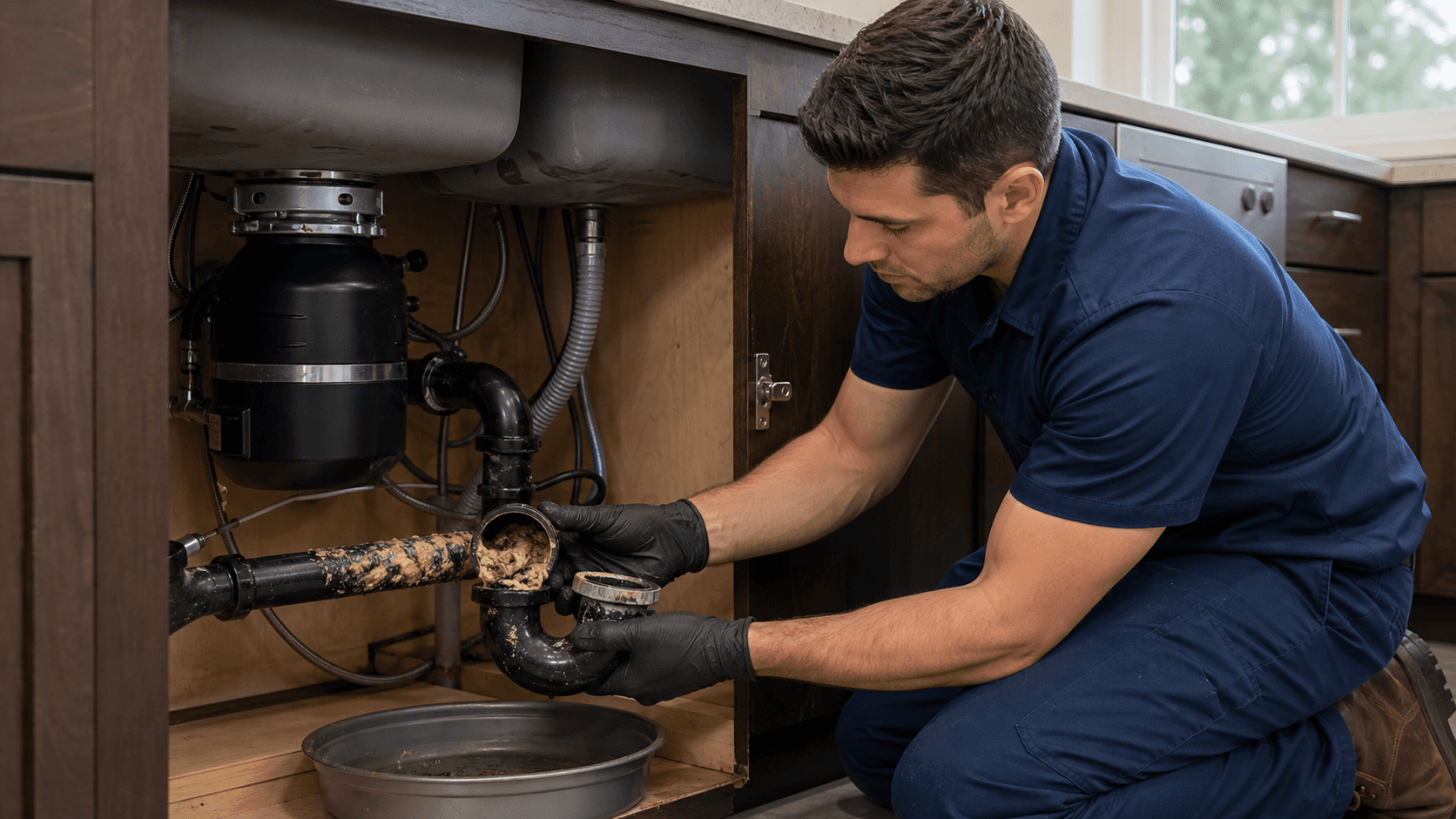
The Bellevue-kitchen recipe for a recurring clog is hot grease poured down a drain that travels 6 to 18 feet through a horizontal branch line before reaching the stack, with a dishwasher discharging into the same line. Grease cools below 115°F within the first few feet of pipe and starts depositing on the interior. Once a coating forms, every subsequent grease pour adds to it and catches food debris. The dishwasher cycle compounds the problem by pushing the grease-laden water through the same horizontal run twice a day.
Cooking grease pours liquid because it's hot — typically 180 to 350°F when you drain a pan into the sink. Drain water cools rapidly as it travels through the pipe. By the time it reaches the P-trap a few feet downstream the temperature has dropped to roughly 90 to 110°F. At that temperature, the dissolved fats and oils precipitate out of solution and deposit on the inside of the pipe.
Once a thin grease coating exists on the pipe interior, the chemistry compounds. Soap from dish detergent and dishwasher discharge reacts with the deposited grease to form fatty acid salts — the chemistry the soap industry calls saponification. Saponified grease bonds to the pipe wall harder than the original grease alone, and it captures food particles, coffee grounds, and lint as they pass through. The clog grows from the wall inward over weeks to months until effective pipe diameter is half or less of original.
The Bellevue rambler architecture makes this worse. Many 1970s and 1980s ranch-style homes in Lake Hills, Crossroads, and East Bellevue have kitchen islands or peninsula sinks 8 to 18 feet from the main drain stack, with the branch line running horizontally through the floor joists. Long horizontal runs give grease more cooling distance before it reaches the stack, which means more deposition per pour.
Kitchen grease clogs usually form as a wall coating first, then catch food solids and dishwasher discharge.
This happening in your home right now? A licensed plumber can talk you through the next step on the phone — 24/7, and the call is free.
The dishwasher discharge problem in older Bellevue kitchens
Washington Plumbing Code (UPC with WA amendments, Chapter 51-56) requires dishwasher discharge to either drain through an air gap mounted on the sink rim, or loop the discharge hose above the highest level of the sink drain (a 'high loop'). Many pre-1995 Bellevue kitchens were installed without either, with the dishwasher hose connecting directly to the disposal or branch tailpiece below the sink trap level. When the dishwasher cycle drains, the discharge pushes back up through the trap and into the sink — looking like a clog, but actually a code-violation backflow.
The air gap is the visible cap on the kitchen counter or sink rim — a small chrome cylinder with vents. When water comes out of it during a dishwasher cycle, that is the air gap doing its job: a brief overflow indicates the dishwasher line downstream of it is clogged, but it also means the dishwasher cannot siphon dirty drain water back into itself or push backwards into the sink. The high loop alternative routes the discharge hose up under the counter to the highest point possible before turning back down to the drain, providing similar but less reliable protection.
Retrofit kitchens often skip both. A homeowner installs a new dishwasher and the installer routes the discharge hose to the cheapest available connection — typically the side port on the garbage disposal — without an air gap and without a high loop. The unit works fine until the branch drain develops any restriction (the grease buildup above). At that point the discharge has nowhere to go and pushes back through the disposal into the sink. The fix is plumbing the air gap or high loop the original install skipped, not snaking the drain.
The City of Bellevue does not actively inspect existing kitchen installations for air-gap compliance, but a sale-time home inspector will flag a missing air gap as a building-code defect that the seller is expected to correct before close. If you are reading this in advance of selling, factor a 1 to 2-hour plumber visit and $180 to $300 in materials into your repair budget. The broader Bellevue plumbing permits framework also covers the disclosure obligations on sale.
Pre-1980 cast iron drain stacks and Lake Hills / Crossroads specifics
Bellevue's housing stock built between 1955 and 1980 uses cast iron drain stacks (the vertical pipe running through walls and floors collecting waste from each fixture). Cast iron interiors corrode over decades, forming rust nodules called tubercles that narrow the effective diameter and provide rough texture for grease to catch on. A 1968 Lake Hills kitchen drain stack today has 60 to 70 percent of its original interior cross-section, with the rest of the diameter taken up by tuberculation that catches kitchen grease, dishwasher discharge soap, and food debris.
Cast iron was the dominant residential drain material in the United States from roughly 1900 to 1980. Manufactured in 5-foot bell-and-spigot lengths, joined with lead and oakum, with horizontal branch lines tied in via cast iron fittings. Strong, fire-resistant, and quiet under flow — all reasons it was used. The trade-off is that the interior surface is not smooth (raw cast iron is mildly textured by manufacturing) and the material corrodes from the inside out under decades of wastewater exposure.
Lake Hills (built 1953-1970) and Crossroads (built 1958-1972) are the Bellevue neighborhoods where this pattern is most consistent. Walk into a typical original-construction 1965 Lake Hills rambler and the drain stack going up through the wall behind the kitchen is cast iron. Sixty years of soap, grease, and food residue have left the interior coated with a 1/4 to 1/2 inch layer of bonded tuberculation and saponified deposits. New kitchen grease pours have less than 75 percent of the original 3-inch diameter to flow through, and the rough interior catches anything that would have passed through cleanly on a 1985 PVC stack.
Bridle Trails, Newport Hills, and the upper sections of Somerset have similar mid-century cast iron throughout. West Bellevue and Downtown Bellevue homes built before 1955 also tend to have cast iron but with a different decade pattern (more 1940s-1950s installations). Homes built after 1985 mostly use PVC or ABS drain stacks, which have smooth interiors that don't catch grease the same way.
The kitchen-grease problem in modern (post-1985) PVC homes is real but slower. PVC walls are smooth and grease coating bonds less aggressively. A 2005 Bellevue home will see a kitchen clog every 5 to 8 years if grease habits are bad; a 1965 Lake Hills home with original cast iron will see one every 18 months under the same use pattern.
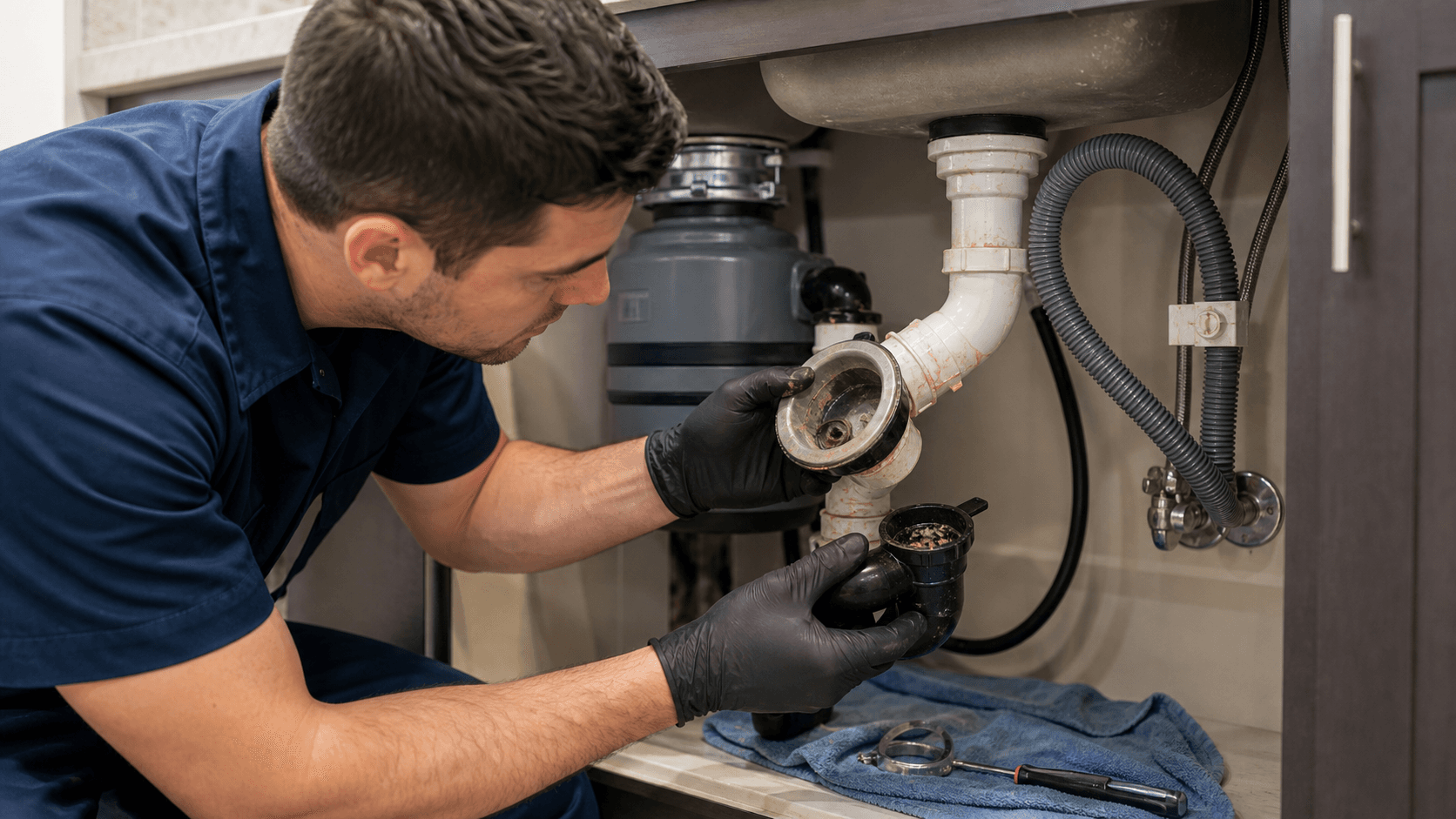
Dishwasher discharge can move warm grease farther downstream, where it cools and hardens in the branch line.
What works (and what doesn't) for kitchen drain maintenance
Three approaches actually work: enzymatic monthly maintenance, weekly hot-water-plus-dish-soap flushes, and an annual professional cable. Three approaches commonly tried but ineffective: baking soda and vinegar, Drano and chemical drain cleaners (which damage older cast iron faster than they clear the clog), and garbage disposal cleaners that smell like citrus.
Enzymatic drain cleaner is the only consumer-grade product with documented effectiveness on kitchen grease. Products like Bio-Clean, Roebic K-87, and Earthworm work by introducing bacterial cultures that digest organic matter (FOG, food debris, soap film) over days to weeks. They do nothing for hair, plastic, or mineral scale. Dose monthly: a quarter to a half cup poured down the drain at bedtime, no water flush, let it sit overnight. After three months of monthly dosing, grease buildup in the branch line slows noticeably. Enzymatic cleaners cost $15 to $30 per bottle and last 6 to 12 months at monthly dosing.
Hot-water-plus-dish-soap flushes work on fresh grease (less than 30 days deposited) and are useless on bonded deposits. The procedure: half a gallon of water just under boiling temperature mixed with a tablespoon of dish detergent, poured slowly down the drain over 60 to 90 seconds. The detergent emulsifies the fresh grease and the hot water carries it through the line. Do not pour boiling water directly into PVC or ABS drains — temperatures above 160°F can soften the plastic at joints. Older cast iron tolerates higher temperatures.
An annual professional cable on a kitchen branch costs $189 from the cleanout under the sink. For Bellevue homes built before 1985, an annual cabling visit catches buildup before it becomes a clog and is cheaper than the eventual emergency call. The full Drain Cleaning and Clog Removal in Bellevue service page has pricing for branch lines and main lines.
Drano and similar chemical cleaners are the wrong tool, and they're particularly bad for the pre-1980 cast iron the typical Bellevue kitchen drain stack is made of. The chemistry is documented in our chemical-drain-cleaner-damage guide (forthcoming in this cluster) — the short version is that sodium hydroxide heats to ~200°F as it reacts with water, the heat concentrates against the corroded interior of an aged pipe, and the result is accelerated corrosion at exactly the joint or fitting most likely to develop a leak.
What works on Bellevue kitchen drains
Enzymatic drain cleaner (Bio-Clean, Roebic K-87): monthly maintenance, safe for all pipe materials, $15-$30 per bottle
Hot water + dish soap flush: weekly on fresh grease, do not use on PVC at boiling temperature
Annual professional cable from cleanout: $189 prevention vs $300+ emergency
AVOID: Drano, Liquid-Plumr, Crystal-D — damages aged cast iron and rubber gaskets
AVOID: garbage disposal citrus cleaners as the only maintenance — pleasant smell, no grease removal
AVOID: baking soda + vinegar — marginal effectiveness on bonded grease, mainly cosmetic
When the kitchen clog is actually a main-line problem
Three signs the kitchen issue is downstream of the kitchen branch — meaning the main sewer lateral, not the kitchen drain itself: multiple fixtures backing up at the same time (kitchen sink plus shower, or kitchen plus laundry), a toilet that gurgles when the kitchen sink drains, and a basement floor drain or crawlspace drain that smells of sewer or shows water when the kitchen sink is used heavily. Any of these three and the right call is a sewer camera, not a kitchen cable.
The branch versus main distinction matters because the repair scope changes dramatically. A clogged kitchen branch is a $189 cable visit; a clogged main sewer lateral can range from a $345 cable to a $14,000 trenchless replacement depending on what the camera finds. Getting the right diagnostic before authorizing work saves money in both directions: you don't pay for jetting when cabling solves it, and you don't pay for cabling when the line actually needs sewer-lateral attention.
Cedar and Douglas fir root intrusion in the main lateral is the most common Bellevue cause of a 'kitchen clog' that is actually a main-line problem. The full pattern — which neighborhoods are most affected, how root intrusion progresses, and the four repair tiers ranked by cost — is in our cedar and Douglas fir roots in Eastside sewer lines guide. If your kitchen sink backs up at the same time as the shower drain in another part of the house, read that guide before authorizing any work, because the right service is a main-line camera and possibly hydro jetting rather than a kitchen branch cable.
The hydro jetting vs cabling in Bellevue guide also covers the decision between the two main-line tools once the camera identifies a main-line cause. Most Bellevue main-line root clogs are best solved with a single hydro jet pass plus an 18 to 36-month maintenance interval, not repeated cabling.
Sources
Every fact in this guide cites a verifiable public source. If you find a number we got wrong, email dispatch@bellevueplumberpro.com.
Need help with this in your home? See our Drain cleaning and clog removal in Bellevue page for pricing, our diagnostic process, and how same-day service works across the Eastside.
— Bridge to service
We dispatch for this across Downtown Bellevue, Somerset, and Lake Hills — see your neighborhood page for local response times and recent jobs.
Kitchen drain clogs in Bellevue — questions homeowners ask
QUESTION01
Why does my kitchen drain keep clogging?
The Bellevue-kitchen recipe: hot grease poured down a drain that travels 6 to 18 feet through a horizontal branch line before the stack, with a dishwasher discharging into the same line — grease cools and coats that run, and every cycle rebuilds the layer.
QUESTION02
What actually works on grease clogs?
Three things: enzymatic monthly maintenance, weekly hot-water-plus-dish-soap flushes, and an annual professional cable. Baking soda and vinegar, boiling water alone, and store caustic gels are the commonly tried approaches that don't work.
QUESTION03
Do older Bellevue homes clog more?
Yes — 1955–1980 housing uses cast iron drain stacks, and cast iron interiors corrode and roughen over decades, giving grease and debris something to catch on that smooth PVC never provides.