What does a gurgling drain mean?
Air is being forced backward through a trap because a partial blockage — in the main line or a blocked vent — keeps the system from moving air freely as water drains.
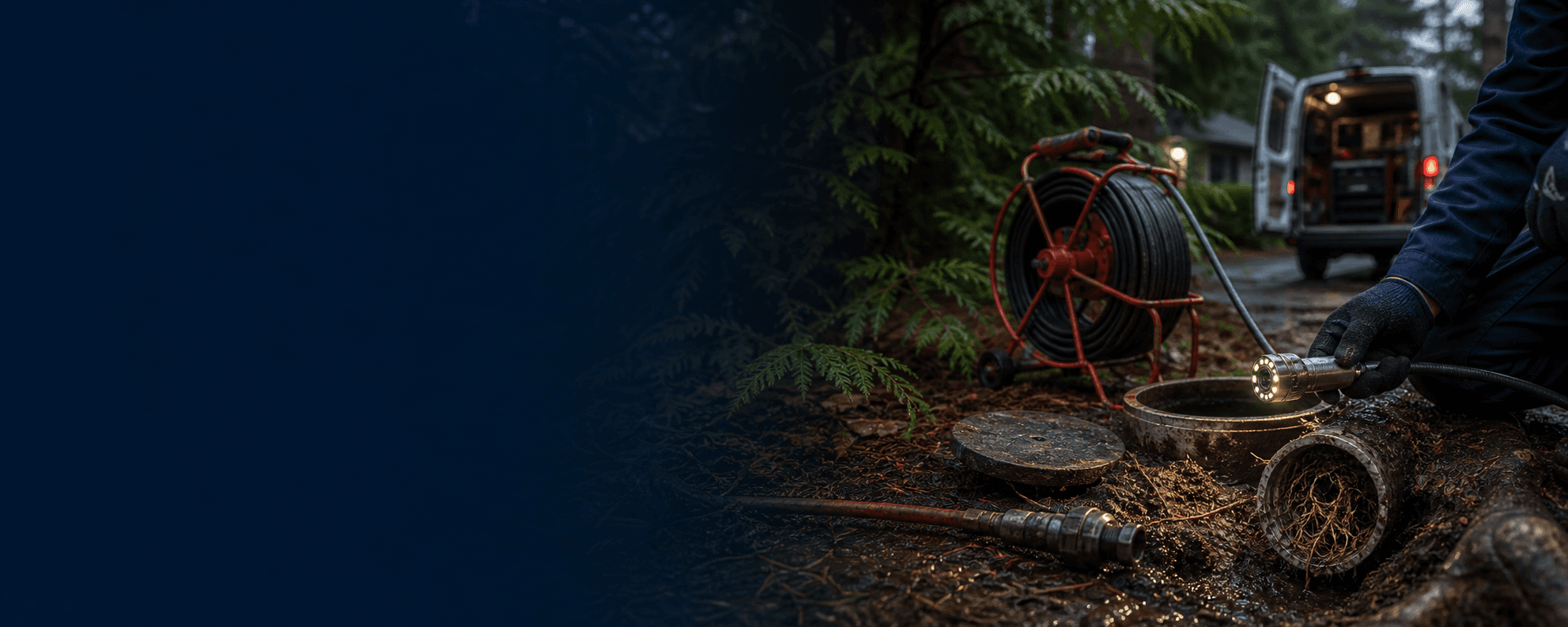
A gurgling drain is the sound of air being forced backward through a fixture's trap because the drainage system can no longer move air freely past a blockage. Two things cause that: a partial blockage in the shared main line, or a blocked vent stack that the drains can no longer breathe through. The most reliable way to tell a main-line problem from a local one is interaction between fixtures — when running the washing machine makes a toilet gurgle, or flushing makes the shower bubble, the blockage sits in the line they share, downstream of both. Left alone, a main-line gurgle follows a predictable progression from an occasional bubble to a full backup, and a gurgle that gets worse when it rains points at a cracked line letting groundwater in. In Bellevue and across the Eastside, the most common cause of a main-line blockage is cedar and Douglas fir root intrusion into older clay and cast-iron laterals. This guide explains the physics, the main-line tell, the progression, the rain signal, the Bellevue root angle, and what to do right now — including why you should never pour chemical drain cleaner into a main-line problem.
Last reviewed: 2026-06-04
A gurgle is air forced backward through a trap because a partial blockage — in the main line or a blocked vent — keeps the system from moving air freely as water drains.
A drainage system moves air as well as water, and a gurgle is the sound of that air going the wrong way. When everything works, water flows down the drains and air follows behind it through the vents, so the system breathes smoothly and the traps stay full and quiet. A gurgle happens when something blocks that normal airflow: draining water creates negative pressure behind a partial obstruction, and instead of drawing air down a vent, the system pulls air backward up through the nearest trap, bubbling through the standing water.
There are two things that block the airflow and produce gurgling. The first is a partial blockage in the drain line itself — most consequentially in the main line that carries everything to the sewer — which narrows the pipe so that draining water has to drag air through the traps to get past it. The second is a blocked vent stack, which cuts off the outside air supply the drains rely on, so the suction of draining water again pulls air through the traps instead of down the vent.
The gurgle is therefore always a report of a problem somewhere downstream or in the venting, never a fault in the fixture that makes the sound. The toilet or sink that gurgles is simply the easiest place for the displaced air to escape — often the toilet, because its large trap and standing water make the bubbling loud and obvious. Treating that fixture does nothing; the actual obstruction or vent fault is elsewhere in the system.
Because the cause is either a line blockage or a vent problem, the diagnostic question is which one, and how far down. The most powerful clue is whether using one fixture affects another, which tells you the trouble is in plumbing they share. The sections below use that interaction to separate a main-line blockage from a local clog and a vent fault, then cover how it progresses and what to do about it.
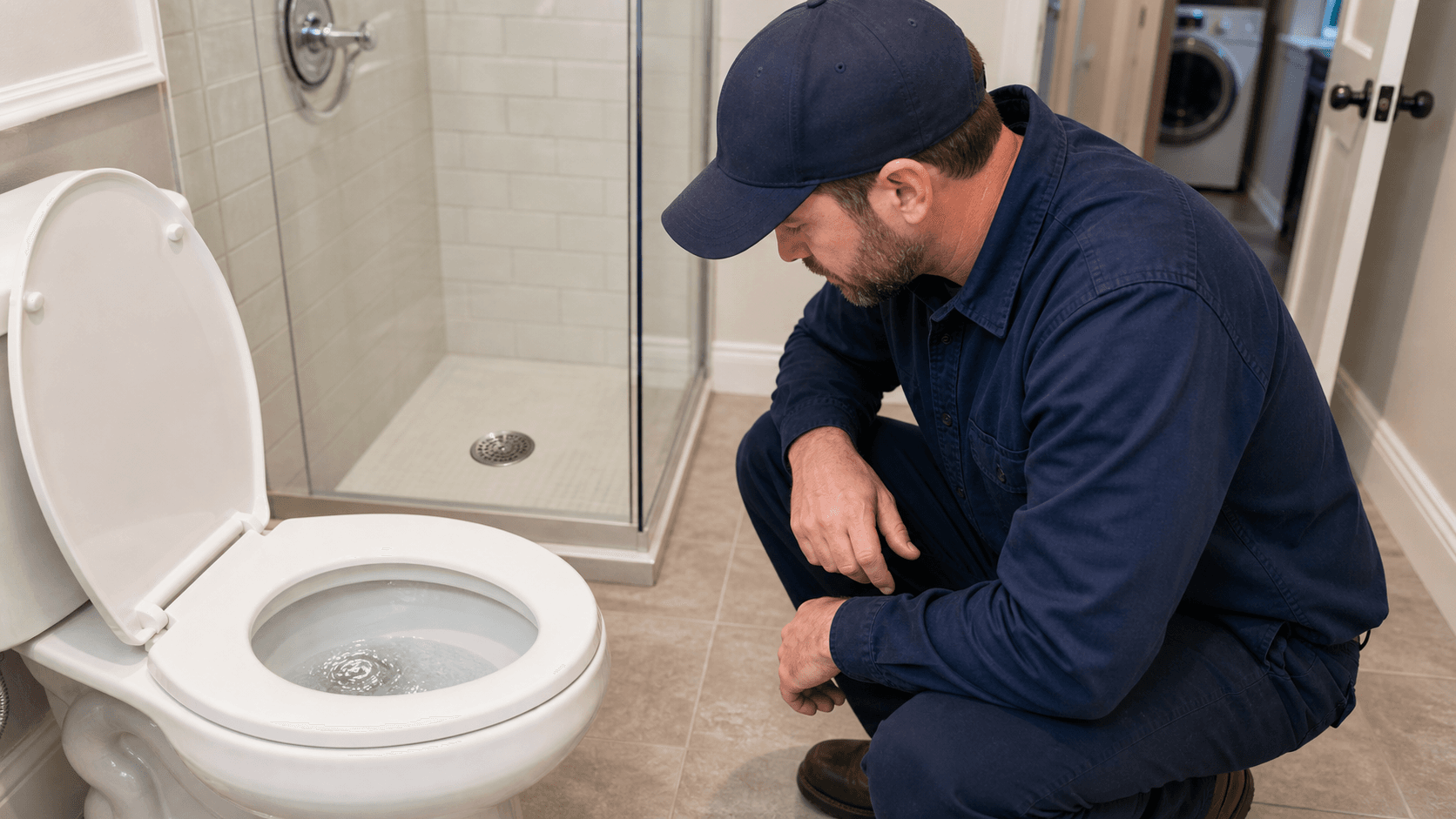
This happening in your home right now? A licensed plumber can talk you through the next step on the phone — 24/7, and the call is free.
Call a plumberWhen using one fixture makes another gurgle — the washer drains and a toilet bubbles, or a flush makes the shower gurgle — the blockage is in the line they share, downstream of both.
The single most reliable sign that a gurgle is a main-line problem rather than a local one is interaction between fixtures that are otherwise unrelated. If draining the washing machine makes a toilet gurgle, or flushing a toilet makes the shower or tub bubble, those fixtures are talking to each other through the only thing they have in common — the main line that carries all of their wastewater to the sewer. A blockage there forces the displaced air from one fixture's drainage back up through another's trap.
This works because of the tree structure of household drainage. Each fixture branches into larger drains that combine into the building main and then the sewer lateral, and a blockage only affects fixtures upstream of it. When two fixtures that drain through completely different branches still affect each other, the obstruction has to sit below the point where their branches join — in the main line or the lateral. The set of fixtures that interact brackets the blockage to that shared run.
A classic and telling example is the washing machine, because it dumps a large volume of water fast. When the washer drains and a nearby toilet gurgles or its water level rises and falls, the surge of wastewater hitting a partially blocked main line has nowhere to go but to push air and water back up the lowest, nearest opening — the toilet. The same logic applies to a flush that makes a floor drain bubble or a tub that backs up when the toilet is used.
Contrast this with a local clog, where only one fixture misbehaves and the rest of the house drains normally. A single slow, gurgling sink with every other drain working fine is a branch clog near that sink, not a main-line problem. It is the cross-fixture interaction — one fixture's use producing a reaction in another — that distinguishes the main-line case, and it is the most important thing to observe before deciding how serious the gurgle is.
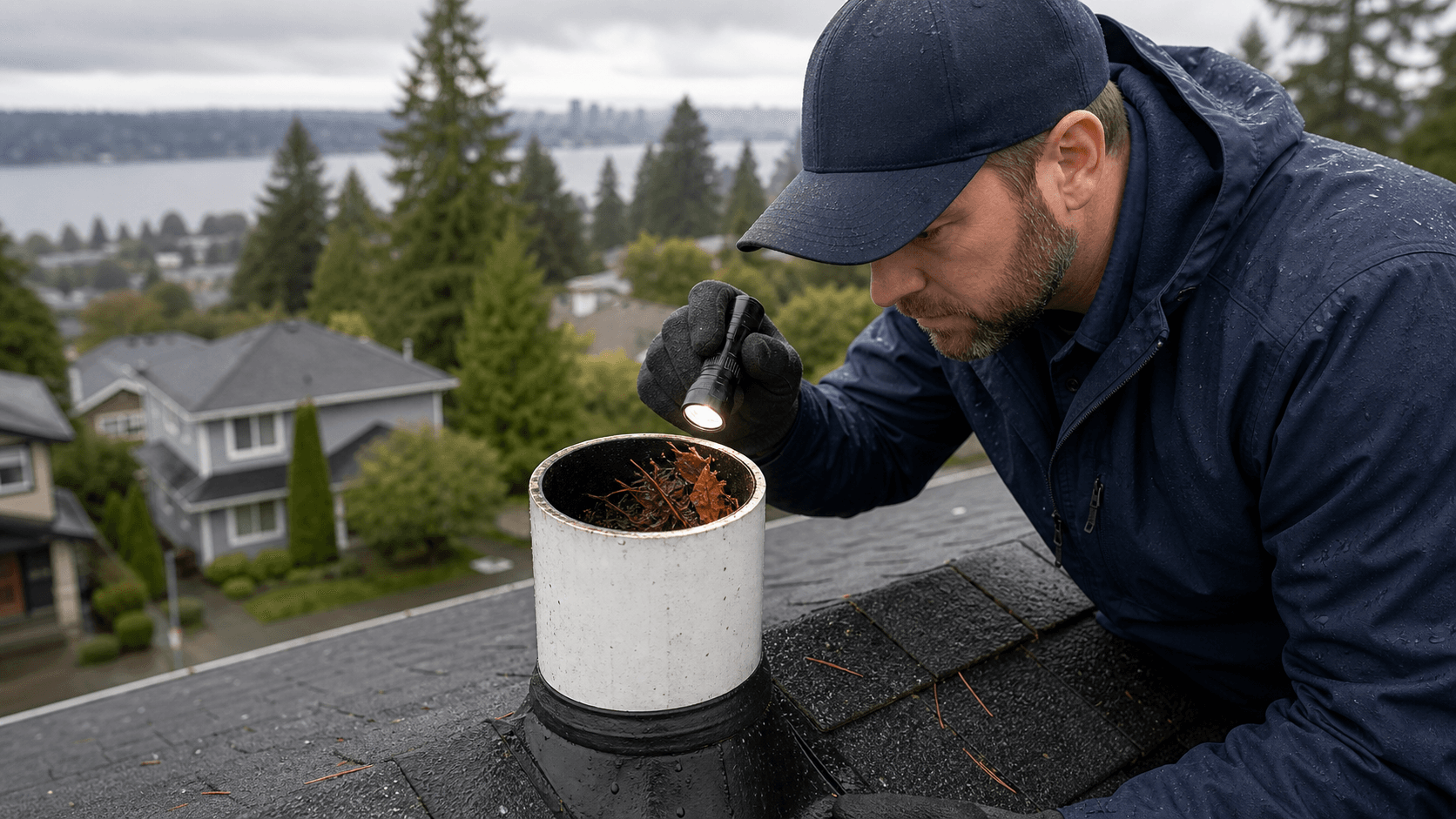
If the drains gurgle but nothing is clogging, the vent may be blocked — leaves, a nest, or debris on the roof vent. The drains can't breathe, so they pull air through the traps instead.
Not every gurgle is a clog in the drain line; a blocked vent produces the same symptom from the opposite direction. The vent stack that runs up through the roof supplies the outside air that drains need to flow smoothly, and when it is blocked — by leaves, a bird or wasp nest, frost, or accumulated debris at the roof opening — the drains lose their air supply. Draining water then creates suction with nowhere to draw air except backward through the traps, which gurgle as a result.
The pattern that points at the vent rather than a line clog is gurgling without an accompanying backup. With a blocked vent, water still drains, but slowly and noisily, and traps may gurgle and even get siphoned dry across several fixtures because the whole system is starved of air. There is no rising water or sewage backing up the way a main-line clog eventually produces; instead there is widespread gurgling, slow drainage, and sometimes a faint sewer smell as traps lose their seals.
A blocked vent and a partially blocked main line can look similar at first because both make multiple fixtures gurgle, so the distinction is in the other symptoms. A main-line clog tends to produce slowing drains that progress toward a backup and may smell at the cleanout or yard; a vent block tends to produce gurgling and slow, air-starved drainage without water actually backing up. A plumber checks the roof vent when the gurgling is widespread but nothing is clogging the line.
Clearing a blocked vent — removing the nest, leaves, or debris from the roof opening, or flushing the stack — restores the airflow and the gurgling stops on its own, because the drains can breathe again. This is a different and often simpler fix than a main-line cleaning, which is why ruling the vent in or out matters before assuming the worst. When the gurgle is paired with slowing drains across the house and signs of a developing backup, though, the line itself is the more likely culprit.
A main-line gurgle is an early warning. As the blockage grows, it moves from an occasional bubble to slow drains across the house, then to water backing up at the lowest fixture.
A main-line gurgle is rarely a steady state; it is an early point on a progression toward a backup, and understanding that arc is what turns a nuisance noise into a reason to act. At the start, a partial blockage in the main line is small enough that water still drains, and the only symptom is an occasional gurgle when a fixture is used — easy to dismiss. But the blockage does not stay small: the same restriction that catches air also catches debris, so it tends to grow over weeks and months rather than resolve.
As the obstruction narrows the line further, the gurgling becomes more frequent and the drains begin to slow. Several fixtures start draining sluggishly, the gurgling shows up reliably whenever a large volume drains, and the interaction between fixtures becomes obvious. This is the middle of the progression, where the main-line nature of the problem is unmistakable but it has not yet failed completely — the window in which clearing the line is straightforward and a full backup can still be prevented.
The end of the progression is a backup, where the blockage has grown enough that wastewater can no longer pass and instead backs up out of the lowest opening in the system — usually a basement floor drain, a ground-floor tub or shower, or the lowest toilet. At that point the problem is no longer a noise but raw sewage in the house, which is a genuine emergency, and the cost and disruption are far higher than they would have been when the gurgle first appeared.
The reason to treat an early main-line gurgle seriously is precisely that it is the cheapest and cleanest moment to deal with it. A line cleared while it is still only gurgling is a routine cabling or jetting job; the same line left until it backs up means sewage cleanup on top of the cleaning, and possibly damage. The gurgle is the system's advance warning, and the right response is to find out what is narrowing the line before the line decides for you.
If gurgling and slow drains get worse during heavy rain, the line is cracked: groundwater seeps in through the breaks, overwhelming an already-narrowed pipe. This is inflow and infiltration.
A gurgle that gets noticeably worse when it rains is a specific and revealing symptom, because it points at a cracked or broken line rather than a simple clog. A sound, sealed sewer line carries only the wastewater the house produces, and rain outside should make no difference to it. When drainage slows and gurgling worsens during and after heavy rain, it means the line is no longer sealed — groundwater is entering through cracks and broken joints, a phenomenon called inflow and infiltration.
The mechanism is straightforward. Rain raises the groundwater level in the soil around the buried line, and any crack, gap, or failed joint lets that groundwater seep in. A line that is already partially blocked or narrowed now has to carry both the household wastewater and the infiltrating groundwater, and the extra volume overwhelms it — so the drains that gurgled mildly in dry weather slow markedly and gurgle hard in the rain. When the rain stops and the groundwater recedes, the symptoms ease again.
This rain-linked pattern is important because it changes the diagnosis from a cleaning problem to a structural one. A clog can be cabled or jetted out, but a cracked line that admits groundwater will keep doing so even after it is cleaned, and the cracks that let water in are often the same flaws that let roots in. A gurgle that tracks the weather is therefore a sign the pipe itself is compromised, not just dirty, and that a camera inspection is needed to see the damage.
In the Pacific Northwest, where heavy winter rain saturates the ground for months, a rain-worsened gurgle is a common and meaningful signal. It tells a homeowner that the line has broken somewhere, that groundwater is finding the breaks, and that the problem will recur with every wet spell until the cracked section is repaired or replaced. It is one of the clearest indications that the trouble is in the buried line rather than anywhere inside the house.
In Bellevue the most common cause of a main-line blockage is root intrusion: cedar and Douglas fir roots enter older clay and cast-iron laterals through cracks and joints, then trap debris into a clog.
When a Bellevue or Eastside home develops a main-line gurgle that progresses toward a backup, the most common underlying cause is tree-root intrusion. The region's mature western red cedars and Douglas firs have aggressive lateral root systems that seek out the warm, nutrient-rich vapor escaping from any small flaw in a buried sewer lateral, and the older clay and cast-iron laterals under pre-1980 homes are full of exactly the cracks and loose joints those roots exploit. Once a root hair finds a flaw, it grows in and thickens into a fibrous mass inside the pipe.
Roots cause a main-line blockage in two stages. First the root mass itself partially fills the pipe, narrowing the channel water and air move through. Then that mass acts like a net, catching the toilet paper, grease, and solids passing through the line, so the actual blockage is the debris the roots trap rather than the roots alone. This is why a root-invaded line gurgles and slows progressively — the mass grows and catches more each month — and why it recurs after a simple cleaning if the roots are not addressed.
The full biology of how cedar and fir roots find and invade Eastside sewer laterals, which pipe materials are most vulnerable, and the warning signs is covered in our cedar and fir root intrusion guide. The practical point for a gurgling drain is that in this region, a main-line blockage is far more likely to be roots than grease or a foreign object, and the recurring, progressive pattern of a root clog is distinctive once you know to look for it.
Because roots both block the line and signal that the pipe is cracked, clearing them is a two-part decision: how to clear the current mass, and whether the line needs more than cleaning. The choice between mechanically cabling the roots and hydro-jetting them out is covered in our hydro jetting versus cabling guide, and confirming what is actually in the line starts with our sewer camera inspection guide. A root-caused main-line problem is ultimately handled as sewer line repair and replacement in Bellevue once the camera shows the extent of the intrusion.
Stop running water to keep a partial blockage from becoming a backup, watch which fixtures interact, and do not pour chemical drain cleaner into a main-line problem — it cannot reach the clog and is hazardous.
The first move when several drains are gurgling and slowing is to stop adding water to the system. A partial main-line blockage can be tipped into a full backup by a large volume of water all at once — a load of laundry, a long shower, a dishwasher cycle — so easing off on water use buys time and keeps a manageable problem from becoming sewage on the floor. This is especially true if you have already seen any water backing up at a low fixture.
While you hold off on water, observe and note which fixtures interact, because that information is what a plumber needs to locate the problem. Does the washer make the toilet gurgle? Does flushing affect the shower? Is it worse in the rain? Is there a smell at the cleanout or yard? These observations distinguish a main-line clog from a vent fault from a local clog, and they let the plumber arrive with the right approach rather than starting from scratch.
The most important thing not to do is pour chemical drain cleaner into a main-line problem. Chemical cleaners are designed for a localized clog right under a fixture, and they cannot reach a blockage far down a main line — the product just pools against the obstruction. Worse, a main-line clog often will not clear, so the caustic chemical sits in standing water in the pipe, and then a plumber has to work in and around that hazardous liquid; the damage these products do is covered in our chemical drain cleaner damage guide.
Once the immediate risk is managed, a main-line gurgle is a cleaning-and-inspection job, not a wait-and-see one, because of the progression toward a backup. The right next step is to have the line looked at while it is still only gurgling — cabled or jetted to clear the current blockage and camera-inspected to see whether roots or cracks are behind it. A persistent or worsening main-line gurgle is handled as sewer line repair and replacement in Bellevue, ideally before it backs up.
A toilet gurgling when the washer runs means a main-line blockage; it is heading toward a backup; rain-linked gurgling means a cracked line; in Bellevue it is frequently roots.
If your toilet gurgles when the washing machine drains, the blockage is in the main line they share, downstream of both. The washer dumps a large volume of water fast, and a partially blocked main line forces that displaced air and water back up the nearest, lowest opening — the toilet — which gurgles or rises and falls. It is the classic sign of a main-line problem rather than a local clog, because two unrelated fixtures are only able to affect each other through the line they have in common.
A gurgling main line is not yet an emergency, but it is an early warning that is heading toward one. The blockage tends to grow rather than resolve, moving from an occasional gurgle to slow drains across the house to water backing up at the lowest fixture, which is sewage in the home. The gurgle is the cheap, clean moment to deal with it; left until it backs up, the same problem means cleanup on top of the cleaning. Yes, a gurgle across multiple fixtures usually means a sewer or main-line clog rather than a fixture problem.
If the gurgling gets worse when it rains, the line is cracked and letting groundwater in — inflow and infiltration — so an already-narrowed pipe is overwhelmed by the extra water and the drains slow and gurgle hard until the rain passes. That is a structural problem, not just a clog, and it points to a camera inspection rather than another cleaning. In Bellevue, yes, a main-line blockage is frequently tree roots: cedar and Douglas fir roots enter older clay and cast-iron laterals through cracks and trap debris into a recurring clog.
The single most important thing not to do is pour chemical drain cleaner into a main-line problem — it cannot reach a deep clog, it sits in standing water as a hazard, and it does not fix the cause. Instead, stop running water to avoid tipping a partial blockage into a backup, note which fixtures interact and whether rain makes it worse, and have the line cabled or jetted and camera-inspected. A persistent main-line gurgle is handled as sewer line repair and replacement in Bellevue before it becomes a backup.
Every fact in this guide cites a verifiable public source. If you find a number we got wrong, email dispatch@bellevueplumberpro.com.
Need help with this in your home? See our Sewer line repair and replacement in Bellevue page for pricing, our diagnostic process, and how same-day service works across the Eastside.
Related services: Drain Cleaning and Clog Removal.
Air is being forced backward through a trap because a partial blockage — in the main line or a blocked vent — keeps the system from moving air freely as water drains.
When using one fixture makes another gurgle — the washer drains and a toilet bubbles, or a flush makes the shower gurgle — the blockage is in the line they share, downstream of both. A single gurgling fixture with no cross-talk is more likely local or a vent issue.
A main-line gurgle is an early warning: as the blockage grows it moves from occasional bubbles to slow drains across the house, then to water backing up at the lowest fixture. Address it at the gurgle stage, not the backup stage.