After-hours plumbing in Bellevue: when to call now versus wait until morning
A Bellevue homeowner facing a plumbing problem at 11pm has roughly sixty seconds to make a decision worth between $200 and $8,000: call an emergency plumber now and pay the after-hours premium, or stabilize what's stabilizable and wait for daytime rates. The right answer depends on five variables — whether water is actively entering the structure, whether sewage is involved, whether the affected area is occupied, the homeowner's confidence in their shutoff competency, and the insurance carrier's stated requirements for prompt notification. This guide is the explicit decision framework: five scenarios that justify immediate dispatch even at premium pricing, four where waiting until morning is the right call, the actual after-hours pricing math in Bellevue and the broader Seattle area, the insurance reporting timing that's required either way, and the mitigation actions a homeowner can take in the hours between the failure and the plumber's arrival.
Five variables determine whether to call now versus wait: active water entry into the structure, sewage involvement, occupancy of the affected area, your ability to operate the shutoff, and what your insurance carrier requires for prompt notification. If any of the first three are 'yes', call now. If you can't operate the shutoff, call now regardless. Otherwise, document the situation and wait.
The decision happens fast because water damage escalates fast. A burst supply line at typical Bellevue residential pressure delivers 5-20 gallons per minute; the difference between catching it in five minutes and catching it in an hour is the difference between a plumber bill and an insurance claim. Most homeowners default to one of two extremes — call immediately every time, which over-pays for non-emergencies; or wait every time, which under-responds to real emergencies. The honest framework is somewhere between.
The five variables. (1) Is water actively entering the structure right now, or have you stopped the inflow? Active = call. Stopped = consider. (2) Is sewage involved? Sewage backups have biological hazard and odor implications that worsen rapidly — call. (3) Is the affected area occupied or critical (kitchen, primary bath, only bathroom)? Loss of essential plumbing for 8-10 hours impacts the household — call. (4) Can you confidently operate the main shutoff and any relevant fixture shutoffs? Yes = you have leverage. No = call. (5) What does your insurance carrier require for prompt notification? Most require notification 'as soon as reasonably possible' — typically within 24 hours of discovery. Calling at 2am, documenting the call, and getting an adjuster assigned shows reasonable promptness even if the on-site work happens in the morning.
The walkthrough in plain English. Stand in front of the problem. Ask yourself the five questions in order. If you get two or more 'call now' signals, dispatch. If you get one signal and it's not water actively entering the structure, you can usually wait if you can stabilize. The decision should take about a minute.
Active water spread is the key sign that an after-hours call is worth the surcharge.
This happening in your home right now? A licensed plumber can talk you through the next step on the phone — 24/7, and the call is free.
Five scenarios justify after-hours dispatch even at 1.5x to 3x daytime rates: active uncontainable water entering the home, sewage backup with active inflow, complete loss of water supply in winter (freeze risk), gas leak from a water heater or fuel line, and any situation where the homeowner cannot locate or operate the main shutoff.
Active water entry is the highest-stakes scenario because of the escalation curve. At Bellevue residential pressure (60-80 PSI), a 1/2-inch supply line delivers 5-10 gallons per minute when fully ruptured. A 3/4-inch line delivers 10-20 GPM. The full scenario coverage for emergency response is in our emergency plumber cost in Bellevue guide; the cost difference between catching the burst in minute 5 versus minute 60 is typically $2,000-$15,000 in additional damage.
Sewage backup is different because the contamination is non-recoverable. Drying out drinkable-water flood damage is straightforward; cleaning up sewage requires Category 3 water-damage restoration with antimicrobial treatment, drywall removal to non-affected levels, and often replacement of porous materials including insulation and subfloor. The mitigation cost scales with how long the sewage sits — 4 hours versus 12 hours can double the restoration scope.
Scenarios that justify immediate after-hours dispatch:
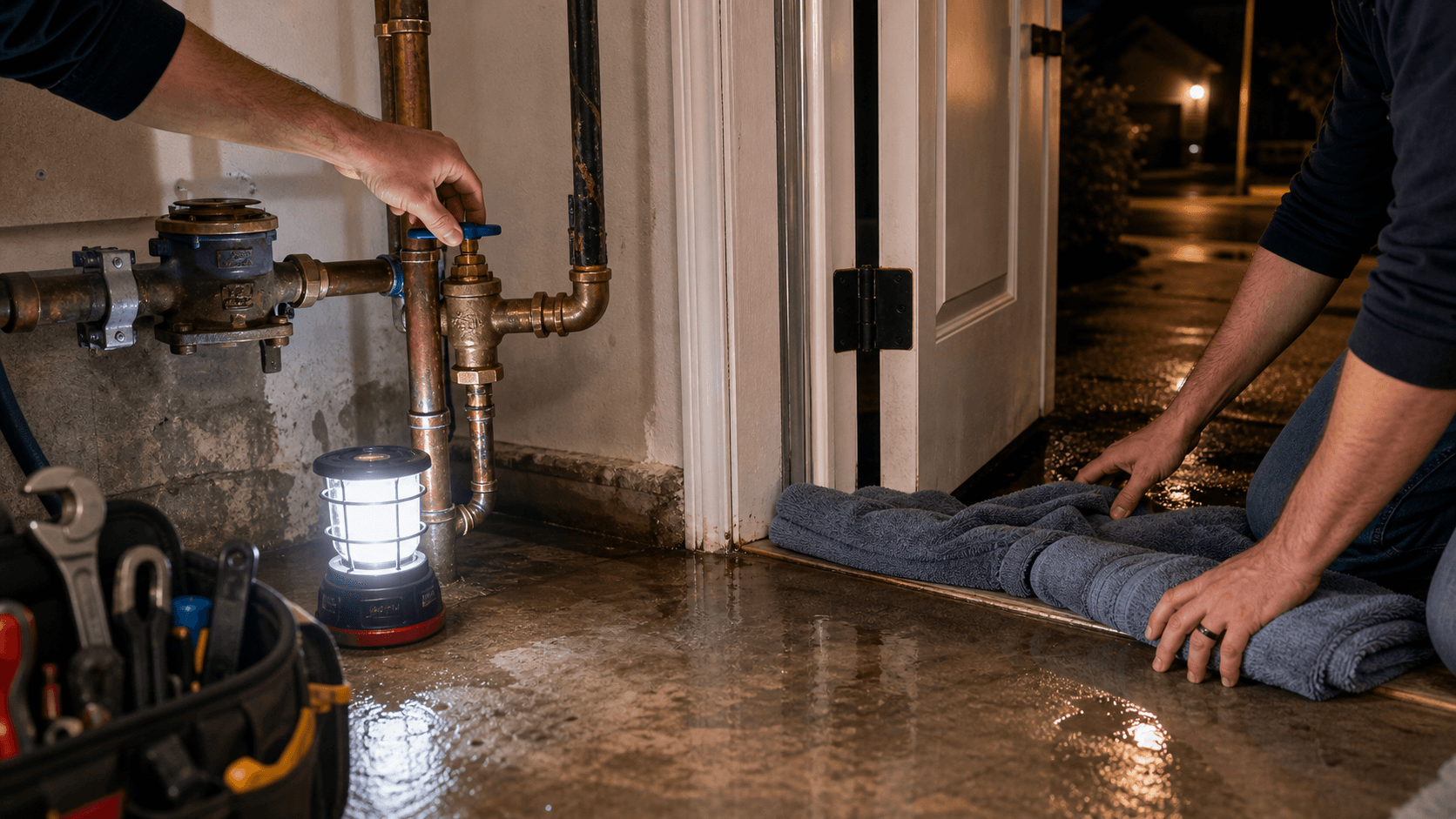
Active uncontainable water entry — burst supply line, ruptured water heater, supply hose failure with no accessible shutoff. The main shutoff is your first move; if you can't reach it or it's seized, the emergency call is mandatory
Sewage backup with active inflow — toilets overflowing into the house, basement floor drain backing up with sewage, shower or tub drain producing wastewater. Biohazard, structural risk, and odor escalate within hours
Complete loss of water supply during a freeze event — supply line burst or frozen-and-cracked beyond the shutoff, with sub-freezing temperatures threatening additional pipe damage to the rest of the system
Gas leak from a water heater, supply line, or fixture — smell of gas, hissing at a fitting, hissing at the water heater. Combined plumbing-and-gas trades. Call 911 first for confirmed gas leaks; then call a licensed plumber
Inaccessible or seized main shutoff — even for a manageable leak, if you can't operate the shutoff yourself, the plumber's first job is shutting off the supply at the meter or main, which requires their tools and access
The four 'wait until morning' scenarios
Four scenarios justify waiting until business hours despite the inconvenience: a contained leak you've successfully stopped, a non-essential fixture failure (second-bath toilet, basement bar sink), a slow drip you've contained with a bucket and isolated via the fixture shutoff, and routine service interruptions like a dripping kitchen faucet or running toilet.
The math for the 'wait' scenarios. Daytime plumber rates in Bellevue run $150-$250 per hour for non-emergency service. After-hours rates run 1.5x to 3x that — so $250-$700 per hour, plus an after-hours dispatch fee of $100-$300. A 2-hour service call at 11pm runs $500-$1,700; the same call at 9am runs $300-$500. The premium is real and worth saving on non-urgent jobs.
Decision-making in low-pressure situations. If you've stopped the leak and isolated the problem, the next call should be your insurance carrier (during their 24/7 claims line) to start the documentation clock. Then you can schedule the morning service appointment. The carrier doesn't require the plumber to be on-site for the initial notification — they require you to notify them promptly. A 2am call to the claims line followed by an 8am plumber visit satisfies the 'as soon as reasonably possible' standard. The full insurance interaction landscape is in our water damage insurance claims in Bellevue guide.
Scenarios where waiting until morning is the right call:
Contained leak you've successfully stopped — main shutoff operated, water no longer entering the structure, damage assessment can wait for daylight
Non-essential fixture failure where the rest of the house is functional — second-bath toilet runs constantly, basement utility sink leaks, an unused outdoor faucet drips. Other plumbing works; the household functions
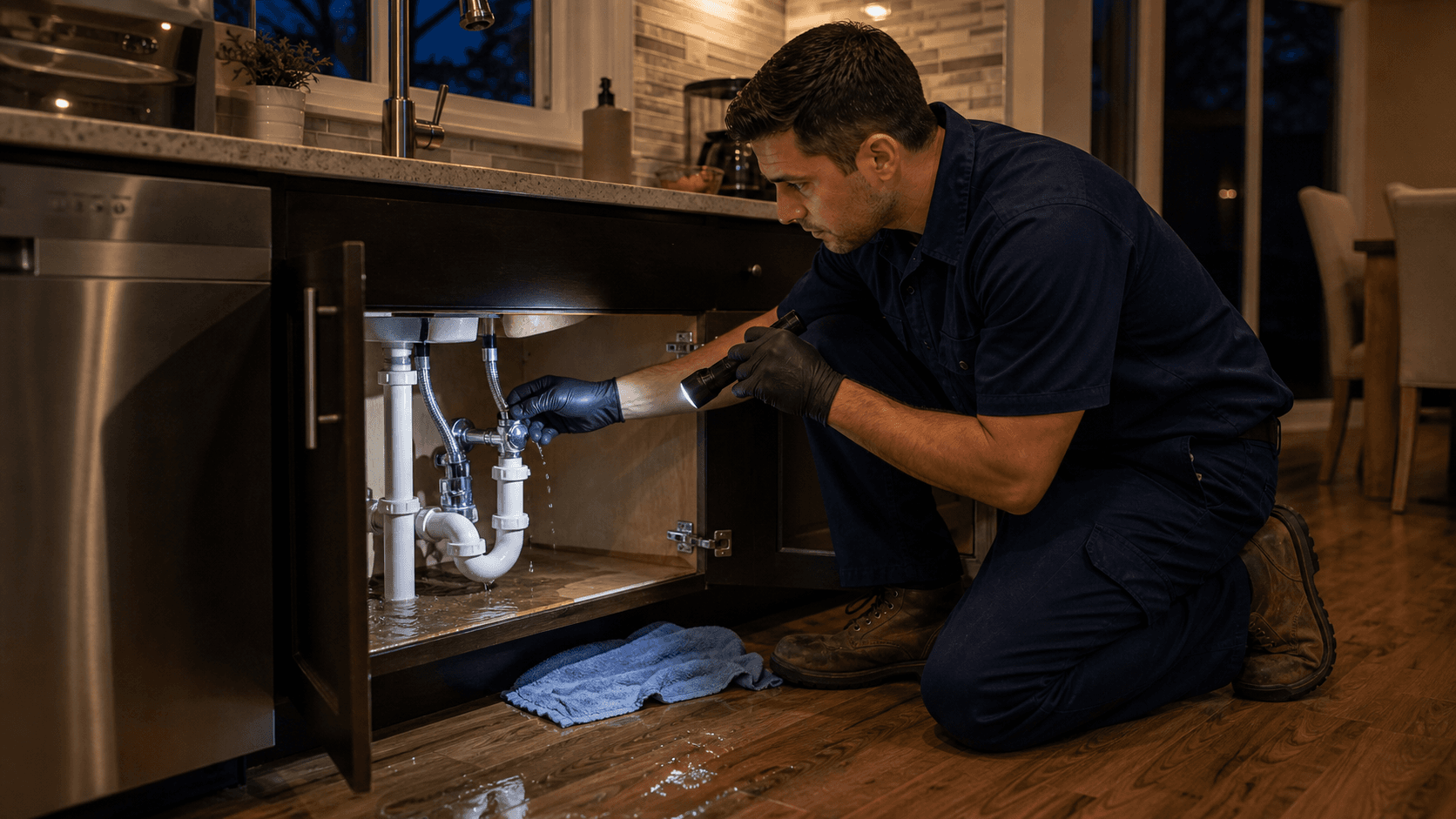
Slow drip contained with a bucket and isolated via the fixture-level shutoff — under-sink supply weep, toilet supply slow-drip with the angle stop closed. Annoying, not urgent
Routine fixture issues like a running toilet, dripping kitchen faucet, slow drain that responds to plunging. These need service but not emergency dispatch
If the water can be shut off and contained, the decision may shift from emergency to morning repair.
After-hours pricing reality in Bellevue
Bellevue after-hours plumbing dispatch typically runs 1.5x to 3x daytime rates with an additional dispatch fee. A burst pipe at midnight that would cost $400-$600 in repair labor during business hours runs $800-$1,500 with the after-hours premium and dispatch fee added.
The pricing structure. Most Bellevue plumbing companies charge an after-hours dispatch fee ($100-$300) plus an hourly rate that's marked up over standard daytime rates by a published multiplier (1.5x for weekends and weeknight evenings, 2x for overnight hours 11pm-7am, and 3x for major holidays in some shops). Some companies use flat-rate emergency pricing instead of hourly; flat-rate pricing tends to include the after-hours premium in the published number.
Sample call pricing. Burst supply line repair at 3am: $149-$250 dispatch fee + 1.5 hours at $250-$400/hour ($375-$600) + materials ($50-$150) = total $574-$1,000. Same repair at 10am: $0-$75 service fee + 1.5 hours at $150-$200/hour ($225-$300) + materials = $275-$525. The premium is roughly $300-$500 for this scope.
What makes the premium worth it. Active water damage that's continuing because you can't stop the inflow. Sewage exposure that worsens hourly. Freeze events with multiple potential failure points where rapid response prevents additional damage. The full breakdown of when premium is worth paying is in emergency plumber cost in Bellevue.
What makes the premium not worth it. Non-essential fixtures, contained leaks, slow drips, and routine service. For any of these, the $300-$500 premium is purely waste — the morning rate gets the same outcome.
Insurance reporting — what your carrier requires
Most Washington homeowners policies require notification of a claim 'as soon as reasonably possible' — typically interpreted as within 24-48 hours of the loss event. Calling the carrier's 24/7 claims line at any hour starts the formal timeline; the actual adjuster visit happens 2-7 days later.
The carrier's promptness requirement. Standard homeowners policy language varies but generally requires the insured to notify the carrier of a covered loss 'as soon as reasonably possible' or 'as soon as practicable.' Delays past 48 hours can be cited by the carrier as grounds to investigate or reduce the claim. Calling at 2am to the 24/7 claims line, getting a claim number, and getting an adjuster assigned satisfies the timing requirement even if no actual on-site work has happened yet.
What to say on the initial call. Date and time of discovery, source of the failure if known (burst pipe at master bath supply, water heater rupture, etc.), scope of damage observed, mitigation steps already taken. Get the claim number and the adjuster's contact information. Confirm whether emergency mitigation services are pre-approved. The detailed claim-call playbook is in our water damage insurance claims in Bellevue guide.
What you don't owe the carrier on the first call. You don't owe diagnostic certainty (the plumber will determine the cause). You don't owe scope of repair (the adjuster will estimate). You don't owe acceptance of any partial settlement (the call is purely informational). Be factual, be brief, get the claim number, end the call.
Stabilization actions in the wait window
If you're going to wait until morning, the 6-10 hour stabilization window includes: shutting off water to the affected fixture or zone, draining downstream lines to reduce remaining leak volume, moving valuables out of the affected area, beginning visible water cleanup, photographing damage from multiple angles, and contacting your insurance carrier's 24/7 line.
Stabilization steps during a wait-until-morning scenario:
Confirm main shutoff is operated; verify by opening a downstream faucet and confirming flow has stopped
Open faucets downstream of the leak to drain residual water from the supply lines (reduces continued drip volume in the affected area)
Move valuables, electronics, furniture, and rugs out of the affected area
Start visible water cleanup — towels, mop, shop vac if available, fans pointed at wet areas
Photograph damage from multiple angles, in good light if possible — these photos are critical for the insurance claim
Call your insurance carrier's 24/7 claims line, get a claim number, ask about emergency mitigation pre-approval
Schedule the plumber for first morning availability — many plumbers will book the appointment overnight via website or text
If the damage extends into walls or floors, contact a restoration company on the morning call; the carrier may have preferred vendors with direct-billing arrangements
The stabilization window is not idle time. The actions during these 6-10 hours largely determine whether the claim comes in at the lower or upper end of the damage range. Photos and documentation are the highest-leverage activity — claims with comprehensive photos from the night of the event settle materially better than claims that rely on adjuster-visit photos two days later, when much of the visible water has already evaporated.
Plumber dispatch realities in Bellevue at 2am
Most reputable Bellevue plumbing companies offer 24/7 dispatch but the response time varies dramatically by hour. Weeknight 11pm-2am: typical response is 60-120 minutes. 2am-6am: 90-180 minutes. Holidays and weekend overnight: similar to weeknight overnight. The 'we dispatch in 30 minutes' claim is daytime rhetoric; honest after-hours response is an hour minimum.
What the dispatch process actually looks like at 2am. Call comes to an answering service or rotating on-call line. On-call plumber receives the alert, calls back within 10-20 minutes for triage. After confirming the job is real and urgent, the plumber drives from home to the truck (10-20 minutes), then to the customer (15-45 minutes depending on location). Total clock time from initial call to truck-in-driveway is typically 60-120 minutes weeknight overnight, longer for holidays or major weather events.
Why response time matters less than you think. If you've successfully shut off the main, the active damage is paused. The plumber arriving in 60 versus 30 minutes doesn't materially change the outcome. The first-hour actions — shutoff, drainage, photography, insurance call — are what determine the damage scope; the plumber's job is the repair, which they do once they arrive regardless of arrival time.
The exception: situations where you cannot operate the shutoff. If your main shutoff is seized, missing, or inaccessible, the plumber's first action is to shut off at the meter or at the city stop. That call has urgency that justifies fastest-possible dispatch. The full shutoff-knowledge framework is in our where every shutoff valve is in a Bellevue home guide — homeowners who can operate their own shutoff have leverage to wait for the plumber; homeowners who can't are dependent on the response time.
What if you're wrong — escalating after the wrong call
If you waited and damage worsens, dispatch immediately and document the timeline carefully — the insurance adjuster's question will be 'when did you discover the issue, when did you stop the active inflow, and what mitigation did you start.' Honest documentation and continued reasonable response usually preserves the claim even if the initial decision was wrong.
The wrong-direction wait scenario. You assessed a slow drip as containable, went to sleep, and woke at 6am to find the bathroom ceiling collapsed because the supply line above it had worsened overnight. The mitigation case is harder but not lost: dispatch a plumber immediately, document the discovery time honestly, complete the mitigation as if the event had just been discovered.
The carrier's framework. Insurance carriers do not punish reasonable judgment that turned out to be wrong; they punish unreasonable delay or willful neglect. A homeowner who reasonably believed a slow drip was contained, took stabilization actions, slept, and responded immediately on discovery of worsening damage is acting reasonably. Document the timeline and the decisions for the adjuster.
The wrong-direction call scenario. You called at midnight for a contained slow drip, paid the after-hours premium, and now feel you over-spent. This is annoying but not damaging — the work got done, the cost was real but not catastrophic, and the next time you'll have better calibration. Most homeowners err on the side of over-calling for the first 2-3 plumbing events of their ownership, then settle into more accurate judgment.
The reverse-engineering question. After any plumbing event, write down what happened, what decisions you made, and what the outcomes were. Two or three of these events build calibration. By the fifth event, the 60-second decision framework feels intuitive.
The plumbing emergencies most likely to happen at the worst possible time
Plumbing emergencies cluster around three high-risk windows: cold-snap events in January-February (frozen and burst pipes), holiday weekends with heavy household water use and minimal contractor availability (kitchen and laundry overload), and storm-event power outages where sump pumps fail during heavy rain.
Cold snap clusters. The January 2024 Seattle-area cold snap produced over 150 documented water-leak responses from Seattle Fire Department alone, plus 312 water line break responses from Eastside Fire and Rescue in Issaquah. Every working plumber in the Eastside was booked solid for the duration. The lesson: prepare before the freeze rather than scrambling during it. Our Bellevue October winterization guide covers the pre-freeze checklist; our cold-snap real-time response playbook covers the during-event window.
Holiday weekend overload. Thanksgiving, Christmas, and New Year's see elevated kitchen drain failures (grease loads from holiday cooking), garbage disposal jams, and laundry-related supply-line failures (visitors using washing machines beyond normal household load). Most plumbing companies operate with skeleton crews during holiday weekends; expect 2x normal response times.
Storm-event sump pump failures. Pacific Northwest windstorms cause widespread PSE outages — recent events have impacted 100,000 to 363,000 customers at peak. A primary sump pump on grid power fails during the outage; if no battery backup or generator, the sump pit fills and basement floods. The combination of major storm + power outage + saturated soil is one of the worst-case scenarios for basement flooding in Bellevue. The fall coordinated drainage checklist in our fall leaf-clog prevention guide covers prevention; battery backup sump installation is the specific fix for this scenario.
Sources
Every fact in this guide cites a verifiable public source. If you find a number we got wrong, email dispatch@bellevueplumberpro.com.
After-hours plumbing in Bellevue — questions homeowners ask
QUESTION01
Should I call an emergency plumber tonight or wait until morning?
Five variables decide: active water entering the structure, sewage involvement, occupancy of the affected area, your ability to operate the shutoff, and whether the problem can physically wait. Uncontainable water, sewage with active inflow, or total water loss justify the 1.5–3× after-hours rate; a contained leak on a non-essential fixture can wait.
QUESTION02
What plumbing problems can wait until business hours?
A contained leak you've stopped at the shutoff, a non-essential fixture failure (second-bath toilet, bar sink), a slow drain with no backup, and anything scheduled-repairable — waiting typically saves 30–50 percent.