Home/Learn/Plumbing emergencies/Where every shutoff valve is in a Bellevue home: main, fixtures, water heater, and irrigation
Emergencies
Where every shutoff valve is in a Bellevue home: main, fixtures, water heater, and irrigation
A plumbing emergency is decided in the first 60 seconds. The homeowner who knows where the main water shutoff is — and reaches it before water hits the floor — pays for a $400 repair instead of a $14,000 restoration claim. This guide is the field map for every shutoff valve in a typical Bellevue home: the main supply shutoff (usually in the garage, basement, or crawlspace), the water meter shutoff at the property line, the water heater cold-supply shutoff, the angle stops under every sink and toilet, the washing machine shutoffs, the irrigation system shutoff, and the two valves most homeowners don't know exist — the icemaker shutoff and the whole-house pressure-reducing valve. Includes the differences between 1960s, 1980s, and 2010s Bellevue construction and a practical 15-minute walk-through to do once, in daylight, before you ever need it.
Why this is the single most valuable plumbing skill for a homeowner
Water damage from a residential plumbing failure escalates at roughly 5 to 25 gallons per minute depending on the source. The difference between shutting off in 60 seconds versus 10 minutes is the difference between a $400 repair and a $14,000-plus restoration claim. Every member of the household — including renters, college-age kids, and elderly parents — should know where the main shutoff is and how to operate it.
The flow rates. A standard 1/2-inch supply line at typical Bellevue residential pressure (60-80 PSI) delivers roughly 5-10 gallons per minute when it bursts. A 3/4-inch line delivers 10-20 GPM. A 1-inch water main delivers 20-40 GPM. A burst kitchen sink supply that runs for 10 minutes dumps 50-100 gallons. A burst water heater that runs for an hour dumps 600-1,200 gallons. The difference between catching it in the first minute versus the first 30 minutes is the difference in dollar terms between 'plumber bill' and 'insurance claim.'
What makes this skill underrated. Most homeowners can describe their thermostat, their breaker panel, and the operating quirks of their dishwasher in detail. The same homeowners can't tell you where their main water shutoff is. The asymmetry exists because thermostats and breakers get used regularly while the main shutoff might go untouched for years. The day it matters, the homeowner is wading through standing water trying to find a valve they've never operated.
Bellevue-specific factors. Bellevue's housing stock spans 1950s ranches through 2020s townhomes. Each era has a different default shutoff location. Knowing the era of your home narrows the search substantially — 1950s-1970s ranch construction puts the main shutoff in the garage or crawlspace; 1980s-1990s split-level construction puts it in the basement utility room; 2000s-2010s construction typically has it in the garage near the front of the house or in a labeled mechanical closet.
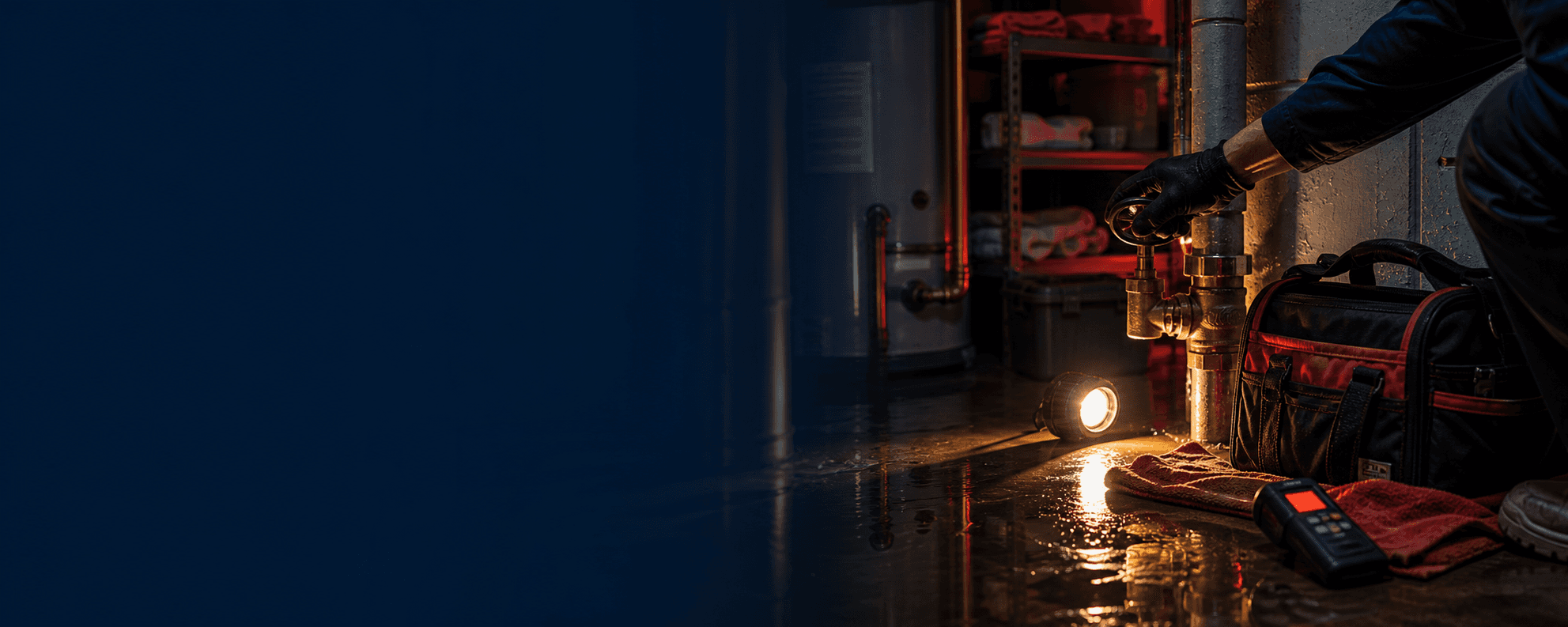
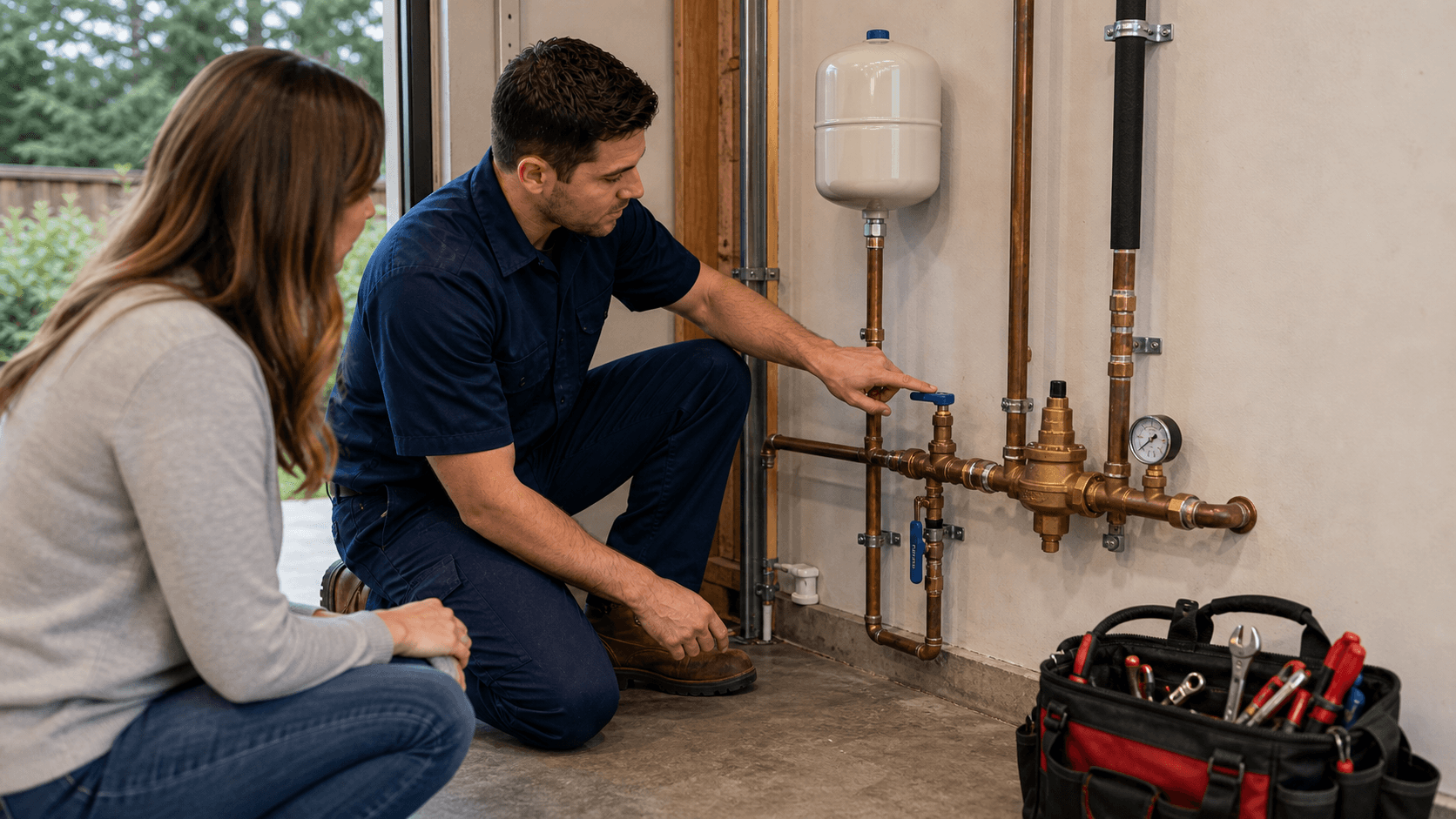
The main shutoff is the most important valve to identify before an emergency starts.
This happening in your home right now? A licensed plumber can talk you through the next step on the phone — 24/7, and the call is free.
The main water shutoff — where to find it in your specific Bellevue home
The main water shutoff is on the interior side of the wall where the water service line enters the house — typically a ball valve or gate valve on a 3/4-inch or 1-inch line, located in the garage, basement utility room, crawlspace access, or a labeled mechanical closet. Find it by following the line from the water heater backwards toward the property line.
How to find it if you don't know. Start at the water heater. The cold-supply line entering the top of the water heater is the same line that comes from the main shutoff (with branches to fixtures along the way). Trace it backwards. The line will lead to a wall, ceiling, or floor penetration; the main shutoff is at that penetration, usually within a few feet on the inside of the house.
Common locations by Bellevue housing era. Pre-1970 ranches: garage ceiling near the front wall, garage floor against the house wall, crawlspace access entry, or — in homes with concrete-slab garages and no basement — sometimes in a wall-mounted enclosure inside the house. 1970s-1980s split-levels: basement utility room near the water heater, often within 3-6 feet of where the service line enters. 1990s-2000s two-story homes: garage corner closest to the street, mechanical closet on the first floor, or in a closet near the laundry room. 2010s-current construction: labeled in a mechanical closet, often near the front of the house, with a clearly visible quarter-turn ball valve.
Valve types you'll see. A quarter-turn ball valve (lever handle, 90-degree rotation) is the modern standard and easiest to operate. A gate valve (round wheel handle that rotates many turns) is older and can stick or seize from disuse. A globe valve (similar wheel handle, internal seat) is sometimes used and behaves like a gate valve. If your main shutoff is a gate or globe valve and you haven't operated it in two-plus years, exercise it twice a year (quarter-turn off, quarter-turn back) to keep it from seizing.
What 'closed' looks like. On a ball valve, the lever is perpendicular to the pipe — across the line, not along it. On a gate or globe valve, the wheel is rotated fully clockwise (lefty-loosey, righty-tighty). Verify the shutoff worked by opening a faucet downstream — water should flow out at decreasing pressure and stop within 15-30 seconds.
What to do if the main shutoff seizes. Don't force it. A seized gate valve handle that snaps off makes the situation worse — the valve stem is still seized and now there's no handle. Go to the water meter shutoff at the property line (see next section) and shut off there. After the emergency is handled, have a plumber replace the seized main shutoff. The replacement is a $250-$500 job; the labor on a forced-handle-broken emergency is significantly more.
The water meter shutoff — the backup for when the main shutoff fails
The water meter shutoff is at the property line in a meter box (rectangular concrete or plastic box, usually 12-18 inches across) embedded in the parking strip, sidewalk, or front lawn. It requires a meter key (a long T-handled wrench, $15-$30 at any hardware store) to operate. Every Bellevue homeowner should own a meter key and know which box is theirs.
Finding your meter. Bellevue Utilities meters are at the property line, usually in the parking strip between the sidewalk and the street, occasionally in the front lawn or sidewalk itself. The box has a heavy lid (cast iron or plastic) marked 'WATER' or 'WATER METER'. The lid lifts off — sometimes requiring a pry tool. Inside, you'll see the meter (a brass cylinder with a register on top) and either a ball valve or a curb stop. Your home is on one side; the city main is on the other.
The curb stop versus the customer shutoff. Some meter installations have two valves — one on the city's side (curb stop, controlled by Bellevue Utilities) and one on the customer's side. The customer-side valve is what you operate; the curb stop is technically off-limits to homeowners but in practice is the only valve in some older installations. If your meter has only one valve, that's what you use.
Operating the meter shutoff. The valve in the meter box is typically a quarter-turn ball valve, but older installations (1970s-1980s and earlier) sometimes have a 'curb key' style operator that requires a long T-handled wrench dropped down to the valve. The wrench engages the valve stem at depth and lets you rotate it 90 degrees. Hardware stores sell meter keys in the $15-$30 range; pick one up before you need it.
When to use the meter shutoff instead of the main. Three scenarios: (1) the main interior shutoff is seized and won't operate, (2) the leak is between the meter and the main interior shutoff (in the supply line itself), or (3) you can't safely reach the interior main shutoff (basement flooded, crawlspace access blocked). In any of these, the meter shutoff is the next line of defense.
Coordination with Bellevue Utilities. The meter and curb stop are city infrastructure. If your customer-side shutoff is missing, broken, or inaccessible, Bellevue Utilities can dispatch a crew to shut off at the curb stop — call the 24/7 utility emergency line (425-452-7840). Crews respond within an hour for emergencies. For non-emergency situations, your plumber can coordinate the shutoff for repair work without involving the city.
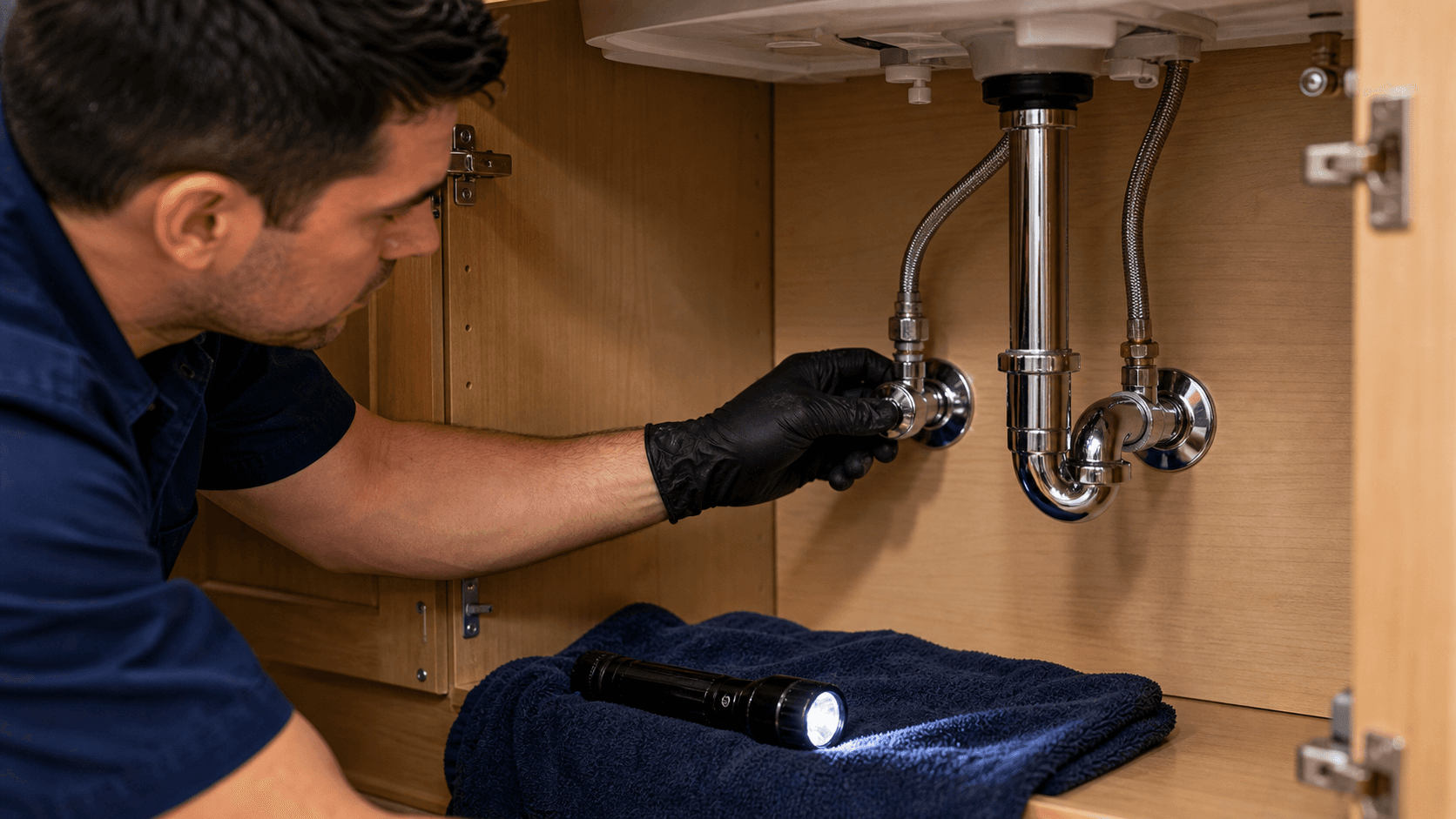
Fixture stops let you isolate a toilet, faucet, or sink leak without shutting down the whole house.
Water heater shutoffs — the cold supply, the hot output, and the gas valve
Every water heater has a cold-water supply shutoff at the top (a ball or gate valve on the cold inlet) — closing it stops water flow to and from the heater without affecting the rest of the house. Gas heaters also have a gas shutoff at the heater (yellow lever or knob) for gas leak emergencies. Electric heaters use the breaker at the panel for the same purpose.
The cold supply shutoff. Located on top of the water heater, on the cold-water inlet (typically marked with a blue ring or 'C' label, opposite the hot outlet). Closing this valve isolates the water heater from the rest of the plumbing — useful for a leaking water heater, for water heater replacement, or for anode rod service. Closing it does not stop water flow to other fixtures in the house; the rest of the plumbing continues to operate on cold water only.
The hot output line. Above the hot-output side of the water heater, usually within 12-18 inches of the tank. This line is typically not a shutoff — it's just a flex connector or rigid line going up to the home's hot-water distribution. There is rarely a valve here. To isolate the hot side, close the cold-supply shutoff and drain the tank from the drain valve at the base.
Gas water heater controls. Gas water heaters have a gas shutoff valve on the gas supply line, usually within 18 inches of the unit (often a yellow lever-style ball valve, sometimes a knob). Turning the lever perpendicular to the pipe shuts the gas. There is also a thermostat dial or control panel on the unit itself with a 'PILOT' or 'OFF' setting; in a leak emergency, shut the gas at the supply valve, not at the unit control.
Electric water heater controls. Electric water heaters have no gas valve. The equivalent emergency control is the 240V breaker at the main electrical panel, typically labeled 'Water Heater' (a double-pole breaker). Flipping it off cuts power to the heating elements. In a major water leak emergency from an electric heater, both the breaker and the cold-supply shutoff should be closed.
The water heater pan and drain. Every code-compliant water heater installation in Bellevue has a drain pan beneath the tank and a discharge line from that pan to a floor drain, laundry drain, or condensate pump. A small leak shows up first in the pan — confirm the pan is clean and the drain line is clear during your annual walk-through. A water heater that's leaking into its pan rather than across the floor is dramatically less expensive to clean up. Our tankless versus storage water heater guide covers the lifespan and failure patterns that determine when to expect a leak event.
Every fixture in a Bellevue home has an angle stop (small chrome valve, usually with an oval handle) on each supply line connecting it to the wall or floor. These are the first-line shutoffs for fixture-specific leaks. A typical home has 12-25 angle stops total.
Toilet angle stops. Behind every toilet, on the wall near the floor, where the supply line emerges. One supply line per toilet (cold only); one angle stop per toilet. Turning it clockwise shuts off water to that toilet only. Use for: running toilet, leaking tank, supply-line drip, toilet replacement.
Sink angle stops. Under every sink, on each supply line (hot and cold for most sinks; cold only for bar sinks and laundry sinks). Two angle stops per typical bathroom or kitchen sink. Turning each clockwise shuts off the respective hot or cold water to that fixture. Use for: leaking faucet, supply-line failure, fixture replacement.
Washing machine shutoffs. Behind the washer, two valves (hot and cold) typically mounted in a recessed washer box or directly on the wall. These should be closed when the washer is not in use — washer supply line failures are one of the most common high-volume residential water damage events. Modern washer boxes include a single-lever shutoff that closes both hot and cold simultaneously.
Dishwasher shutoff. Usually located under the kitchen sink, where the dishwasher supply line tees off the cold-water line (or, in some configurations, the hot-water line). Sometimes a dedicated angle stop, sometimes shared with the sink's cold supply. Closing it isolates the dishwasher without affecting the sink.
Refrigerator icemaker shutoff. The icemaker supply line tees off either the kitchen cold-water line (under the sink) or a basement/crawlspace line directly below the refrigerator. The shutoff is often a small saddle valve or a dedicated angle stop. Saddle valves are notorious for slow failures and intermittent leaks; if yours is older than 10 years, plan to replace it with a proper angle stop. Icemaker supply lines are the third-most-common slow-leak source in Bellevue kitchens, behind dishwasher supply and kitchen faucet base.
Outdoor faucet (hose bib) shutoffs. Covered in detail in our Bellevue October winterization guide. For standard hose bibs, the interior shutoff is in the garage or basement near where the hose bib exits the wall. For frost-free hose bibs, there's typically no separate interior shutoff because the design handles isolation.
The two valves most Bellevue homeowners don't know they have
Two often-overlooked valves matter during emergencies: the pressure-reducing valve (PRV) on the main supply line near the meter, and the dedicated irrigation supply shutoff. Knowing these exist — and where they are — separates a confident emergency response from a panicked one.
Pressure-reducing valve. Bellevue Utilities supplies water at 80-120 PSI at the meter — too high for residential plumbing, which is engineered for 40-80 PSI. A pressure-reducing valve (PRV) sits between the meter and the home's distribution system, dropping the pressure to a safe range. The PRV is a brass valve (typically 6-10 inches long, bell-shaped) on the main supply line, usually within 6-10 feet of where the line enters the house — often visible just inside the main shutoff. PRVs fail with age (15-25 year typical lifespan) and a failed PRV causes whole-house pressure issues, water hammer, and accelerated wear on fixtures. The PRV itself doesn't shut off water — but knowing it's there explains the layout of your main-supply plumbing and helps when describing a problem to a plumber.
Dedicated irrigation supply shutoff. Most Bellevue irrigation systems tap off the main supply line before the home enters the house, with a dedicated shutoff valve for the irrigation system separately. This shutoff is typically in a valve box near the front of the house or near the irrigation backflow preventer. Closing it isolates the irrigation system without affecting the house — useful for fall winterization, spring startup, and irrigation system service. If you don't know where yours is, ask your irrigation contractor at the next service visit to point it out.
Secondary mains in multi-zone homes. Some larger Bellevue homes (especially 2010s-built homes over 4,000 sq ft) have a secondary main shutoff after the PRV, isolating different zones — sometimes a separate shutoff for an in-law unit, garage workshop, ADU, or guest suite. Walking through with the original builder's plans, the home inspection report, or a plumber on the first emergency-prep walkthrough identifies these. Most homeowners discover them only when they're trying to isolate a leak.
Sewer cleanouts — not a shutoff, but in the same family
Sewer cleanouts are not shutoffs but are critical during sewer-side emergencies (backups, line breaks). Every Bellevue home has at least one cleanout — usually a capped 4-inch pipe outside the foundation — and many have multiple. Knowing where yours is shortens the response time when sewage backs up and you need a plumber to camera or clear the line.
What a cleanout is. A capped vertical 4-inch pipe (sometimes 3-inch in older homes) that provides access to the sewer line for cleaning and camera inspection. The cap is usually plastic or brass, threaded, and clearly visible above grade or at grade level. Cleanouts are required by code at certain locations — typically where the building drain exits the foundation, at major direction changes, and at the property line where the building sewer meets the public sewer.
Common cleanout locations in Bellevue. Outside the foundation, within 10 feet of where the main drain exits the house — often near the back or side of the house, sometimes near the front. In some older homes, the only cleanout is inside the home (basement floor or laundry room) as a 4-inch capped pipe in the floor or wall. Newer construction typically has an outside cleanout plus interior access points.
Why this matters during an emergency. A sewer backup that causes wastewater to come up through floor drains, toilets, or shower drains is a sewer-side problem — closing the water shutoffs does nothing because the problem isn't water coming in, it's water not going out. The fix is clearing the sewer line, which requires access through a cleanout. A plumber arriving for an emergency sewer backup spends the first 5-15 minutes locating the cleanout if the homeowner doesn't know where it is. Knowing where yours is shaves that time off the response. The full diagnostic methodology for sewer backups is in our sewer camera inspection guide.
The 15-minute walk-through — do this once, in daylight
The single highest-leverage emergency-prep activity is a 15-minute daylight walk-through of the home, locating every shutoff and verifying each one operates. Done once and noted on a printed sheet posted near the main panel, it transforms an emergency response from panicked search to a 60-second action.
Bellevue shutoff walk-through checklist:
Find the main water shutoff. Operate it. Confirm water stops at a downstream faucet within 30 seconds.
Locate the water meter at the property line. Open the box, identify the customer-side valve, confirm a meter key fits.
Find the water heater cold-supply shutoff. Operate it (no need to drain — just verify it closes).
Find the water heater gas valve (gas units) or breaker (electric units). Verify both are labeled and operable.
Walk to every toilet, sink, washing machine, dishwasher, and refrigerator icemaker. Identify each angle stop. Note any that are missing, seized, or look corroded.
Find the irrigation system shutoff. Verify it operates.
Locate the pressure-reducing valve. No operation needed — just confirm its location.
Locate at least one sewer cleanout. Outside or inside, note the location.
Identify any secondary main shutoffs (ADU, in-law suite, workshop) and document.
Take 30 seconds of phone video panning across each shutoff location. Save the video where the household can find it.
Print a one-page shutoff map; post it on the inside of the main electrical panel door or the back of a utility room cabinet.
Buy a meter key ($15-$30) and store it in a known location near the front door or in the garage.
The whole exercise takes 15-20 minutes once you know what you're looking for. Couples should do it together so both household members know the answers. Households with college-age kids or elderly parents should brief every member of the household on at least the main shutoff and the water heater shutoff — these are the two that matter in 80 percent of emergencies.
Repeat the walk-through every 2-3 years and after any major plumbing work. Renovations sometimes relocate shutoffs; the angle stop count grows over the years as new fixtures are added. The cost of the recurring walk-through is trivial compared to the value of operating a shutoff in 60 seconds during the one event when it matters.
When the shutoffs aren't enough — calling for help
Closing the main shutoff stops the inflow but doesn't address the damage already done. The 24-hour window after the shutoff is when the real claim outcome is decided — through mitigation, documentation, and the right plumber-restoration coordination. Call a licensed plumber first; involve the insurance carrier within 24 hours.
The plumber call. A licensed plumber arriving within 30-60 minutes assesses the source, completes the temporary or permanent repair, and provides a written diagnosis the insurance carrier will use to make a coverage decision. Our emergency plumber cost in Bellevue covers the after-hours pricing realities — emergency dispatch is 1.5-2x daytime rates, but the alternative (waiting until morning while water continues to spread) costs vastly more.
Stopping water at the source vs. mitigating already-spilled water. The main shutoff stops the inflow but does nothing about the 200 gallons that already hit the floor. Mitigation — drying out the affected area, removing wet drywall and flooring, preventing mold growth — is its own scope. Most insurance carriers either approve a specific restoration contractor or expect the homeowner to choose one. The plumber and the restoration contractor are different trades; coordinating them is the homeowner's responsibility unless one is hired through the other.
Insurance carrier timing. Most homeowner policies require notification of a claim 'as soon as reasonably possible' — typically interpreted as within 24-48 hours. Delays past that window can be cited by the carrier as a reason to reduce or deny the claim. Make the call early. The full process for water-damage claims in Bellevue is covered in our water damage insurance claim guide; in brief, the first call to the carrier is informational (you're not committing to anything by reporting), and the adjuster visit follows in 2-5 days.
Sources
Every fact in this guide cites a verifiable public source. If you find a number we got wrong, email dispatch@bellevueplumberpro.com.
Where every shutoff valve is in a Bellevue home — questions homeowners ask
QUESTION01
Where is my main water shutoff?
On the interior side of the wall where the water service line enters the house — typically a ball or gate valve on a 3/4-inch or 1-inch line. If the house-side valve is seized, the water meter shutoff sits at the property line in a 12–18 inch meter box in the parking strip or front yard.
QUESTION02
Why does knowing the shutoff matter?
A residential plumbing failure flows at 5 to 25 gallons per minute. The difference between shutting off in 60 seconds versus finding the valve for ten minutes is the difference between a mop-up and a destroyed floor.