Home/Learn/Water heaters/Tankless vs tank water heaters for Bellevue homes: when each one actually wins
Water heaters
Tankless vs tank water heaters for Bellevue homes: when each one actually wins
The conventional wisdom that 'tankless is always better' is wrong for a meaningful share of Bellevue homes. The right choice depends on three things: your existing gas line size, your household's hot-water draw pattern, and how long you plan to own the home. Tankless costs more upfront ($3,000-$6,500 installed versus $1,700-$3,200 for a tank), lasts longer (15-20+ years versus 8-12), and saves on energy bills — but those savings take 7 to 12 years to pay back the upfront difference. Heat pump water heaters are the third option most homeowners overlook: 70% more efficient than electric tanks, qualifying for PSE rebates, but with installation requirements that don't fit every home. This guide breaks the decision down by household, walks through verified 2026 costs, and explains what the federal tax credit expiration on December 31, 2025 changed for Bellevue homeowners.
The three water heater types in 2026 — quick overview
Bellevue homeowners replacing a water heater in 2026 choose between three technologies: a conventional storage tank (gas or electric), an on-demand tankless unit (almost always gas), or a heat pump water heater (electric, hybrid storage tank with heat pump on top).
Conventional tank: a 40, 50, or 75-gallon insulated tank that keeps water hot 24/7, ready for any demand. Gas-fired tanks burn natural gas in a burner under the tank; electric tanks use resistance elements inside the tank. Lifespan typically 8 to 12 years. The default choice for most US homes for the past 50 years.
Tankless (on-demand): a wall-mounted unit that heats water as it flows through, with no storage tank. Almost always gas-fired in residential applications. Provides unlimited hot water but limited by flow rate — typically 5 to 9 gallons per minute, depending on the unit and inlet water temperature. Lifespan 15 to 20+ years with proper maintenance.
Heat pump water heater: an electric storage tank with a heat pump on top that pulls heat from surrounding air to warm the water (the same principle as a heat pump HVAC system, applied to water). About 70% more efficient than a standard electric resistance tank. Lifespan 15+ years. Has been available for 15+ years but is increasingly popular in Washington State as electric utility incentives push adoption.
Which one is right depends on a small number of binary questions: do you have an existing gas line and what size is it; how many people in the household; what's your hot-water draw pattern; how long will you own the home; how much space do you have in the mechanical room or garage; and what's your local water hardness. The rest of this guide walks through each.
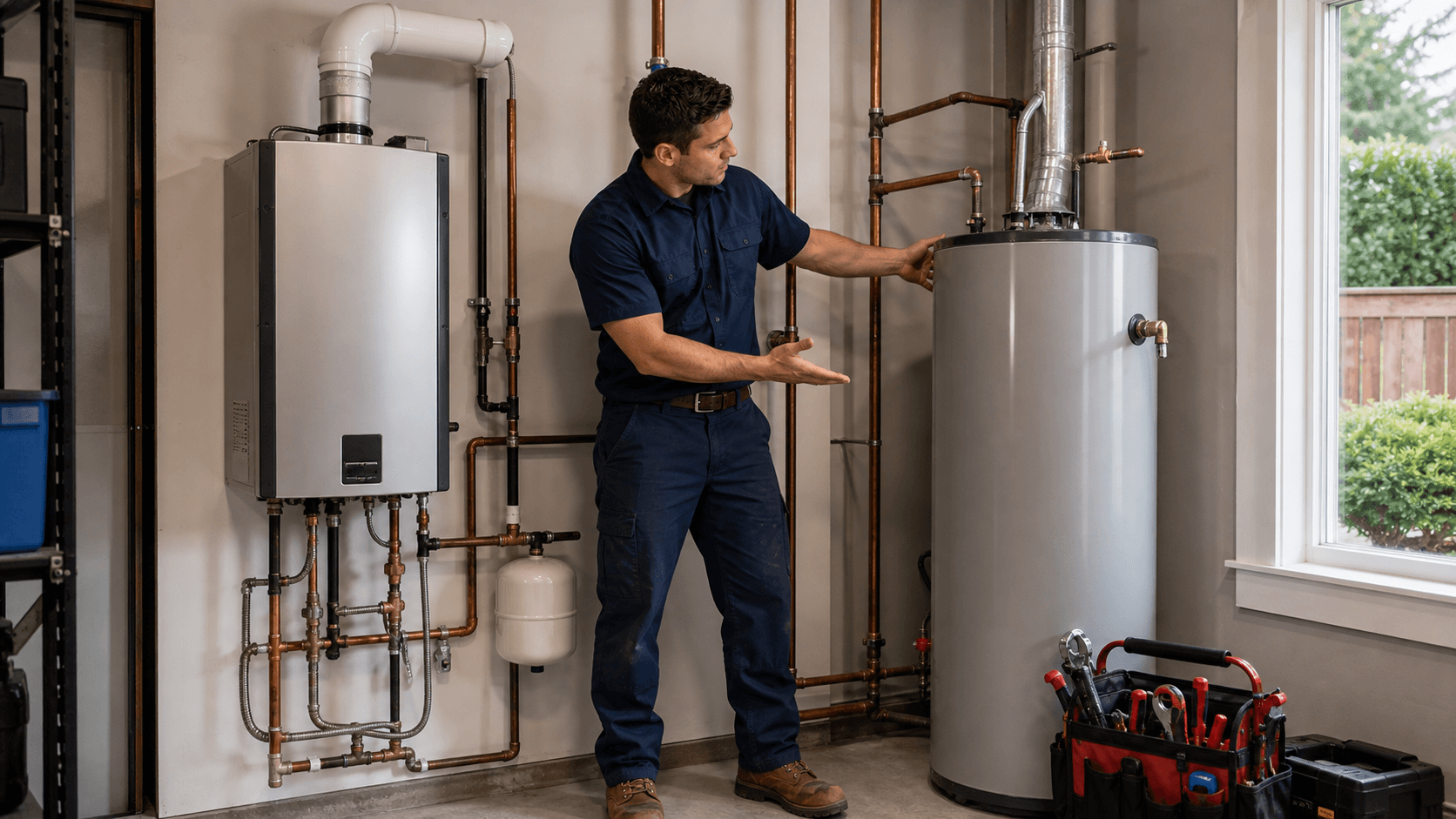
Tankless and storage systems solve different space, flow, and installation problems in Bellevue homes.
This happening in your home right now? A licensed plumber can talk you through the next step on the phone — 24/7, and the call is free.
A 50-gallon gas tank installed in Bellevue runs $1,700 to $3,200 including permit, expansion tank, and haul-away. A gas tankless installed runs $3,000 to $6,500, or higher if gas line upgrades are needed. A heat pump water heater installed runs $3,500 to $5,500 before PSE rebates.
These ranges come from HomeBlue's Bellevue-specific pricing data and Angi's 2026 cost reports for the Seattle metro. They reflect typical installations in single-family homes with accessible mechanical rooms and existing utility connections that don't require modification.
The variability inside each range comes from three factors: the specific unit selected (entry-level Bradford White or Rheem versus higher-end Navien, Rinnai, or A.O. Smith), whether the existing utility connections are adequate (gas line size, electrical service, venting), and the complexity of the install location (basement easy, attic crawlspace hard).
Hidden costs that push tankless toward the upper end of the range:
Hidden costs that change the math
Gas line upgrade. Most Bellevue homes have 1/2-inch or 3/4-inch gas line at the existing water heater. Tankless units typically need 3/4-inch or 1-inch gas line to deliver full flow. Upsizing runs an additional $500 to $1,500.
Electrical panel upgrade. A gas tankless still needs 120V power for its controls and pump. An electric tankless or heat pump water heater can need a 240V circuit and panel space — add $500 to $2,500 if the panel is full.
Venting. Gas tankless uses different venting than a gas tank (typically PVC concentric vent through a sidewall versus a B-vent through the roof). Reusing existing venting is rare; new venting adds $300 to $800.
Water softener or filter. Bellevue municipal water is soft, so a softener at the cold inlet is optional rather than required. In the slightly-to-moderately-hard well-water pockets of Sammamish and Issaquah, tankless manufacturers recommend a filter or scale-inhibitor at the cold inlet. Add $150 to $600.
Permit. City of Bellevue plumbing permit for water heater replacement runs $85 to $145 — water heater replacement always requires a permit, as covered in our [Bellevue plumbing permits guide](/learn/code-and-permits/when-you-need-one/). A licensed plumber pulls the permit as part of the install.
The lifespan math — and what shortens each type
Tank water heaters average 8 to 12 years; tankless 15 to 20+ years; heat pump 15+ years. The biggest preventable lifespan-killer for all three is mineral scale buildup from hard water — particularly damaging to tankless units, where scale can cut lifespan from 20 years to 12.
Why tanks fail at 8 to 12 years: the steel tank itself rusts from the inside. The sacrificial anode rod (a magnesium or aluminum bar inside the tank) is supposed to corrode preferentially to protect the tank steel, but most homeowners never inspect or replace it. Once the anode is consumed (typically 5 to 8 years), the tank steel starts rusting and the clock starts ticking on the failure event — usually a slow leak from the bottom of the tank that becomes a flood.
Why tankless lasts longer: there's no steel tank to fail. The heat exchanger inside a tankless unit is copper or stainless steel and has no large surface area exposed to standing water 24/7. The trade-off: the heat exchanger has narrow passages where any scale buildup hits performance fast.
Why heat pump units fall in between: they have a tank that's subject to the same corrosion as a conventional tank, but they also have a heat pump compressor and refrigerant system that adds another potential failure point. The compressor typically outlasts the tank.
Scale impact on tankless is severe. Industry data shows that scale buildup as thin as 1.5mm reduces heat transfer efficiency by 12%. Once the heat exchanger is significantly scaled, the burner runs longer and hotter to compensate, which accelerates wear. Without regular descaling, tankless lifespan can drop from the advertised 20 years down to 12 years — eliminating much of the lifespan advantage over a tank.
Recommended maintenance: tanks should have their anode rod inspected every 3 to 5 years and flushed annually to remove sediment from the tank bottom. Tankless units need annual descaling in moderate-hardness water and every 6 to 9 months in hard-water areas. Heat pump units need air filter cleaning every 3 to 6 months and condensate-line inspection annually.
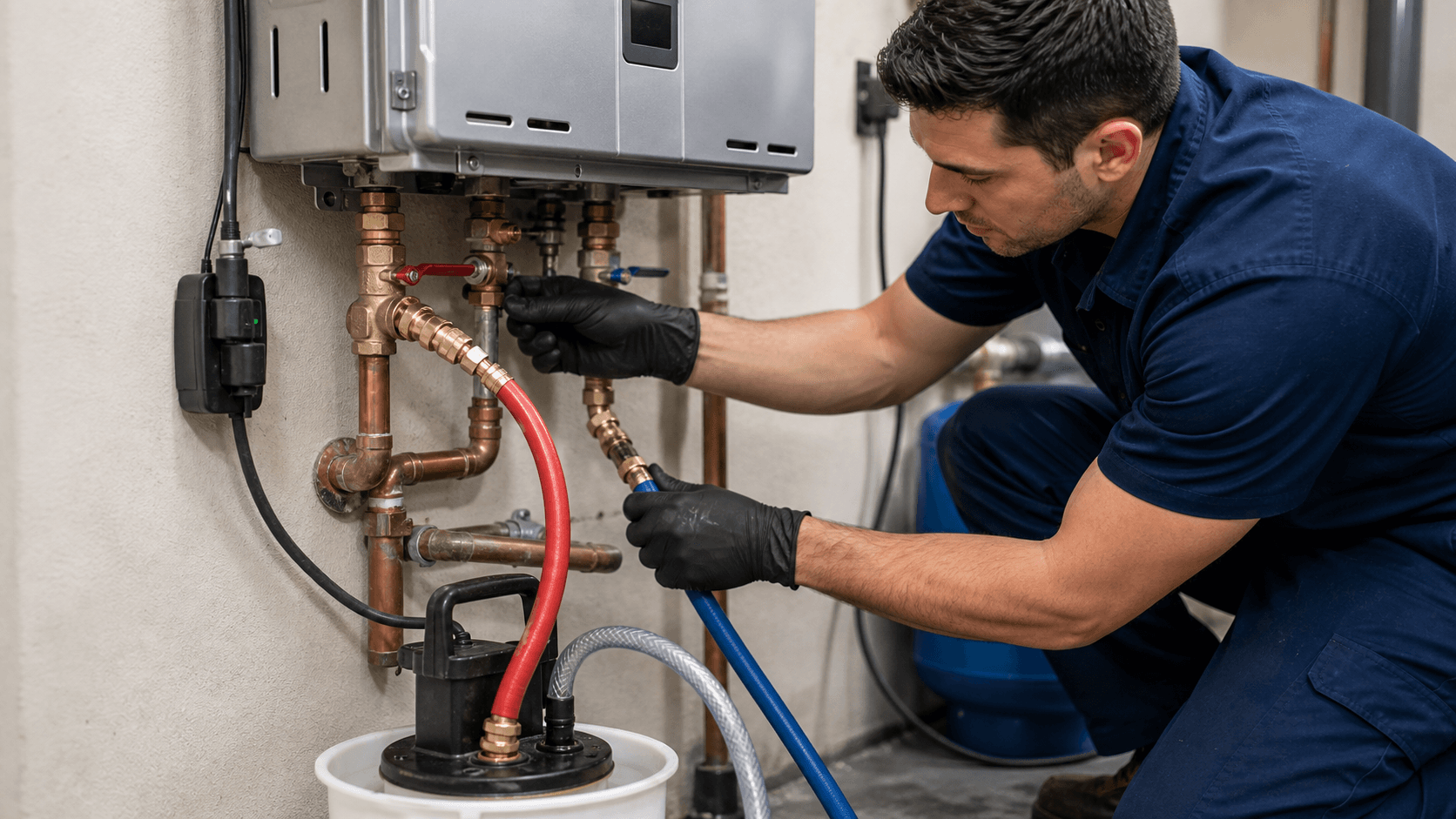
Tankless units need periodic descaling, especially when flow rates or outlet temperature start drifting.
When tankless actually wins
Tankless is the right choice when your existing gas line is already 1-inch (or you're willing to upsize), your household has 4 or fewer people with non-overlapping hot-water draw, you'll own the home 10+ years, mechanical-room space is constrained, and you can commit to annual descaling.
Five conditions where tankless is the clear winner:
Existing 1-inch gas line. New construction since the early 2000s often has this; older Bellevue homes typically don't. If you already have it, the tankless install drops $500-$1,500 in cost and the unit can deliver full flow.
Household of 1-4 people with predictable draw. Tankless excels at single-task hot water: one shower at a time, then a dishwasher, then a load of laundry. It struggles with simultaneous demand — a 7 GPM tankless unit splits its flow when two showers run at once, dropping to 3.5 GPM each.
Long-term ownership. The payback period for tankless versus tank, based on energy savings alone, runs 7 to 12 years. If you'll own the home that long, the math works. If you're selling in 3-5 years, you don't recoup the upfront cost difference.
Constrained mechanical-room space. Tankless wall-mounts and frees up the 3'×3' floor space a 50-gallon tank occupies. For Bellevue condos or finished basements where space is at a premium, this can be the deciding factor.
Willingness to maintain the unit. Tankless needs annual or semi-annual descaling to hit its lifespan potential. Owners who will commit to this (DIY or paid service) win with tankless. Owners who won't are better off with a tank that tolerates neglect.
When tank wins
A conventional tank is the right choice for households with simultaneous high-volume hot water demand (4+ people with overlapping showers), short-term ownership (under 5 years), homes with 1/2-inch or 3/4-inch gas line where upsizing isn't worth it, and homeowners who won't commit to descaling maintenance.
Five conditions where a tank still wins:
Large household with simultaneous demand. A 50-gallon tank can supply two showers and a dishwasher running concurrently because it has 50 gallons of pre-heated water ready to draw from. A tankless rated at 8 GPM might only sustain that combined draw for the first few minutes before flow rate becomes the bottleneck.
Short ownership horizon. Selling in 1-5 years? A standard tank is the lowest upfront cost, and you won't be around to capture the energy savings. The next owner can decide whether to upgrade.
Existing 1/2-inch or 3/4-inch gas line. If the home's gas service can't support tankless without an upgrade, the additional $1,000+ cost can push the payback to 15+ years — beyond the unit's lifespan.
Neglect-tolerant owner. Tanks tolerate years of zero maintenance and still deliver hot water (until they finally fail and leak). Tankless punishes neglect by losing efficiency and lifespan quickly.
Budget-constrained replacement. Sudden tank failure means you need hot water tomorrow, not next week. The same-day install of a like-for-like tank replacement is hard to beat when the calculus is 'shower works again' versus 'optimize for 10-year savings.'
The heat pump option most Bellevue homeowners overlook
Heat pump water heaters (HPWH) are the highest-efficiency option for electric homes in 2026, using approximately 70% less electricity than a standard electric resistance tank. They cost $3,500 to $5,500 installed, qualify for PSE rebates, and pay back the upfront premium in 3 to 6 years.
How they work: a heat pump on top of an insulated tank pulls heat from surrounding air, concentrates it, and transfers it to water in the tank. Same principle as an air-source heat pump HVAC system, applied at smaller scale to water heating. The tank itself can also use electric resistance heating as a backup, hence the term 'hybrid' that some manufacturers use.
The efficiency advantage is real. ENERGY STAR data shows heat pump water heaters use about 70% less electricity than standard electric resistance tanks. For a household currently spending $400-$600 per year on electric water heating, the savings run $250-$400 per year. Over the 15-year lifespan, that's $3,750-$6,000 in cumulative energy savings, easily offsetting the upfront cost premium over a conventional electric tank.
For the full Bellevue-specific picture — ambient-air requirements, condensate routing, panel capacity, climate considerations, and the four scenarios where a heat pump unit is the wrong call — see our heat pump water heaters in Bellevue guide.
Installation requirements that don't fit every home:
Heat pump water heater installation requirements
Space — needs approximately 1,000 cubic feet of surrounding air (roughly a 10×10×10 foot room) for efficient operation. A small mechanical closet won't work unless louvered doors provide airflow.
Ambient temperature — operates effectively at 40 to 120°F ambient air temperature. A garage that drops below 40°F in winter reduces efficiency dramatically.
Noise — 40 to 60 decibels during operation (similar to a refrigerator). Acceptable in a garage or basement, potentially annoying in a small utility closet adjacent to a bedroom.
Cooling effect — pulls heat from surrounding air, so it slightly cools the install space. Beneficial in a warm garage in summer; potentially a disadvantage in a conditioned space in winter.
Condensate drainage — pulls moisture from the air as a byproduct. Needs a condensate drain or floor drain near the install location.
PSE rebates and the federal tax credit that expired
Puget Sound Energy offers rebates for qualifying heat pump water heaters installed in existing single-family Bellevue homes on or after January 1, 2026. The federal 25C tax credit for heat pump water heaters expired December 31, 2025 — installations completed in 2026 or later are not eligible for the federal credit.
PSE's heat pump water heater rebate program is documented at pse.com under residential water-heating rebates. The program requirements per PSE's official program page:
PSE heat pump water heater rebate requirements
Equipment must be installed on or after January 1, 2026 to qualify.
Applies to existing single-family properties only. Single-family new construction is not eligible. Multifamily buildings with five or more attached units are not eligible. Commercial accounts are not eligible.
PSE's 'Efficiency Boost' program provides increased rebates for income-qualified customers.
Rebate processing time is 4 to 6 weeks after submission.
Application can be completed online (fastest) or via downloadable form.
The exact rebate dollar amount changes by program year and equipment efficiency tier. We don't quote a specific amount here because it varies; the current amount is listed on pse.com/en/rebates/water-heating/heat-pump-water-heater-rebate. A licensed plumber familiar with PSE incentive paperwork can confirm the current rebate at the time of your install and handle the application as part of the job.
The federal tax credit situation changed at the end of 2025. The 25C Energy Efficient Home Improvement Tax Credit, which previously provided up to 30% of project cost (capped at $2,000 per year for heat pump water heaters), expired on December 31, 2025. Installations completed in 2026 or later are not eligible for the federal 25C credit. Some prior published advice still references the expired credit — disregard it for current installations.
What replaces the federal credit in 2026: state-administered rebate programs funded by the Inflation Reduction Act are the primary federal-money path now. These programs vary by state and are administered through the state energy office. Washington's specific program rollout is in progress as of mid-2026; check the Washington State Department of Commerce for current status. PSE's utility rebate is separate from the IRA-funded state rebate and can typically be stacked.
Hard water in Bellevue — the tankless-specific factor
Bellevue municipal water is soft, not moderately hard — approximately 25.7 mg/L calcium carbonate (1.50 grains per gallon) per the City of Bellevue 2024 Water Quality Report. Scale buildup on a tankless heat exchanger is slower than in most US markets but not absent. Annual descaling is the recommended maintenance interval for Bellevue municipal customers; semi-annual descaling is recommended in the slightly-to-moderately-hard Sammamish/Issaquah well-water pockets.
We cover Bellevue water source, treatment, and hardness in detail in a separate guide. The short version for tankless decision-making: scale builds up inside the narrow passages of a tankless heat exchanger faster than inside a wide-open tank. Without regular descaling, a tankless unit's efficiency degrades within 2-3 years and its lifespan can drop from 20 years to 12.
Descaling cost: $150 to $250 per service when done by a licensed plumber, or roughly $30 in materials (food-grade vinegar or commercial descaling solution) plus 90 minutes of your time if you do it yourself. Tankless manufacturers publish DIY descaling guides; the procedure isn't difficult but requires understanding the isolation valves on the unit.
If you're choosing tankless and not committing to descaling, factor in $200-$400/year in maintenance costs over the unit's life — which can change the long-term cost comparison versus a tank meaningfully. The full hardness picture for the Eastside (Bellevue municipal is genuinely soft; rural well water can be moderately hard) is in our hard water in Bellevue and the Eastside guide.
The honest recommendation framework
Match the choice to the household. Family of 2-4 with predictable draw and 10+ year ownership horizon: tankless. Family of 5+ with simultaneous demand: tank, or two tankless units in parallel. All-electric Bellevue home with garage or basement space: heat pump. Short-term ownership or sudden tank failure: conventional gas tank.
What a reputable Bellevue plumber will ask you before recommending a water heater:
Questions a good plumber asks before recommending
How many people live in the home, and do you ever run multiple showers simultaneously?
What's your current gas line size at the existing water heater? (Plumber should physically measure, not estimate.)
How long do you plan to own this home?
Where is the mechanical room or garage that the unit would install in? How much space and what ambient temperature range?
Have you ever flushed or descaled your current water heater? How willing are you to commit to that maintenance?
Are you on PSE for electricity or gas? Both? Either? (Determines rebate eligibility.)
What's your current water hardness? (Bellevue municipal is moderate; some well-water areas in Issaquah/Sammamish are significantly harder.)
If a plumber walks into your house and quotes a tankless without asking most of these questions, they're selling whatever's in the truck rather than recommending what's right for your home. The cost difference between tankless and tank is $1,500 to $3,500 — enough that the wrong choice is a real financial mistake. Get a written quote with the technology specified, the rationale documented, and the comparison numbers (lifespan, energy use, payback period) shown. Our water heater repair and installation in Bellevue service page lists current 2026 pricing for tank, tankless, and heat-pump installs including the rebate paperwork we handle.
Sources
Every fact in this guide cites a verifiable public source. If you find a number we got wrong, email dispatch@bellevueplumberpro.com.
Tankless vs tank water heaters for Bellevue homes — questions homeowners ask
QUESTION01
How much does a tankless water heater cost versus a tank in Bellevue?
A 50-gallon gas tank installed runs $1,700 to $3,200 including permit, expansion tank, and haul-away. A gas tankless installed runs $3,000 to $6,500 — more if the gas line needs upsizing. A heat pump unit sits between them and takes a $1,000 PSE rebate.
QUESTION02
How long do tankless water heaters last compared to tanks?
Tank water heaters average 8 to 12 years, tankless units 15 to 20+ years, and heat pump units 15+ years. The biggest preventable lifespan-killer for all three is mineral scale from hard water.
QUESTION03
When is tankless the right choice?
When your gas line is already 1-inch (or you're willing to upsize it), your household has 4 or fewer people with non-overlapping hot-water draws, and you'll own the home 10+ years — the higher install cost needs time to pay back.