Home/Learn/Water heaters/Water heater leaking from the bottom: causes, diagnosis, and when to replace
Water heaters
Water heater leaking from the bottom: causes, diagnosis, and when to replace
Water heater leaking from the bottom comes from one of four sources: a failing drain valve, water tracing down from the temperature-and-pressure (T&P) relief valve, condensation on a cold tank, or a tank that has corroded through. The first three are repairable; a corroded tank that pools water underneath is end of life and gets replaced. The distinction matters because a $20 drain valve and a corroded steel tank produce the same puddle on the floor, and only a 15-minute paper-towel test reliably tells them apart. This guide walks that test, explains the repair-vs-replace line by part and by tank age, and covers the Bellevue plumbing permit, two-strap seismic bracing, and expansion-tank requirements that apply on any replacement. It also covers the Eastside-specific angle: soft Cedar- and Tolt-sourced water corrodes tanks more slowly than hard-water regions, yet so many Bellevue tanks date to the original 1960s–80s housing stock that a bottom leak here still points to the tank as often as not.
What causes a water heater to leak from the bottom?
A bottom leak has four causes: a leaking drain valve, T&P discharge, condensation, or a corroded-through tank — the first three repairable, the last not.
Manufacturer guidance from A.O. Smith lists the three most frequent bottom-leak sources as a leaking drain valve, condensation, and a corroded tank. The drain valve is the spigot near the base of the tank, used for flushing; on most residential storage heaters it is a molded plastic fitting that weeps after roughly 8 to 10 years as the seat and washer harden. A weep at the drain valve produces water at one specific point near the floor rather than a spreading pool from underneath, and it is replaceable in under an hour with the tank drained — a repair that costs a fraction of a new unit.
The temperature-and-pressure relief valve is the second fitting that masquerades as a tank leak. It is threaded into the top or upper side of the tank and pipes down to within six inches of the floor, so when it discharges, water runs the full height of the tank and pools at the base exactly where a corroded-tank leak would. The T&P valve is a safety device rated to open at 150 psi or 210°F; a few drops after a heavy hot-water draw is normal, but a steady drip means the valve is relieving real over-pressure or over-temperature, and that is a thermal-expansion or thermostat problem to chase rather than a tank that has failed.
Condensation is the third source and the most benign. A tank refilled with cold inlet water sweats on its outer steel until the contents warm, and the droplets run down to the base and evaporate — most visible in winter and in unheated spaces. The fourth source is the tank itself: sediment settling at the base combined with a depleted sacrificial anode rod corrodes the steel from the inside out, and once the wall perforates, water seeps from under the jacket along the bottom seam. That is the one cause on the list that no repair reaches, because the pressure vessel has lost integrity.
Telling these apart by cause rather than by appearance is the entire point of the diagnosis, because three of the four are cheap fixes and the fourth is a replacement. A bottom leak on a young, regularly flushed tank with a current anode rod almost always traces to a fitting; the same puddle under an original 1965 Bellevue tank that has never been flushed almost always means the steel has gone. Age and maintenance history shift the odds before you even lay down a paper towel.
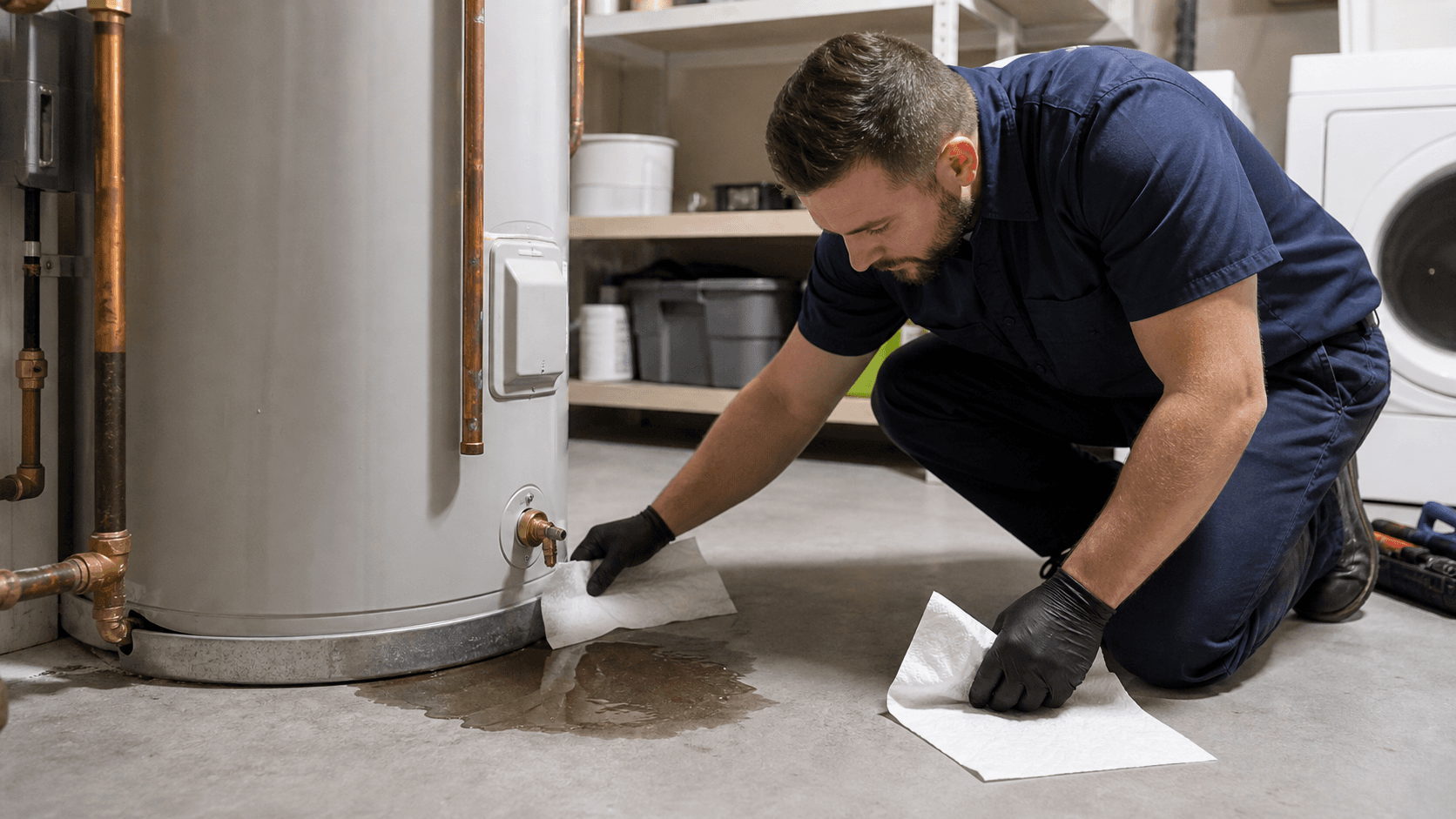
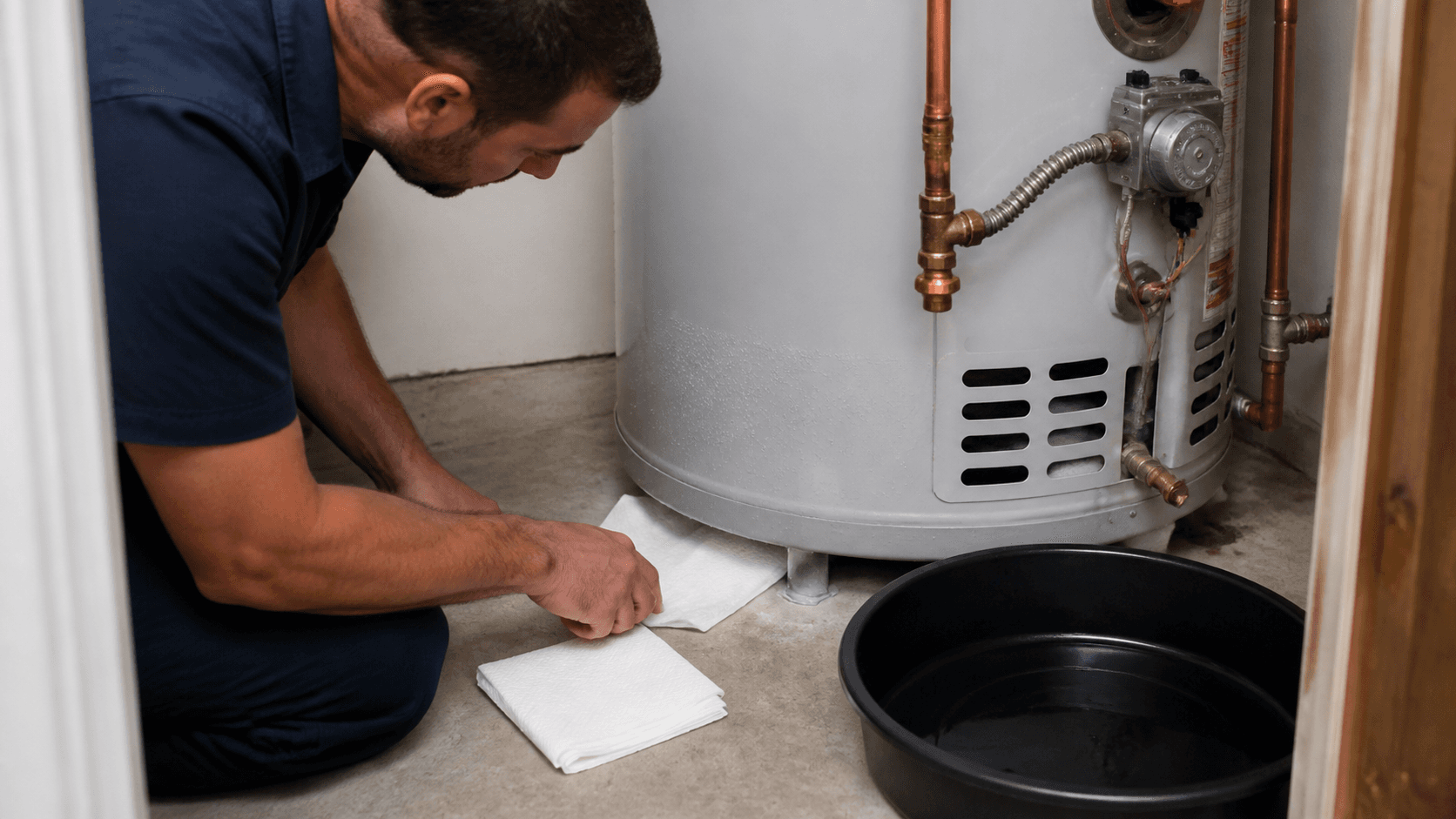
A paper-towel test separates a repairable drain-valve leak from a tank that has corroded through.
This happening in your home right now? A licensed plumber can talk you through the next step on the phone — 24/7, and the call is free.
How do you find where a water heater is leaking from?
Dry the area completely, lay paper towels around the base and along the T&P discharge pipe, and check after 15 minutes — the first spot to re-wet identifies the source before any repair.
Start by drying every surface — the top of the tank, the supply and outlet connections, the drain valve, the T&P discharge pipe, and the floor under the unit — so that any new moisture is unambiguous. Lay a ring of paper towels around the entire base and a strip running the length of the T&P discharge pipe, then leave the heater running normally and check at 15 minutes, an hour, and again the next morning. The first towel to re-wet, and its position, is the diagnosis: the slower the leak, the longer the observation window needs to run.
Wet only at the drain valve, with the rest of the base dry, means a drain-valve leak — repairable by swapping the valve. Wet along the T&P discharge pipe or at its outlet points to the relief valve releasing because of over-temperature or over-pressure; because the T&P valve is rated to open at 150 psi or 210°F, repeated discharge sends you to the thermal-expansion tank and the temperature setting rather than to a conclusion that the tank has failed. Confirming this distinction up front prevents the common mistake of condemning a sound tank for what is actually an expansion-pressure problem.
Moisture that returns slowly, only while the burner or elements are firing and only in cold months, is condensation — common in the unheated garages and crawlspaces where many Eastside tanks live during a Pacific Northwest winter, and usually harmless. The tell is that it disappears once the tank contents are fully up to temperature and never appears in warm weather. Water emerging from directly under the tank jacket or along the bottom seam, by contrast, is the tank corroded through, and that pattern worsens steadily rather than clearing as the tank heats.
When the towels stay dry at the fittings but the floor under the center of the tank keeps wetting, the conclusion is corrosion through the steel, and no further fitting test will change it. At that point the diagnostic value shifts from repair to safe shutdown and replacement planning. If the leak is fast enough that towels are saturated within minutes, skip the patient observation and treat it as an active leak — shut the water off and move to the safety steps below.
Is it condensation or a real leak?
Condensation appears only while the tank reheats cold water and dries once it is hot; a real leak seeps from under the jacket or a fitting and worsens steadily instead of drying.
A.O. Smith lists condensation alongside the drain valve and a corroded tank as one of the three things owners most often mistake for a bottom leak, and it is the easiest to rule out because it follows the heating cycle. A tank refilled with cold water sweats on its cooler outer steel the same way a cold glass beads up on a humid day; the droplets run down the jacket to the base and pool there until the tank contents warm and the sweating stops. The defining tell is timing — condensation appears while the tank is recovering and disappears once it is hot, where a true leak holds steady or grows regardless of the heating cycle.
Two further signatures separate the two. Condensation is seasonal and location-driven: it is most visible in cold months and in the unheated garages and crawlspaces where many Eastside tanks sit, because the colder the surrounding air, the more the cold tank surface sweats. A real leak ignores the weather and the season — it weeps the same on a warm July afternoon as on a January morning. If the base is dry in summer and damp only on cold mornings during a reheat, that pattern alone is enough to call it condensation rather than a failing tank.
Confirm with the paper-towel method already described: dry the base, lay towels, and watch what re-wets and when. Condensation leaves a faint, even film across the bottom that evaporates as the tank heats; a fitting leak re-wets at one specific point — the drain valve or the T&P discharge — and a corroded tank re-wets from directly under the jacket and keeps spreading. Getting this distinction right is what keeps an owner from condemning a perfectly sound tank for harmless winter sweating, which is the single most common false alarm on a bottom-leak call.
Condensation follows the heating cycle; a true leak keeps wetting the same source point.
Why does a water heater leak from the bottom in an older Bellevue home?
In an older Bellevue home, a bottom leak usually means the original 1960s–80s tank corroded through on a spent anode rod — though a drain-valve weep or winter condensation is still possible.
Bellevue's housing stock skews old, and a large share of the original tanks installed with those 1960s–80s homes are already past the typical 8-to-12-year service life. When a tank that old leaks from the bottom, the odds favor terminal corrosion: sediment settling at the base plus a long-depleted sacrificial anode rod has eaten through the steel from the inside, and once the wall perforates, water seeps from under the jacket along the bottom seam. No patch or sealant returns a perforated pressure vessel to safe service, so on an aged, never-maintained tank a genuine bottom-of-tank leak is a replace, not a repair.
Soft water complicates the intuition in the homeowner's favor, though. Bellevue's Cedar- and Tolt-sourced supply is soft and corrodes tanks more slowly than hard-water regions, so an older Eastside tank that did get its anode rod kept current and an annual flush can outlast its years and still be leaking from nothing worse than an aged drain valve. That is why age alone does not settle the question — the same puddle under an original tank can be a $20 fitting weep or a dead pressure vessel, and only locating the source with the paper-towel test tells them apart.
The practical reading for an older Bellevue home is to weigh three facts together: the tank's age off the rating sticker, its maintenance history, and exactly where the water is emerging. A young or well-maintained tank weeping at the drain valve or relieving at the T&P valve is repairable; an undated, never-flushed original tank wetting from under its center is almost certainly finished. When the location and the age both point at the steel, the next step is the replacement-and-code path — about $1,700 to $2,500 installed with a City of Bellevue plumbing permit — through water heater repair and installation in Bellevue, and the full age-based decision is in how long water heaters last.
Can you repair a water heater leaking from the bottom?
A bottom leak is repairable when it traces to the drain valve, the T&P valve, or condensation, and is not repairable when the tank itself has corroded through and pools water underneath.
Replacing a weeping drain valve restores a unit that is otherwise sound: the tank is drained, the old plastic valve unthreaded, and a new valve — often a more durable brass replacement — installed in its place. A chattering or steadily dripping T&P valve is likewise a part swap, though the smarter move is to first confirm why it is discharging, since a valve that opens repeatedly is usually reporting a closed-system expansion problem that a thermal-expansion tank solves. Condensation needs no repair at all beyond improving airflow and clearance around the tank so the sweat evaporates.
A tank that pools water from underneath has failed at the steel and gets replaced — there is no patch, weld, or sealant that returns a perforated pressure vessel to service safely. This is where tank age becomes the deciding fact: in Bellevue's 1960s–80s housing stock, a large share of original tanks are already past the typical 8-to-12-year service life, so a genuine bottom-of-tank leak there is far more likely to be terminal corrosion than a fitting that happened to fail. Pairing the leak source with the unit's age gives a clean repair-or-replace call.
Keeping the sacrificial anode rod current is the single best defense against ever reaching tank failure, because the rod corrodes in place of the steel and buys the tank years once it is replaced before full depletion. Soft Eastside water already slows the scale-and-sediment side of corrosion compared to hard-water markets, so a Bellevue owner who also stays ahead on the anode rod gets the most life a storage tank can give. Our guide on anode rod replacement in Bellevue covers how to check and change it, and how long water heaters last puts the anode in the full lifespan picture.
Is a leaking water heater dangerous?
A leak creates a flooding and scald risk, and on a gas unit, standing water reaching the burner adds a combustion hazard — so shut off the water supply first, then the power or gas.
The fastest way to limit damage is to stop the water before chasing the cause. Turn off the cold-water supply at the valve directly above the heater; if that valve is seized or absent, close the home's main shutoff instead. Stopping inflow drops the tank pressure that is driving water out of the leak and buys time to work the rest of the shutdown safely. A tank holds 40 to 50 gallons under household pressure, so an unaddressed bottom failure floods a finished basement or garage quickly.
With the water off, cut the heat source next: switch off the dedicated breaker for an electric unit, or turn the gas control knob to off for a gas unit. On a gas heater this step also addresses the combustion hazard — standing water reaching the burner compartment or pilot is a real risk, so the gas comes off whenever water is pooling near the base. The hot water already in the tank can scald, which is another reason to keep the supply isolated rather than draining through a fixture during cleanup.
A T&P valve that discharges intermittently is doing exactly its job — relieving over-temperature or over-pressure to keep the tank from becoming a hazard — and should never be capped or plugged to stop the drip. A valve that streams continuously, by contrast, signals sustained over-pressure or a failed valve and needs prompt attention, because it is reporting a condition the tank should not be holding. The fix is the underlying cause: an expansion tank for closed-system pressure, or a corrected temperature setting.
If water is actively spreading across the floor faster than towels can keep up, treat it as an emergency rather than a diagnosis: get the supply and the power or gas off, move belongings clear, and call for help. Our 24/7 emergency plumbing line dispatches same-day across the Eastside for an actively leaking tank, and a fast shutoff plus a fast dispatch is what keeps a failed water heater from becoming a water-damage insurance claim.
What does water heater replacement cost on the Eastside, and what does code require?
A storage water heater replacement on the Eastside runs about $1,700 to $2,500 installed, and the City of Bellevue requires a plumbing permit for the work.
That installed range covers the unit, labor, code-required upgrades, and disposal of the old tank; the spread reflects tank size, fuel type, and how much the existing connections need to be brought up to current code. The City of Bellevue requires a plumbing permit to replace a water heater, which means the work is inspected — a protection for the homeowner, since an uninspected swap can leave seismic, expansion, and venting defects that surface later as failures or as problems at resale.
A compliant replacement adds two-strap seismic bracing: Washington requires the tank strapped in its upper and lower thirds, with the straps anchored by lag screws into wall studs rather than just into drywall. This is not optional finish work — it is what keeps the tank from walking off its connections and shearing the gas or water lines in an earthquake, a live concern across the seismically active Puget Sound region. A code replacement also adds a thermal-expansion tank whenever the system is closed by a check valve, pressure-reducing valve, or backflow preventer (UPC §608.3), because a closed system has nowhere to vent the pressure spike that heating water produces.
The expansion tank is also why so many T&P valves drip in the first place: on a closed system without one, every heating cycle raises pressure until the T&P valve relieves, and homeowners read that as a leak. Installing the expansion tank during replacement resolves a problem many owners did not realize they had, and it protects the new tank from the repeated thermal-pressure stress that shortens service life. Pairing it with a 120°F temperature setting slows corrosion further — the reasoning is in water heater temperature setting.
The repair-versus-replace line follows tank age. A tank past 10 to 12 years old that is leaking from the tank itself is a replace, not a repair, because the steel is at end of life and a patched fitting will not save a perforating vessel. Newer units with a single failed part — drain valve, T&P valve, element — are worth repairing, and our guide on how long water heaters last covers that full decision. When the call is replacement, or when you want a heat-pump or tankless option weighed against a like-for-like swap, compare tankless vs storage water heaters in Bellevue and book through water heater repair and installation in Bellevue.
Common questions about a water heater leaking from the bottom
Yes — shut a leaking water heater's water supply first, then cut the power or gas. Whether insurance covers the damage depends on your policy and the failure mode.
Yes — turn off a leaking water heater, and do it in order: water first, then heat. Close the cold-water supply valve directly above the tank (or the home's main shutoff if that valve is seized) to stop the inflow driving water out of the leak, then switch off the dedicated breaker on an electric unit or turn the gas control knob to off on a gas unit. Cutting the water before the power matters because it drops the tank pressure feeding the leak and, on a gas unit, removes the combustion hazard of standing water reaching the burner. A 40-to-50-gallon tank under household pressure floods a finished space quickly, so the shutoff is the first move on any active bottom leak.
Whether homeowner's insurance covers a water heater leak is policy-dependent, and this guide does not assert that it will. Coverage typically turns on the failure mode — a sudden burst is treated very differently from slow, long-term seepage — along with the cause and the specific terms of your policy, so the only reliable answer comes from reading your coverage and documenting the loss with photos and the plumber's invoice. The full walkthrough of what carriers actually pay, the adjuster process, and the documentation that wins a claim is in our water damage insurance claims in Bellevue guide — read it before the claim conversation.
Sources
Every fact in this guide cites a verifiable public source. If you find a number we got wrong, email dispatch@bellevueplumberpro.com.
Water heater leaking from the bottom — questions homeowners ask
QUESTION01
Why is my water heater leaking from the bottom?
Four causes: a leaking drain valve, T&P discharge, condensation, or a corroded-through tank. The first three are repairable; a tank corroded through means replacement — no repair exists for a failed tank.
QUESTION02
How do I find where my water heater is leaking?
Dry the area completely, lay paper towels around the base and along the T&P discharge pipe, and check after 15 minutes — the first spot to re-wet identifies the source.
QUESTION03
Is it a leak or just condensation on my water heater?
Condensation appears only while the tank reheats cold water and dries once hot; a real leak seeps from under the jacket or a fitting and steadily worsens instead of drying.
QUESTION04
What does a bottom leak mean in an older Bellevue home?
Usually that the original 1960s–80s tank corroded through on a spent anode rod — though a drain-valve weep or winter condensation is still possible, so run the paper-towel test before assuming the worst.