Why did my water heater stop heating?
Either an electrical fault — tripped reset, failed element, bad thermostat — or a gas fault: pilot out, weak thermocouple, or failed gas valve. Electric and gas units fail in completely different ways.
A water heater that stops producing heat fails along one of two paths set by its fuel type. Electric units lose heat from a tripped high-limit (ECO) reset, a failed heating element, or a bad thermostat. Gas units lose heat from an out pilot, a weak thermocouple, an interrupted gas supply, or a failed gas control valve. Identifying the fuel type first, then working a fixed diagnostic order, isolates the cause without guesswork or parts-swapping. This guide gives that order for each fuel, explains the safe DIY checks a homeowner can run with a multimeter, shows why a reset that keeps tripping signals a deeper fault rather than a fluke, and draws the line between work you can do and work that belongs to a licensed plumber. It also covers the Eastside angle: because soft Cedar- and Tolt-sourced water leaves little scale, element and thermostat failures here come from age and burnout rather than the heavy mineral buildup that drives them in hard-water regions.
Last reviewed: 2026-06-04
No heat comes from an electrical fault — a tripped reset, failed element, or bad thermostat — or a gas fault — an out pilot, weak thermocouple, or failed gas valve.
An electric storage heater carries two heating elements and two thermostats stacked behind access panels on the side of the tank. The upper element heats the top third of the tank first so the household has hot water sooner, then control hands off to the lower element, which does most of the day-to-day work. Each element is governed by its own thermostat, and the upper thermostat also carries the emergency cut-off (ECO) high-limit switch with its red reset button. Knowing which element does what is the key to reading the symptom: which part of the supply has gone cold tells you which element or thermostat to suspect.
A gas storage heater works on a different chain entirely. A standing pilot flame heats a thermocouple, the thermocouple generates a small voltage that proves the flame is lit, and that voltage holds open a safety circuit inside the gas control valve so the main burner can fire. Pull any link out of that chain — pilot out, thermocouple weak, supply interrupted, valve failed — and the burner stays dark. The chain is also a built-in safety interlock: if the pilot ever goes out, the thermocouple voltage collapses and the valve shuts the gas off rather than letting it flow unburned.
Because the two fuels fail through completely different parts, the single most useful first step is simply confirming which one you have, then following that fuel's diagnostic order rather than checking parts at random. An electric unit has a breaker and access panels but no flame; a gas unit has a burner, a flue, and a gas control valve with a pilot. Most of the wasted-effort calls come from a homeowner testing the wrong system — relighting a pilot on a unit that turns out to be electric, or hunting for an element on a gas tank.
This happening in your home right now? A licensed plumber can talk you through the next step on the phone — 24/7, and the call is free.
Call a plumberCheck the breaker first, then press the red reset button on the upper thermostat, then test the elements and thermostats with a multimeter.
Begin at the electrical panel, because a tripped breaker is the cheapest possible cause and the fastest to rule out. Reset the dedicated double-pole breaker for the water heater once; if it holds, the problem may have been a transient surge, and if it trips again immediately, an element or wiring fault is drawing a short and the unit needs service rather than another reset. Only after the breaker is confirmed on should you move to the unit itself.
Next, remove the upper access panel, fold back the insulation, and press the red reset button on the emergency cut-off. The ECO trips near 180°F to protect against scalding overheat, and a single press restores a large share of no-heat calls where the trip was a one-time event. If the reset clicks and the unit heats again, watch it: a reset that holds is a fix, and a reset that trips again within hours is a symptom of a deeper fault covered in its own section below.
When power and reset are both confirmed, the symptom narrows the search to a specific element. Lukewarm water that cools quickly usually means the lower element has failed, since the upper element can still heat the top of the tank but cannot carry the full load; no hot water at all points to the upper element or its thermostat, because the upper stage feeds the part of the tank a household draws from first. Reading the symptom this way tells you which panel to open before you ever touch a meter.
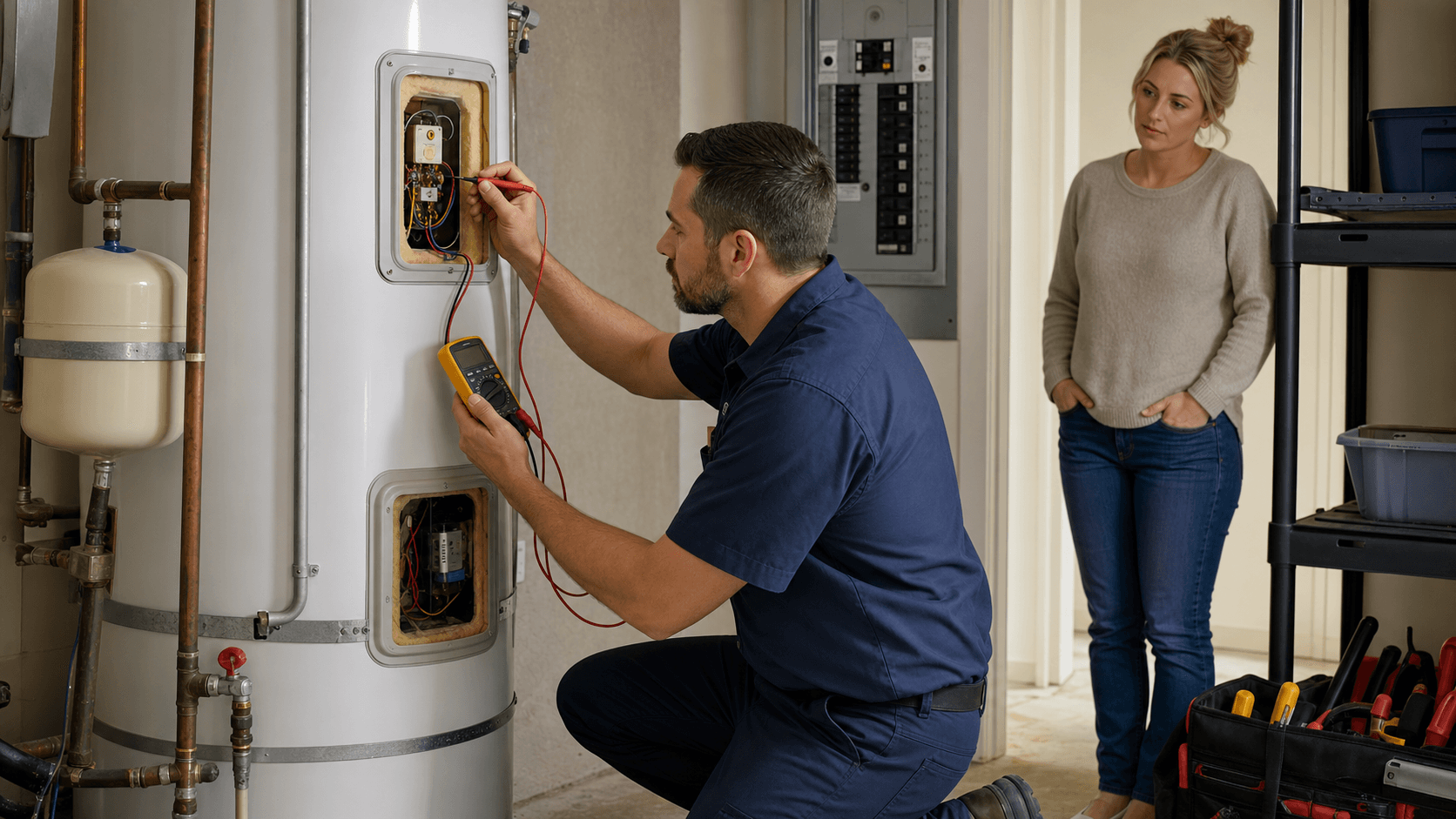
Confirm the suspect part with a multimeter. With the breaker off for safety, test each element across its terminals for resistance — an open (infinite) reading means a burned-out element. To separate a bad thermostat from a bad element, restore power carefully and check for voltage reaching the element terminals while the unit calls for heat: voltage present but the element cold means the element is open, while no voltage reaching an element that should be firing points to the thermostat upstream of it. Element and thermostat replacement on a drained, de-energized tank is within reach for a confident DIYer, but if the meter readings are ambiguous, that is the point to call.
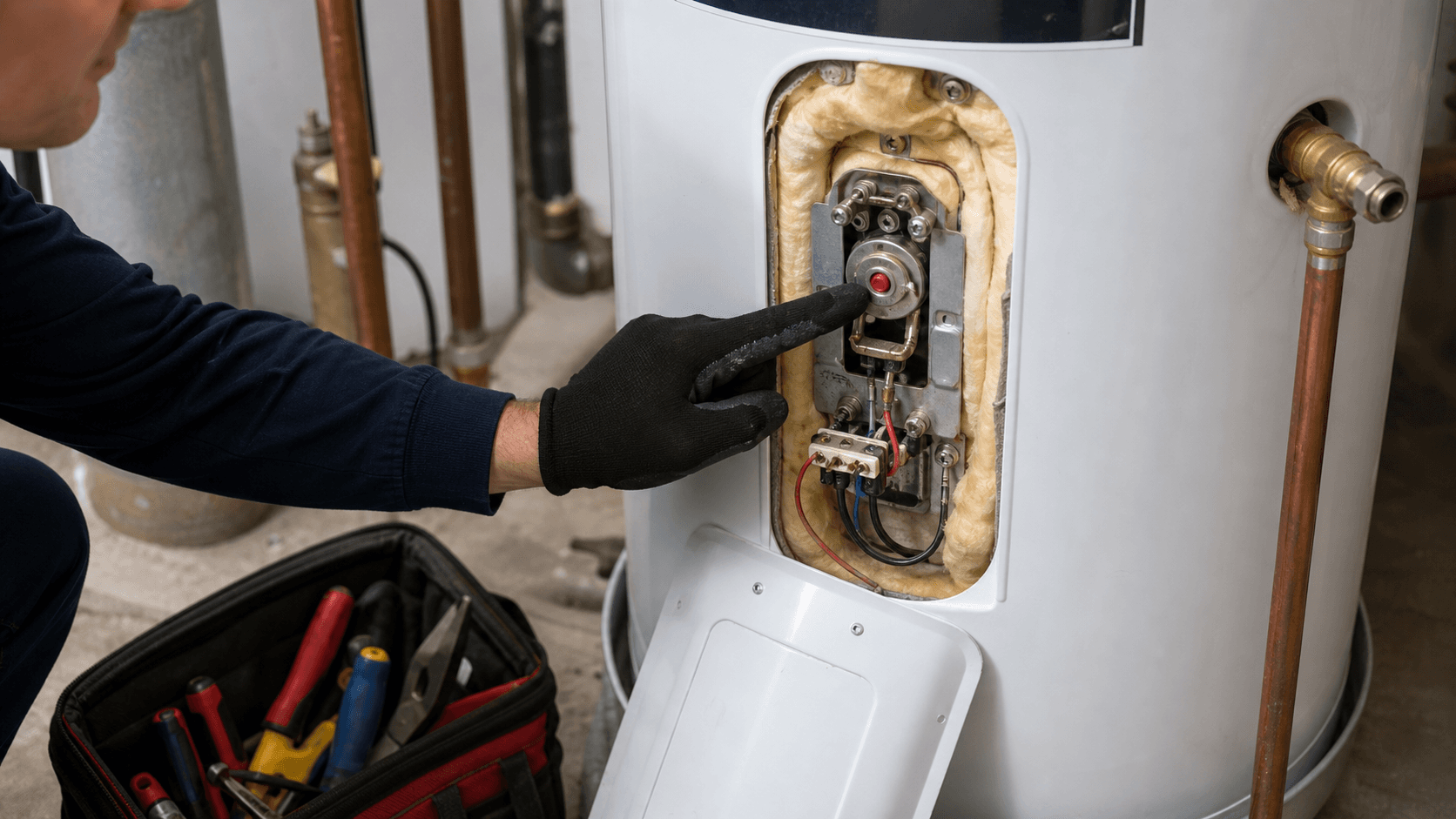
The reset button is the red button on the emergency cut-off (ECO) high-limit switch, found behind the upper access panel on the side of an electric tank, under the fold-back insulation, on the upper thermostat.
On an electric storage heater, the reset button lives behind the upper access panel — the small removable cover on the side of the tank near the top. Remove that panel and fold back the insulation blanket underneath, and the red button sits on the upper thermostat assembly, which carries the emergency cut-off (ECO) high-limit switch. There is no separate reset on the lower thermostat; the single ECO on the upper stage protects the whole unit, which is why this one button is the only reset on the appliance.
The ECO exists to stop the tank delivering scalding water: it trips and cuts power to the elements when the water climbs near 180°F, and pressing the red button re-arms it. A single press restores a large share of no-heat calls where the trip was a one-time overheat event — so locating and pressing this button is one of the first checks after confirming the breaker is on. Set the breaker off before opening the panel, since you are working next to 240-volt terminals.
What the button does not do is fix a recurring fault. If the reset trips again within hours of pressing it, the ECO is catching a real overheat from a failed thermostat or a shorted element, and re-arming it repeatedly only hands the safety device the same fault to catch again — the full reasoning is in the repeated-trip section below. Gas units have no ECO reset button at all; their safety interlock is the thermocouple chain covered in the gas-diagnosis section, so a hunt for a reset button on a gas tank is a hunt for a part that does not exist.
Lukewarm water that cools quickly means the lower element has failed, and no hot water at all means the upper element or its thermostat has failed.
The two elements split the work, and the symptom maps straight to the one that died. The upper element heats the top third of the tank first so the household gets hot water sooner, then control hands off to the lower element, which does most of the day-to-day heating. When the lower element fails, the upper element can still heat the top of the tank but cannot carry the full load, so you get water that is warm or lukewarm and runs cold quickly — the classic lower-element signature. When the upper element or its thermostat fails, the stage that feeds the part of the tank the household draws from first is dead, so you get no hot water at all.
Reading the symptom this way tells you which access panel to open before you ever touch a meter. Lukewarm-and-fading sends you to the lower panel; no-hot-water-at-all sends you to the upper panel and its thermostat, which also carries the ECO reset worth pressing first. This symptom-first approach is more reliable in Bellevue than in hard-water markets, because soft Cedar- and Tolt-sourced Eastside water does not bury the lower element in scale the way hard water does, so the elements age out cleanly rather than failing in a muddied, sediment-driven pattern.
Confirm the suspect element with the multimeter test from the electric-diagnosis section: with the breaker off, an open (infinite) resistance reading across the element's terminals means it has burned out. If the meter says the element is fine but the symptom persists, the thermostat upstream of it is the next suspect. Element and thermostat replacement on a drained, de-energized tank is a confident-DIYer job; ambiguous readings or any discomfort working inside a 240-volt appliance is the point to book water heater repair and installation in Bellevue.
Diagnose a gas water heater in order — pilot, thermocouple, gas supply, then gas control valve.
Start with the pilot, because everything downstream depends on it. If the pilot is out, follow the lighting instructions printed on the tank and watch what happens: a pilot that lights and stays lit while you hold the control knob but dies the moment you release it is the classic thermocouple signature, while a pilot that will not light at all points upstream to gas supply or to the valve. A pilot that burns but is weak, yellow, or lifting off the thermocouple tip is starving for air or fuel and needs cleaning before any part is condemned.
The pilot flame must burn a steady blue and fully envelop the tip of the thermocouple, because the thermocouple only generates voltage from the heat it actually receives. A healthy thermocouple produces roughly 20 to 30 millivolts when heated; a reading low of that range, or zero, means it has degraded and needs replacement. This is the most common gas-side failure and the one that explains the majority of pilots that will not stay lit — the part is a few dollars, but it sits in the gas-control assembly and its replacement is gas work.
If the pilot is healthy and the thermocouple reads in range but the burner still will not fire, check the gas supply: confirm the shutoff at the tank is open, and confirm other gas appliances in the home are working, since a whole-house supply interruption presents as a dead water heater. Puget Sound Energy supplies natural gas across the Eastside, so a neighborhood supply event or a closed valve after other service work can leave the unit with nothing to burn through no fault of the heater itself.
When the pilot lights and holds, the thermocouple reads correctly, and gas is confirmed at the unit, the remaining suspect is the gas control valve, which has failed internally and is not passing gas to the main burner on a call for heat. A failed gas valve is a replacement, not a field repair, and gas-valve and thermocouple work is gas work that belongs to a licensed plumber under Washington's contractor and gas-piping rules. Working the order above first means you hand the plumber a narrowed diagnosis rather than an open-ended no-heat call.
A pilot that lights while you hold the control knob but dies the moment you release it is the classic sign of a weak or failed thermocouple, the part that proves the flame and holds the gas valve open.
The behavior names the part. The thermocouple sits in the pilot flame and generates a small voltage from the heat it receives; that voltage holds open a safety circuit in the gas control valve. While you press the knob to light the pilot, you are manually holding that circuit open, so the pilot burns — but the instant you release the knob, the valve relies on the thermocouple's voltage alone, and if the thermocouple is too weak to hold the circuit, the gas shuts off and the pilot dies. A pilot that will not survive knob release is therefore the thermocouple signature, and it is the single most common reason a gas water heater stops staying lit.
Before condemning the thermocouple, confirm the flame itself is healthy, because a starved flame mimics a dead thermocouple. The pilot must burn a steady blue and fully envelop the tip of the thermocouple, since the part only generates voltage from heat it actually receives — a flame that is weak, yellow, or lifting off the tip is starving for air or fuel and needs cleaning first. A healthy thermocouple produces roughly 20 to 30 millivolts when properly heated; a reading low of that range, or zero, confirms the part has degraded and needs replacement rather than the flame being at fault.
Thermocouple replacement is gas work. The part costs only a few dollars, but it sits inside the gas-control assembly, and gas-valve and thermocouple service belongs to a licensed plumber under Washington's contractor and gas-piping rules. Cleaning a dirty pilot orifice and relighting per the printed instructions is a reasonable homeowner step; once the flame is confirmed good and the pilot still will not hold, the next move is to book water heater repair and installation in Bellevue rather than keep relighting a pilot the thermocouple can no longer prove.
A reset button that trips again within hours signals a failed element or thermostat, not a one-time fault — stop resetting it.
The emergency cut-off trips when the water exceeds roughly 180°F, and it does that to stop a unit that is overheating from delivering scalding water or building dangerous pressure. A one-time trip can follow a transient — a brief overheat after an unusual draw pattern — and a single reset clears it. The problem is the trip that returns within hours, which is the ECO doing its job against a fault that is still present.
The usual mechanism is a thermostat that has failed closed: instead of cutting the element when the setpoint is reached, it leaves the element energized, the water climbs past the setpoint, and the ECO intervenes at 180°F to stop the runaway. A shorted or grounded heating element can produce the same repeated trip. In both cases the ECO is the last line of defense, and re-arming it without fixing the underlying part simply hands the safety device the same overheat to catch again — eventually it can stick.
Because the consequence of an ignored repeat-trip is scalding-hot water or a stressed tank, the correct next step after the second trip is to stop pressing the button and test the elements and thermostats for continuity, exactly as in the electric-diagnosis section above. A reset that will not hold is diagnostic information, not an inconvenience to be cleared. If the meter points at a thermostat or element and the repair is beyond your comfort, that is the call to make a service appointment rather than a third reset.
Soft Cedar- and Tolt-sourced Eastside water leaves little scale, so element and thermostat failures here come from age and burnout rather than the mineral encrustation that drives them in hard-water regions.
In a hard-water market, dissolved calcium and magnesium plate onto the lower heating element and bake into a hard scale crust that insulates the element from the water, forces it to run hotter to transfer the same heat, and burns it out early. That failure mode is the dominant cause of dead electric elements where the water is hard. Bellevue's supply is soft — sourced from the Cedar and Tolt watersheds — so that crusting mechanism is largely absent, and elements here simply age out of service instead of being killed by scale.
The practical effect is that a no-heat Bellevue electric unit is more likely to have a thermostat that has drifted or failed, or an element at the end of its natural service life, than one buried in mineral deposit. It also means the lower element — the one a hard-water region loses to scale first — is not under that specific accelerated stress here, so symptom-reading by element stays a reliable diagnostic rather than being muddied by buildup. The soft-water advantage is real, but it does not make the parts immortal; it shifts the cause from scale to age.
Soft water still leaves some sediment over years, and an aging never-flushed tank can develop enough buildup to affect heating regardless of hardness — the mechanism and the flush procedure are in water heater making noise, and the broader local water chemistry is in Eastside water hardness. The takeaway for a Bellevue homeowner diagnosing a no-heat unit is to weight age and component wear ahead of scale, which is the opposite of the default advice written for hard-water markets.
DIY covers one reset, a breaker check, and a pilot relight; a plumber handles the gas valve, the thermocouple, repeated ECO trips, and element or thermostat replacement.
The safe homeowner checks are the non-invasive ones: resetting the breaker once, pressing the ECO reset once, relighting a gas pilot per the printed instructions, and confirming other appliances have gas. A confident DIYer with the breaker off can also meter elements and thermostats for continuity. Each of these is reversible and low-risk, and together they resolve a meaningful share of no-heat calls without a service visit.
The work that belongs to a licensed plumber is anything on the gas side and anything that the safe checks have escalated: a failed or replacement gas control valve, a thermocouple swap inside the gas assembly, a reset button that keeps tripping after the second press, and element or thermostat replacement where the homeowner is not comfortable working inside a 240-volt appliance. Gas-piping and gas-appliance work is regulated in Washington and is not a place to improvise. When a reset keeps tripping, the gas valve is suspect, or an element needs replacing, book water heater repair and installation in Bellevue.
Match the guide to the symptom, too. A unit that produces some hot water but runs out fast is a different problem than one that produces none, and it starts with our no hot water troubleshooting tree rather than this no-heat path. If the failure lands during a Pacific Northwest cold snap, when a cold house compounds the loss of hot water, our 24/7 emergency plumbing line dispatches same-day across the Eastside.
Every fact in this guide cites a verifiable public source. If you find a number we got wrong, email dispatch@bellevueplumberpro.com.
Need help with this in your home? See our Water heater repair and installation in Bellevue page for pricing, our diagnostic process, and how same-day service works across the Eastside.
Related services: Leak Detection and Pipe Repair.
Either an electrical fault — tripped reset, failed element, bad thermostat — or a gas fault: pilot out, weak thermocouple, or failed gas valve. Electric and gas units fail in completely different ways.
Check the breaker first, then press the red reset button on the upper thermostat — it's behind the upper access panel under the fold-back insulation on the side of the tank.
Lukewarm water that cools quickly means the lower element has failed; no hot water at all means the upper element or its thermostat has failed. A multimeter on the elements and thermostats confirms which.