Home/Learn/Water heaters/Anode rod replacement in Bellevue water heaters: the 5-year decision that adds 4-7 years to tank life
Water heaters
Anode rod replacement in Bellevue water heaters: the 5-year decision that adds 4-7 years to tank life
The anode rod is the single most important maintenance item on a Bellevue water heater and the one most homeowners never touch. The rod is a sacrificial metal cylinder that corrodes preferentially to protect the tank's steel walls from rusting through. In Bellevue's soft slightly-alkaline municipal water, the standard magnesium anode rod runs out faster than the typical hard-water region — usually by year 5-7 versus the 7-10 year service life the rod is theoretically rated for. Once consumed, the tank itself starts corroding and the failure clock starts. A $200-$500 professional rod replacement, or a $30-$70 DIY swap, can extend a water heater's life from the typical 10-12 years to 16-18 years. This guide covers the chemistry, the three rod materials (magnesium, aluminum, powered), why Bellevue's soft water specifically shortens magnesium rod life, the 5-year inspection-or-replace decision, the DIY scope, the clearance issues that drive the cost up, and what powered (impressed-current) anode rods change.
The anode rod is a sacrificial metal cylinder threaded into the top of the tank, hanging down through the water column. It corrodes preferentially to the tank's steel walls — galvanic action attacks the rod first, leaving the tank intact. When the rod is consumed, the tank itself starts corroding, and the failure clock starts.
The chemistry. A standard residential water heater tank is mild steel with a glass-lining interior. The glass lining is the primary corrosion barrier, but the lining has tiny imperfections (called holidays) where bare steel is exposed to water. Without protection, those exposed steel points corrode within months, the corrosion spreads, and the tank ruptures within 3-5 years.
The anode rod is the protection. Threaded into the top of the tank, the rod hangs down through the water column for most of the tank's height. The rod is made of a metal more reactive than steel — magnesium, aluminum, or zinc alloys are common. Galvanic action drives the corrosion to attack the more reactive metal first; while the anode rod has material remaining, the steel is protected.
The end state. Over years of service, the rod erodes from the bottom up. The exposed steel core of the rod (a wire that runs the rod's length) becomes visible as the rod is consumed. When the wire is fully exposed or when less than 25 percent of the original rod diameter remains at any point, the rod's protective function is essentially gone. From that point, the tank itself starts corroding — typically beginning at the bottom where sediment accumulates.
Why this matters in cost terms. A typical Bellevue tank water heater fails at 10-12 years, usually from tank corrosion. Replacing the anode rod before consumption — typically year 5-7 in Bellevue's soft water — extends the tank's life to 16-18 years. The cost of replacement ($200-$500 professional) is dwarfed by the cost of premature tank replacement ($1,500-$3,500 typical for a 50-gallon electric or gas tank, $3,000-$6,500 for a heat pump unit). The full water heater replacement context is in our tankless versus storage water heaters and heat pump water heaters guides.
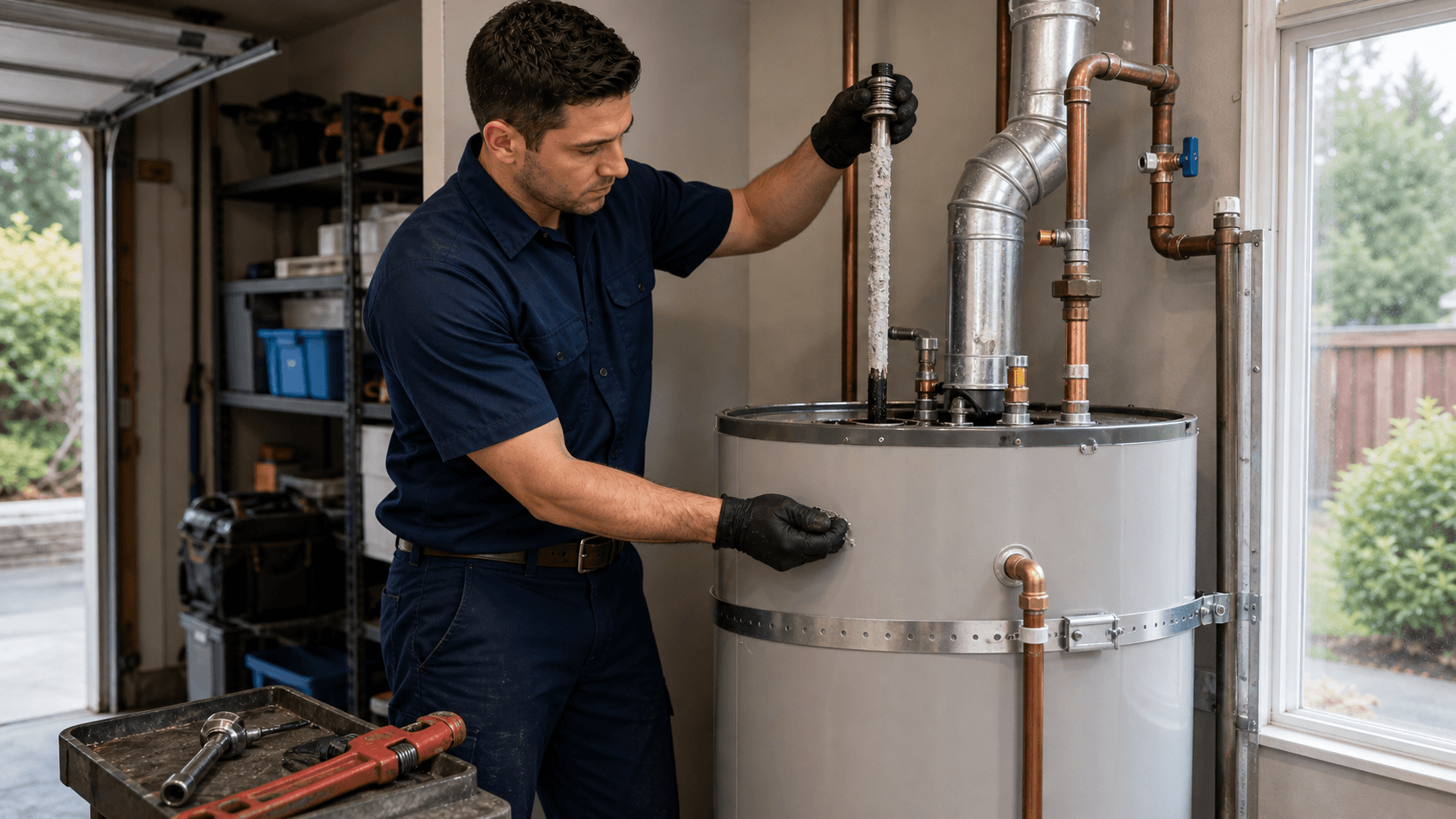
Anode rods are service parts; checking them is one of the few maintenance steps that can extend tank life.
This happening in your home right now? A licensed plumber can talk you through the next step on the phone — 24/7, and the call is free.
The three anode rod materials — and why Bellevue's water matters
Magnesium rods are the highest-performing in soft water but consume themselves the fastest. Aluminum rods last longer (5-8 years in hard water) but provide less protection. Powered (impressed-current) anode rods use external electricity to provide protection without consumption — best for soft-water markets but $400-$700 installed.
Magnesium. The highest-reactivity option. Best protection in soft water with low mineral content. In Bellevue's 25.7 mg/L hardness municipal water, magnesium rods provide aggressive protection but consume themselves quickly — typical service life is 4-6 years, sometimes less. Magnesium is the default rod installed at the factory in most water heaters sold for soft-water markets.
Aluminum (or aluminum-zinc). Less reactive than magnesium, longer service life — typically 5-8 years in hard water. Aluminum's lower reactivity means less protection in soft water and potential tank corrosion if Bellevue's chemistry doesn't fully activate the rod. Aluminum-zinc combination rods address sulfur smell complaints (a chemistry interaction with some softening systems) and provide moderate protection.
Powered (impressed-current) anode rod. A modern alternative that uses external electricity to provide cathodic protection without consuming the rod. Brands include Corro-Protec and others. Cost is $200-$400 for the rod plus $100-$300 installation. The rod itself does not erode (it's titanium with a non-sacrificial coating), so service life is essentially unlimited — but it requires continuous electrical power, and if the home loses power during a freeze or windstorm, the protection lapses for the duration of the outage.
The Bellevue-specific question. The default magnesium rod is the right choice for protecting the tank against Bellevue's specific water chemistry — but it consumes itself faster than in hard-water regions. The inspection-and-replacement schedule for Bellevue should be tighter than the manufacturer-default 5-year interval. Year 4 inspection is reasonable; year 5 replacement is the conservative call for most homeowners.
Why Bellevue's soft water shortens magnesium rod life
Bellevue's water at pH 7.5-8.2 and 1.50 grains per gallon hardness drives more aggressive galvanic action between the magnesium rod and steel tank than higher-hardness water. The rod corrodes faster because the protective scale layer that would partially insulate a rod in hard water never forms in Bellevue's soft water.
The scale layer mechanism. In hard-water regions (5+ grains per gallon), dissolved calcium and magnesium precipitate onto the rod surface over the first weeks of service, forming a partial insulating layer that slows the galvanic reaction. The rod still functions but consumes itself more slowly because the protective scale moderates the chemical reaction.
In Bellevue's soft water (1.50 gpg), this scale layer never forms substantially. The rod surface stays bare metal, the galvanic reaction proceeds at full rate, and consumption is faster. The same magnesium rod that would last 7-8 years in Phoenix or Dallas runs 4-6 years in Bellevue.
What this means for the inspection schedule. Manufacturer-default 'inspect every 5 years' guidance assumes typical US municipal water at moderate hardness. For Bellevue's soft water, year 3-4 first inspection and year 4-5 replacement is the appropriate schedule. For homes with water softeners installed (rare in Bellevue but documented — see our hard water in Bellevue and the Eastside guide), the rod consumes even faster because softeners further reduce the moderating effect of mineral content.
The well-water exception. Outer Eastside homes on private wells (parts of Sammamish, Issaquah, Woodinville) have hardness in the 3-4 grains per gallon range — closer to typical US municipal averages. Anode rod service life on well-water homes is closer to manufacturer-default (5-7 years for magnesium). The geographic difference is meaningful: a Bellevue municipal customer should plan year-4 inspection; a Sammamish well-water customer can use year-5 inspection.
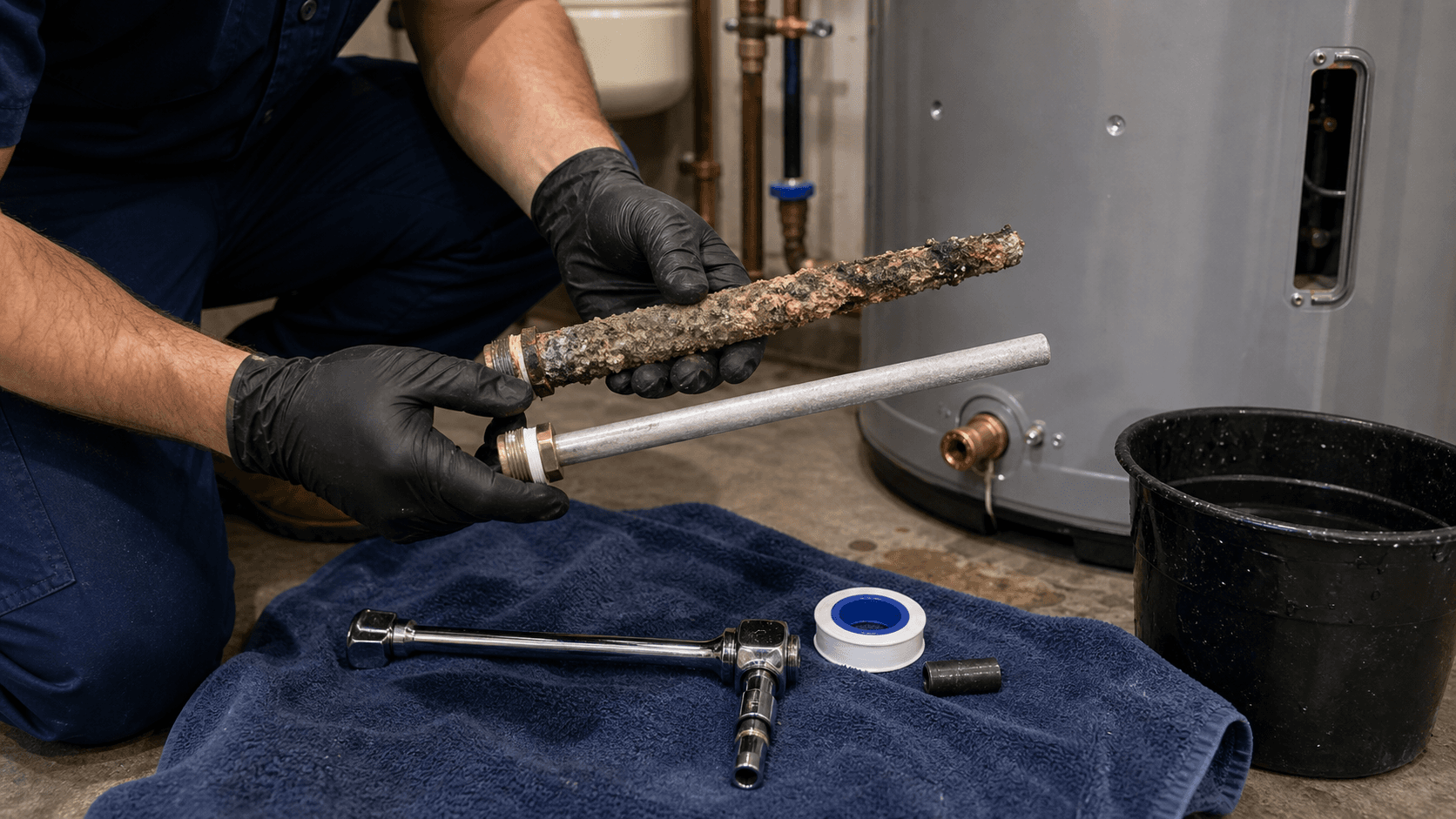
A depleted anode rod leaves the tank itself to become the sacrificial metal.
The 5-year inspection decision — what you're actually looking at
At year 4 or 5 of tank service, unscrew the anode rod and inspect. If less than 25 percent of the original rod diameter remains at any point along its length, or if more than 6 inches of bare core wire is exposed, replace the rod. If the rod is intact with 75 percent or more diameter remaining, reinstall and check again in 2 years.
What a healthy rod looks like. Solid metal cylinder, original diameter (typically 3/4 inch) maintained along most of its length. Some surface oxidation is normal and not a problem. The threaded fitting at the top remains intact.
What a consumed rod looks like. The metal is thinned, often to a fraction of original diameter. The bare steel core wire (visible as a 1/4-inch steel wire running through the rod's center) is exposed for 6 inches or more. Pieces of the rod may have broken off entirely. In the worst cases, only the threaded fitting remains attached, and the rod itself has disintegrated into pieces in the bottom of the tank.
The inspection mechanics. Drain a few gallons from the tank's drain valve to reduce internal pressure. Loosen the anode rod fitting (3/4-inch or larger socket, sometimes requires breaker bar). Unscrew the rod fully. The rod can be 36-50 inches long depending on tank size; you need clearance above the heater to extract it straight up. In tight installations (closets, garages with shelving above), the rod can't be extracted in one piece — that's where a flexible or segmented replacement rod is required.
Reinstallation versus replacement decision. If the rod is healthy and 75 percent original diameter remains, apply pipe-thread sealant to the threads and reinstall. If the rod is significantly consumed, install a new one. New magnesium rods cost $20-$40 at hardware stores; aluminum-zinc rods $25-$50; flexible/segmented rods (for tight installations) $30-$70.
DIY versus professional replacement — and the clearance problem
DIY anode rod replacement costs $20-$70 in materials and takes 60-90 minutes for a homeowner with basic plumbing comfort. Professional replacement runs $200-$500 total, with most jobs landing around $300. The decision usually comes down to clearance above the heater — installations without 36-48 inches of overhead space require flexible or segmented rods and frequently warrant professional installation.
DIY scope. Required tools: socket wrench with appropriate size (typically 1-1/16 inch for standard residential rods), breaker bar for stuck fittings, pipe-thread sealant, replacement rod, drain bucket, garden hose. The procedure: turn off power or gas to the heater, close cold supply shutoff, drain 2-3 gallons via the drain valve, unscrew the old rod, install the new one with thread sealant, refill the tank by opening the cold supply, restore power or gas. Total time: 60-90 minutes for a first-time DIY.
Professional cost breakdown. Parts: $20-$70 depending on rod type. Labor: 30-60 minutes at $150-$250 per hour Seattle area, or flat-rate $200-$400 inclusive. Total: $200-$500 for most installations. Most Bellevue plumbers will perform anode rod replacement as a standalone service call, sometimes bundled with a tank flush at the same visit.
The clearance problem. A standard 36-50 inch anode rod must be extracted in one piece. In a typical garage installation with 24 inches of clearance above the heater, that's not possible — the rod can't be lifted out vertically. Solutions: a flexible rod (segmented into 4-6 sections that articulate, $30-$70) or a powered rod (no extraction needed for replacement since it doesn't consume itself, $200-$400). Both add cost and complexity but solve the access constraint.
When professional installation is the right call. Limited overhead clearance, stuck or seized rod fitting that resists basic socket pressure, homeowner not comfortable with the supply shutoff and drain procedure, or any electric water heater where the breaker isn't clearly labeled (incorrect electrical isolation while working on the tank creates safety risk).
Powered anode rods — when they make sense
Powered impressed-current anode rods make economic sense for Bellevue homeowners planning to keep the same water heater for 10-15+ more years, who have limited overhead clearance making conventional rod replacement difficult, or who are switching from sulfur-smell-prone magnesium without wanting to use aluminum. Total installed cost $400-$700; service life essentially unlimited.
How they work. A powered rod is a titanium rod (not a reactive metal) coated with a special non-sacrificial coating. A small electrical controller (plugs into a standard 120V outlet, draws roughly 2 watts) drives a constant low-voltage current through the rod, providing cathodic protection to the tank without consuming the rod material. The rod doesn't erode; the controller doesn't need maintenance beyond annual visual confirmation that the indicator light is on.
When the economics work. For a water heater under 5 years old that will likely run another 10-15 years, the $400-$700 powered rod installation pays back via a single avoided magnesium rod replacement plus extended tank life. For a water heater approaching 10 years already, a conventional magnesium rod is the better near-term investment because the tank itself may fail from other causes before the powered rod's value is realized.
The smell problem. Some Bellevue homeowners report sulfur smell (rotten egg odor) from hot water — caused by bacteria interacting with magnesium rod corrosion products in low-flow conditions. Switching to aluminum-zinc resolves smell in most cases. Powered rods also resolve smell because they don't release reactive ions into the water at the same rate.
The power-outage caveat. Powered rods need continuous AC power. During an extended outage, the protection lapses — which matters less than it sounds because corrosion is slow, and a 2-3 day outage doesn't materially shorten tank life. For routine PSE windstorm outages of a few hours to 1-2 days, the protection gap is negligible.
Signs your anode rod is gone (even without inspecting)
Three signals strongly suggest the anode rod is consumed: sulfur or rotten-egg smell in hot water, visible rust in hot water (especially during high-flow events), and active leakage from the bottom of the tank. The first is partially recoverable; the second is late-stage; the third is terminal.
Sulfur smell in hot water. The rotten-egg odor comes from hydrogen sulfide gas formed by bacterial interaction with magnesium corrosion products. It indicates active rod consumption combined with bacterial activity, often in installations with low flow patterns (vacation homes, infrequently-used guest bathrooms). The fix: replace the magnesium rod with aluminum-zinc, or install a powered rod. After replacement, flush the tank thoroughly and run hot water for 10-15 minutes at multiple fixtures to clear the existing hydrogen sulfide.
Rust in hot water. Once the anode rod is fully consumed and tank corrosion begins, iron oxide (rust) particles appear in hot water. Initially visible only at high-flow events (first morning shower, immediately after a tank drain), then becoming more persistent as corrosion progresses. By this stage, the tank is corroding from the inside and replacement is typically 6-18 months away. Replacing the rod at this point doesn't reverse the tank corrosion but may slow it.
Active tank leakage. Water visible on the floor around the water heater, with no obvious source from fittings or the drain valve, indicates the tank itself has perforated. This is terminal — there is no fix short of full water heater replacement. Active leakage warrants immediate shutoff (close the cold supply, turn off gas or power) and water heater replacement scheduling. The full emergency response framework is in our where every shutoff valve is in a Bellevue home guide.
What to inspect proactively. The drain pan beneath the tank should remain dry — any standing water in the pan is a signal even if the cause isn't yet obvious. Annual visual inspection of fittings, supply lines, the relief valve discharge tube, and the area around the tank base catches early signs that won't show up as visible leakage for months.
The annual maintenance routine that pairs with anode rod inspection
Anode rod inspection pairs naturally with two other annual maintenance items: sediment flush from the tank's drain valve, and temperature-pressure relief (T&P) valve test. The combined annual visit takes a homeowner 30-45 minutes and prevents most water heater failures unrelated to tank end-of-life corrosion.
Annual water heater maintenance routine for Bellevue homes:
Visual inspection of tank exterior — look for rust streaks below fittings, moisture in the drain pan, corrosion around the cold supply fitting
Sediment flush — drain 2-3 gallons via the drain valve into a bucket, observe water clarity (clear is good, brown/cloudy indicates sediment buildup requiring full flush)
Full tank flush every 2-3 years for Bellevue municipal water (more often if visible sediment) — turn off heat source, close cold supply, drain tank fully via the drain valve and a garden hose to a floor drain or outside
Temperature-pressure relief (T&P) valve test — lift the test lever briefly, confirm water discharges through the relief tube and stops when released. A T&P valve that doesn't actuate or doesn't stop should be replaced
Anode rod inspection — year 4-5 first inspection; replace when consumed
Confirm seismic strapping is intact (required in WA per WAC 51-56) and the unit is plumb
Total annual time investment: 30-45 minutes for homeowner inspection routine; 90-120 minutes for the every-2-3-year full tank flush. The annual routine is well within DIY scope for any homeowner comfortable with basic tank operation. The anode rod inspection at year 4-5 is the highest-leverage single item — it's also the one most homeowners skip, because nothing visible suggests action is needed until the tank starts failing.
When the anode rod conversation isn't worth having
Three scenarios make anode rod replacement uneconomic: water heater is already past 10 years (tank corrosion is likely advanced; replacement makes more sense than rod-led extension), water heater shows signs of active failure (rust in water, drain pan moisture), or planned replacement within 24 months for reasons unrelated to age (remodel, fuel-type change, capacity upgrade).
The aging-tank scenario. A 12-year-old gas tank water heater that's been on its original anode rod the whole time has exhausted the rod years ago. Tank corrosion is already in progress. Replacing the rod now doesn't reverse the corrosion — at best it slows the remaining timeline by 1-2 years. The economically rational call is planning the replacement (gas tank replacement runs $1,700-$3,200 installed in Bellevue) rather than buying 1-2 more years with a $300 anode rod investment.
The active-failure scenario. Rust in hot water, drain pan moisture, audible popping or banging during heating cycles (severe sediment), or any sign of tank perforation moves the decision from 'maintain' to 'replace.' Anode rod work at this stage is throwing money at a problem the rod can't fix.
The planned-replacement scenario. Homeowner is planning a kitchen remodel that includes water heater relocation, or upgrading from electric to heat pump, or moving from tank to tankless. Any of these means the current unit is on a known replacement timeline. Anode rod investment between now and the planned replacement makes sense only if the tank is young (under 5 years) and the replacement is 18-24 months away.
The break-even rule of thumb. Anode rod replacement is worth doing when (a) the tank is under 8 years old, and (b) the homeowner plans to keep the same water heater for 5+ more years, and (c) the tank shows no signs of active failure. Outside those conditions, the math gets shaky.
Sources
Every fact in this guide cites a verifiable public source. If you find a number we got wrong, email dispatch@bellevueplumberpro.com.
Anode rod replacement in Bellevue water heaters — questions homeowners ask
QUESTION01
What does a water heater anode rod do?
The anode rod is a sacrificial metal cylinder threaded into the top of the tank. It corrodes preferentially to the tank's steel walls — galvanic action attacks the rod first, which is why replacing it extends tank life.
QUESTION02
How often should an anode rod be replaced in Bellevue?
Inspect at year 4 or 5 of tank service. Replace when less than 25 percent of the original rod diameter remains at any point, or when more than 6 inches of bare core wire is exposed. Bellevue's soft water (1.50 grains per gallon, pH 7.5–8.2) actually drives more aggressive galvanic action, wearing magnesium rods faster.
QUESTION03
Magnesium, aluminum, or powered anode rod — which is best?
Magnesium performs best in soft water but consumes itself fastest. Aluminum rods last longer (5–8 years in hard water) but protect less. Powered (impressed-current) anodes don't consume at all — the premium option.