Why is my water heater making a popping noise?
Popping and rumbling come from water trapped beneath a layer of mineral sediment flashing to steam and bursting through it. The fix is a tank flush.

A noisy water heater is reading out its condition. Popping and rumbling mean mineral sediment at the tank bottom, where trapped water flashes to steam and bursts through the layer — the fix is flushing the tank and checking the anode rod. Ticking is thermal expansion of the connected pipes, and a screech is water forced through a partly closed valve. Most water-heater noise is a maintenance signal rather than an emergency, but the sediment behind the most common sounds overheats the steel and quietly shortens tank life, so it pays to act on it. This guide maps each sound to its cause, gives the annual flush procedure step by step, covers the anode-rod inspection that goes with it, and explains why soft Eastside water keeps a once-a-year flush sufficient where hard-water regions need two.
Last reviewed: 2026-06-04
A water heater makes noise from three sources: mineral sediment, which causes popping and rumbling; thermal expansion, which causes ticking; and a restricted valve, which causes a screech.
The sound itself is the diagnosis, so the first job is to listen carefully and name it. Popping, crackling, and a deep churning rumble all come from sediment at the bottom of the tank interacting with the heat source, and these are by far the most common complaints. Ticking is a light, intermittent click that tracks the heating cycle, and a screech or whistle is a steady high-pitched sound while water is flowing — both mechanical and usually benign.
Matching the sound to its source separates the noises that demand maintenance from the ones that are merely cosmetic. Sediment noise is a signal that buildup has reached the point of trapping water against the heat source and is worth acting on, while ticking and a faint screech are the tank and its plumbing behaving normally under thermal and flow stress. Confusing the two leads either to ignoring a real maintenance need or to chasing a phantom problem on a healthy unit.
It also helps to know when the noise occurs. Popping and rumbling rise during and just after a heating cycle, when the burner or lower element is driving steam through the sediment; ticking follows the same cycle but is mechanical expansion rather than steam; a screech appears whenever water is drawn, tied to flow rather than heat. Pairing the kind of sound with its timing nails the cause before any tool comes out.
This happening in your home right now? A licensed plumber can talk you through the next step on the phone — 24/7, and the call is free.
Call a plumberPopping and rumbling come from water trapped beneath a layer of mineral sediment flashing to steam and bursting through it.
The mechanism is steam escaping through a sediment layer. As calcium and magnesium and fine debris settle to the bottom of the tank, they form a porous crust over the heat source; water seeps under and into that layer, and when the burner or lower element fires, the trapped water superheats and flashes to steam that bursts up through the sediment — the popping is those steam bubbles breaking through, much like corn kernels popping. The heavier the layer, the more violent the effect, which is why advanced buildup reads as a deep, continuous rumble rather than discrete pops.
That same sediment layer does quiet damage beyond the noise. By sitting between the heat source and the water, it insulates the water and forces the burner or element to run longer and hotter to deliver the same temperature, which both cuts efficiency and overheats the steel of the tank floor above the layer. Steel that is repeatedly overheated this way fatigues and corrodes faster, so a tank left to rumble for years is being aged prematurely by the very buildup making the sound.
The progression of the sound is a rough gauge of severity. Occasional faint popping after a long draw is early sediment that an annual flush easily clears; a heavy, churning rumble on every heating cycle means the layer is thick and the flush should not wait. In an original 1960s–80s Eastside tank that has never been flushed, decades of accumulation can be advanced enough that the noise is signaling the tank is near the end of its serviceable life rather than simply due for maintenance.
Because soft Eastside water deposits sediment slowly, a Bellevue tank that has reached heavy-rumble territory has usually gone many years without a flush — the sound is as much a maintenance-history readout as a hardness readout. The fix in every case is the same: drain the accumulated sediment out of the tank and keep up an annual flush so it never rebuilds to the rumbling stage again.
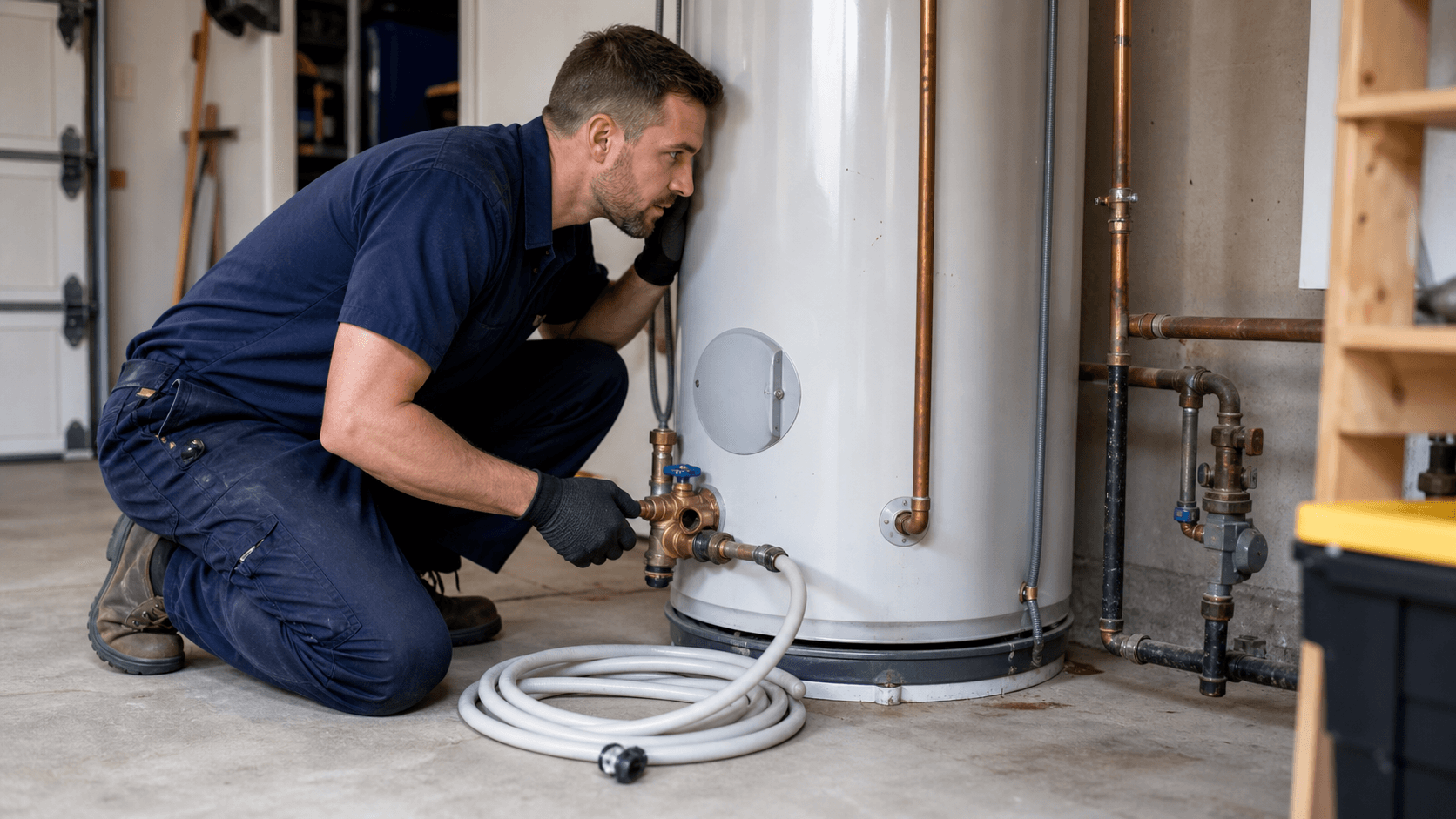
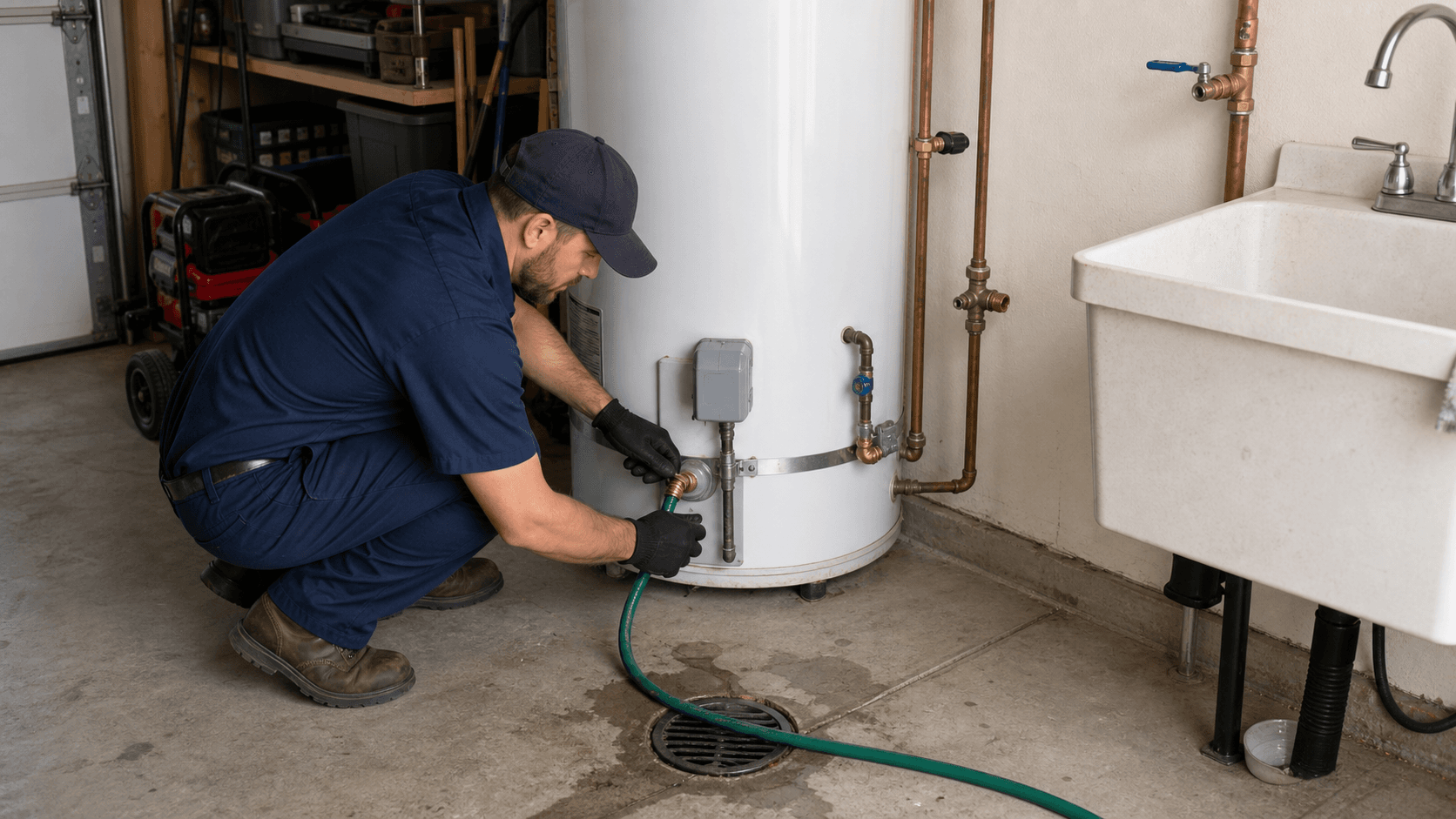
Shut off the heat source, close the cold inlet, connect a hose to the drain valve, open a hot tap, and drain the tank until the water runs clear — then refill before restoring power or gas.
Start by shutting off the heat source so the tank cannot fire on an empty or partly empty tank: switch off the breaker on an electric unit, or set the gas control to pilot or off on a gas unit. Close the cold-water inlet valve at the top of the tank to stop the refill, then let the water cool somewhat if it has been running hot, since you will be handling near-scalding water otherwise. These shutoffs in order are what make the flush safe rather than just effective.
Connect a garden hose to the drain valve at the base of the tank and run it to a floor drain or outside to lower ground, then open a hot-water tap somewhere in the house to break the vacuum so the tank drains freely. Open the drain valve and let the tank empty, watching the discharge: it runs cloudy and gritty at first and should be drained until it runs clear. Briefly reopening the cold inlet a few times to stir and rinse the remaining sediment off the tank floor helps carry out the stubborn settled layer.
Once the water runs clear, close the drain valve, remove the hose, close the hot tap you opened, and reopen the cold inlet to refill the tank completely — confirm a full tank by running a hot tap until water flows steadily and air stops sputtering. Only then restore the heat source by switching the breaker back on or returning the gas control to its run setting, because energizing an element or burner in a tank that is not full can burn out the element or damage the unit. Flush at least once a year on the Eastside.
The frequency is where the local angle pays off: hard-water regions need to flush twice a year to stay ahead of rapid mineral deposition, but soft Cedar- and Tolt-sourced Eastside water keeps a single annual flush sufficient — a genuine maintenance saving for Bellevue owners. While the tank is drained is the ideal time to inspect the sacrificial anode rod, which should be checked every 3 to 5 years; a depleted rod lets corrosion compound the sediment problem and is the single biggest lever on tank life. Our anode rod replacement in Bellevue guide covers that step in detail, and the local water chemistry behind the slow-sediment advantage is in Eastside water hardness.
An anode rod is a sacrificial metal rod that corrodes in place of the steel tank to protect it from rust, and it should be inspected every 3 to 5 years and replaced when it is heavily worn.
The anode rod is a length of metal threaded into the top of the tank whose entire purpose is to corrode instead of the steel. Because the rod is more reactive than the tank's steel, the corrosive electrochemistry attacks the rod preferentially and the tank wall stays intact — sacrificial protection that is the reason a steel tank full of hot water for a decade does not simply rust through. It is also the single biggest lever on how long a tank lasts, which is why it belongs in the same conversation as the sediment that drives the popping and rumbling.
Inspect the rod every 3 to 5 years and replace it when it is heavily worn, before it is fully consumed. The job pairs naturally with the annual flush: while the tank is already drained for the flush, the rod can be pulled from the top and checked, folding the two highest-impact maintenance tasks into one session. Catching a worn rod and swapping it for the cost of a part adds years to a tank, where letting it run out hands the corrosion straight to the bare steel — a depleted rod left unreplaced is the hidden first failure behind many tanks that later leak from the bottom.
The anode and the sediment work together against the tank, which is why the noise and the rod are linked. Sediment overheats and stresses the steel floor while a depleted rod removes the corrosion protection, and the two compounding is what ages an unmaintained tank prematurely. Our anode rod replacement in Bellevue guide walks through how to check and change the rod, and how long water heaters last puts the rod in the full lifespan picture. If the rod has seized in place and resists removal, that is a job for water heater repair and installation in Bellevue.
Ticking comes from the connected pipes and fittings expanding as hot water moves through them, and a screech comes from water forced through a partly closed valve.
Ticking is thermal expansion, not a tank fault. As hot water moves into and through the supply pipes, fittings, and any pipe straps or hangers near the heater, the metal expands and rubs or clicks against its supports and against the framing it passes through. The sound tracks the heating cycle because that is when the hot water is moving, and it stops once temperatures equalize. It indicates nothing about the condition of the tank and needs no repair, though insulating or cushioning a noisy pipe run can quiet it if it is bothersome.
A screech or whistle is a flow noise from a restriction. When water is forced through a partly closed valve — most often the cold inlet valve or a supply shutoff that was never fully reopened after service — the constriction makes the water hiss or screech as it passes. The fix is simply tracing the sound to the partly closed valve and opening it fully, which restores flow and silences the noise. A persistent screech is worth following up because the same restriction can also reduce hot-water delivery to the house.
The contrast with sediment noise is what makes this section diagnostic rather than reassuring. Neither ticking nor a faint flow screech says anything about the tank's health, while persistent popping or rumbling is the one sound that signals buildup and a needed flush. Sorting the benign mechanical sounds from the sediment signal keeps a homeowner from either over-reacting to harmless expansion clicks or under-reacting to a rumble that is quietly shortening the tank's life.
A popping or rumbling water heater is not an immediate hazard, but the underlying sediment overheats the tank and shortens its life, so address it before it forces an early replacement.
The noise itself is not an emergency — a popping tank is not about to fail catastrophically — but the sediment causing it is steadily overheating the steel and eroding both efficiency and service life, so it is a maintenance signal to act on rather than tune out. The cost-effective move is to flush before the buildup advances to the rumbling stage, when it has already done years of accelerated wear. Catching it early is the difference between a free annual flush and an early replacement.
An annual flush is squarely a homeowner task, and so is a routine anode-rod check on an accessible unit. A service visit is warranted when the anode rod has seized in place and resists removal, when a heavy rumble signals sediment so advanced that flushing alone may not recover the tank, or when the noise comes with other end-of-life symptoms like a bottom leak. Those cases are where a professional can both clear the buildup and assess whether the tank is worth keeping.
When decades of buildup in an original 1960s–80s Eastside tank have already caused tank damage, the decision shifts from maintenance to repair-or-replace. At that point, compare the cost and uncertain payoff of a deep flush against a full replacement — about $1,700 to $2,500 installed on the Eastside, with a Bellevue plumbing permit required — through water heater repair and installation in Bellevue. Our how long water heaters last guide frames that decision by tank age, and water heater leaking from the bottom helps tell a recoverable tank from a failed one.
Yes, soft Bellevue water reduces sediment buildup — and because it accumulates so slowly, a single annual flush is enough to keep an Eastside tank quiet where hard-water regions need to flush twice a year.
Yes — soft water reduces sediment. Sediment is the mineral and debris that settles to the tank floor and causes the popping and rumbling, and it forms from the dissolved calcium and magnesium in the supply. Bellevue's Cedar- and Tolt-sourced water is soft and carries far less of those minerals than hard-water supplies, so the sediment layer that drives the noise builds up much more slowly here. The practical payoff is the flush interval: hard-water regions need to flush twice a year to stay ahead of rapid deposition, but a single annual flush keeps a soft-water Eastside tank from ever reaching the heavy-rumble stage. Soft water reduces the buildup but does not eliminate it — even soft water deposits some sediment over years, so the annual flush is the maintenance that actually keeps it in check, and the local water chemistry behind the advantage is detailed in our Eastside water hardness guide.
Every fact in this guide cites a verifiable public source. If you find a number we got wrong, email dispatch@bellevueplumberpro.com.
Need help with this in your home? See our Water heater repair and installation in Bellevue page for pricing, our diagnostic process, and how same-day service works across the Eastside.
Related services: Leak Detection and Pipe Repair.
Popping and rumbling come from water trapped beneath a layer of mineral sediment flashing to steam and bursting through it. The fix is a tank flush.
Shut off the heat source, close the cold inlet, connect a hose to the drain valve, open a hot tap, and drain the tank until the water runs clear — then refill before restoring power or gas.
Three sources: mineral sediment causes popping and rumbling, thermal expansion causes ticking, and a restricted valve causes a screech. Each points to a different fix.