Home/Learn/Water heaters/Heat pump water heaters in Bellevue: cost, install, and Eastside fit
Water heaters
Heat pump water heaters in Bellevue: cost, install, and Eastside fit
Heat pump water heaters (HPWHs) are the fastest-changing piece of residential plumbing in the Eastside market. The technology moves heat instead of generating it, which makes a 50-gallon HPWH roughly three times more efficient than the standard electric tank it usually replaces. For Bellevue homes with a garage installation, an existing 240V circuit, and a household of two to four people, the math is now compelling enough that the PSE rebate, the upcoming DOE efficiency standard (effective May 2029), and Washington's IRA-funded HARP and HOMES programs all push in the same direction — even though the federal Section 25C tax credit expired December 31, 2025 and no longer applies to new installations. The catch is installation: HPWHs need ambient air, a condensate drain, and floor space that not every basement or utility closet can give them. This guide covers how the technology actually works, what it costs installed in Bellevue in 2026, which incentives currently apply, the sizing math for an Eastside household, and the four scenarios where a heat pump unit is the wrong call.
A heat pump water heater extracts heat from the surrounding air, concentrates it through a refrigerant cycle, and transfers it to water inside an insulated tank — using roughly one third the electricity of a standard electric resistance tank for the same gallons of hot water.
The technology is the same refrigerant cycle used in a refrigerator and a central heat pump, run in reverse. A small compressor (typically 1.0-1.5 amps in heat-pump-only mode) drives a refrigerant through an evaporator coil that absorbs heat from the room air. The refrigerant is then compressed and run through a condenser coil wrapped around the storage tank, transferring the heat into the water. The cooled, dehumidified air is exhausted back into the room.
Because the unit is moving existing heat rather than generating new heat with resistance elements, the energy efficiency is dramatic. A standard 50-gallon electric resistance tank has a Uniform Energy Factor (UEF) of around 0.92. ENERGY STAR certifies heat pump water heaters at a minimum UEF of 2.0; certified units typically deliver UEF in the 3.3 to 4.1 range depending on tank size and model. In plain terms: the same amount of hot water for roughly one third of the electricity, sometimes less.
Most modern HPWHs are hybrid units. They include conventional 4,500-watt resistance elements that activate when demand exceeds what the heat pump can deliver alone, when ambient air is too cold for efficient heat-pump operation, or when the user selects an electric-only mode for a recovery emergency. Day to day in heat-pump mode, the resistance elements are dormant, which is where the efficiency gain lives.
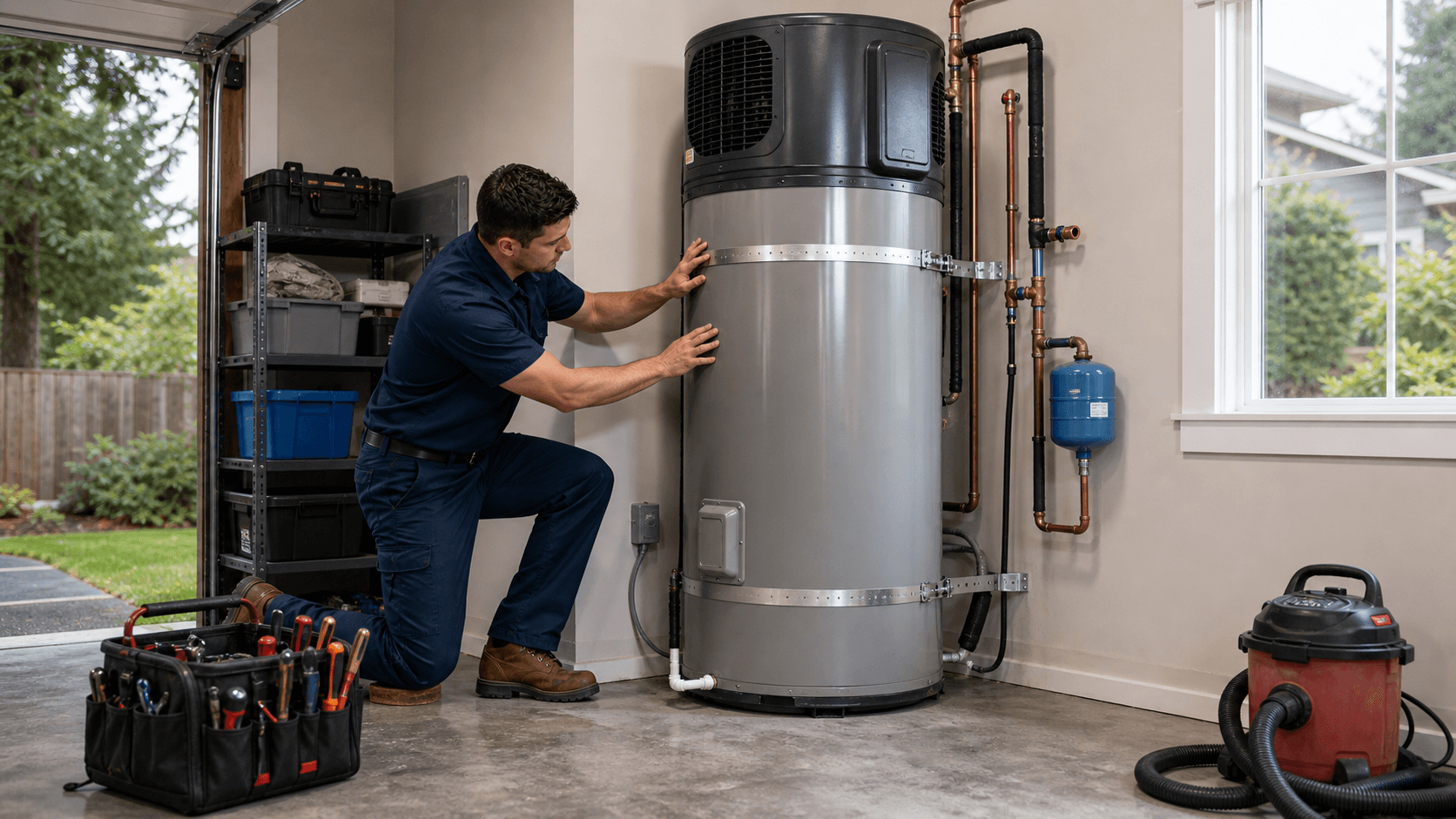
Heat pump water heaters need space, air volume, condensate handling, and proper seismic support.
This happening in your home right now? A licensed plumber can talk you through the next step on the phone — 24/7, and the call is free.
Three Bellevue-specific factors stack in favor of HPWHs: the marine climate keeps garage and basement ambient temperatures within the unit's efficient operating range most of the year, the city's water is soft enough that scaling on the tank is minor, and Puget Sound Energy's electric grid mix makes the carbon-per-gallon-of-hot-water lower than most US markets.
Climate. Bellevue sits in IECC Climate Zone 4C (Marine), where winter outdoor lows rarely drop below the mid-20s°F for sustained periods and indoor garage temperatures typically stay between 40°F and 65°F year-round. Most current ENERGY STAR HPWHs operate efficiently in ambient air down to 37-45°F (manufacturer-specific) and fall back to resistance heating below that threshold. In a Bellevue garage, the heat pump runs nearly all the time except for the coldest weeks of the year — which is the opposite of homes in Minneapolis or Buffalo, where the resistance elements pick up half the load every winter.
Water hardness. As covered in our Bellevue and Eastside hard water guide, municipal water from Bellevue Utilities runs around 1.50 grains per gallon — genuinely soft by Water Quality Association standards. Scale buildup on the heat exchanger and inside the tank is correspondingly slow. Anodes still need to be inspected and the tank still needs to be flushed annually, but Bellevue customers do not experience the rapid heat-exchanger fouling that plagues HPWH owners in well-water suburbs east of the Cascades or in hard-water markets like Phoenix and Las Vegas.
Grid mix. Puget Sound Energy's electricity supply is roughly 36% hydro, 26% renewable plus other non-emitting, and the balance from gas and other sources, per PSE's published fuel mix disclosures. A kWh of PSE electricity carries materially less embodied carbon than the US average, which means the efficiency gain from electrifying your water heating actually shows up in your household's emissions ledger. The economics still need to pencil at the meter, but the broader environmental case is real here in a way that it is not in coal-heavy grids.
What it costs installed in Bellevue in 2026
Expect $3,500 to $6,500 installed for a like-for-like replacement of an existing electric tank, and $4,500 to $8,500 if the install requires panel work, condensate drain routing, or relocation from a closet to a garage.
Equipment cost. Quality 50-65 gallon hybrid HPWHs from Rheem, A. O. Smith, Bradford White, and State range from roughly $1,800 to $3,800 at distributor pricing in 2026. Bigger 80-gallon units run $2,500 to $4,500. Internet retail listings can look lower, but most warranties require professional installation by a licensed contractor — homeowner-installed units routinely lose the longer parts-and-tank warranty.
Installation labor in the Seattle area runs $1,500 to $3,000 for a clean swap, depending on whether the existing electrical, drain, and venting can be reused. The full breakdown looks like this for a typical Bellevue garage swap:
Typical line items for a Bellevue HPWH install:
Equipment (50-65 gal ENERGY STAR HPWH): $1,800-$3,800
Electrical work if breaker or wiring needs upgrading: $300-$1,200
City of Bellevue plumbing permit: approximately $90 to $200 (verify current fee via the Bellevue Permit Fee Estimator)
Inspection coordination and follow-up trip: $0 (included with permitted job)
Cost factors that drive the high end. Moving the heater from an interior utility closet to a garage adds $400-$1,200 in line-extension cost (water, drain, gas-decommissioning if replacing a gas unit). Adding a dedicated 240V circuit from the panel for a previously gas-fueled water heater adds $400-$1,500. Routing a condensate drain through a finished basement to a usable drain point can be the most expensive surprise of all — $300-$900 in some homes, and occasionally enough to push the customer toward a 50-gallon tankless instead.
Where this lines up with the broader market. Our plumber cost and pricing in Bellevue guide covers the standard rate structure for any plumbing job in the Eastside; HPWH installs are flat-rate jobs in 2026, not hourly, because the equipment cost dominates and the labor scope is predictable.
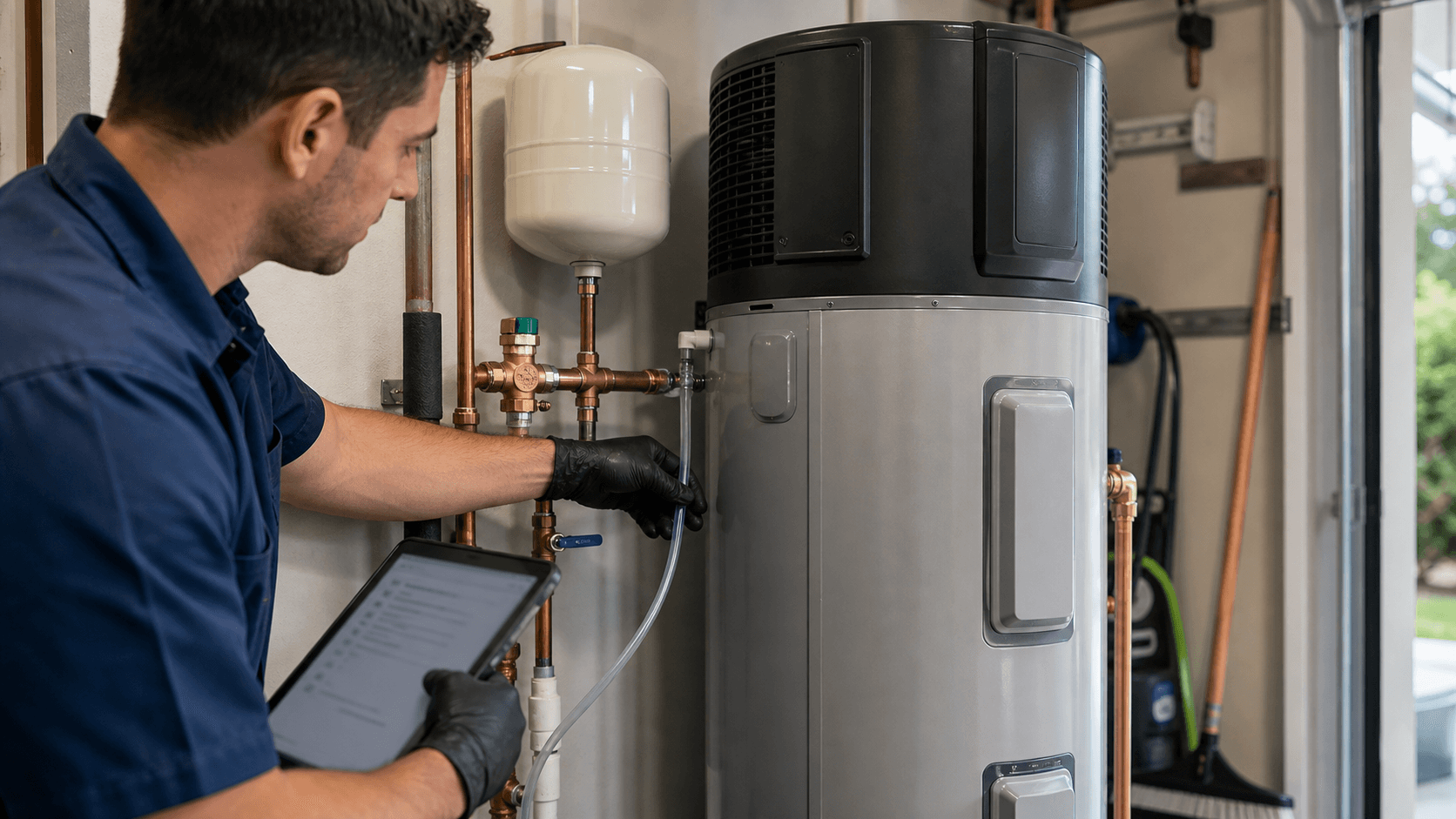
Condensate routing, valves, and clearance details decide whether the installation works well long term.
The three models worth installing — current quotes
The contractor-standard tier: Rheem ProTerra 65-gal (PROPH65) installed $4,200–$4,800; AO Smith Voltex 80-gal (HPTU-80) $4,400–$5,100 — the 80-gal preferred where household demand wants maximum hybrid-mode runtime; Bradford White AeroTherm 65-gal $4,100–$4,700, the quietest of the three on dB rating. All three qualify for the $1,000 PSE rebate.
"The 80-gallon Voltex vs the 65-gallon ProTerra question is really a household-rhythm question," says the water heater lead on our network. "Big back-to-back draws favor the bigger tank in hybrid mode; staggered morning-evening use is fine on the 65."
A same-circuit swap from an existing electric tank keeps the price at the low end of each range; a gas-to-heat-pump conversion adds $1,400–$2,400 for the new circuit, gas cap, and condensate routing. The heat pump water heater service details carry the full install scope.
PSE rebates, the expired federal credit, and Washington's IRA programs
Puget Sound Energy pays a $1,000 rebate (up to $1,100 for income-qualified households) on qualifying ENERGY STAR Tier 3 or Tier 4 heat pump water heaters installed on or after January 1, 2026. The federal Section 25C tax credit for heat pump water heaters expired December 31, 2025, so installations completed in 2026 or later are not eligible for that credit. Washington State's IRA-funded HARP and HOMES programs are in the final DOE approval phase as of mid-2026 and will be administered by Guidehouse when fully launched.
PSE heat pump water heater rebate. Puget Sound Energy pays a $1,000 rebate (up to $1,100 for income-qualified households via PSE Efficiency Boost) on qualifying installations meeting all the following: equipment installed on or after January 1, 2026; the unit is ENERGY STAR Tier 3 or Tier 4; the unit is equipped with a CTA-2045-compliant communications port (commonly branded EcoPort), which is required for new electric storage water heaters sold in Washington under the state plumbing code; the installation replaces an existing electric resistance water heater; the unit is placed in an unconditioned space (garage, unfinished basement, unconditioned utility room) or its exhaust is ducted to the outside; and the rebate application is submitted within 30 days of installation. The rebate is paid to the homeowner after install and proof of purchase — not deducted at point of sale. The PSE program page at pse.com/en/rebates/water-heating/heat-pump-water-heater-rebate has the current qualifying-products list and the application form. Check your specific eligibility with our heat pump water heater rebate finder.
Federal Section 25C status. The Inflation Reduction Act of 2022 set the 25C credit at 30% of qualifying expenditures, capped at $2,000 per year for heat pumps, heat pump water heaters, and biomass stoves. The credit expired on December 31, 2025 for heat pump water heaters. Installations completed on or after January 1, 2026 are not eligible for the 25C credit. Equipment installed during 2025 and placed in service by December 31, 2025 can still be claimed on a 2025 tax return filed in 2026 using IRS Form 5695 — but new 2026 installations cannot. Some published advice still references the credit as if it were active; that advice is out of date.
Washington's IRA Home Energy Rebate programs. The Inflation Reduction Act allocated funding for state-administered home electrification rebates. Washington's implementation is two separate programs: HARP (Home Appliance Rebate Program — point-of-sale rebates on efficient electric equipment for income-eligible consumers) and HOMES (Whole Home Efficiency Rebates — whole-house retrofit rebates). Washington's total allocation is approximately $165 million. As of mid-2026, the programs are in final DOE approval; Guidehouse has been selected as the statewide administrator and is finalizing intake procedures. Eligibility extends to households up to 150% of area median income. While the IRA programs await launch, the separate Washington State HEAR program remains active for some categories — check commerce.wa.gov/energy-incentives for the current status of both.
Stacking. The PSE rebate and the Washington IRA-funded rebates (once launched) can generally be combined. The federal 25C credit is not available for 2026+ installations, so the previous stacking math no longer applies. Have your installer itemize equipment, labor, and electrical work on the invoice so PSE rebate submission is straightforward and the future IRA rebate paperwork (when it opens) has clean line items.
Sizing for a Bellevue household
Match the heater's First Hour Rating (FHR) to your household's peak hot-water hour rather than to nominal tank gallons — most 50-gallon HPWHs deliver an FHR of 60 to 75 gallons in hybrid mode, which covers a household of two to four people comfortably.
First Hour Rating versus tank size. FHR is the gallons of hot water a heater can deliver in the first hour of high demand, starting from a fully heated tank. For HPWHs, the FHR is usually larger than the tank gallons because the resistance elements assist during peak draw. A 50-gallon hybrid with a 67-gallon FHR can support two back-to-back showers, a dishwasher cycle, and a load of laundry over a peak morning hour without running the tank cold. A 65-gallon unit with a 78-gallon FHR comfortably supports four people in the same household.
DOE's residential water heater sizing guidance and the manufacturer FHR specs are more accurate than the old rule of 'tank gallons = household size + 30'. Use the FHR table on the product specification sheet, multiplied by your worst-case morning hour. A standard rule of thumb: one shower equals 12-17 gallons of hot water at typical mix ratios, a clothes washer uses 10-25 gallons depending on the cycle, a dishwasher uses 4-8 gallons.
2-3 people, average usage: 50 gallon HPWH, FHR 65-75
3-4 people: 65 gallon HPWH, FHR 75-85
4-5 people or with deep tubs: 80 gallon HPWH, FHR 85-95
6+ people, multi-bath simultaneous demand: 80 gallon HPWH with mixing valve, or split system
Recovery in heat-pump-only mode. The heat pump alone recovers roughly 8-15 gallons per hour at 90°F temperature rise, depending on ambient air temperature. The resistance elements can recover an additional 20-25 gallons per hour. In practice, a properly sized HPWH will rarely deplete its tank under normal household use — but back-to-back guest demand (Thanksgiving with eight house guests) is exactly when the elements earn their keep.
HPWHs need a minimum room volume for ambient air, a gravity or pumped drain for condensate, a 240V circuit, and clearance for service access — which is why garage installations are easiest and finished-basement installations are sometimes expensive.
Ambient air volume. Manufacturers specify a minimum room volume so the unit has enough warm air to extract heat from. A typical 50-gallon HPWH wants 700-1,000 cubic feet of unconditioned air space — roughly a 10x10x10 room. Smaller spaces require ducting kits that pull warm air from one space and exhaust the cooled air to another, which adds $200-$600 in materials and complicates the install. Closets that work fine for a conventional electric tank often do not work for an HPWH without modification.
Condensate drain. The dehumidification side effect produces about a gallon of condensate per day. The drain must be routed to an existing floor drain, laundry drain, sump pit, or condensate pump. In a Bellevue daylight basement or garage with a floor drain, this is a 20-minute job. In a finished basement with no floor drain, a small condensate pump and a discharge line to a laundry or bathroom drain solves the problem at modest extra cost. The drain pan beneath the tank should be plumbed to the same drain — a code requirement for any tank water heater, but especially important here.
Electrical. Almost all HPWHs are 240V appliances. A like-for-like replacement of an existing electric tank usually reuses the existing 30-amp double-pole breaker and #10 wire. Replacing a gas unit with an HPWH requires running a new 240V circuit, which means panel capacity, breaker space, and a wire run — between $400 and $1,500 in most Bellevue homes depending on distance from panel and whether the run is exposed or fished through walls.
Clearance and service access. Manufacturers specify minimum clearance around the unit for filter service (the air filter on the top needs annual cleaning) and anode-rod access. Tight closet installs that worked for a 24-inch-diameter electric tank may not work for the typical 22-24 inch HPWH because of vertical clearance to the ceiling (HPWHs are taller, often 70-80 inches versus 58-62 for an equivalent electric tank).
Noise, cold air, and where to put it
HPWHs run between 45 and 55 dB at one meter — comparable to a refrigerator or a quiet dishwasher — and they cool the air around them by 4-6°F, which is fine in a garage or utility room but disqualifies most bedrooms, offices, and finished living spaces as install locations.
Noise. The 1.0-1.5 amp compressor and the small fan that moves air across the evaporator coil together produce 45-55 dB of sound at one meter, depending on the model and operating mode. That is roughly the sound level of a household refrigerator. In a garage, mechanical room, or unfinished basement, it disappears into the ambient sound floor. Through an uninsulated wall into an adjacent bedroom, it is audible at night and most homeowners eventually find it irritating. Add R-13 wall insulation and a solid-core door, and the problem usually goes away.
Cold air output. The unit exhausts air that is 4-6°F cooler and noticeably drier than the room air it pulled in. In summer, this is a feature — Bellevue garages get genuinely warm in July and August, and an HPWH gently cools and dehumidifies the space. In winter, it can be a small negative if the install location is a partially conditioned space — you are pulling some heat out of the house envelope. In an unconditioned garage, this is a wash. In an attached, partially heated basement, the heat extraction is real and counts against the system's net household efficiency by a small margin.
Best install locations in a Bellevue home, ranked. Detached or attached unfinished garage — easiest, no penalties. Unfinished basement with floor drain — close second. Utility room with louvered door and 500+ cubic feet — workable. Interior closet with ducting kit — possible but adds cost and noise complaints. Interior closet without ducting — wrong call, choose a different technology.
Heat pump versus tank versus tankless — the actual comparison
For a 2-4 person Bellevue household with a garage install, a heat pump unit beats both standard electric tanks (on operating cost) and tankless units (on installation cost and complexity) in nearly every scenario; the exceptions are high-simultaneous-demand households and homes with no viable install location.
Operating cost over 10 years. The headline efficiency advantage is real. A 50-gallon electric resistance tank uses roughly 3,500-4,500 kWh per year for a household of three at average Bellevue usage. The equivalent ENERGY STAR HPWH uses roughly 1,000-1,400 kWh. At PSE's residential electric rate (verify current rate at billing time — rates change), the operating-cost difference is in the range of $300-$450 per year. Over a 12-15 year unit life, that is $3,500-$6,500 in operating savings before any incentive.
Versus gas tankless. A high-quality gas tankless with adequate gas-line size and venting still has a place in Bellevue — particularly for high-flow homes with multiple simultaneous showers, or remodels where electrical capacity is limited. Our tankless versus storage water heaters comparison covers the head-to-head economics in detail; the short version is that HPWHs have moved past tank electric as the default electric replacement, but tankless gas remains competitive where natural gas service and demand patterns align.
Versus electric tankless. For most Bellevue homes, electric tankless is the wrong choice. The required electrical service (100-200 amps of dedicated capacity for a whole-house unit) typically exceeds what the panel can deliver without an upgrade, and the operating cost is dramatically higher than an HPWH. Electric tankless makes sense only for point-of-use applications — a single sink far from the main water heater, a basement bar — not as a whole-house solution.
Equipment life. ENERGY STAR HPWHs typically come with 10-year limited warranties on both the tank and the heat-pump components, with prorated terms after that. Real-world service life under Bellevue's soft water and mild climate is running 12-15 years in early-cohort installs; the cohort is young enough that long-tail reliability data is still maturing. Anode-rod replacement at the 5-7 year mark and annual filter cleaning are the only meaningful maintenance items.
When a heat pump water heater is the wrong call
Four scenarios disqualify an HPWH: an install location with less than 700 cubic feet of air and no ducting path, a household with high simultaneous-shower demand that exceeds 80 gallon capacity, a homeowner planning to sell within 18-24 months who will not capture the payback, and electrical panel capacity that cannot accommodate a 240V circuit and where a panel upgrade would cost more than $3,000.
No viable install location. If the only place the water heater can go is a small interior closet, on a finished floor, with no path to a drain and no way to duct ambient air, then a tank or tankless unit is the right answer. Trying to force an HPWH into a space that violates the manufacturer's air-volume spec results in poor efficiency, frequent fallback to resistance heating, and a tank that runs cold faster than expected.
Very high simultaneous demand. A six-person household with three teenagers and two bathrooms running simultaneously every morning may exceed even an 80-gallon HPWH's FHR. In those cases, a split system (two HPWHs in parallel, or one HPWH plus a small electric booster) or a high-flow gas tankless is the appropriate engineering answer. This is uncommon — most Bellevue household profiles are well within HPWH range — but it does come up.
Short-term ownership. The HPWH payback period in Bellevue is typically 6-10 years at current rates, including incentives. A homeowner planning to sell within 18-24 months will not capture the operating-cost savings, and HPWHs do not currently carry a meaningful resale premium — appraisers and most buyers do not differentiate between an HPWH and a standard tank during pricing. If the existing tank has 2-3 years of life remaining, the case to upgrade early is weak.
Panel upgrade required. If the home has a 100-amp panel that is already at capacity, adding a 30-amp HPWH circuit may require either a panel upgrade or a load-management device. A full panel upgrade in Bellevue runs $2,500-$4,500. Combined with the heater install, the total can exceed $9,000 — which pushes the payback past 12-15 years and erodes the case. In that scenario, a high-efficiency gas tankless or a standard electric replacement with a plan to upgrade later is often the better near-term move.
Permits, inspections, and the City of Bellevue process
A water heater replacement in Bellevue requires a plumbing permit pulled by a licensed plumber, with a final inspection scheduled through City of Bellevue Development Services — typically a 1-3 day window between install and inspection.
Permit requirement. Water heater replacements — including like-for-like swaps — require a plumbing permit in the City of Bellevue. The permit covers the water connections, the temperature-pressure relief valve and discharge piping, the expansion tank, the seismic strapping, and (for gas-to-electric conversions) the gas-line decommissioning. Permit fees are typically approximately $90 to $200 (verify current fee via the Bellevue Permit Fee Estimator) and the licensed plumber pulls the permit on the homeowner's behalf.
Inspection. A field inspector visits the home after install to verify the work meets the Uniform Plumbing Code and Bellevue amendments — check valves, dielectric unions, drain pan and discharge, seismic straps anchored to studs, T&P discharge terminating outside or to an approved location, condensate routing, and (for HPWHs) the air volume of the install space. Failures are uncommon for permitted installs by licensed plumbers but do happen — most commonly missing seismic straps and improperly terminated T&P discharge lines.
Why this matters. Unpermitted water heater installs are a recurring failure point during real estate transactions. A buyer's inspector flags the missing permit, the buyer's agent requests retroactive permitting before close, and the seller scrambles to schedule a re-inspection of work the original installer did 5 years ago. The approximately $90 to $200 (verify current fee via the Bellevue Permit Fee Estimator) permit fee at install time avoids a 10-day delay and a $400-$800 retroactive permitting cost at sale time. Beyond water heaters, our broader guidance on plumbing permits and inspections in Bellevue covers when permits are required for repairs, replacements, and repipes across the rest of the system.
What to ask your installer
The five questions that separate a competent HPWH installation from a cut-rate one are: ducting requirement for your install location, condensate drain plan, ENERGY STAR Most Efficient certification of the specific model, scheduled-inspection timing with City of Bellevue, and itemized invoice for federal credit and PSE rebate documentation.
Use the installer conversation to verify the fit before you sign. The five questions are not gotchas — they are the conversation a competent installer welcomes because it shortens their estimate-to-install time.
Five questions for an HPWH installer in Bellevue:
What's the cubic footage of my install location, and does this unit need a ducting kit? (Expect a tape measure and a calculation, not a guess.)
Where will condensate drain to, and is a pump required? (Walk to the drain point together; vague answers here cause callbacks.)
Is the specific model on PSE's current qualifying-products list (ENERGY STAR Tier 3 or greater, CTA-2045/EcoPort equipped)? (Required for the $1,000 PSE rebate.)
Who pulls the permit, and what's the typical inspection scheduling window? (You want a permitted job with City of Bellevue, not a handshake.)
Will the invoice be itemized — equipment, labor, electrical, permit — so PSE rebate submission is clean and the future Washington HARP and HOMES rebate paperwork has clean line items? (Bundled invoices cause rebate rejections.)
If the answer to any of these is hedged or impatient, take a second quote. The HPWH category is changing fast and the install cohort that learned on conventional tanks 15 years ago is not always current on the air-volume, condensate, and certification details that matter for both code compliance and incentive paperwork.
Sources
Every fact in this guide cites a verifiable public source. If you find a number we got wrong, email dispatch@bellevueplumberpro.com.
Heat pump water heaters in Bellevue — questions homeowners ask
QUESTION01
How much does a heat pump water heater cost installed in Bellevue?
$3,500 to $6,500 installed for a like-for-like electric-tank replacement, and $4,500 to $8,500 when panel work, condensate routing, or relocation from a closet is needed. The PSE rebate takes $1,000 off qualifying installs.
QUESTION02
What rebates are available for heat pump water heaters in 2026?
Puget Sound Energy pays $1,000 (up to $1,100 income-qualified) on qualifying ENERGY STAR Tier 3 or Tier 4 units. The federal Section 25C tax credit has expired — the utility rebate is now the main stacking benefit, so verify current programs before purchase.
QUESTION03
Where can a heat pump water heater be installed?
Anywhere with enough ambient air volume (garages and utility rooms are easiest), a condensate drain, a 240V circuit, and service clearance. Units run 45–55 dB and cool the surrounding air by 4–6°F — fine for a garage, wrong for bedrooms, offices, or finished living space.
QUESTION04
What size heat pump water heater does a Bellevue household need?
Match the First Hour Rating to your peak hot-water hour, not the tank gallons — most 50-gallon heat pump units deliver a 60–75 gallon FHR in hybrid mode, which comfortably covers a household of two to four.