Why do I have no hot water all of a sudden?
On electric units: a tripped breaker or ECO reset, or a failed upper element. On gas units: pilot out, weak thermocouple, or a gas-valve fault. Sudden total loss is almost always one of these.
No hot water traces to one of four symptom patterns — none at all, hot water that runs out fast, lukewarm water, or hot-then-cold — and each points to a different cause once you split gas from electric. None at all is a power, pilot, or upper-element problem. Runs out fast is sediment, a broken dip tube, or an undersized tank. Lukewarm everywhere is a failed lower element or sediment, and hot-then-cold mid-shower is almost always a broken dip tube. This guide works the full decision tree, gives the homeowner fixes for each branch, and explains why soft Eastside water shifts the likely cause toward the dip tube or an undersized tank rather than the heavy scale that dominates hard-water regions. The goal is to walk in already knowing which part to suspect rather than swapping components in the dark.
Last reviewed: 2026-06-04
Sudden total loss of hot water comes from a tripped breaker or ECO and a failed upper element on electric units, or an out pilot, weak thermocouple, or gas-valve fault on gas units.
A complete and sudden loss of hot water — every tap cold, not just running short — means the heat source has stopped entirely, and the cause splits cleanly by fuel. On an electric unit the heat stops when the dedicated breaker trips, when the emergency cut-off (ECO) trips on an overheat, or when the upper element or its thermostat fails, since the upper stage feeds the part of the tank the household draws from first. Press the red reset on the upper thermostat first — it clears a large share of total-no-hot-water cases — and reset the breaker once if it has tripped.
On a gas unit, a total loss means the burner is no longer firing, and the chain to check runs pilot, thermocouple, gas supply, then gas control valve. A pilot that has gone out, a thermocouple too weak to hold the gas valve open, an interrupted supply, or a failed valve each leave the tank with no heat input while the stored hot water bleeds away over a few hours. Working that order isolates the failed link without parts-swapping, and our water heater not heating guide details each test in full.
Distinguishing a sudden total loss from a gradual decline matters, because the two point at different parts. Total and sudden is a heat-source failure — power, pilot, element, valve — and is the branch this section covers. A tank that still makes hot water but less of it, or hot water that does not last, is a capacity or mixing problem covered in the run-out-fast and lukewarm branches below, and chasing an element on a tank that actually has a dip-tube fault wastes a service call.
This happening in your home right now? A licensed plumber can talk you through the next step on the phone — 24/7, and the call is free.
Call a plumberStart by classifying the symptom — none, runs out fast, lukewarm, or hot-then-cold — then split gas from electric.
The whole diagnosis turns on naming the symptom precisely before touching a part, because each of the four patterns maps to a different cause. None at all is a heat-source failure: on electric, work the breaker, the ECO reset, then the upper element and thermostat; on gas, work the pilot, thermocouple, supply, then valve. This is the branch where a single reset or relight most often restores service.
Some hot water that runs out faster than it used to is a capacity problem with three candidate causes separated by their onset. A broken dip tube produces a sudden change — hot water that was fine last week now lasts minutes. Sediment produces a gradual change — capacity that has crept downward over months or years. An undersized tank produces a chronic struggle that was never quite adequate, often dating to a household growing or a remodel adding a large fixture. The onset pattern alone usually names the cause.
The last two branches are quick to read. Lukewarm everywhere — never properly hot at any tap — points to a failed lower element on an electric unit, since the lower element does most of the heating, or to sediment insulating the heat source from the water. Hot then suddenly cold partway through a single shower points to a broken dip tube letting incoming cold water mix straight into the hot outlet at the top of the tank. Matching the exact symptom to its branch is what turns a vague no-hot-water complaint into a specific part to check.
Run the tree in order and the field of suspects collapses fast. A homeowner who can say which of the four patterns they have — and, for the run-out-fast branch, whether the onset was sudden, gradual, or always-present — has done most of the diagnostic work before any panel comes off. That is also the information a plumber most wants on the phone, because it shortens the visit and points straight at the likely part.
Hot water runs out fast because of sediment buildup, a broken dip tube, or a tank that is undersized for the household.
The dip tube is a long plastic tube that carries incoming cold water from the inlet down to the bottom of the tank, so the burner or lower element reheats it before it reaches the hot outlet at the top. When the dip tube cracks or breaks, cold water dumps in near the top and mixes straight into the outlet, so you draw a brief burst of genuinely hot water and then a rapidly cooling stream. The tell is sudden onset — a tank that delivered a full shower last month and now runs cold in minutes is the dip-tube signature, not slow decline.
Sediment attacks capacity from the opposite direction and on a slower clock. Mineral and debris settle to the bottom of the tank, where the layer both insulates the water from the heat source — forcing longer recovery — and physically occupies volume that would otherwise hold hot water. The result is a tank that holds and reheats less than its rated gallons, declining gradually over months and years rather than overnight. Because the change is slow, households often adapt to it without noticing until showers are routinely short.
An undersized tank is the third cause, and it presents as a chronic shortfall rather than a change. A 40-gallon tank that 'used to be fine' after a household adds people, or after a remodel adds a large rain-shower head or a deep soaking tub, has simply been outpaced by demand that now exceeds its stored volume and recovery rate. Nothing has failed; the tank was sized for a smaller load. The fix is upsizing the tank or moving to a tankless unit that heats on demand, and the trade-offs are in our tankless vs storage water heaters in Bellevue guide; a heat-pump option is weighed in heat pump water heaters in Bellevue.
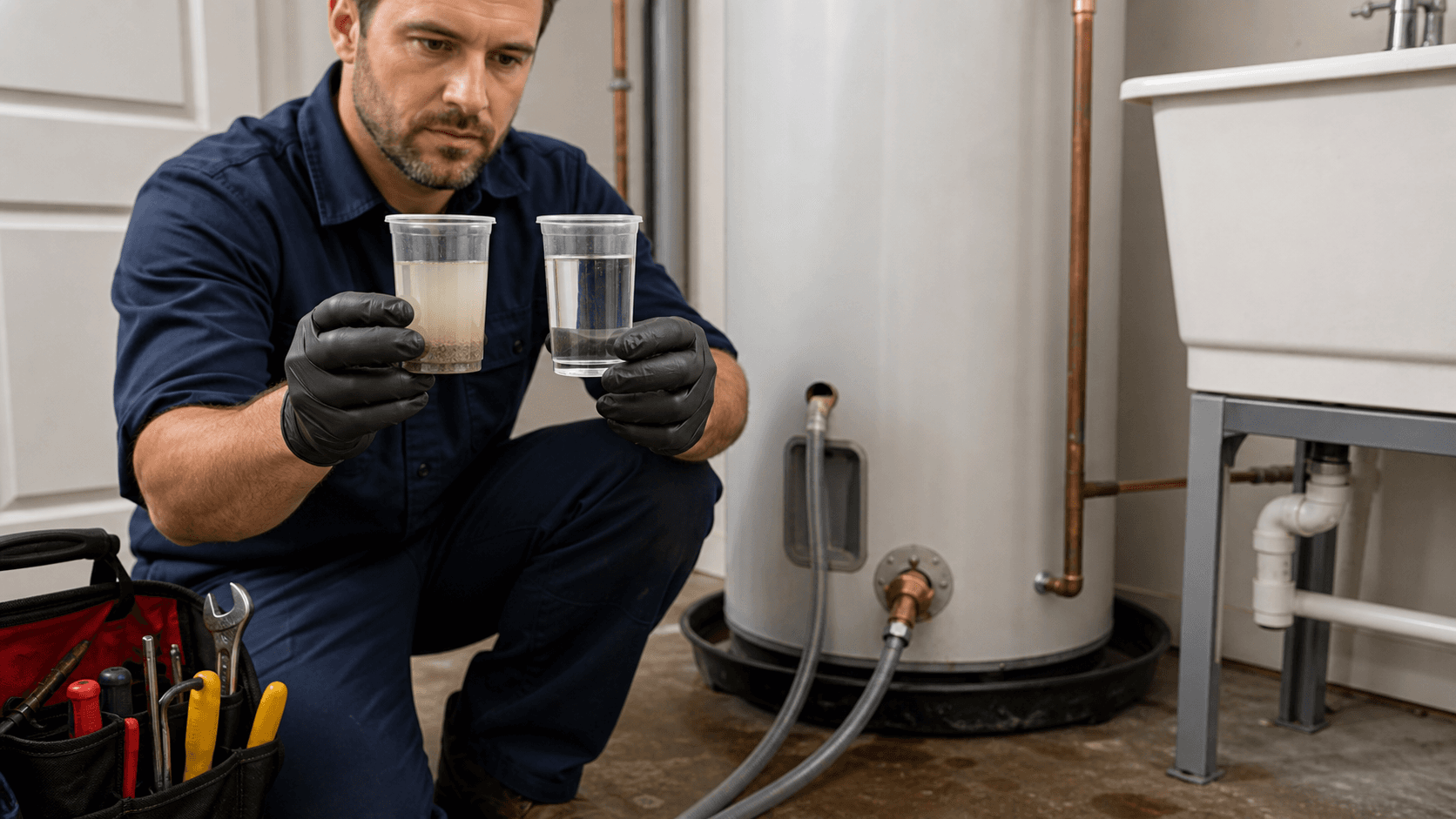
Sediment insulates the burner and eats into tank volume, but soft Eastside water builds it slowly — so a fast-running Bellevue tank usually points to a dip tube or undersizing.
Sediment cuts hot-water supply two ways at once. The settled layer sits between the burner or lower element and the water, insulating the heat source so the tank recovers more slowly between draws, and it occupies physical volume at the base so the tank stores fewer usable gallons of hot water. Together those mean a tank that both runs out faster and refills slower than it did when new, which reads to the household as steadily shorter showers.
The Eastside difference is the rate of accumulation. Bellevue's soft Cedar- and Tolt-sourced water carries far less dissolved calcium and magnesium than hard-water supplies, so sediment builds up more slowly here and a once-a-year flush keeps it in check — a genuine local maintenance saving over the twice-yearly flushing hard-water regions need. Because sediment is the slow-developing cause, a Bellevue tank that suddenly runs cold is statistically more likely to have a broken dip tube or to be simply undersized than to be choked with mineral, which inverts the default troubleshooting advice written for hard-water markets.
Flushing the tank clears the sediment that has accumulated and restores the lost capacity, and our water heater making noise guide covers the full flush procedure step by step. The decision rule for a Bellevue homeowner is onset-driven: gradual decline over years justifies a flush, while hot-then-cold or a sudden change points to the dip tube before scale. The broader local water chemistry behind the slow-sediment advantage is in our Eastside water hardness guide.
A dip tube carries cold inlet water to the tank bottom to reheat; a broken one turns hot water cold partway through one shower — a sudden onset, not a gradual fade.
The dip tube does one job: it routes the cold water entering the tank down to the bottom, so the burner or lower element reheats it before it can reach the hot outlet at the top. Without that routing, cold supply water would short-circuit straight to the outlet. The tube is plastic and runs nearly the full height of the tank from the cold-inlet fitting on top, which is why a crack or a break leaves cold water dumping in near the top of the tank instead of the bottom.
The broken-tube symptom is distinctive: a hot shower that goes cold midstream. When the tube fails, incoming cold water mixes straight into the hot outlet, so you draw a brief burst of genuinely hot water and then a rapidly cooling stream within the same shower. The tell that separates a dip tube from sediment is onset — a dip tube fails suddenly, so a tank that delivered a full shower last week and now runs cold in minutes is the dip-tube signature, where sediment declines slowly over months and years. Hot-then-cold mid-shower is the pattern to watch for.
Replacing the dip tube is a homeowner-reachable job on a powered-down, drained tank: the tube unthreads from the cold-inlet fitting on top of the tank and a new one drops in. Because the failure is sudden rather than a slow decline, a Bellevue tank that abruptly runs cold points to the dip tube before scale — soft Eastside water makes heavy sediment the less likely cause of a sudden change. If the inlet fitting is corroded in place or the diagnosis is unclear, book water heater repair and installation in Bellevue.
A water heater is too small when it runs out during normal use though nothing has failed — a chronic shortfall, not a sudden or gradual change.
Undersizing presents as a chronic struggle, not a change. A tank that 'used to be fine' after the household adds people, or after a remodel adds a large rain-shower head or a deep soaking tub, has simply been outpaced by demand that now exceeds its stored volume and recovery rate. Nothing has broken — the tank was sized for a smaller load and the load grew past it. That onset pattern is what separates undersizing from a dip tube, which fails suddenly, and from sediment, which declines gradually: undersizing is a shortfall that was either always present or began the day demand jumped.
The classic case is a 40-gallon tank meeting spiky simultaneous draws it was never sized for — two showers running while the laundry fills, for instance. A storage tank can only deliver its stored hot water plus what it can reheat in real time, so when several large draws overlap, an undersized tank empties faster than it recovers and everyone downstream gets cold water. Reading the symptom as a sizing problem rather than a failure is what keeps a homeowner from replacing a perfectly good element on a tank that is simply too small.
The fix is a design decision, not a part swap: upsize the storage tank, or move to a tankless unit that heats on demand and never runs out. Each path has trade-offs in upfront cost, gas-line capacity, and capacity behavior, which we lay out in our tankless vs storage water heaters in Bellevue guide; a heat-pump option is weighed in heat pump water heaters in Bellevue. An Eastside replacement or upsize runs about $1,700 to $2,500 installed and is booked through water heater repair and installation in Bellevue.
DIY covers one reset, a breaker check, a tank flush, and a dip-tube replacement; a plumber handles gas diagnosis, recurring ECO trips, and sizing or replacement.
The homeowner-safe fixes track the decision tree. A single ECO reset and a breaker check handle the electric none-at-all branch; a tank flush addresses gradual sediment decline; and a dip-tube replacement — the tube unthreads from the cold-inlet fitting on top of the tank — addresses the sudden hot-then-cold case. Each is a reversible, low-risk job for a confident DIYer working on a powered-down, drained tank.
A plumber takes over for the gas side and for anything the safe checks escalate: gas pilot, thermocouple, and valve diagnosis is regulated gas work; a reset that keeps tripping points to a failed element or thermostat that needs replacing rather than re-arming; and a sizing call — upsize, tankless, or heat-pump — is a design decision rather than a part swap. When the answer is a new or larger unit, book water heater repair and installation in Bellevue; an Eastside replacement runs about $1,700 to $2,500 installed.
Timing matters in the Pacific Northwest. A complete loss of hot water during a winter cold snap, when the house is already hard to keep warm, is worth same-day attention through our 24/7 emergency plumbing line rather than waiting out a multi-day backlog. Catching it the same day also limits the cascade — a cold house and no hot water together turn a routine repair into an urgent one.
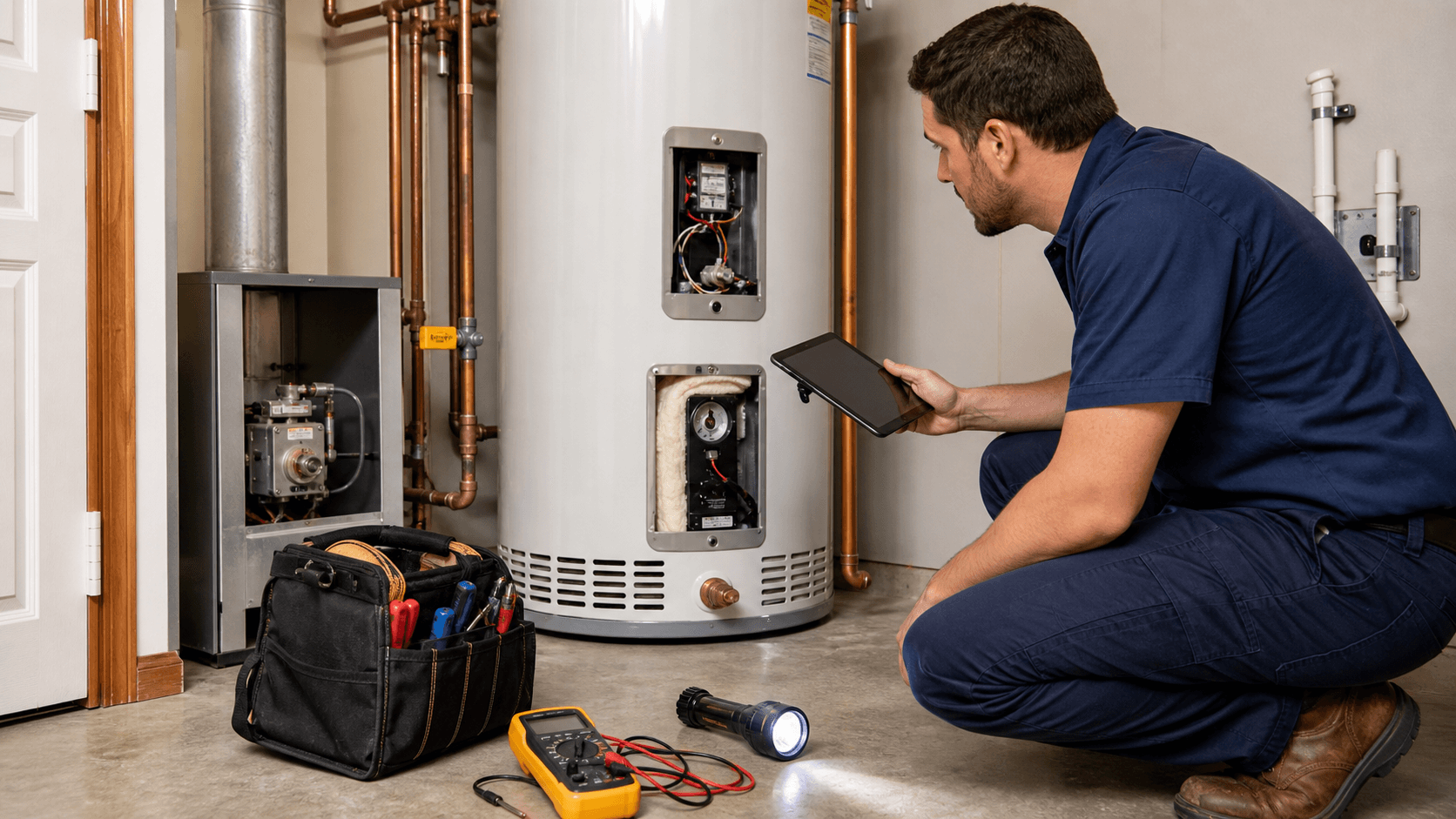
Tell gas from electric by the hardware: a gas unit has a burner, flue, and pilot; an electric unit has a dedicated breaker and side access panels but no flame.
Identify the fuel before chasing a fix, because the failure paths do not overlap. A gas water heater has a standing pilot, a thermocouple, a flue venting combustion gases, and a gas control valve on the front near the base; it loses heat from an out pilot, a weak thermocouple, an interrupted gas supply, or a failed valve. An electric water heater has no flame at all — just a dedicated double-pole breaker at the panel and one or two access panels on the side hiding the elements and thermostats; it loses heat from a tripped breaker, a tripped ECO reset, or a failed element or thermostat. Most wasted no-hot-water calls come from testing the wrong system, like relighting a pilot on a unit that turns out to be electric. The full fuel-specific diagnostic order for each is in our water heater not heating guide.
Every fact in this guide cites a verifiable public source. If you find a number we got wrong, email dispatch@bellevueplumberpro.com.
Need help with this in your home? See our Water heater repair and installation in Bellevue page for pricing, our diagnostic process, and how same-day service works across the Eastside.
Related services: Leak Detection and Pipe Repair.
On electric units: a tripped breaker or ECO reset, or a failed upper element. On gas units: pilot out, weak thermocouple, or a gas-valve fault. Sudden total loss is almost always one of these.
Three causes: sediment buildup, a broken dip tube, or a tank undersized for the household. In Bellevue, soft Eastside water builds sediment slowly — so a fast-running tank usually points to the dip tube or undersizing.
Classify the symptom first — none, runs out fast, lukewarm, or hot-then-cold — then split gas from electric. The symptom class eliminates half the possible causes before you touch a tool.