When should I winterize my plumbing in Bellevue?
October — average overnight lows run 42–48°F, cold enough to confirm winter is coming but warm enough to comfortably do irrigation, hose-bib, and crawlspace work before the first freeze.
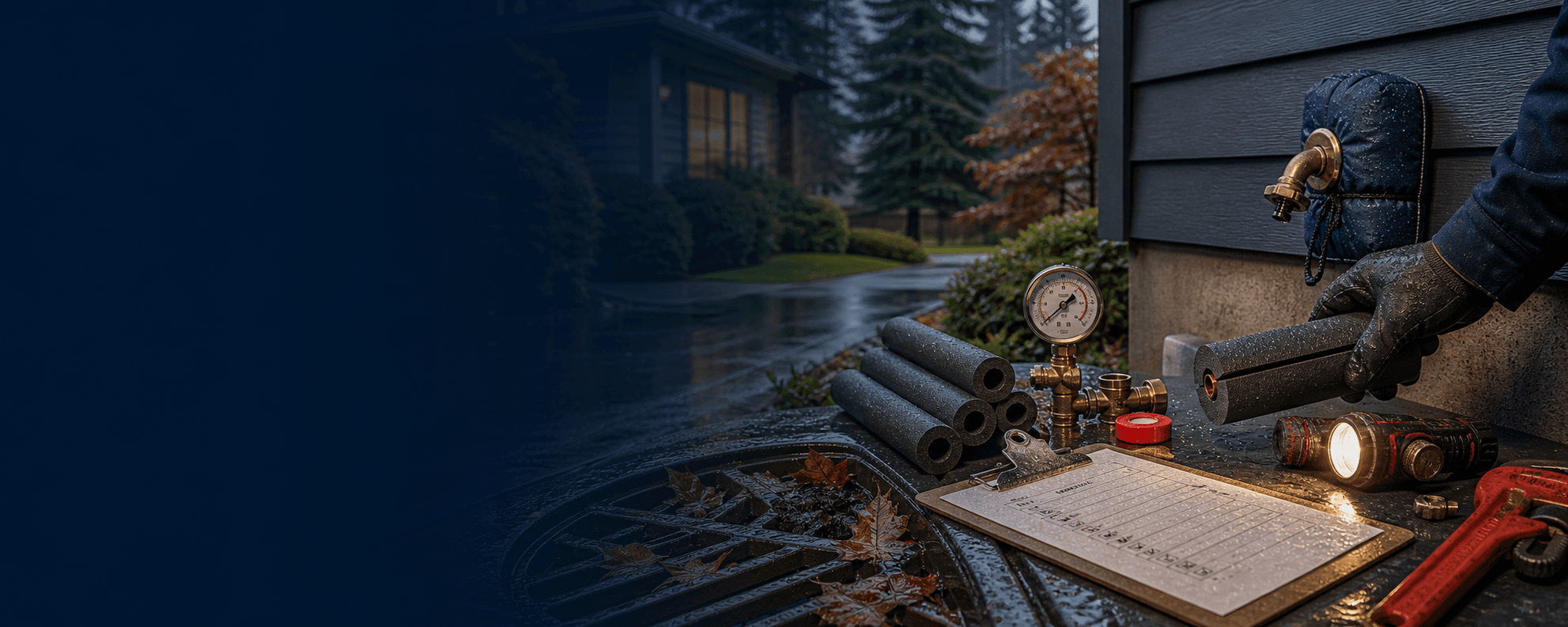
Bellevue winterizing is a mid-October job that takes 3-4 hours of homeowner time and prevents most of the burst-pipe damage that hits Eastside homes during the January and February cold snaps. The Pacific Northwest's mild reputation lulls homeowners into skipping prep — and then a four-day stretch below 25°F causes garage hose bibs to split, irrigation backflow preventers to crack, and crawlspace supply lines to burst at $8,000-$40,000 per loss event. This guide walks the actual October checklist — hose bib disconnect, irrigation blowout, crawlspace vent insulation, pipe-sleeve placement, outdoor shower drain — with the order of operations, the equipment, the realistic DIY scope, and the work that should be hired out to a licensed plumber or irrigation contractor.
Last reviewed: 2026-05-13
October's average overnight lows in Bellevue run 42-48°F — cold enough to confirm winter is coming but warm enough that the irrigation system, outdoor faucets, and crawlspace work are still comfortable to handle. November brings the first frost events and December the first hard freezes; doing prep work in those months means working in the cold, often after damage has already begun.
Bellevue's climate is IECC Climate Zone 4C (Marine). Per NOAA's 1991-2020 Seattle-area climate normals, October average low is 47°F, November average low is 41°F, December average low is 37°F. First freeze events typically arrive in mid to late November, with the deeper cold snaps clustering between mid-December and early February. The hardest freezes — the ones that cause material burst-pipe damage — typically run four to seven consecutive days below 25°F.
The October prep window is approximately September 25 through October 25. Earlier than that, the irrigation system is still being used for late-season watering. Later than that, you're racing the first frost and outdoor work is uncomfortable. Mid-October hits the sweet spot — the irrigation can be drained, the soil is still workable, daylight hours are reasonable, and you're well ahead of the first damage-causing freeze.
Homeowners who skip October prep typically discover the issue in one of two ways. Either a hose bib that wasn't disconnected splits during the first hard freeze and shows up as a wet wall behind the garage, or an irrigation backflow preventer cracks during a freeze and floods the lawn during the spring thaw. Both failure modes are well-documented across PNW insurance carriers and both are preventable with the October checklist.
This happening in your home right now? A licensed plumber can talk you through the next step on the phone — 24/7, and the call is free.
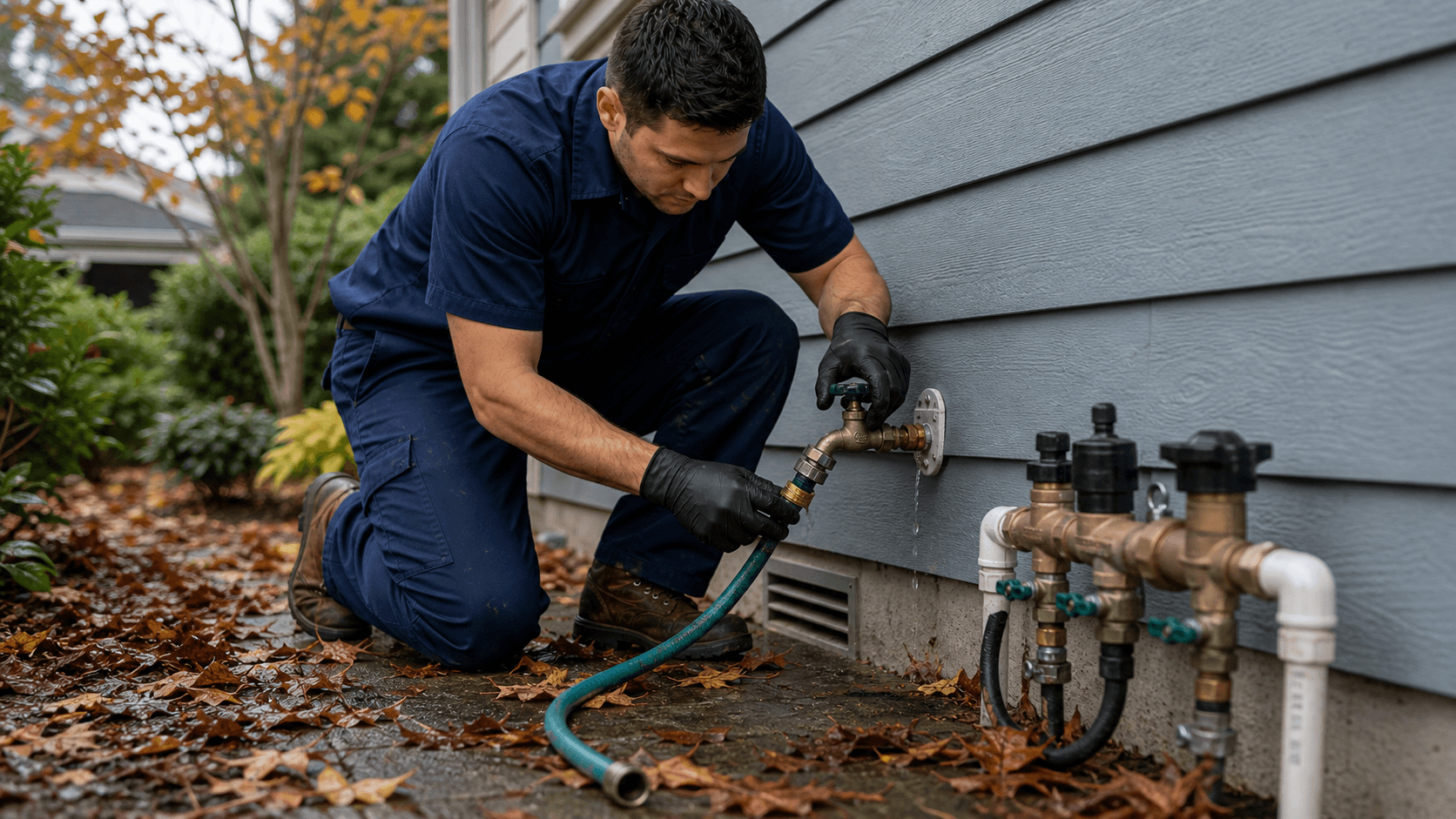
Call a plumberEvery outdoor hose bib in Bellevue needs to be disconnected from its hose, drained, and (where there is one) the interior shutoff closed for the winter. Hose bib burst is the most common single-source freeze failure across PNW homes — and the most preventable.
The failure mode. A garden hose left attached to a hose bib traps water in the spigot's bonnet, the threaded end, and the first few inches behind the wall. When temperatures drop below 25°F, that trapped water freezes and expands by 9 percent. The expansion cracks the spigot itself, the copper or PEX line behind it, or the soldered joint at the back of the spigot. In most Bellevue homes, the crack is behind the wall — invisible — until spring when the homeowner turns on the bib and water sprays into the wall cavity, the garage, or the crawlspace.
Two protective designs exist. A standard hose bib has the valve at the visible spigot — water sits in the entire run from the indoor shutoff to the spigot, freeze-vulnerable at the spigot end. A frost-free hose bib (also called frost-proof, anti-siphon, or sillcock) has the valve 6-12 inches back from the spigot, inside the heated envelope of the house — water in the unheated portion drains out automatically when the valve closes. Most Bellevue homes built before 2000 have standard hose bibs; homes built since 2005-ish generally have frost-free units.
The October process for both types. Step 1: disconnect every garden hose, splitter, sprinkler, and quick-coupler. The garden hose itself is what causes the failure — leaving it connected blocks the drain path even on frost-free units. Step 2: open the spigot momentarily to drain residual water. Step 3 (standard hose bibs only): locate the interior shutoff valve on the supply line — usually in the garage ceiling, basement, or crawlspace within a few feet of where the spigot pipe exits the wall — and close it. Step 4: open the spigot again to drain the trapped water in the now-isolated section. Step 5: leave the spigot open through winter so any condensation has an escape path.
Frost-free bibs do not need an indoor shutoff close because the design handles the freeze prevention automatically. They still need the hose disconnected — that's the universal step. Most burst frost-free bibs in Bellevue are bursts that happened with a hose still attached.
Irrigation system winterization uses 50-100 cubic feet per minute of compressed air at 40-80 PSI to clear residual water from every zone, head, and the backflow preventer — equipment most homeowners don't own and shouldn't buy. The job is $75-$200 from an irrigation contractor and takes 30-60 minutes.
What an irrigation system contains in October. By season's end, every zone valve, every lateral line, every sprinkler head, and the backflow preventer at the supply point hold standing water. The mainline from the meter to the system is usually below the frost line and survives Bellevue freezes intact, but everything downstream is shallow-buried or exposed and will freeze.
The blowout procedure. An irrigation tech connects a high-CFM air compressor (typically a tow-behind unit, 185 CFM, 80 PSI) to the system at the backflow preventer or at the dedicated blowout port. They open each zone in sequence, running air through until only mist comes out the heads, then stop. The whole job is 30-60 minutes for a residential 4-8 zone system.
Why DIY rarely works. The pancake-style and small portable compressors most homeowners own (1-10 CFM) cannot move enough air volume to clear a residential zone — the air just bypasses water in the low spots. Insufficient blowout leaves water in lateral runs, which freezes and cracks the PVC. Owners who attempt DIY blowout with a 6-CFM compressor and discover the cracked laterals in April typically spend $400-$1,200 on spring repairs that the $150 fall blowout would have prevented.
The backflow preventer is the highest-stakes component. The pressure-vacuum breaker (PVB) or reduced-pressure (RP) device on the irrigation supply costs $200-$800 to replace and is mandatory under Washington State cross-connection control rules. A frozen-and-cracked backflow assembly is the single most expensive freeze failure in residential irrigation. Most contractors wrap or insulate the assembly after blowout — confirm yours does, or wrap it yourself with a fitted bag-style cover (~$15-$30 at any hardware store).
Timing. Schedule the blowout for the first or second week of October. Most Bellevue and Eastside irrigation contractors book up by mid-October, and waiting until the first frost event creates an emergency-rate scramble. Our plumber cost and pricing in Bellevue guide covers the broader rate landscape; irrigation winterization sits at the low end ($75-$200) compared to actual plumbing work because the scope is predictable and the equipment is the contractor's bottleneck.
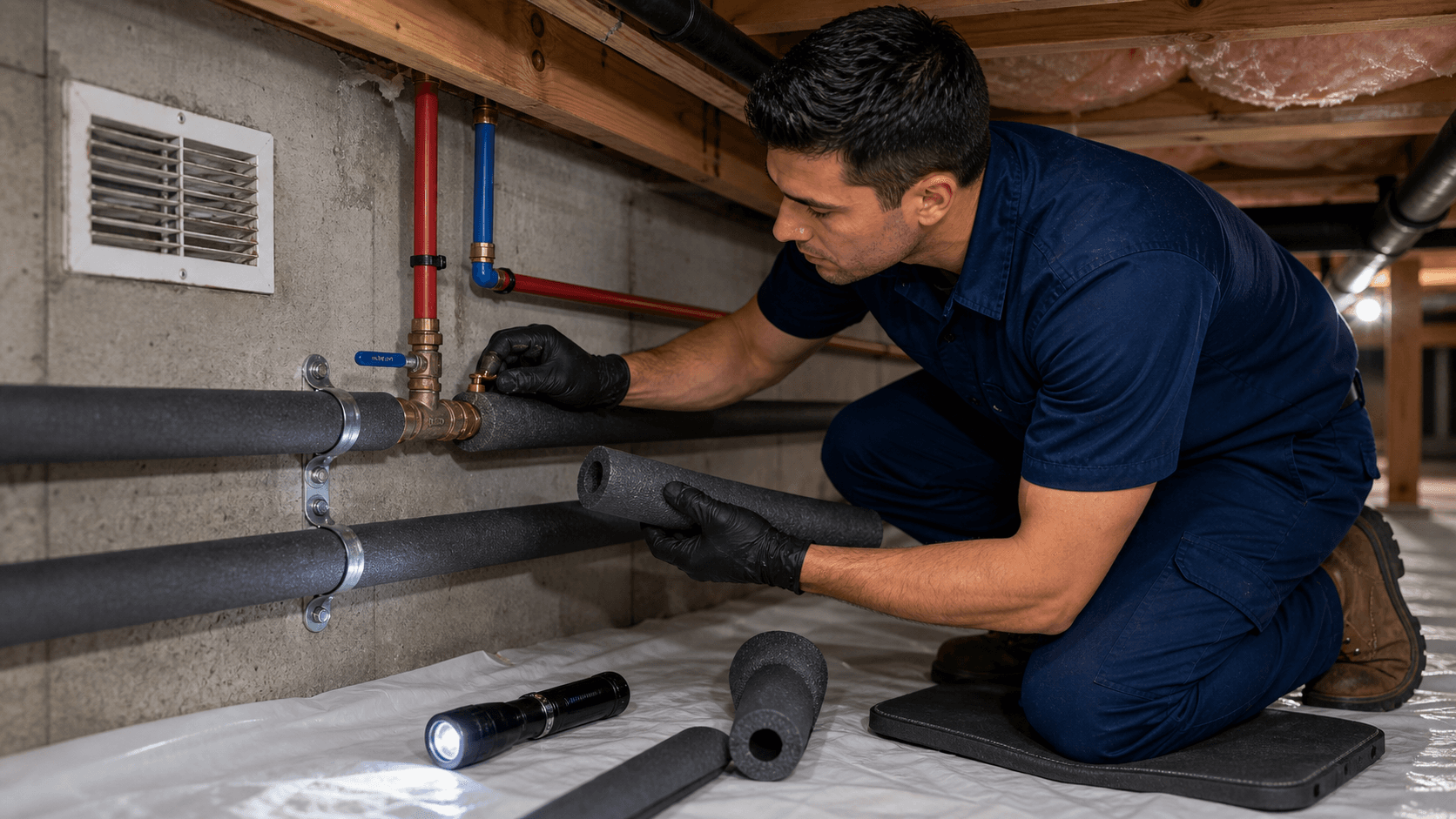
Crawlspace winterization in Bellevue covers three items: insulating exposed copper or PEX supply lines with foam sleeves, closing or insulating crawlspace vents through the freeze months, and confirming the vapor barrier is intact. Crawlspace burst is the second-most-common freeze failure in Bellevue after hose bibs.
Bellevue's housing stock includes a significant share of homes built 1955-1985 with crawlspace foundations (rather than full basements or slab-on-grade). These crawlspaces typically have copper or PEX supply lines running between the floor joists, 24-30 inches above grade. The crawlspace itself is ventilated — code requires venting to prevent moisture buildup — which means the air in the crawlspace tracks outdoor temperature within 5-10°F when vents are open.
The freeze sequence. Outdoor temperatures drop into the teens or single digits during a cold snap. Crawlspace air tracks down to the low 20s. Exposed copper or PEX supply lines, if not insulated, drop to the same temperature. Water in the lines freezes and expands. Cracks form at the most stressed point — usually a fitting, a turn, or the connection to a fixture above. The line bursts and water cascades into the crawlspace, often undiscovered until the floors above start showing damage days or weeks later.
Prevention has three components. Pipe insulation: foam tubing (polyethylene or rubber) cut to length and snapped around the supply pipes. Standard sizes fit 1/2-inch and 3/4-inch copper or PEX. Cost runs $0.50-$2 per linear foot at any hardware store; a typical 1,500 square-foot Bellevue home needs 60-120 feet of tubing. Installation is a homeowner job for anyone willing to crawl through the crawlspace; allow 2-4 hours for a clean run.
Vent management. Crawlspace vents allow outdoor air in to manage moisture during warm months. In winter, the same vents drop the crawlspace temperature dangerously. Two strategies: install foam vent covers (rigid foam blocks sized to fit standard 8x16 vent openings, $2-$5 each, removed in spring) on every vent through the freeze months, or install operable vents with manual flaps that close during cold weather. The foam-block approach is simpler and cheaper for a one-time fall job.
Vapor barrier check. The black plastic sheeting on the crawlspace floor manages soil moisture. If it's torn, displaced, or missing, the crawlspace humidity stays elevated and any insulation work is fighting a losing battle. The October prep visit is the right time to walk the crawlspace with a flashlight and confirm the vapor barrier is intact — repair or replace as needed with 6-mil black poly at ~$0.10-$0.20 per square foot.
For homeowners with galvanized supply lines (1950s-1960s construction), pipe insulation is necessary but not sufficient — see our galvanized supply line guide for old Bellevue homes for the longer-term repipe planning. Galvanized lines burst more readily than copper or PEX during freezes because the internal corrosion has already weakened the wall.
Exposed plumbing in unheated or partially-heated spaces — attached garages, attics, north-wall plumbing chases, exterior wall fixtures — needs foam pipe sleeves at minimum and heat tape in the most freeze-prone spots. Material cost is $20-$80 for a typical Bellevue home; installation is a 1-2 hour homeowner job.
Garage plumbing. The water line running through the garage ceiling to the kitchen above (or to a laundry room sharing a wall with the garage) is one of Bellevue's most common burst locations. Detached and unheated attached garages can drop into the 30s during cold snaps; the pipe inside tracks down with them. Foam sleeves on every exposed run in the garage, plus pipe insulation at the wall penetration where the line enters heated space, addresses 90 percent of garage-related freeze risk.
Attic plumbing. Most Bellevue homes have minimal plumbing in attics, but exceptions include venting (relevant for ice damming, not freeze burst), tankless water heaters mounted in attics (the unit and lines need insulation and freeze-protection mode enabled), and shared bathroom vents. Attic-mounted tankless units are a known cold-snap failure mode — the manufacturer's freeze-protection mode runs the burner during sub-freezing exposure, but only if the unit has power. Power outages during freeze events have caused total losses on attic-mounted tankless installations.
North-wall and exterior-wall plumbing. Original 1960s-1980s Bellevue construction often ran kitchen sink supply lines through exterior north walls. These walls don't have full insulation in older construction, and the supply lines run close to the cold exterior face. The fix in a remodel is to relocate the supply lines to interior walls; the fix without remodel is to add insulation behind the line, install foam sleeves on the line itself, and (in the worst cases) install thermostatic heat cable that activates at 38°F.
Heat tape and heat cable. UL-listed pipe heat cable (different from the dangerous 1970s heat tape — current products are safe and code-compliant) attaches along a pipe and includes a thermostat that activates at low temperatures. Used appropriately, heat cable is the right answer for a known problem spot — say, an exterior-wall kitchen supply that has burst in two prior freeze events. Used inappropriately (every pipe in the house wrapped in heat cable), it's expensive overkill that drives electric bills up and creates a fire risk if installed wrong. The narrow use case is targeted protection of identified vulnerabilities.
The October checklist usually catches hose bibs and irrigation but misses outdoor showers, decorative fountains, pond and pool equipment, second-floor balcony drains, and outbuilding plumbing. Each of these is a freeze-vulnerable system that gets remembered the spring after damage occurs.
Outdoor showers. Built into many newer Bellevue homes near pools, hot tubs, or the back of the house, outdoor showers have a supply line, a mixing valve, and a shower head — all freeze-vulnerable. Winterizing means closing the interior shutoff for the line (most installations have one), draining the line, and opening the valve and shower head to allow expansion room. Outdoor showers without an interior shutoff are a build defect; that's a winter to fix it.
Decorative fountains and ponds. Bellevue's residential ponds and decorative fountains use pumps, supply plumbing, and sometimes circulation lines. The October winterization removes the pump (most are external and unplug from a GFCI outlet), drains the pumphouse and any aboveground lines, and either drains the pond entirely (small ones) or installs a stock-tank de-icer to prevent surface ice damage on planted ponds.
Pool and spa equipment. Concrete pools — common in older West Bellevue and Medina homes — need a full close: lower the water level below the skimmer line, drain the equipment pad, blow out the lines, add winterizing chemicals, and cover. This is contractor work ($400-$1,000) for anyone without prior experience. Above-ground spas (the hot tub category) usually run year-round but need cover insulation and freeze-protection mode confirmed.
Drain lines and balcony drains. Second-floor decks and balconies often drain through internal pipes that exit at grade. These drains can hold water that freezes and either cracks the pipe or blocks the drain with ice. Pour a quart of plumbing antifreeze (propylene glycol, not ethylene glycol — pet-safe formulation) into balcony drains in November as a freeze barrier. The same applies to floor drains in unheated garages and bonus rooms.
Outbuilding and detached structure plumbing. Detached workshops, ADUs, and pool houses with full plumbing need the same winterization workflow as the main house. ADUs in particular have become common in Bellevue since the city's zoning reforms; their plumbing is often less robust than the main house's and more vulnerable to freeze damage.
During an active cold snap, set the thermostat no lower than 60°F day or night, open cabinet doors below kitchen and bath sinks on exterior walls to let warm air reach the supply lines, and leave a pencil-thick stream of water running from at least one faucet in the coldest part of the house. These three actions prevent most freeze events that prep didn't already cover.
Thermostat minimum. Standard advice is 'don't drop below 55°F when away'; the realistic minimum for freeze prevention in a Bellevue home is 60°F. Heat distribution within a house is uneven — closets, corners, exterior-wall plumbing, and unused rooms can be 10-15°F below the thermostat reading. At 55°F whole-house, the exterior-wall plumbing can drop into the low 40s overnight; at 60°F whole-house, the same plumbing stays in the mid-50s. The cost difference between 55°F and 60°F on a PSE electric or gas bill during a four-day cold snap is roughly $20-$60. The cost of a single burst pipe is $3,000-$40,000.
Cabinet doors open. Under-sink cabinets on exterior walls create a sealed pocket of cold air around the supply lines. Opening the cabinet doors during freeze events lets warm room air reach the lines and prevents the pocket from concentrating cold. The practice is most relevant for kitchen sinks on the north side of the house and bathroom sinks on exterior walls.
Drip a faucet. Moving water resists freezing because the kinetic energy disrupts ice crystal formation. A pencil-thick drip from the highest fixture on the coldest run of plumbing (often a bathroom on the north or west side of the house, on an upper floor) ensures movement through the most vulnerable section. The water cost during a four-day freeze is roughly $3-$8 at Bellevue Utilities' current rates. The risk-reduction is substantial. Drip both hot and cold lines — both are vulnerable.
Power outage contingency. If a windstorm or ice storm cuts power during a freeze event, the thermostat-minimum strategy stops working. Two responses: (1) wood stove or gas fireplace if available, kept burning to preserve at least partial interior heat, (2) shut the main water supply off at the meter or main shutoff valve and open all faucets to drain the lines if the outage is expected to extend more than 24 hours. The latter is aggressive but eliminates burst risk entirely. The full real-time response for a freeze event is covered in our cold-snap playbook for Eastside homes.
The complete winterization checklist for a Bellevue home is 12 items spanning three to four hours of homeowner time plus one contractor visit for irrigation blowout. Done by October 25, it covers most residential freeze risk.
Bellevue October winterization checklist:
Total cost for the items the homeowner handles directly: $80-$300 in materials. Total contractor cost for irrigation blowout and (if applicable) pool closing: $150-$1,200. Total time investment: 3-4 hours homeowner, plus contractor visits scheduled.
Skipping any one item is not catastrophic on its own. Skipping all of them creates a stack of latent failures that one bad cold snap can trigger simultaneously — the kind of January morning where a homeowner finds water in the garage, the irrigation backflow cracked, and the kitchen sink line burst behind the wall. That stacked-failure scenario is what insurance adjusters see consistently after PNW cold snaps; the underlying cause is almost always missed October prep, not an unusually severe freeze.
Irrigation blowout, backflow preventer service, and outdoor shower winterization are irrigation-contractor work. Crawlspace pipe insulation, hose bib indoor shutoff installation (if missing), heat-cable installation, and frost-free hose bib replacement are plumber work. The two trades overlap less than homeowners expect; using the right one prevents follow-up trips.
Irrigation contractors carry the high-CFM compressors required for proper blowout, hold the cross-connection control specialist certifications required for backflow preventer maintenance in Washington, and handle the seasonal lifecycle (spring startup + fall winterization) as a recurring service. Most Eastside irrigation contractors offer fall winterization as a flat-rate package starting at $75-$100 for small systems.
Plumbers handle pipe-level work — the actual supply lines, fittings, hose bibs, and fixtures. If your standard hose bib doesn't have an interior shutoff (about 30 percent of pre-1990 Bellevue homes), installing one is a 30-60 minute plumber job in the $200-$400 range. Replacing a standard hose bib with a frost-free unit is similar cost and scope. Pipe insulation can be a plumber job or a homeowner job; most plumbers will price it if asked but treat it as a small-job add-on rather than a primary scope.
For homeowners new to Bellevue's climate (moving from California, Texas, or the Southeast), the October prep is unfamiliar enough that a single-visit consultation with a licensed plumber to walk the home and identify vulnerabilities is worth the trip charge. Cost runs $125-$225 for the consultation depending on home size and complexity. The plumber identifies the specific risk points in your specific home — much more valuable than generic checklists for someone learning the climate.
Every fact in this guide cites a verifiable public source. If you find a number we got wrong, email dispatch@bellevueplumberpro.com.
Need help with this in your home? See our Frozen and burst pipe repair across Bellevue and the Eastside page for pricing, our diagnostic process, and how same-day service works across the Eastside.
Related services: 24/7 Emergency Plumbing.
October — average overnight lows run 42–48°F, cold enough to confirm winter is coming but warm enough to comfortably do irrigation, hose-bib, and crawlspace work before the first freeze.
Disconnect every hose, drain the bib, and close the interior shutoff where one exists. A hose left connected traps water that freezes back into the pipe — hose-bib burst is the most common and most preventable freeze failure.