Fall leaf-clog prevention for Bellevue: gutters, downspouts, drains
Pacific Northwest fall leaf drop dumps roughly 50-150 pounds of organic matter into the typical Bellevue residential drainage system between late September and early December. The gutters, downspouts, yard drains, sewer cleanouts, and foundation perimeter all collect debris that — left unmanaged — cause winter ice damming, foundation drainage failures, and spring sewer-line backups. This guide walks the coordinated October leaf-management sequence: gutter cleaning timing and frequency, downspout disconnection requirements under Bellevue's stormwater code, yard drain and French drain inspection, the connection between exterior debris and interior plumbing, the DIY-versus-hire economics, and the equipment that actually works at PNW scale. Done correctly, the fall maintenance costs $150-$600 and prevents three categories of spring failure that average $1,500-$8,000 per event.
The PNW leaf-fall window — and why it matters more than in other regions
Bellevue's deciduous canopy — bigleaf maple, vine maple, alder, cottonwood, oak, and the imported deciduous ornamentals in most neighborhoods — drops leaves between late September and early December, with peak volume in October. The PNW combination of large leaves, sustained drop period, and continuous wet weather creates a debris management challenge that drier climates don't face at the same scale.
The species and the volume. A mature bigleaf maple (Acer macrophyllum) drops 8-12 pounds of leaves per year. A mature vine maple drops 2-5 pounds. A typical Bellevue residential lot in an established neighborhood like Bridle Trails, Lake Hills, or West Bellevue includes 4-8 mature deciduous trees plus understory shrubs. Total annual leaf drop per residential lot is roughly 50-150 pounds of organic material — most of it falling within an 8-week window.
Why the wet matters. In a dry climate, leaves blow off the roof and lawn into corners and can be collected weeks later in dry condition. In Bellevue, leaves hit a wet roof, absorb water, stick to the surface, and decompose into a paste that adheres to gutters, downspout interiors, drain grates, and sewer cleanouts. The same leaf-management workflow that works in Phoenix or Denver doesn't work here — wet matted leaves require active removal, not passive collection.
The drainage cascade. Roof catches the leaves. Gutters channel them toward downspouts. Downspouts deliver them to either splash blocks at grade (which then drain into the yard), tight-line drains (which carry them underground to the storm sewer or a dry well), or — in older homes — directly into the building sewer line via a non-code-compliant connection. Each transfer point is a potential clog. Each clog backs up the upstream system. Sustained backups during a winter wet event cause everything from siding stains to foundation water intrusion to sewer-line backups.
The interior-exterior connection. Most homeowners think of gutter cleaning as exterior maintenance. The reality is that exterior drainage failures cascade into interior plumbing problems within 6-18 months. A downspout illegally connected to the sewer line introduces tree-leaf debris into a system designed for human waste — see our Pacific Northwest sewer cedar root invasion guide for the related decomposition issue that compounds when leaves and roots both reach the sewer line. The connection between leaf management and plumbing isn't obvious but it's direct.
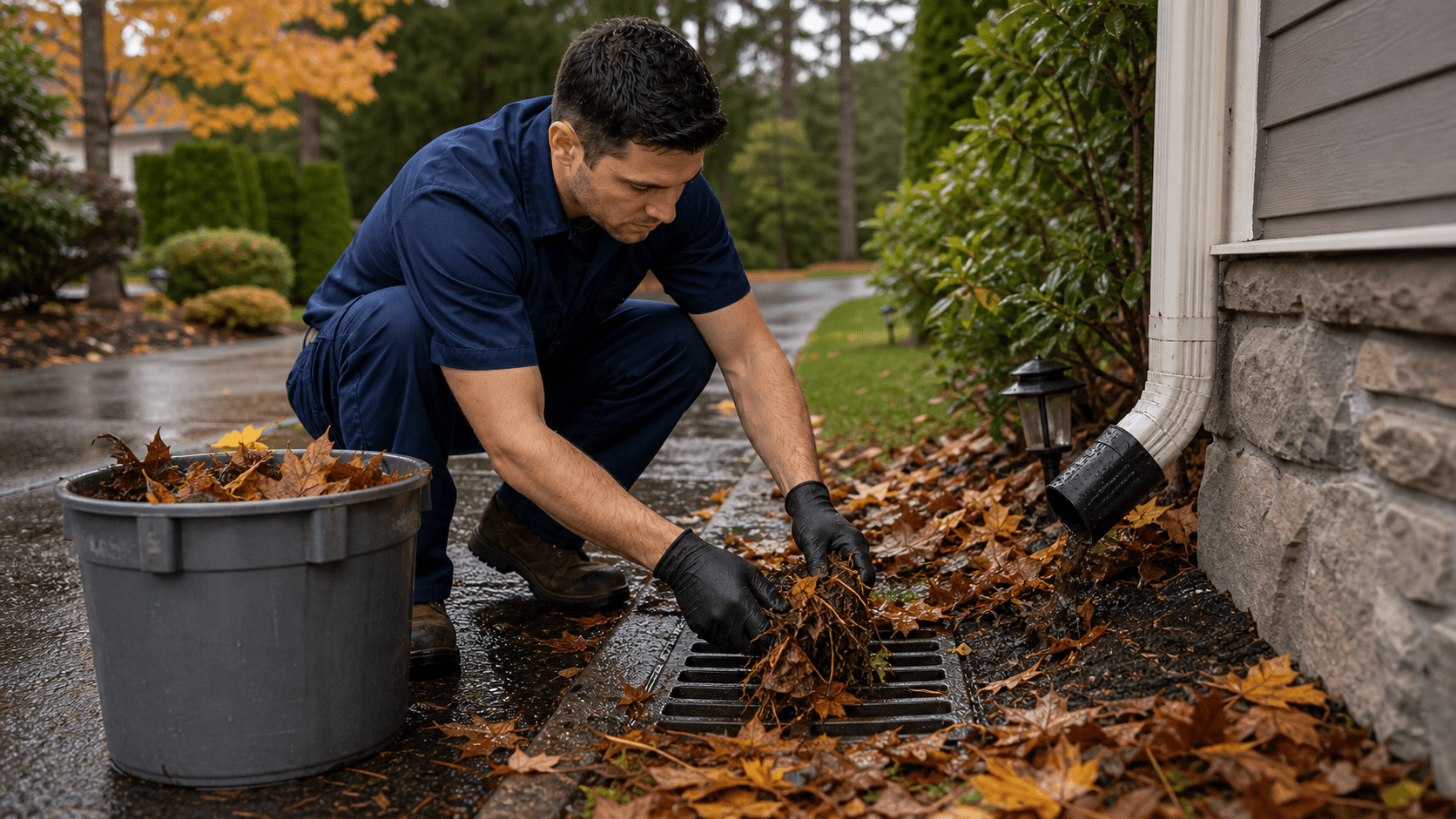
Yard drains and downspout discharge points clog quickly once wet leaves mat over the grate.
This happening in your home right now? A licensed plumber can talk you through the next step on the phone — 24/7, and the call is free.
Bellevue residential gutters need cleaning at least twice during the leaf-fall window — once in late October after the peak drop has finished, and once in early December to clear what came down through November storms. Lots with multiple mature deciduous trees benefit from a third cleaning in late November.
The 'leaves have stopped falling' marker. Don't clean gutters in early or mid-October — the trees aren't done dropping yet, and you'll be doing it again three weeks later anyway. Wait until the canopy is roughly 70-80 percent bare, typically late October to early November. The exact week varies year to year based on the first hard rain and the first frost; in most years late October is the right window.
Why a second cleaning. After the first cleaning, November and early December bring more leaves down, plus the storms wash residue from the roof itself into the gutters. The second cleaning in early December clears these and sets the system up for winter operation. A clean gutter in mid-December means ice damming is much less likely if a freeze event occurs.
Hire versus DIY. A typical Bellevue residential single-story or split-level gutter cleaning runs $150-$300 per visit from a licensed contractor. A two-story home runs $250-$450. Multiple-story homes with complex roof geometry or chimney work-arounds run $350-$650. DIY costs $0-$50 in materials (a sturdy ladder, gutter scoop, work gloves, and a tarp) but requires comfort on a ladder and at least 2-3 hours per cleaning.
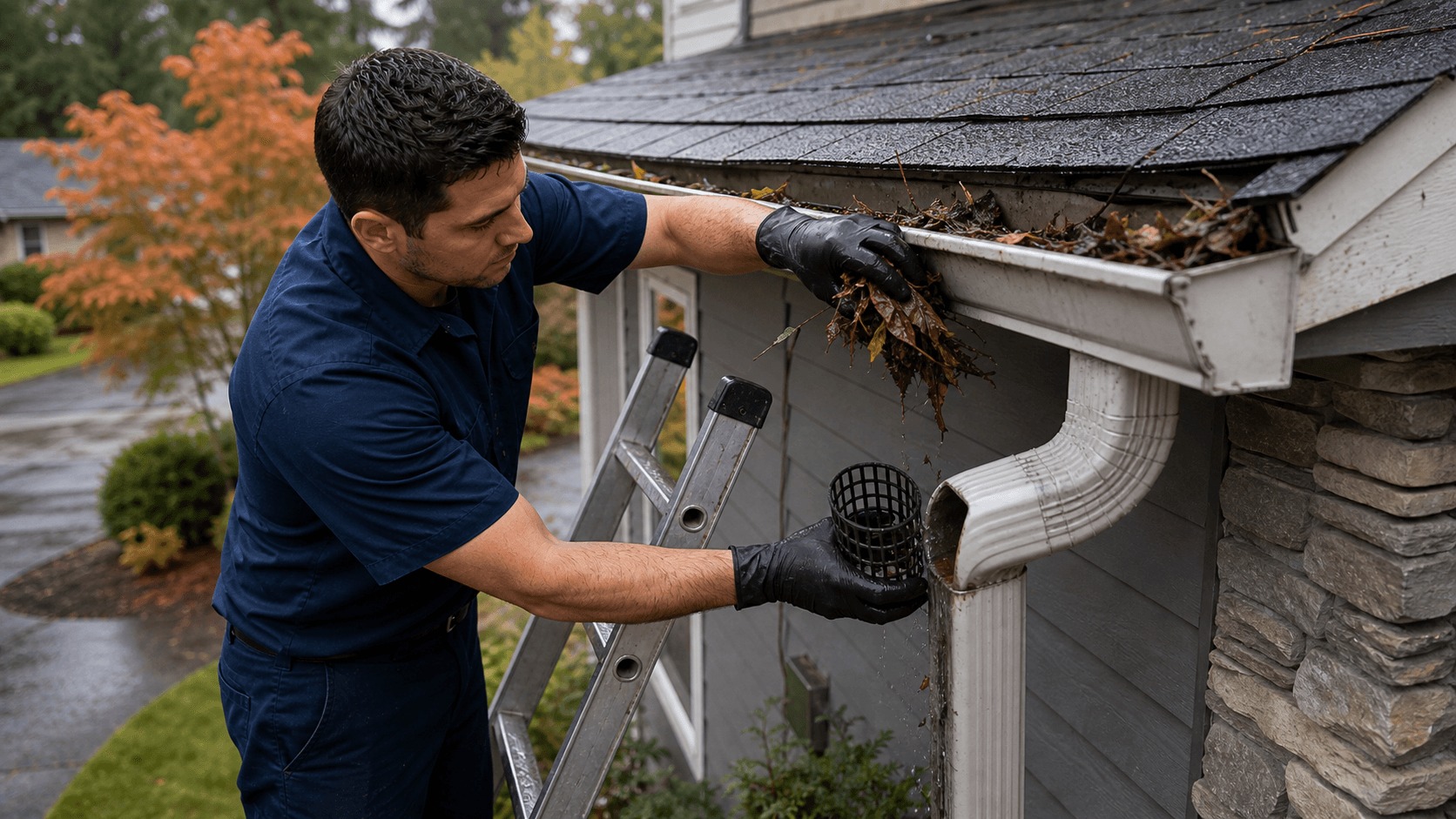
Equipment. The single most important DIY tool is a stable extension ladder properly positioned. Most ladder-related injuries from gutter cleaning happen because the ladder was the wrong type, set on a soft surface, or angled too steeply or shallowly. Use a 24-foot extension ladder for single-story, 28-32 foot for two-story; set the base at a 4:1 vertical-to-horizontal ratio; secure the top with a stabilizer arm against the roof. A gutter scoop (~$10) collects debris faster than gloved hands and doesn't risk gutter-edge cuts.
Gutter guards. Several gutter-guard product categories exist — mesh screens, foam inserts, surface-tension hooded systems. None completely eliminate the need for cleaning in heavy-canopy Bellevue lots, but the better products extend cleaning intervals from twice-yearly to once-yearly. Material cost runs $4-$15 per linear foot installed; for a typical 150 linear feet of residential gutter, that's $600-$2,250. The payback against contractor cleaning costs is 4-15 years depending on cleaning rates and product quality.
Downspout disconnection — Bellevue's stormwater code and what's actually required
City of Bellevue's stormwater code (Bellevue City Code Chapter 24.06) prohibits connecting downspouts, gutters, and roof drains to the sanitary sewer. Acceptable termination points are the separate storm sewer system, an approved infiltration system on the property (dry well or French drain), or a splash block at grade discharging to landscaped infiltration area. Many older Bellevue homes still have non-compliant connections from prior eras of construction, which contribute to sanitary sewer overflows during heavy rain events.
Why downspouts can't connect to the sanitary sewer. The sanitary sewer is sized for residential and commercial wastewater volumes. Adding stormwater (which can be 10-100x the sanitary volume during a heavy rain event) overwhelms the system, causing sewer overflows into local waterways and basement backups in low-lying homes. Bellevue, like every other modern PNW municipality, separates stormwater from sanitary sewage at the system level.
Identifying non-compliant connections. Walk to each downspout and look at where it terminates. Three common patterns: (1) the downspout ends at a splash block on the ground, then drains to lawn or French drain — COMPLIANT. (2) The downspout enters a buried pipe that runs to a stormwater catch basin in the street or to a dry well in the yard — COMPLIANT. (3) The downspout enters a buried pipe that runs to a sewer cleanout, an interior basement connection, or disappears under the foundation toward the building sewer — POTENTIALLY NON-COMPLIANT, requires verification.
How to verify and disconnect. If you suspect a non-compliant connection, a plumber can run a camera through the system to confirm and recommend disconnection. Disconnection typically involves cutting the downspout above grade and redirecting to a splash block, infiltration trench, or dry well. Plumber cost is $200-$800 per downspout depending on the existing routing complexity. Permit may be required depending on the scope.
Bellevue Utilities and the disconnection program. Bellevue has run various stormwater management programs over the years. Some include rebates or technical assistance for downspout disconnection in older neighborhoods. Current program status changes — check bellevuewa.gov/utilities for the current offering. Combined with the broader work on permit and code (see our Bellevue plumbing permit guide), disconnection work in older homes often comes up during major remodels, repipes, or sewer line work.
What disconnection prevents. Beyond the regulatory requirement, disconnection prevents three real problems: it removes stormwater spikes from the sanitary system (reducing your risk of sanitary backups during heavy rain), it prevents leaf-debris from the roof from entering the sewer line, and it routes stormwater to where it can infiltrate the soil and recharge groundwater rather than overwhelming the city's stormwater system.
Gutters, downspouts, and yard drains need to be cleared as one drainage path, not separate chores.
Yard drains and French drains — the part everyone forgets
Most Bellevue residential lots have surface drains (grates set in the lawn or driveway) and French drains (perforated pipe in gravel trenches) that carry surface and subsurface water away from the house. These collect leaves and silt over the leaf-fall season and need inspection and cleaning to prevent winter water intrusion at the foundation.
Surface drains (catch basins). The metal or plastic grate set in the lawn, driveway, or patio that collects surface runoff. Below the grate is typically a small sediment basin and a horizontal pipe carrying water to a tight-line drain or to a stormwater facility. The sediment basin fills with leaves, dirt, and debris over the leaf-fall season; left full, water backs up and pools around the foundation. Inspection: lift the grate, look in. Cleaning: scoop or vacuum the debris.
French drains. A trench filled with gravel and a perforated pipe at the bottom, designed to collect subsurface water and carry it away. Older Bellevue homes (especially homes built into hillsides in Somerset, Lakemont, and West Bellevue) often have French drains around the foundation perimeter. They don't have a visible inspection point unless a cleanout was installed; signs of failure include water pooling near the foundation, basement dampness, or surface water collecting after rain.
Driveway drains. The trench drain or area drain at the bottom of a sloped driveway, designed to catch water before it reaches the garage. These collect leaves, gravel, and silt over the leaf-fall season and need clearing every fall.
The connection to interior plumbing. Yard drain failures cause exterior water to pool around the foundation. Over time, this water can: (1) infiltrate the foundation through wall cracks or window wells, causing basement leakage that the homeowner blames on plumbing (it isn't — it's drainage); (2) saturate the soil around buried supply lines, accelerating corrosion on galvanized pipes; (3) overwhelm sump pumps, leading to pump failure during major storms; (4) cause hydrostatic pressure on slab foundations, contributing to slab cracks and slab leak risk.
Maintenance cadence. Inspect every yard drain in late October after the peak leaf drop. Clean any that are more than 25 percent full. Re-inspect in late November or early December if the canopy is still dropping. A single fall maintenance pass on yard drains takes 30-60 minutes for a typical Bellevue residential lot.
Sewer cleanout fall check — keeping the main line clear
Every Bellevue home has at least one sewer cleanout — a capped vertical pipe outside the foundation or in the yard, providing access to the main sewer line. The fall maintenance includes a quick check that the cleanout cap is in place, the area around it is clear, and no surface water is pooling near it. Cleanouts that get covered by lawn growth or buried by yard work become unfindable when an emergency hits.
Locate every cleanout. Most Bellevue homes have one cleanout outside the foundation, within 10 feet of where the main sewer exits the house — often near the back or side of the home. Some have additional cleanouts at the property line or at major direction changes in the sewer line. Walk the property and confirm you can find every cleanout. Mark the locations on a simple yard map.
Check the cap. The cap should be threaded in tight and free of damage. Caps degrade over years in the weather; replace any that are cracked, missing, or loose. A 4-inch threaded cleanout cap costs $5-$15 at any hardware store.
Clear the area. Leaves and yard debris piled around a cleanout can disguise the location and cause confusion during an emergency. Keep a 2-3 foot clear radius around each cleanout — visible, accessible, and free of pooled water. If a cleanout is at ground level and routinely covered by lawn growth, install a small ground-level marker (a flat paver, a marked stake) so it can be found in the dark with a flashlight.
Pre-winter camera inspection. Homes with older sewer lines (especially the 1950s-1970s clay-tile and Orangeburg lines common in mid-century Bellevue construction) benefit from a fall sewer camera inspection — see our sewer camera inspection guide for the diagnostic methodology. A camera inspection in October catches root intrusion or pipe damage before the heavy winter use season; spring camera inspections often arrive too late to prevent winter backups.
Equipment that matters versus equipment that's marketing
Three tools handle 90 percent of residential fall leaf-management: a stable extension ladder with a stabilizer arm, a gutter scoop or gutter-cleaning vacuum attachment, and a wet-dry vacuum or pressure washer for catch basin and downspout cleanout. Most other 'gutter-cleaning gadgets' sold at retail are marketing.
The ladder. The most-leveraged purchase is a quality extension ladder appropriate for your home's height. A 24-foot extension ladder ($150-$300) covers single-story and most split-levels. A 28-32 foot ladder ($250-$500) covers two-story homes. A roof stabilizer arm ($30-$60) replaces the ladder's contact with the gutter (which can damage the gutter) and rests against the roof safely. Don't economize on the ladder.
Gutter scoop and gutter cleaning vacuum. A plastic gutter scoop ($10-$20) is the basic tool. Some homeowners prefer a wet/dry vacuum with a 6-12 foot gutter attachment (~$30-$60 for the attachment, in addition to the vacuum itself), which reaches into the gutter from a stable ground position on simpler home geometries — but the attachments don't work well for second-story homes or homes with complex roof lines.
Wet/dry vacuum for catch basins and downspouts. A shop vac (~$60-$150 for a 5-10 gallon unit) does double duty: clears yard drain sediment basins, sucks up wet leaf paste from gutters and downspouts, and handles general household cleanup. The single most-used tool in fall yard maintenance for many homeowners.
Pressure washer for stuck debris. Not always necessary but useful for: stuck downspout interiors, clogged catch basin connections, ground-level cleanout flushes. A consumer-grade electric pressure washer (~$100-$300) is sufficient; gas pressure washers are overkill for residential maintenance.
Tools that don't justify the cost. Gutter-cleaning robots (battery-powered devices that ride along the gutter chewing up debris) work in dry, level conditions and fail in PNW wet matted leaves. Specialty 'gutter-flushing' kits often just rebrand a garden hose attachment. Telescoping pole-mounted gutter cleaners reach the gutter from the ground but can't see what they're cleaning — useful for spot-clearing but not full maintenance. Most fall maintenance is best done with the basic tools and a ladder.
The fall coordinated-pass checklist
The complete fall drainage maintenance for a Bellevue home is one consolidated visit in late October to early November, optionally followed by a touch-up visit in early December after the late-season leaves fall. Total time: 3-5 hours for a single-story home, 4-7 hours for a two-story home, plus any contractor-required work.
October-November coordinated fall drainage checklist:
Walk the property in daylight and map every gutter, downspout, yard drain, and sewer cleanout location
Clean every gutter — full debris removal, not just surface scrape
Flush each downspout from top with water and confirm it discharges correctly at grade or to a tight-line drain
For any downspout that disappears underground without a known terminus: have a plumber camera the line to verify code-compliant routing
Lift each yard drain grate, clear the sediment basin, confirm the discharge pipe is clear
Locate every sewer cleanout, confirm caps are intact, clear a 2-3 foot radius around each
Walk the foundation perimeter, note any standing water, soft soil, or signs of poor drainage
Check basement and crawlspace for any signs of water intrusion that have developed since spring
Confirm sump pump operation (where applicable) by pouring 5-10 gallons of water into the sump
Inspect French drain cleanouts (if accessible) for debris accumulation
Test outdoor lighting around foundation drains, sewer cleanouts, and major drain locations so emergency response in dark conditions works
Schedule this consolidated pass for a dry weekend in late October. Confirm 24-hour weather window — wet ladders are dangerous and wet leaves are heavier and harder to handle. Most weekends in late October bring rain on the typical west-side schedule (one or two dry days per week), so flexibility on the exact date matters.
Total cost for materials and supplies (assuming basic tools already owned): $20-$60. Total cost if hiring out gutter cleaning: $150-$650 depending on home size. Total cost if hiring out the full pass (gutters + downspouts + yard drains + sewer check): $400-$1,200 for a single visit covering all components.
When fall maintenance is the wrong scope — escalating to plumber or drainage specialist
Routine fall maintenance is homeowner or general contractor work. Three scenarios require a licensed plumber or drainage specialist instead: suspected non-compliant downspout-to-sewer connections, persistent foundation water intrusion despite maintenance, and sewer line backups that occur after leaf-fall season despite a clean cleanout.
Non-compliant downspout connections. If a downspout disappears underground and you cannot confirm where it terminates, a plumber can run a camera through the connection to verify and recommend disconnection if needed. The disconnection itself is a permitted plumbing job. Discovery and remediation are best handled by a single licensed plumber to keep the scope coordinated.
Foundation water intrusion. Persistent basement dampness, water stains on basement walls, or actual seepage during heavy rain events is a drainage problem that fall gutter cleaning doesn't solve. The root cause is usually a French drain failure, a yard grading issue, or — less commonly — a foundation crack. Drainage specialists (not general plumbers) diagnose and remediate these issues. Common remediation includes French drain installation or replacement ($3,000-$15,000), exterior foundation waterproofing ($5,000-$25,000), or interior basement drainage retrofits ($5,000-$15,000).
Recurring sewer backups. A sewer line backup after leaf-fall season that occurs despite a clean accessible cleanout suggests the line itself has an internal problem — root intrusion, a partial collapse, or a belly holding standing water. Camera inspection (covered in our Bellevue sewer camera inspection guide) is the next step. The pricing context for any resulting repair work is in the plumber cost and pricing in Bellevue guide.
Sources
Every fact in this guide cites a verifiable public source. If you find a number we got wrong, email dispatch@bellevueplumberpro.com.
Fall leaf-clog prevention for Bellevue — questions homeowners ask
QUESTION01
How often should gutters be cleaned in Bellevue?
At least twice during the leaf-fall window — once in late October after the peak drop, and once in early December to clear what fell after the first cleaning. Bellevue's bigleaf maple, alder, and cottonwood canopy drops late September through November.
QUESTION02
Can downspouts connect to the sanitary sewer in Bellevue?
No. Bellevue City Code 24.06 prohibits connecting downspouts, gutters, and roof drains to the sanitary sewer — acceptable termination is splash blocks, daylit discharge, or the storm system where one exists.