Home/Learn/Sump pumps/Sump pump battery backup in Puget Sound: runtime, sizing, and water-powered vs battery
Sump pumps
Sump pump battery backup in Puget Sound: runtime, sizing, and water-powered vs battery
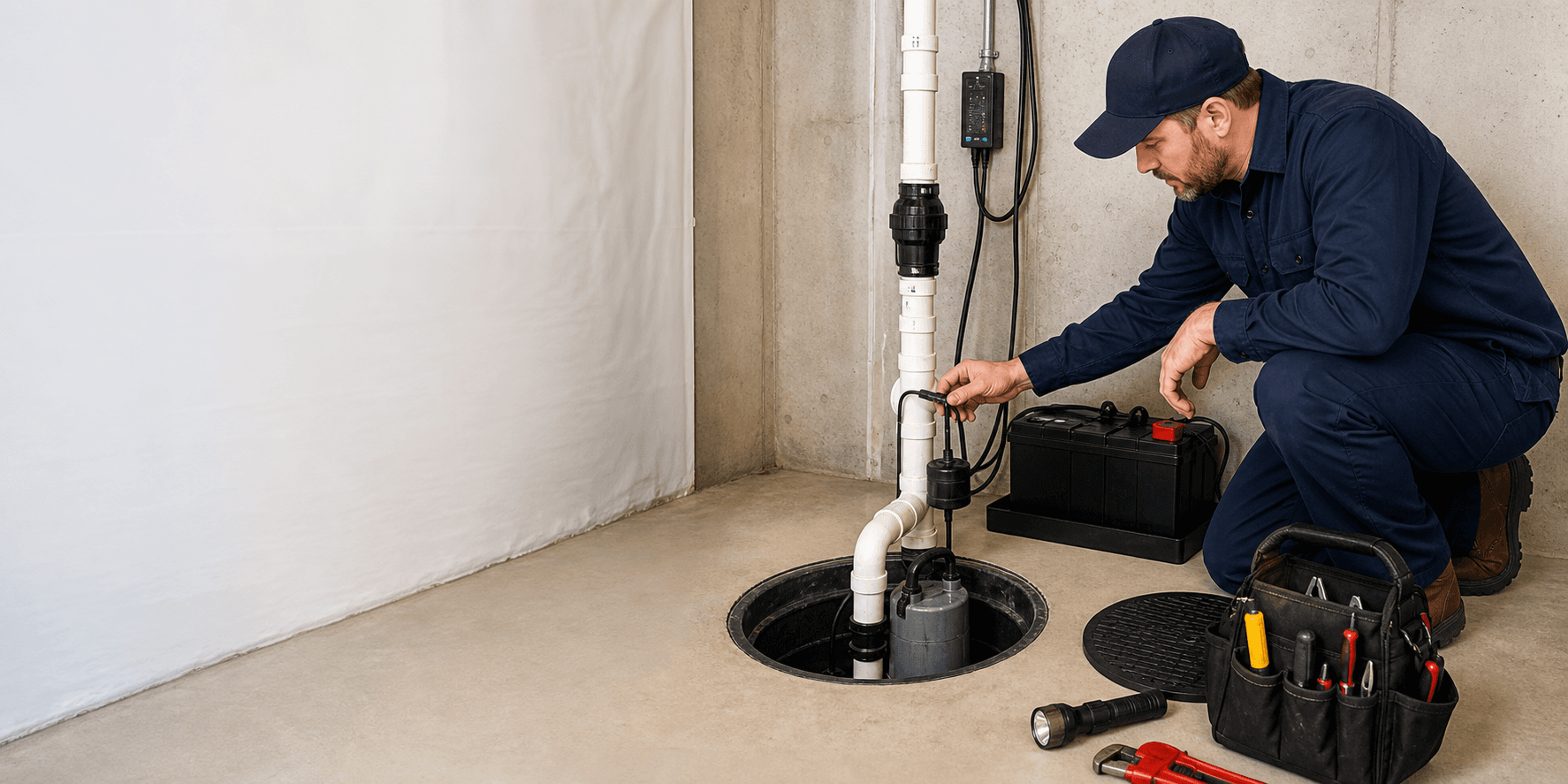
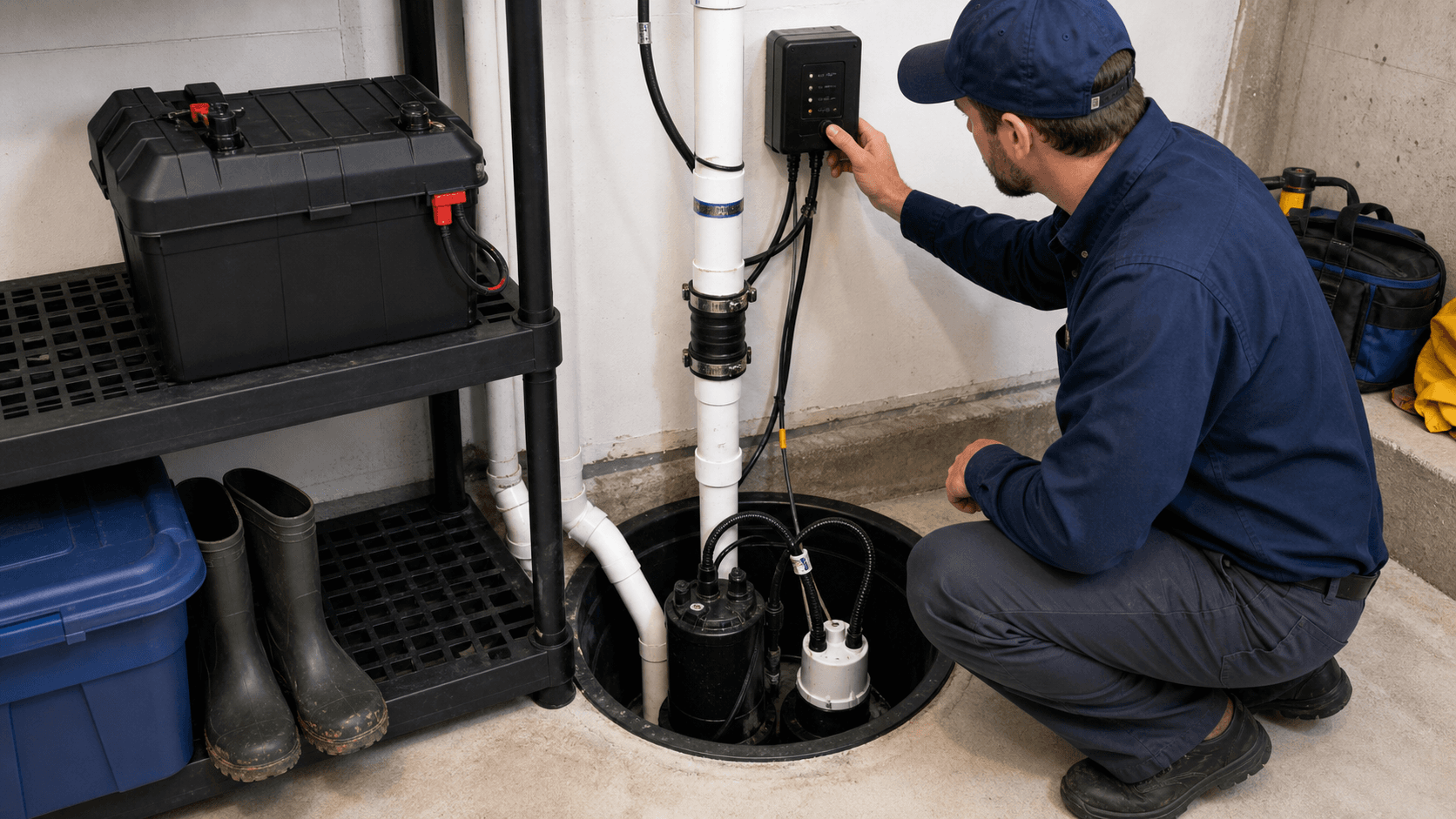
A battery backup sump pump matters in Puget Sound for one specific reason: the winter windstorms that drive the most basement flooding are the same storms that knock out Puget Sound Energy power, so an AC-only pump can fail exactly when it is needed. A battery backup runs roughly 7 to 8 hours of continuous pumping on a charge, which covers a typical outage but is finite. Sizing the backup means matching its flow to the primary pump at the actual discharge head — around 10 feet in a real installation, not the 0-foot catalog rating — because flow drops sharply with head: a Basement Watchdog Emergency moves about 2,000 GPH at 0 feet but 1,000 GPH at 10 feet, the Special CONNECT 2,600/1,850, and the Big Dog CONNECT 3,500/2,200 with two batteries to double runtime. A water-powered backup runs unlimited on 40 to 60 psi municipal pressure (~800 to 1,500 GPH) but adds water cost per event and will not work on well water — and a potable-supply tie-in can require a backflow preventer. This guide covers runtime, sizing, the two backup types, the cross-connection issue, and code.
Do you need a battery backup sump pump in Puget Sound?
Yes — the winter windstorms that flood Puget Sound basements are the same storms that cut Puget Sound Energy power, so an AC-only pump can fail at the exact moment the rising water needs it.
The case for a backup in Puget Sound rests on a single overlapping fact: the weather that floods basements and the weather that cuts power are the same weather. The region's heaviest rain arrives in winter, saturating the ground and filling basement sump pits, and those same systems are windstorms that bring down trees and lines across western Washington. Puget Sound Energy outages during major windstorms have left hundreds of thousands of customers without power for extended periods — precisely the hours a sump pit is filling fastest.
An AC-only sump pump is defenseless in that moment. The pump can be in perfect condition — float free, impeller clear, motor sound — and still sit dead because the outlet has no power. There is nothing wrong with the pump; the failure is upstream at the grid, and a homeowner who comes home to a flooded basement and a healthy-looking pump has run into exactly this gap. No amount of pump maintenance closes it, because maintenance assumes the pump has power to run.
A backup closes the gap by providing an independent source of pumping that does not depend on the grid. A battery backup pumps on its own battery while the AC pump waits for power to return; a water-powered backup pumps on municipal water pressure, which the grid outage does not affect. Either way, the point is the same — a second way to move water out of the pit when the primary pump has no electricity, which in this climate is when the water is rising fastest.
This is why a backup is closer to standard than optional for a Puget Sound basement with a sump pump. In a region where the wettest weather and the power outages coincide rather than alternate, a single AC pump is an incomplete defense by design. The rest of this guide is about choosing and sizing that backup — how long it runs, how to match it to the primary pump, and the tradeoffs between a battery and a water-powered unit — so the backup actually covers the outage it is there for.
A backup pump matters most during the same storms that knock out power.
This happening in your home right now? A licensed plumber can talk you through the next step on the phone — 24/7, and the call is free.
A battery backup runs roughly 7 to 8 hours of continuous pumping on a charge — enough for a typical outage, but finite, so a long multi-day outage can outlast a single battery.
A battery backup sump pump runs on the order of 7 to 8 hours of continuous pumping on a fully charged battery, which is the figure to plan around. That is continuous runtime — the pump is rarely running every second of an outage, so real-world coverage of an intermittent pumping load stretches longer than the continuous number suggests. For a typical outage of a few hours, a single charged battery comfortably covers the gap until grid power or the homeowner intervenes.
The reason runtime is finite is that a battery holds a fixed amount of energy, and every minute of pumping draws it down. Once the charge is spent, the backup stops until the battery recharges from grid power — which during an outage is not available. This is the fundamental limit of a battery system: it is excellent for the common case of a multi-hour outage, but it cannot pump indefinitely, and a severe multi-day windstorm outage can outlast what a single battery holds.
How long a given battery lasts in practice depends on how hard the pump has to work, which ties back to inflow and head. A pump cycling constantly against a high winter water table draws the battery down faster than one cycling occasionally, so the same battery covers fewer hours in a heavy storm than in a light one — and the heavy storm is exactly when the outage is most likely. Planning for the worst case, not the average, is why runtime headroom matters.
The finite-runtime limit is what shapes the choice between backup types and the option to add capacity. A second battery, as on a two-battery system, roughly doubles the runtime for a long outage; a water-powered backup sidesteps the runtime question entirely by running on municipal water pressure for as long as the outage lasts. Knowing that a single battery gives roughly 7 to 8 continuous hours is the starting point for deciding whether that is enough coverage or whether a longer-running option is warranted.
How do you size a backup to your primary pump?
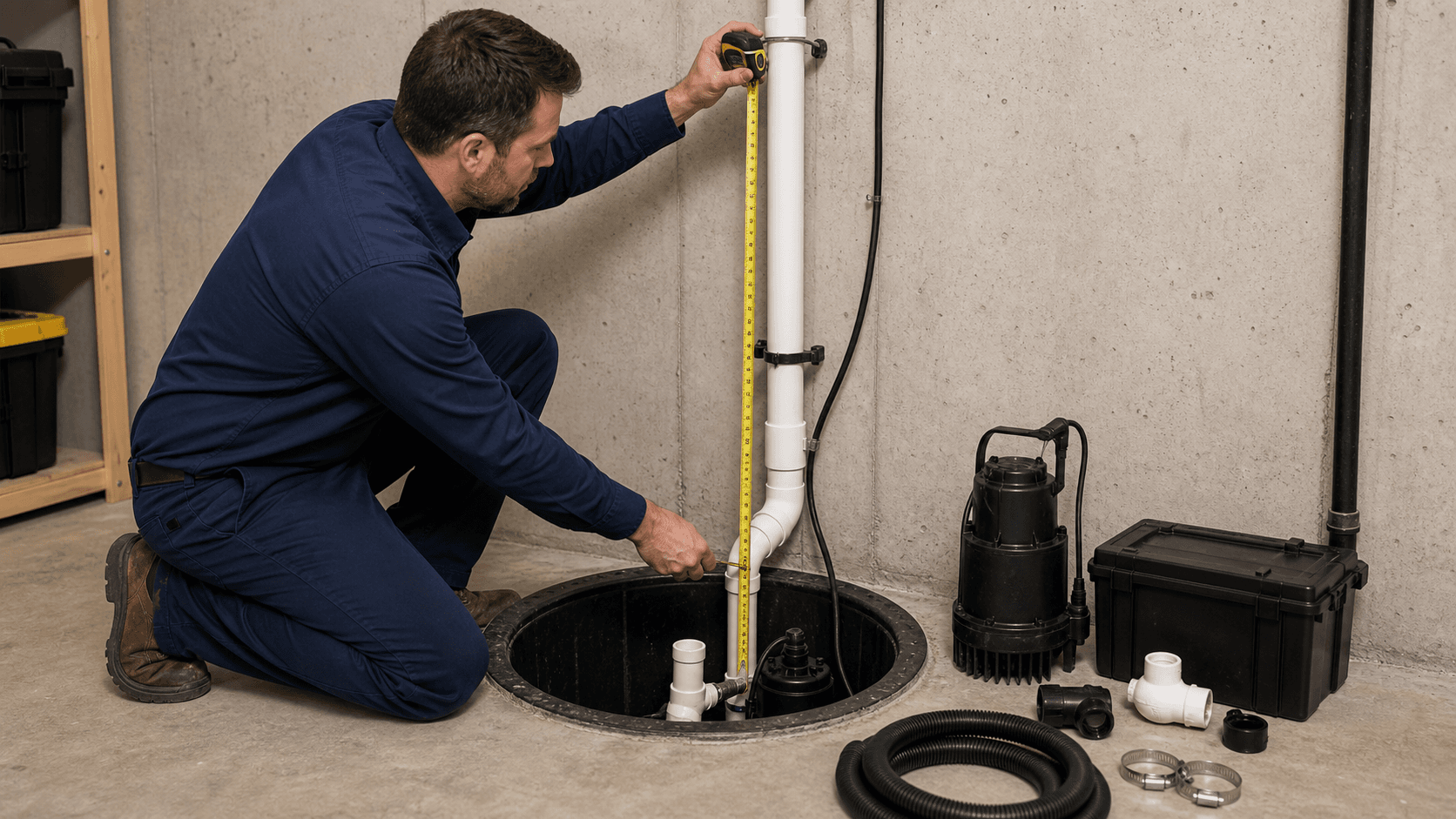
Match the backup's flow to the primary pump at the actual discharge head — around 10 feet in a real install — not the 0-foot catalog rating, because pump flow drops sharply as head rises.
Sizing a backup is about matching flow at the head the pump actually works against, and the single most common mistake is sizing to the zero-foot catalog number. Every installed sump pump has to lift water up out of the pit and out of the house, and that vertical lift plus pipe friction is the total head the pump pushes against — often around 10 feet in a real basement installation. A pump's flow falls steeply as head rises, so the flow that matters is the flow at the real head, not the headline figure measured at zero lift.
The gap between the two numbers is large enough to change the decision. A backup rated at, say, 2,000 gallons per hour at 0 feet may deliver only about 1,000 gallons per hour at 10 feet of head — half its catalog figure — because that is how steeply pump curves drop. Sizing a backup to its 0-foot rating therefore badly overstates what it will actually move in the home, and can leave a backup that looks more than adequate on paper but cannot keep up with the same inflow the primary pump handles.
The right method is to find the primary pump's delivered flow at the installation's actual head and choose a backup that meets or exceeds it at that same head. The backup does not have to match the primary's zero-foot peak; it has to move enough water at the real discharge head to keep the basement dry while the primary is offline. Reading both pumps on their performance at the installed head — not their best-case rating — is what makes the backup an actual substitute rather than a paper one.
Because the inflow during an outage is the worst-case inflow — heavy winter rain and a high water table — the backup should be sized to that worst case at the real head, with headroom rather than just barely enough. A backup that meets the primary's flow at 10 feet of head, and runs long enough to outlast a likely outage, is one that genuinely protects the basement. Getting the head measured and the backup sized to it is part of the work booked as sump pump service in Bellevue.
Backup pump sizing should use the real discharge head, not the zero-foot catalog rating.
Battery backup models and flow at head
Flow drops with head: a Basement Watchdog Emergency moves ~2,000 GPH at 0 ft but 1,000 at 10 ft; the Special CONNECT 2,600/1,850; the Big Dog CONNECT 3,500/2,200, and its two batteries double runtime.
Looking at real model figures shows how steeply flow falls with head and why the at-head number is the one to size against. The Basement Watchdog Emergency battery backup moves about 2,000 gallons per hour at 0 feet of lift but about 1,000 gallons per hour at 10 feet — the flow halves over that realistic head. That is the pattern across these pumps: the catalog peak is at zero lift, and the usable number in a home with around 10 feet of head is substantially lower.
Stepping up the line buys more flow at head. The Basement Watchdog Special CONNECT delivers roughly 2,600 gallons per hour at 0 feet and about 1,850 at 10 feet, a meaningful gain at the head that matters; the Big Dog CONNECT moves about 3,500 gallons per hour at 0 feet and about 2,200 at 10 feet. The CONNECT models add monitoring as well, but for sizing the figure that counts is the at-head flow, where the Big Dog's ~2,200 GPH at 10 feet is what it actually delivers in a real install.
Runtime scales with battery capacity, and the larger systems address the finite-runtime limit directly. The Big Dog CONNECT runs on two batteries, and the second battery roughly doubles the runtime available for a long outage — the relevant feature when the worry is a multi-day windstorm outage rather than a brief one. A two-battery system trades cost and space for the extra hours that a single battery cannot provide, which is the right tradeoff where long outages are the concern.
Choosing among them comes back to the sizing method: pick the model whose flow at the installation's actual head meets or exceeds the primary pump's flow at that head, with runtime enough to outlast a likely outage. A larger basement with high winter inflow and a long-outage risk points toward the higher-flow, two-battery end; a modest installation may be well covered by a smaller unit. Matching the model to the measured head and inflow is part of sump pump service in Bellevue.
Battery vs water-powered backup: which is better?
A battery runs anywhere but is finite (~7 to 8 hours); a water-powered backup runs unlimited on 40 to 60 psi municipal pressure but uses extra water per event and will not work on well water.
The two backup types solve the outage problem in opposite ways, with opposite limits. A battery backup stores energy and pumps on it, so it works anywhere — city water or well, any supply — but it is finite, running roughly 7 to 8 hours of continuous pumping before the charge is spent. A water-powered backup uses the pressure of the municipal water supply to drive an ejector that pumps the pit, so it runs for as long as the outage lasts with no battery to deplete — unlimited runtime, which is its signal advantage.
The water-powered unit's runtime comes with real costs. It needs adequate municipal pressure to work — on the order of 40 to 60 psi — and it moves less water than a strong battery unit, on the order of 800 to 1,500 gallons per hour. It also consumes municipal water while it runs, because it uses incoming water to pump out the pit, which adds a water cost on the order of an extra $20 to $60 of water per flooding event. That water consumption is the price of the unlimited runtime.
The hard limit on the water-powered type is the supply it depends on. A water-powered backup needs pressurized municipal water, so it will not work on a private well — a well's pump is itself electric and goes down with the grid, leaving no pressure to drive the backup. For a home on well water, the water-powered option is off the table and a battery backup is the only choice; for a home on city water with good pressure, the water-powered unit's unlimited runtime is its draw.
The decision is therefore a runtime-versus-constraints tradeoff. A battery backup is simpler, works on any supply, and covers the common multi-hour outage, but it can be outlasted by a long windstorm outage; a water-powered backup runs indefinitely on city pressure but costs extra water per event, moves less flow, will not run on a well, and — as the next section covers — its potable tie-in can require backflow protection. Weighing those against the home's supply and outage risk is part of sump pump service in Bellevue.
Do water-powered backups need backflow protection?
Often yes — a water-powered backup ties into the potable supply, creating a cross-connection between drinking water and the sump pit, which can require a backflow preventer to keep contaminated water from siphoning back.
A water-powered backup works by tapping the home's potable water supply to drive its ejector, and that tap is a cross-connection — a point where the drinking-water system meets a non-potable source, in this case the sump pit and the groundwater it holds. Any cross-connection carries the risk that, under the right pressure conditions, contaminated water could be drawn backward into the potable supply, which is exactly the hazard backflow prevention exists to stop.
The risk in a water-powered backup is that a drop in supply pressure — a main break, heavy demand, or the same storm conditions that triggered the backup — could create back-siphonage that pulls pit water toward the potable lines. Because the backup's whole job is to operate during adverse conditions, the cross-connection it creates is one that can be exposed to exactly the pressure drops that drive backflow, which is why a potable-supply tie-in of this kind can require a backflow preventer on the connection.
What that means practically is that installing a water-powered backup is not just a matter of plumbing in the ejector — it can carry a backflow-protection requirement to isolate the potable supply from the sump pit. The type and necessity of the assembly depend on how the supply is tapped and the local cross-connection rules, which is a code question rather than a product question, and getting it right is what keeps the convenience of the water-powered backup from creating a drinking-water hazard.
Because the backflow side is a code and public-health matter, it is covered in its own depth in our backflow preventer guide, which explains the assembly types, the annual-testing requirement, and who is allowed to test them. A water-powered backup tied into the potable supply should be evaluated for backflow protection as part of the install, not treated as a plumbing afterthought — and that evaluation is part of the work booked as sump pump service in Bellevue.
Where can a backup pump discharge, and what does code require?
A backup discharges to the same approved stormwater outfall as the primary — never the sanitary sewer. Bellevue code (BCC 24.04.215) prohibits connecting groundwater or stormwater to the sanitary sewer.
A backup pump moves the same groundwater as the primary, so the same discharge rule applies: the water must go to an approved stormwater outfall, never the sanitary sewer. Bellevue City Code 24.04.215 prohibits discharging stormwater, groundwater, and other clear-water sources into the sanitary sewer system, and a backup pump emptying the sump pit is moving exactly that clear groundwater. Its discharge has to reach a legal outfall just as the primary pump's does.
In practice a backup is usually tied into the primary pump's discharge line above the check valve, so both pumps share the same path to the approved outfall. That shared routing means a backup added to a compliant system inherits the compliant discharge point — but a backup plumbed to a different, illegal outlet, such as a floor drain connected to the sanitary sewer, would violate BCC 24.04.215 the same way an illegal primary discharge does. The discharge point has to be confirmed legal for the whole system, backup included.
The reason the sanitary-sewer prohibition matters here is the same as for the primary: the sanitary system is for wastewater, not clear groundwater, and loading it with sump flow during a wet-weather event can contribute to surcharging and backups. A backup that runs during a storm — exactly when the sewer system is already stressed by wet weather — must not be the thing dumping additional groundwater into it, which is why the approved stormwater outfall is the required destination.
Getting the backup's discharge, and any water-powered backflow protection, done to code is what separates a proper backup install from a liability. The backup should share the primary's approved stormwater outfall under BCC 24.04.215, any water-powered tie-in should be evaluated for backflow protection, and the whole system should be confirmed compliant rather than assembled piecemeal. That compliant installation is the work booked as sump pump service in Bellevue.
Common questions about sump pump battery backups
A battery backup runs about 7 to 8 hours; water-powered runs unlimited but uses water and won't work on a well; flow drops sharply with head; a backup is close to essential in Puget Sound.
A battery backup runs roughly 7 to 8 hours of continuous pumping on a charge during an outage, which covers a typical multi-hour outage but is finite — a long multi-day windstorm outage can outlast a single battery, which is why two-battery systems exist to roughly double the runtime. Because the pump rarely runs every second, real coverage of an intermittent load stretches somewhat longer than the continuous figure, but planning should assume the worst-case heavy-inflow storm, not the average.
Between water-powered and battery, the answer depends on your supply. A water-powered backup runs unlimited on 40 to 60 psi municipal pressure and moves about 800 to 1,500 GPH, but it consumes extra municipal water — roughly $20 to $60 per flooding event — and it will not work on well water, because a well's pump is electric and goes down with the grid. A battery backup works on any supply but is finite. City water with good pressure favors water-powered for the unlimited runtime; a well requires a battery.
How many gallons per hour you need is set by your primary pump's flow at the actual head, around 10 feet, not the 0-foot rating. Flow drops sharply with head — a Basement Watchdog Emergency moves about 2,000 GPH at 0 feet but 1,000 at 10 feet, the Special CONNECT 2,600/1,850, the Big Dog CONNECT 3,500/2,200 — so the backup must meet or exceed the primary's at-head flow, not its catalog peak. Size to the real head with headroom for worst-case storm inflow.
Yes, a backup is close to essential in western Washington, because the winter windstorms that flood basements are the same storms that cut Puget Sound Energy power, leaving an AC-only pump dead when the water is rising fastest. A water-powered backup that taps the potable supply may also need a backflow preventer, and the backup's discharge must reach an approved stormwater outfall, never the sanitary sewer (BCC 24.04.215). Sizing and installing it to code is handled as sump pump service in Bellevue.
Sources
Every fact in this guide cites a verifiable public source. If you find a number we got wrong, email dispatch@bellevueplumberpro.com.
Need help with this in your home? See our Sump pump service in Bellevue page for pricing, our diagnostic process, and how same-day service works across the Eastside.
Is a battery backup sump pump worth it in the Puget Sound area?
Yes — the winter windstorms that flood basements here are the same storms that cut power, so an AC-only pump can fail at exactly the moment the water rises. A battery backup covers that overlap.
QUESTION02
How long does a sump pump battery backup last?
Roughly 7 to 8 hours of continuous pumping per charge — enough for a typical outage but finite. Match the backup's flow rating to your actual discharge head (around 10 feet in a real install), not the 0-foot catalog number.