Does my Bellevue home need a sump pump?
Most Eastside homes on slopes, in low spots, or with crawlspaces or finished basements should have one — the Puget Sound lowland receives 38 to 50 inches of rain a year, concentrated in November through March.
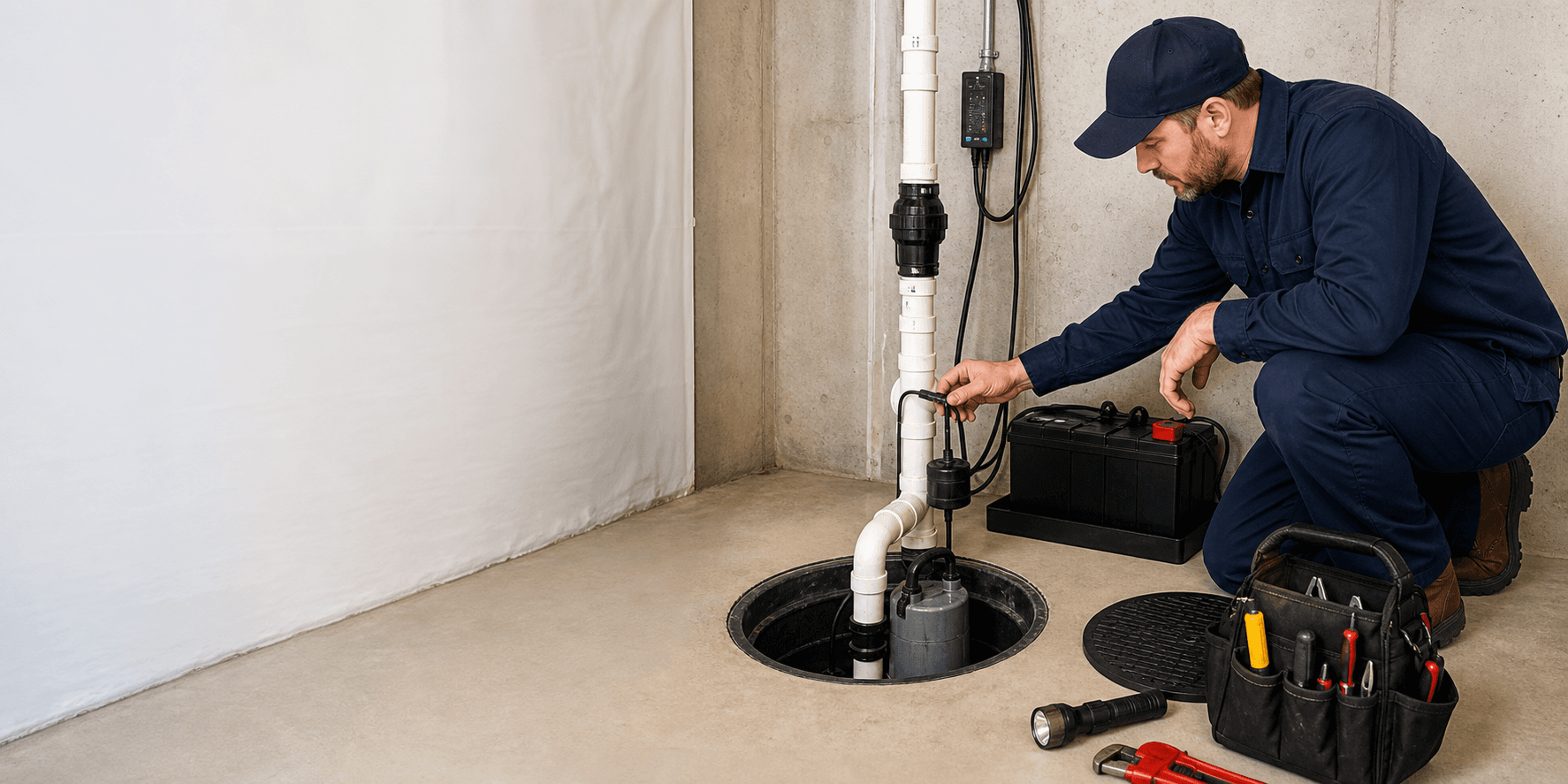
Installing a sump pump is a more involved project than most guides suggest — the basin excavation, the gravel bed, the vapor barrier, the check valve, the discharge line routing, and the backup power setup are each a decision point that affects how well the system works in a real Puget Sound rainy season. This guide covers what goes into a new sump pit installation, how to size a pump for a Bellevue basement or crawlspace, the difference between a pedestal and submersible pump, why a battery backup is more important here than almost anywhere in the country, and what a licensed installation looks like versus a basic sump-pump drop-in.
Last reviewed: 2026-06-13
Most Bellevue and Eastside homes on slopes, in low spots, or with crawlspaces or finished basements should have a sump pump. The Puget Sound lowland receives 38 to 50 inches of rain annually, most of it concentrated in 6 months — and clay-heavy Eastside soils drain slowly, keeping hydrostatic pressure against foundations for weeks after a storm.
The Eastside is wetter than people who moved here from the east coast usually expect — and because the rain arrives as persistent drizzle rather than heavy single-event downpours, foundations see sustained pressure rather than brief spikes. Clay soils in Bellevue, Issaquah, and Sammamish hold water for days after precipitation stops, maintaining hydrostatic pressure against basement walls and crawlspace vapor barriers throughout the October-to-April rainy season.
The triggers that confirm a sump pump is needed: standing water in the crawlspace during or after heavy rain, a damp or musty basement smell in winter, efflorescence (white mineral deposits) on basement walls indicating water wicking through concrete, or a history of basement flooding from a previous owner. Homes in bowl-shaped lots, at the base of slopes, or downhill from impervious surfaces (driveways, roads) that channel runoff toward the foundation are the highest-risk category.
Homes without a sump pump that have any of these indicators are carrying a real financial risk: water damage to finished basements, mold remediation, and foundation repair from sustained moisture. The cost of a properly installed sump system ($1,200 to $2,800 including backup) is a fraction of any of those outcomes. Our sump pump service page covers the full service scope including emergency pump failures during storm events.
The counter-case: a home on a well-drained, flat lot with no history of moisture intrusion, good roof drainage that moves water away from the foundation, and no crawlspace may not need one. If you're unsure, a plumber can assess the crawlspace or basement during a service visit and give an honest opinion — we tell homeowners when the system they have is adequate and when it's not.
This happening in your home right now? A licensed plumber can talk you through the next step on the phone — 24/7, and the call is free.
Call a plumberA 1/2 HP submersible sump pump handles most Bellevue residential applications — it can move 35 to 60 gallons per minute, which exceeds the inflow rate during a normal Pacific Northwest rain event. Larger 3/4 HP pumps are warranted for high-water-table lots or homes that have had flooding. Pedestal pumps are more accessible for maintenance but less suited to the basin flooding a typical Eastside installation sees.
Pump capacity is rated in gallons per hour (GPH) at a given head (vertical rise from the pit to the discharge point). A 1/2 HP submersible rated at 2,160 GPH at 10-foot head moves about 36 gallons per minute — more than enough for the typical residential inflow during a Bellevue winter storm. The key number to size against is the pit fill rate: if the pit is 18 inches in diameter and fills from the bottom to the float trigger in roughly 2 minutes, inflow is about 10 gallons per minute, and a 1/2 HP pump cycling on the inflow provides a 3x safety margin.
Submersible versus pedestal: submersible pumps sit below the waterline in the basin and are cooled by the water they're pumping, which extends motor life in sustained heavy-use scenarios. They're also quieter and fit entirely within the pit, allowing a proper sealed lid that reduces radon infiltration — relevant in parts of the Eastside where radon levels warrant monitoring. Pedestal pumps mount above the pit with only the intake in the water; they're easier to service and last longer in occasional-use applications, but they're noisier and the above-water motor is exposed to basement air. For a regularly-running Eastside installation, submersible is the right choice.
Brand selection: Zoeller, Liberty, and Wayne are the contractor-preferred brands for residential submersible applications — they have stainless steel or cast-iron housings, replaceable wear parts, and track records that justify the $150 to $300 unit price premium over big-box brands. The $89 sump pump from a hardware store has plastic components in the float mechanism and impeller housing that crack faster in sustained use. A sump pump is asked to work hardest exactly when the power goes out and the conditions are worst — this is not the place to economize on the primary unit.
Pit (basin) sizing: a standard residential sump pit is 18 inches in diameter and 24 to 30 inches deep. This is adequate for most applications. Homes with high water table, large foundation drainage areas, or lots where multiple downspouts and French drains converge at one point benefit from a 24-inch diameter pit — the larger volume gives the pump more time to keep up with surge inflow. Basin liner material (corrugated plastic versus solid polymer) matters for long-term water flow into the pit: the liner has holes or slots that allow groundwater to enter while keeping soil out of the pump.
New installation: excavate pit, set gravel bed, install liner, position pump, install check valve on discharge line, route discharge to daylight at least 10 feet from foundation, test float and run cycle. Existing pit retrofit: size-match the new pump, replace check valve if over 5 years old, verify discharge line is clear and terminates properly. Permit required for new pit installations in Bellevue.
New pit installation starts with excavation — a roughly 24-inch-diameter, 30-inch-deep hole in the lowest point of the basement or crawlspace floor, using a rotary hammer and chisel or a rented concrete saw for slab work. The excavated area is lined with 4 to 6 inches of clean crushed gravel that allows water to flow freely into the basin. The pre-formed plastic liner is set in the gravel, leveled, and the excavation backfilled around it. This is the foundation for everything that follows; a poorly leveled or undersized basin causes problems for the pump's lifespan and float operation.
Pump placement and discharge: the pump is set on a few inches of gravel at the basin bottom to keep debris from entering the impeller. The discharge pipe — typically 1.5-inch PVC — exits the basin through the lid, runs to a check valve (essential — prevents backflow into the pit when the pump shuts off, which would immediately re-trigger the float), and then routes through the basement wall to daylight. The discharge terminus must be at least 6 to 10 feet from the foundation and must direct water away from the house, not toward a neighbor's property or a downhill slope that routes back. The discharge line must also have a small weep hole drilled near the check valve to allow trapped air to escape — without it, the discharge column vacuum can hold the check valve closed.
A proper installation includes: the check valve on the discharge, a lid on the pit (sealed with foam tape on the perimeter), a GFCI outlet for the pump (code requirement for basement and crawlspace outlets), and a visible high-water alarm — a battery-operated float alarm that sounds if the pit fills above the pump discharge level. These aren't optional extras; they're the difference between a system that works when you're asleep during a storm and one that floods your basement before you know the pump failed.
The battery backup is the most important element for a Pacific Northwest installation. Puget Sound storms that produce the most ground saturation also produce the most power outages — the pump is needed most exactly when the power is off. A backup system can be a dedicated battery-powered secondary pump (Zoeller Aquanot, Liberty SumpJet) that activates when the primary fails or when water reaches a higher trigger, or a whole-home battery backup or generator that keeps the primary pump running. The backup pump option is $400 to $900 installed and is the single highest-value addition to any Eastside sump installation. Full guide at our sump pump battery backup article.
Replacing an existing sump pump (pump-only, existing pit): $485 to $785 installed. Adding a battery backup to existing system: $485 to $785. New pit installation with pump: $1,200 to $2,200. New pit plus battery backup: $1,600 to $2,800. All prices are flat-rate, include haul-away and labor.
Pump replacement in an existing pit is the most common job and the simplest: disconnect the old pump, pull it from the pit, lower the new one, connect discharge and electrical, test float operation and run cycle. The $485 to $785 range reflects pump selection — a contractor-grade Zoeller M53 or Liberty 257 runs $150 to $250 in materials, and the labor is about 1 to 1.5 hours. Check valve replacement is included if the existing one is more than 5 years old.
Battery backup addition to an existing pit typically involves installing a secondary pump alongside the primary in the same basin, running a separate discharge line (or teeing into the existing), and mounting the battery cabinet nearby. The Zoeller Aquanot and Liberty SumpJet are the two most commonly installed backup systems. Installation runs 2 to 3 hours. The $485 to $785 range for the backup mirrors the primary replacement range because the scope is similar.
New pit installation requires a permit from City of Bellevue for new drainage work — the permit fee is $150 to $300 and is included in the quoted price. The excavation is the labor-intensive part: breaking a concrete slab floor, excavating, setting the basin, and patching concrete around the liner. The patch concrete cures in 24 hours and the pump is operational the same day. The $1,200 to $2,200 range reflects whether the installation is in a basement (slab, easier access) or a crawlspace (limited head clearance, more difficult material removal).
The backup discussion is worth having at the time of any new installation or primary pump replacement. The incremental cost to add a backup system at the same visit ($400 to $700) is roughly half what a second visit would cost, and in an Eastside winter the backup earns its cost in the first real storm. We dispatch for emergency sump pump failures 24/7 — but a backup system means the emergency call becomes a routine replacement rather than a water-damage response.
Every fact in this guide cites a verifiable public source. If you find a number we got wrong, email dispatch@bellevueplumberpro.com.
Need help with this in your home? See our Sump pump service in Bellevue page for pricing, our diagnostic process, and how same-day service works across the Eastside.
Most Eastside homes on slopes, in low spots, or with crawlspaces or finished basements should have one — the Puget Sound lowland receives 38 to 50 inches of rain a year, concentrated in November through March.
A 1/2 HP submersible handles most Bellevue residential applications — 35 to 60 gallons per minute, which exceeds the inflow rate of a normal Pacific Northwest storm event.