How much does sump pump replacement cost?
Roughly $645 to $2,121 installed, averaging about $1,365 — covering the pump, install labor, and any parts the job needs. Labor alone typically runs $300 to $600 depending on pit access and discharge work.
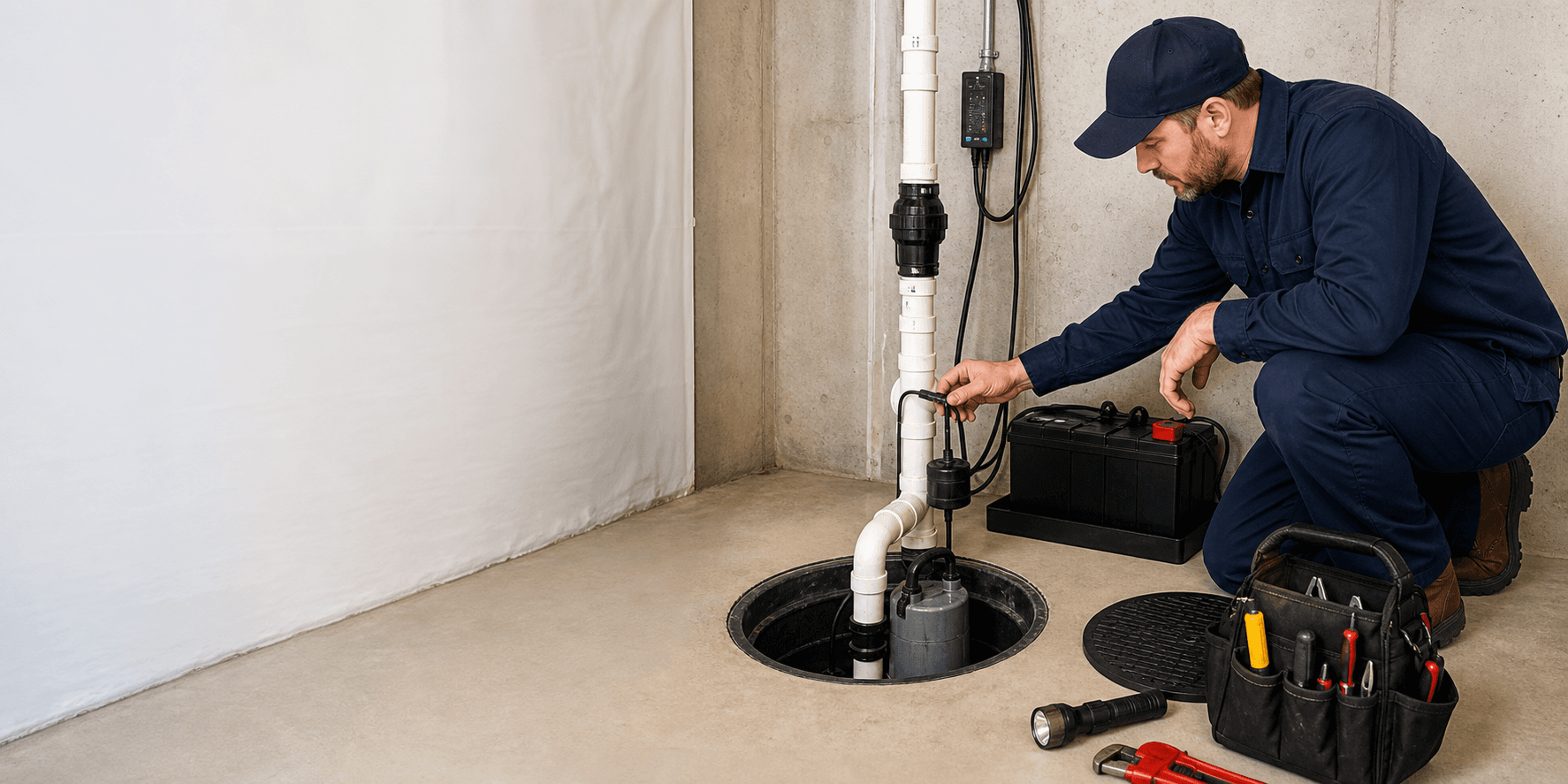
Sump pump replacement runs roughly $645 to $2,121 installed, with an average around $1,365, covering the pump, labor, and parts. The pump itself splits by type: a pedestal unit runs about $60 to $250 and a submersible about $200 to $900, with install labor adding $300 to $600 at $45 to $200 per hour. Most homes are well served by a 1/3 HP pump — the Zoeller M53 is a 1/3 HP unit rated to 43 GPM — while higher head or heavy inflow may call for 1/2 to 3/4 HP. Pumps last 7 to 10 years on average; submersibles run 5 to 15 years and pedestals up to 25. The repair-or-replace line is age and pattern: 7 to 10-plus years, short-cycling, rust and noise, or a failure mid-storm point to replacement, while a single bad part under 5 years is a repair. Eastside pumps wear faster because they run hard against about 42 inches of rain a year, per BestPlaces. This guide covers cost, type, labor, HP, lifespan, add-ons, and the repair-versus-replace call.
Last reviewed: 2026-08-22
Sump pump replacement runs roughly $645 to $2,121 installed, with an average around $1,365 — covering the pump, the install labor, and any parts the job needs.
The installed cost of replacing a sump pump falls in a broad range of about $645 to $2,121, with an average near $1,365. That range is wide because it bundles three variables — the pump itself, the labor to install it, and any parts or modifications the job requires — and each can land at the low or high end. A straightforward swap of a like-for-like pump in an accessible pit sits toward the lower part of the range, while a job that adds capacity, fixes the pit, or includes backup features climbs toward the top.
The pump is the first variable, and it splits sharply by type. A pedestal pump, with its motor mounted above the pit on a column, is the cheaper unit at roughly $60 to $250; a submersible pump, sealed to sit down in the water, runs about $200 to $900. That difference in the unit cost alone moves the total, before any labor, which is why the pedestal-versus-submersible choice covered below is one of the main levers on price.
Labor is the second variable, generally adding $300 to $600 to the job at rates of about $45 to $200 per hour depending on the plumber and the complexity. A pump in an accessible basement pit with a clean discharge connection is quick; a pump in a tight or awkward location, or one needing discharge or electrical rework, takes longer and costs more. The third variable is parts and add-ons — a new check valve, a battery backup, smart monitoring — which stack on top of the base swap.
Set against the alternative, the cost is modest for the protection it buys. A failed sump pump in a Puget Sound winter means a flooded basement, and the cost of water damage to finished space, flooring, and stored belongings dwarfs the price of the pump. Spending in the low four figures to keep a basement dry through the wet season is small next to a single flooding event, which is why a pump at the end of its life is replaced proactively rather than run to failure. Replacement is booked as sump pump service in Bellevue.
This happening in your home right now? A licensed plumber can talk you through the next step on the phone — 24/7, and the call is free.
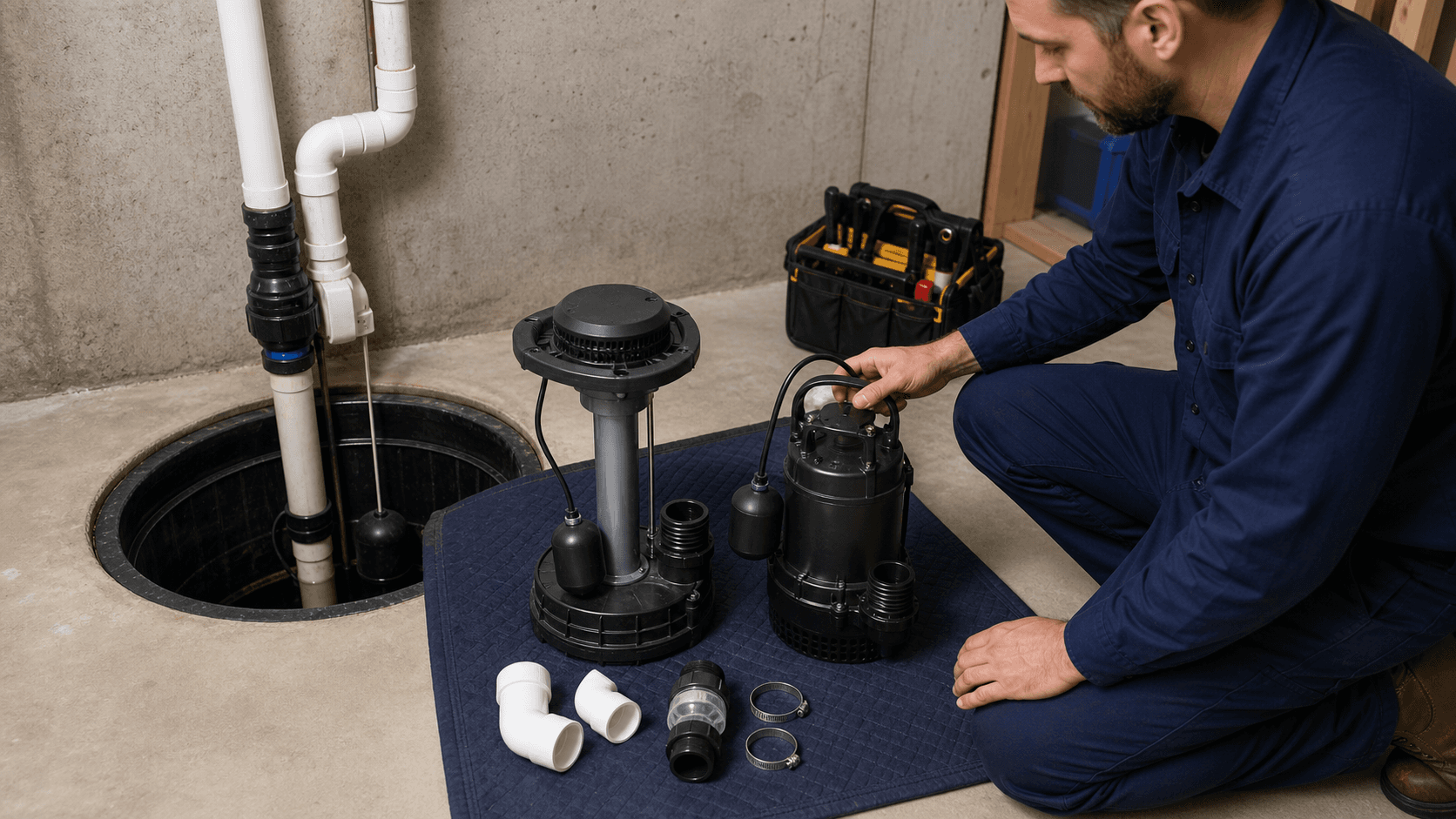
Call a plumberPedestal pumps are cheaper — about $60 to $250 versus $200 to $900 for a submersible — but submersibles run quieter, handle solids better, and often last as long or longer.
The pedestal pump is the cheaper of the two types, with the unit running about $60 to $250 against a submersible's $200 to $900. A pedestal mounts its motor on a column above the pit, with only the intake down in the water, which keeps the motor dry and makes it easy to service or replace — and that simpler, exposed construction is part of why it costs less. For a homeowner focused on the lowest unit price, the pedestal is the budget choice.
The submersible costs more because it is built to sit down in the water, sealed against it. That sealed, oil-filled construction is more involved than a pedestal's exposed motor, and it is what lets the pump run submerged, quieter, and out of sight in the pit. The higher unit price buys a pump that handles solids better through its design, runs more quietly because the water muffles it, and takes up no space above the pit — advantages that matter in a finished or frequently used basement.
Lifespan does not strongly favor the cheaper option, which complicates the pure-price comparison. A submersible runs about 5 to 15 years and a pedestal can run up to 25, so the pedestal's longer potential life can offset its being the budget unit — but the submersible's quieter, solids-tolerant, out-of-the-way operation is why many homeowners choose it despite the higher price. The choice is less about which is cheaper to buy and more about which fits the basement and the inflow.
For most replacements the decision comes down to the basement and the budget rather than a clear winner. A pedestal is the lower-cost unit and easy to service; a submersible costs more but runs quieter and handles a working pit better. The total installed cost shifts with the type chosen, on top of the labor and add-ons, and matching the type to the home is part of the sizing done in sump pump service in Bellevue.
Install labor runs about $300 to $600, at roughly $45 to $200 per hour, depending on the plumber, the pit's accessibility, and whether the discharge or electrical needs rework.
Labor on a sump pump replacement generally runs $300 to $600, billed at roughly $45 to $200 per hour depending on the plumber and the market. The spread in the hourly rate reflects the range from a general handyman rate to a licensed plumber's rate, and the total depends on how many hours the specific job takes — which is driven by accessibility and how much beyond the pump swap the work involves.
A clean swap is the low end of the labor range. When the existing pit is in good shape, the pump is accessible in an open basement, and the discharge connection and outlet are sound, replacing the pump is largely a matter of disconnecting the old unit, fitting the new one, reconnecting the discharge, and testing — a job measured in an hour or two. That straightforward case is what lands near the bottom of the $300 to $600 labor band.
Complications push the labor up. A pump in a tight or awkward location takes longer to reach and work on; a discharge line that needs rerouting or a new check valve adds plumbing; a sump outlet that needs a GFCI or a dedicated circuit adds electrical coordination; and a pit that needs cleaning or modification adds time. Each of these turns a quick swap into a longer job, which is why the labor figure is a range rather than a fixed number.
Because labor is a meaningful share of the total, getting the scope right matters to the price. A homeowner replacing a like-for-like pump in an accessible pit pays near the low end; one upgrading capacity, fixing discharge or electrical, or adding a backup pays more in both labor and parts. Confirming what the job actually needs — and that the discharge is legal, never tied to the sanitary sewer — is part of the assessment in sump pump service in Bellevue.
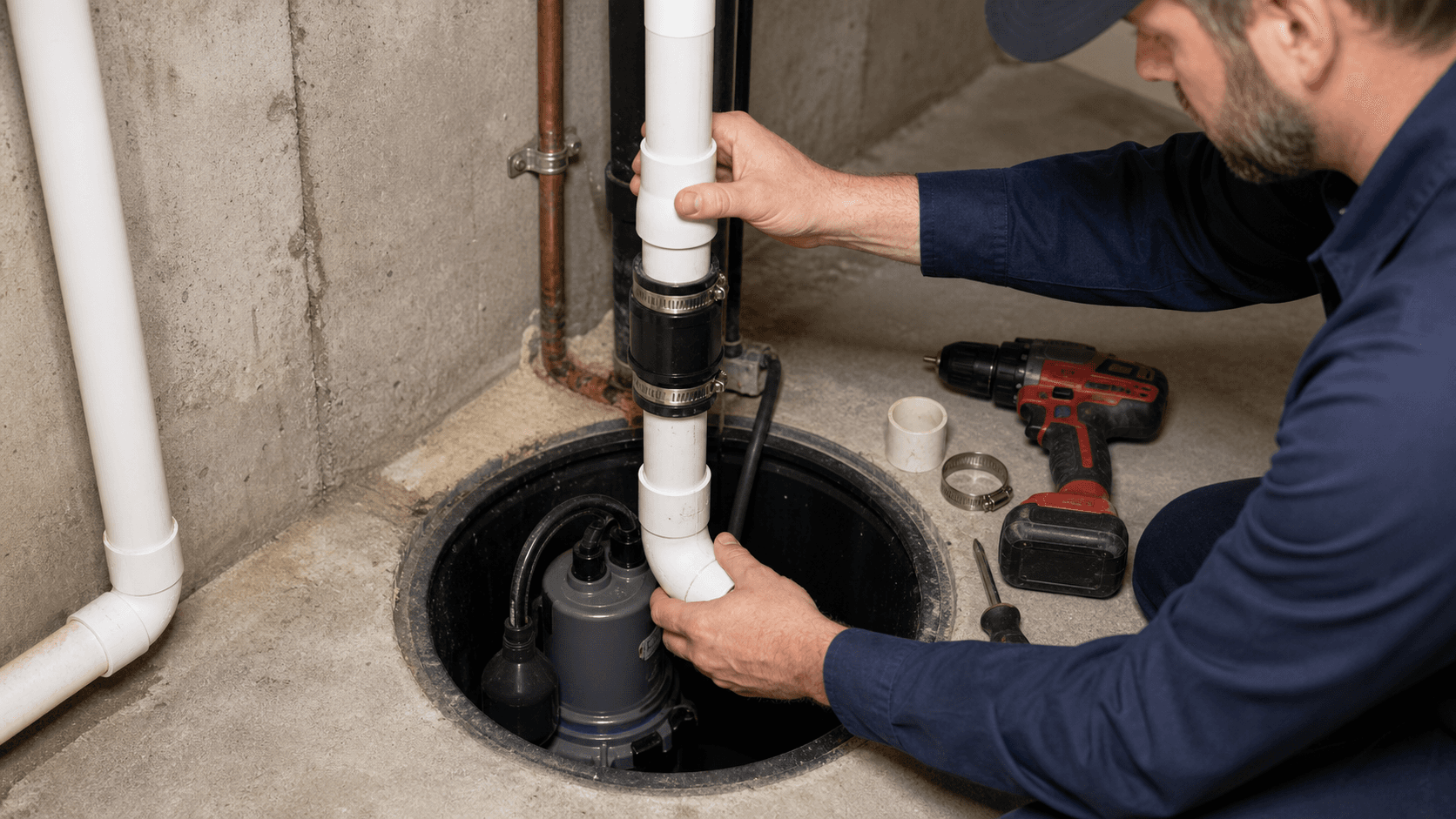
A 1/3 HP pump suits most homes — the Zoeller M53 is a 1/3 HP unit rated to 43 GPM — while higher head or heavy inflow may call for 1/2 to 3/4 HP.
For most homes a 1/3 horsepower sump pump is the right size, and it is the most common residential choice for good reason. A 1/3 HP unit moves plenty of water for a typical basement at a typical head, which is why a workhorse like the Zoeller M53 — a 1/3 HP submersible rated to 43 gallons per minute at zero lift — is a standard pick. For an average pit, average inflow, and average head, stepping up in horsepower buys capacity the home will not use.
Horsepower matters because it determines how much water the pump can move against head, and head is the variable that scales the requirement up. A home with a deeper pit, a longer or higher discharge run, or simply more vertical lift works the pump harder, and at higher head a 1/3 HP pump's delivered flow drops — so a 1/2 to 3/4 HP pump may be needed to keep adequate flow at that head. The higher horsepower is about overcoming more head, not just a bigger basement.
Heavy inflow is the other reason to size up. A home with a high winter water table and fast groundwater inflow during storms needs a pump that can move water faster than it comes in, and if a 1/3 HP unit at the home's head cannot stay ahead, a larger pump is warranted. This ties directly to the real-world flow-at-head numbers: the catalog rating is at zero lift, and the delivered flow at the actual head is what has to beat the worst-case inflow.
Oversizing has its own downside, so bigger is not automatically better. A pump much larger than the pit and inflow can draw the pit down so fast that it short-cycles, snapping on and off and wearing itself out. The goal is to match horsepower to the home's head and inflow — 1/3 HP for most, 1/2 to 3/4 HP for higher head or heavy inflow — which is the sizing judgment made in sump pump service in Bellevue.
Sump pumps last about 7 to 10 years on average; submersibles typically run 5 to 15 years and pedestals up to 25, with how hard the pump runs being the biggest factor.
The average sump pump lasts on the order of 7 to 10 years, which is the planning figure to use for when a replacement is likely due. That average spans the two types, which age differently: a submersible typically runs 5 to 15 years, and a pedestal can run up to 25 years thanks to its motor sitting dry above the pit rather than submerged. The pedestal's longer potential life is one of the tradeoffs against its other limitations.
What drives the spread within those ranges is how hard the pump has to work. A pump that cycles constantly against a high water table through long wet winters racks up far more run hours and starts than one that runs occasionally, and run hours are what wear the motor, the switch, and the seals. Two identical pumps can land at opposite ends of their range purely because one sits in a wet pit that keeps it running and the other rarely turns on.
Failure mode also shifts with the type and the wear. A submersible's sealed motor eventually fails from age and run hours, and because it is sealed it is replaced rather than repaired; a pedestal's exposed motor is easier to service but its switch and bearings wear in the open air. Either way, a pump approaching the upper end of its range is on borrowed time, and one that has started short-cycling, rusting, or running noisily is signaling the end regardless of its exact age.
The practical use of the lifespan figure is to replace proactively rather than at failure. A pump at 7 to 10-plus years, especially one showing wear, is replaced before the wet season rather than left to fail during a storm when a flooded basement is the cost. Knowing the average life and watching for the end-of-life signs is what lets a homeowner schedule a planned replacement through sump pump service in Bellevue instead of an emergency one mid-flood.
Common add-ons are a battery backup, Wi-Fi monitoring, and water-level sensors — each adds parts and labor on top of the base pump swap, pushing a full system toward the high end of the range.
Beyond the base pump and labor, several add-ons push a replacement toward the high end of the cost range, and the biggest is a battery backup. Adding a backup pump and battery is a substantial extra — it is a second pump, a battery, and the plumbing and wiring to integrate it — but in a Puget Sound basement it is the add-on that addresses the power-outage risk a single AC pump cannot. It is the most consequential upgrade and the one most worth its cost in this climate.
Smart monitoring is a second common add-on. Wi-Fi-connected pumps and controllers, like the CONNECT-series backups, alert a homeowner's phone when the pump runs, when the battery is low, or when a high-water condition occurs — turning a silent failure into a notification. That connectivity adds to the unit cost, but it directly addresses the problem of a pump failing unnoticed until the basement floods, which is why it is a popular addition on a system being replaced anyway.
Water-level sensors and high-water alarms are a third. An independent sensor that sounds an alarm or sends an alert when the water rises above a set level provides a warning that does not depend on the pump's own switch, catching a stuck float or a failed pump before the water gets out of hand. It is a relatively inexpensive add that adds a layer of warning to the system, and it stacks onto the base swap like the other upgrades.
Because each add-on adds parts and labor, a full system — a quality submersible plus a battery backup, monitoring, and sensors — lands toward the top of the $645 to $2,121 range, while a bare like-for-like swap sits near the bottom. The add-ons are where the homeowner decides how much protection to build in, and the most valuable in this climate is the battery backup. Specifying and integrating the add-ons is part of sump pump service in Bellevue.
Eastside pumps run hard against about 42 inches of rain a year, per BestPlaces, concentrated in winter — so they accumulate run hours fast and reach the end of their 7 to 10-year life sooner.
Sump pumps on the Eastside tend to reach the end of their life on the early side because they simply run more, and they run more because of the climate. Bellevue gets about 42 inches of rain a year, per BestPlaces climate data, and that rain is concentrated in the wet winter months rather than spread evenly — so a sump pump here works hard through long, saturated stretches when the water table is high and the pit refills fast. More inflow means more run hours, and run hours are what wear a pump out.
The concentration of the rain matters as much as the total. A region that received the same 42 inches spread evenly through the year would work its sump pumps gently and continuously; a region that gets most of it from November through February works them hard in bursts, with pumps cycling heavily through the wet season. That heavy seasonal duty cycle is what pushes an Eastside pump toward the early end of the 7 to 10-year average rather than the late end.
Run hours translate directly into wear on the parts that fail. Every cycle is a start on the motor and the switch and a stroke on the seals, and a pump cycling through a wet Puget Sound winter accumulates those at a rate that ages it faster than a pump in a dry climate. The same model that might run 15 years in a dry basement can land at the lower end of its range here because the wet-season inflow keeps it working.
The practical consequence is that Eastside homeowners should treat the lifespan figures as the early end of the range and plan replacement accordingly. A pump approaching 7 to 10 years that has worked hard through several wet winters is a candidate for proactive replacement before another storm season, ideally with the discharge confirmed legal — never tied to the sanitary sewer (BCC 24.04.215) — as part of the job. That planned replacement is booked as sump pump service in Bellevue.
Five steps: a bucket-test of the failing pump confirms the failure mode (power, float, check valve, or motor), a flat-rate written quote covers pump and any add-ons, the old pump is pulled and the pit cleaned, the new pump is set with a fresh check valve, and the finished system is bucket-tested and put on the September inspection calendar.
"Pull the pit lid before you quote," says the sump lead on our network. "Half the 'bad pump' calls are a float tangled in debris or a check valve that gave up — the diagnosis is cheaper than the replacement."
What the visit looks like:
Replacement runs about $645 to $2,121 (avg $1,365); pedestals are cheaper than submersibles; pumps last 7 to 10 years; labor is $300 to $600; 1/3 HP suits most homes; and a backup adds cost.
Replacing a sump pump costs roughly $645 to $2,121 installed, averaging about $1,365, with the spread driven by the pump type, the install labor, and any add-ons. A like-for-like swap of a basic pump in an accessible pit sits near the low end; a quality submersible with a battery backup, monitoring, and sensors lands near the top. The cost is modest against a flooded basement, which is why an end-of-life pump is replaced proactively.
A pedestal pump is cheaper than a submersible — about $60 to $250 for the unit versus $200 to $900 — because its motor sits dry above the pit on a simpler exposed column. The submersible costs more but runs quieter, handles solids better, and sits out of the way in the pit, which is why many homeowners pay more for it despite the pedestal's longer potential life of up to 25 years.
Sump pumps last about 7 to 10 years on average, with submersibles running 5 to 15 years and pedestals up to 25, and how hard the pump runs is the biggest factor — Eastside pumps working against about 42 inches of rain a year, per BestPlaces, tend toward the early end. Install labor runs $300 to $600 at $45 to $200 per hour, more if the pit is awkward or the discharge and electrical need rework.
Most homes need a 1/3 HP pump — the Zoeller M53 is a 1/3 HP unit rated to 43 GPM — with 1/2 to 3/4 HP reserved for higher head or heavy inflow. And yes, a battery backup adds meaningful cost as a second pump, battery, and integration, but in a Puget Sound basement it is the add-on most worth its price, since the windstorms that flood basements are the same ones that cut power. Replacement and sizing are handled as sump pump service in Bellevue.
Every fact in this guide cites a verifiable public source. If you find a number we got wrong, email dispatch@bellevueplumberpro.com.
Need help with this in your home? See our Sump pump service in Bellevue page for pricing, our diagnostic process, and how same-day service works across the Eastside.
Related services: Water Main Repair.
Roughly $645 to $2,121 installed, averaging about $1,365 — covering the pump, install labor, and any parts the job needs. Labor alone typically runs $300 to $600 depending on pit access and discharge work.
Pedestal pumps are cheaper (about $60–$250 vs $200–$900 for submersible) but submersibles run quieter, handle solids better, and often last as long or longer. For a finished basement, the quieter submersible usually wins.
A 1/3 HP pump suits most homes — the Zoeller M53 is a 1/3 HP unit rated to 43 GPM. High head (tall discharge runs) or heavy inflow calls for 1/2 to 3/4 HP.
About 7 to 10 years on average. Submersibles typically run 5 to 15 years, pedestals up to 25 — and how hard the pump works (duty cycle) is the biggest factor of all.