Home/Learn/Sump pumps/Sump pump not working: 5 causes, the bucket test, and fixes in Bellevue
Sump pumps
Sump pump not working: 5 causes, the bucket test, and fixes in Bellevue
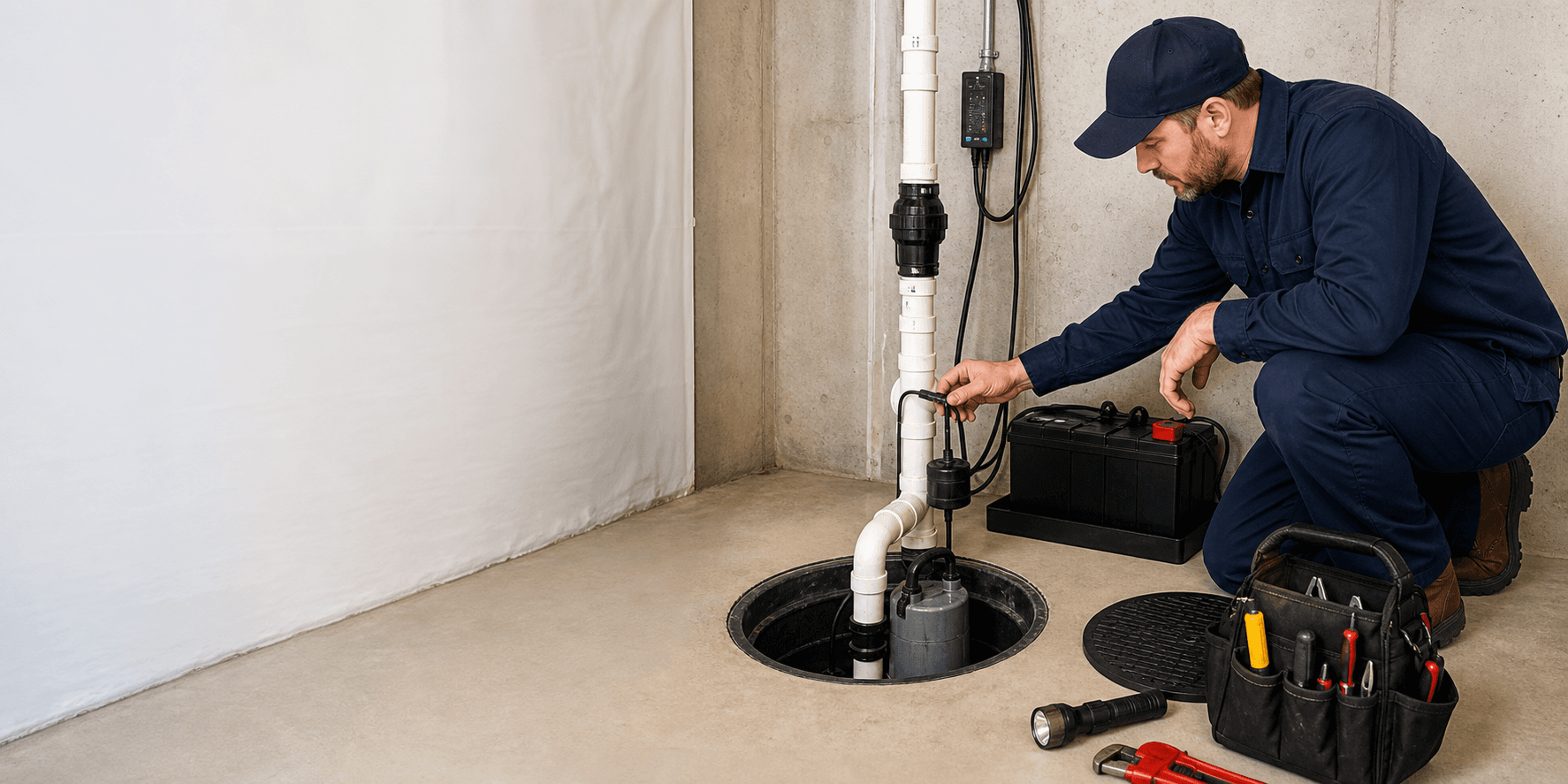
A sump pump that has stopped working has a short list of causes: it has lost power, its float switch is stuck, its intake screen or impeller is clogged, its check valve has failed, or its motor has burned out. The fastest diagnosis is the bucket test — pour about five gallons of water into the pit and watch whether the float rises, the pump kicks on, and the water leaves and stays gone. From there each failure has a distinct signature: no hum at all points to power, a hum with no pumping points to a jam, and water that runs right back into the pit points to the check valve. The stakes are highest in the wettest months, because the Eastside windstorms that drive the most basement flooding are the same storms that knock out Puget Sound Energy power to an AC-only pump. This guide gives the five causes, the bucket test, how to clear each fault, when a burned motor means replacement, and one code point that governs where the water is allowed to go: a sump discharge in Bellevue must never be connected to the sanitary sewer.
A dead sump pump is one of five things: no power, a stuck float switch, a clogged intake or impeller, a failed check valve, or a burned-out motor — and each leaves a different clue.
When a sump pump does nothing as the pit fills, the cause is almost always one of five failures, and they sort cleanly by symptom. The first is no power — the pump is unplugged, its outlet has tripped, or a breaker is off — and the tell is total silence, no hum and no movement. The second is a stuck float switch, where the float that should rise with the water has hung up and never signals the pump to start, which is the single most common reason a sump pump sits idle in a full pit.
The third and fourth causes let the motor try but stop the water. A clogged intake screen or a jammed impeller produces a pump that hums or buzzes but moves no water, because the motor is energized but the flow path is blocked. A failed check valve produces the opposite illusion of failure: the pump runs and empties the pit, but the column of water in the discharge pipe drains straight back down through the dead valve, refilling the pit so the pump seems never to win.
The fifth cause is a burned-out motor, which is the terminal one. A sump-pump motor that has overheated, seized, or shorted is done, and on a sealed submersible unit there is nothing to service — the pump is replaced rather than repaired. The bucket test below separates these five quickly, because each failure shows itself the moment water hits the pit: no reaction at all, a float that does not rise, a hum with no flow, or water that comes right back.
Sorting which of the five you have is what keeps a fix from becoming a guess, and it matters most when the weather is worst. The Eastside's heaviest basement-flooding risk comes during winter windstorms, and those same storms knock out grid power — so a pump that fails the instant it is needed is a common and dangerous scenario the diagnosis below is built around. The fix can be as simple as resetting an outlet or as final as swapping a dead unit, but you only know which after the bucket test names the cause.
A dead sump pump diagnosis checks power, float movement, intake, check valve, and motor.
This happening in your home right now? A licensed plumber can talk you through the next step on the phone — 24/7, and the call is free.
Pour about five gallons of water into the pit and watch: the float should rise, the pump should switch on, the water should leave fast, and it should not come back.
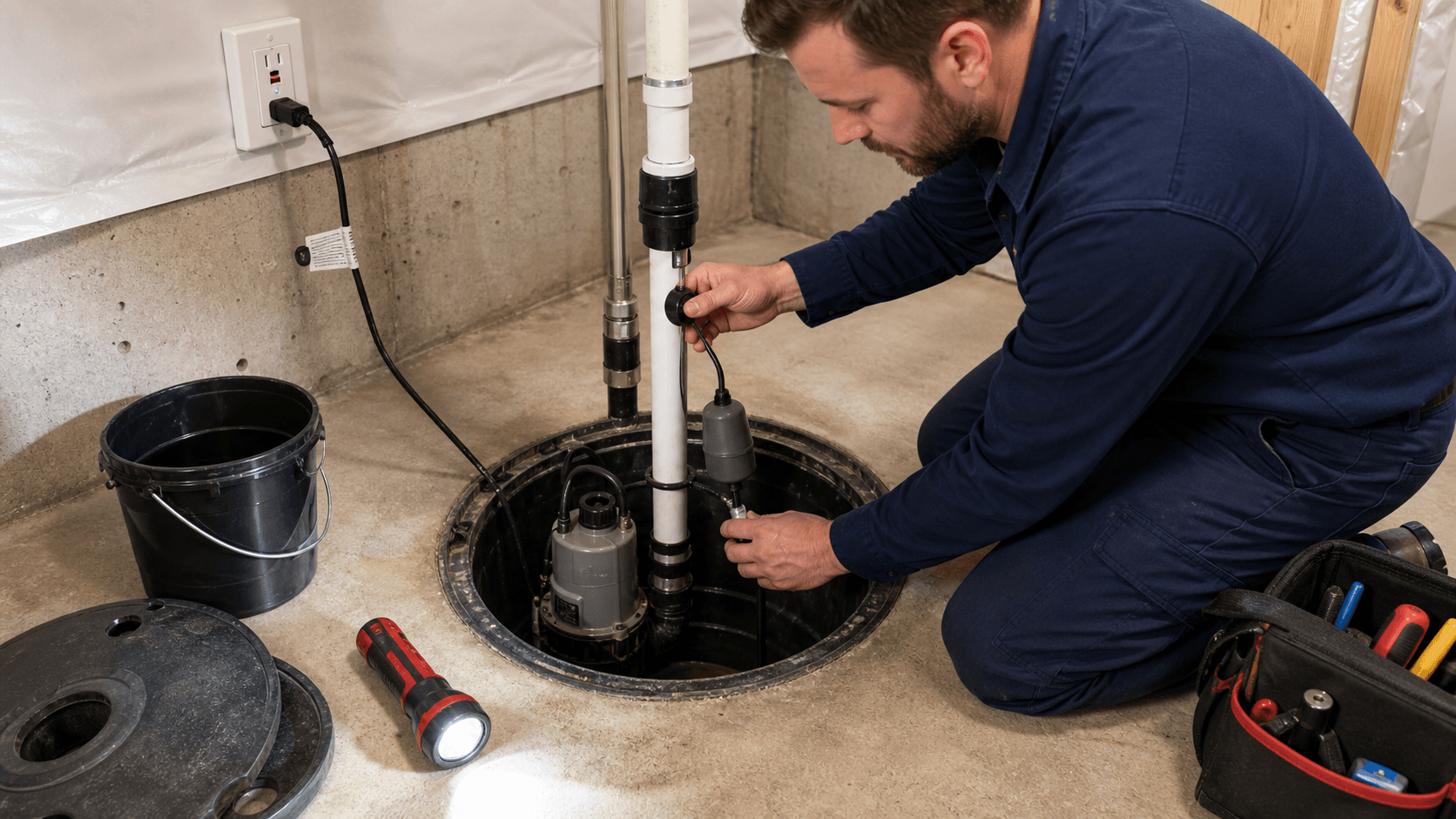
The bucket test is the single most useful diagnostic for a sump pump, and it needs nothing but a five-gallon bucket of water. Pour the water slowly into the sump pit and watch the float rise; as it reaches the trigger level, a working pump should switch on by itself. This recreates the exact condition a storm produces — a rising water level in the pit — without waiting for rain, so you can test the pump deliberately on a dry day rather than discovering a failure mid-flood.
What you watch for is a sequence of four things, and a failure at any step names the problem. First, the float should rise freely with the water; a float that hangs up or stays down is a stuck-float fault. Second, the pump should start when the float trips; a float that rises but no motor responds points at power or the switch. Third, the water should leave the pit quickly; a motor that hums but does not lower the water points at a clog or a dead impeller. Fourth, the water should stay gone.
That fourth step is the check-valve test. After the pump shuts off, watch the pit for a few seconds: if water rushes back in and the level climbs again, the column standing in the discharge pipe is draining back down through a failed or missing check valve. A healthy system holds the water up in the pipe and the pit stays empty; a system that refills itself the moment the pump stops has a check-valve problem regardless of how strong the pump runs.
Running the bucket test on a dry day is the whole point — it turns a pump from an unknown into a verified one before the storm that will test it for real. It is worth doing at the start of the wet season and after any work on the pump, because a pump that passes the bucket test will lift, switch, pump, and hold, while a pump that fails one of the four steps has told you exactly which of the five causes to chase. For a system you cannot get to pass, the work is booked as sump pump service in Bellevue.
Sump pump has no power
No hum at all usually means power: a tripped GFCI outlet, a tripped breaker, or a plug knocked loose. A Zoeller M53 draws about 9.7 amps at 115 volts, so a marginal circuit can trip.
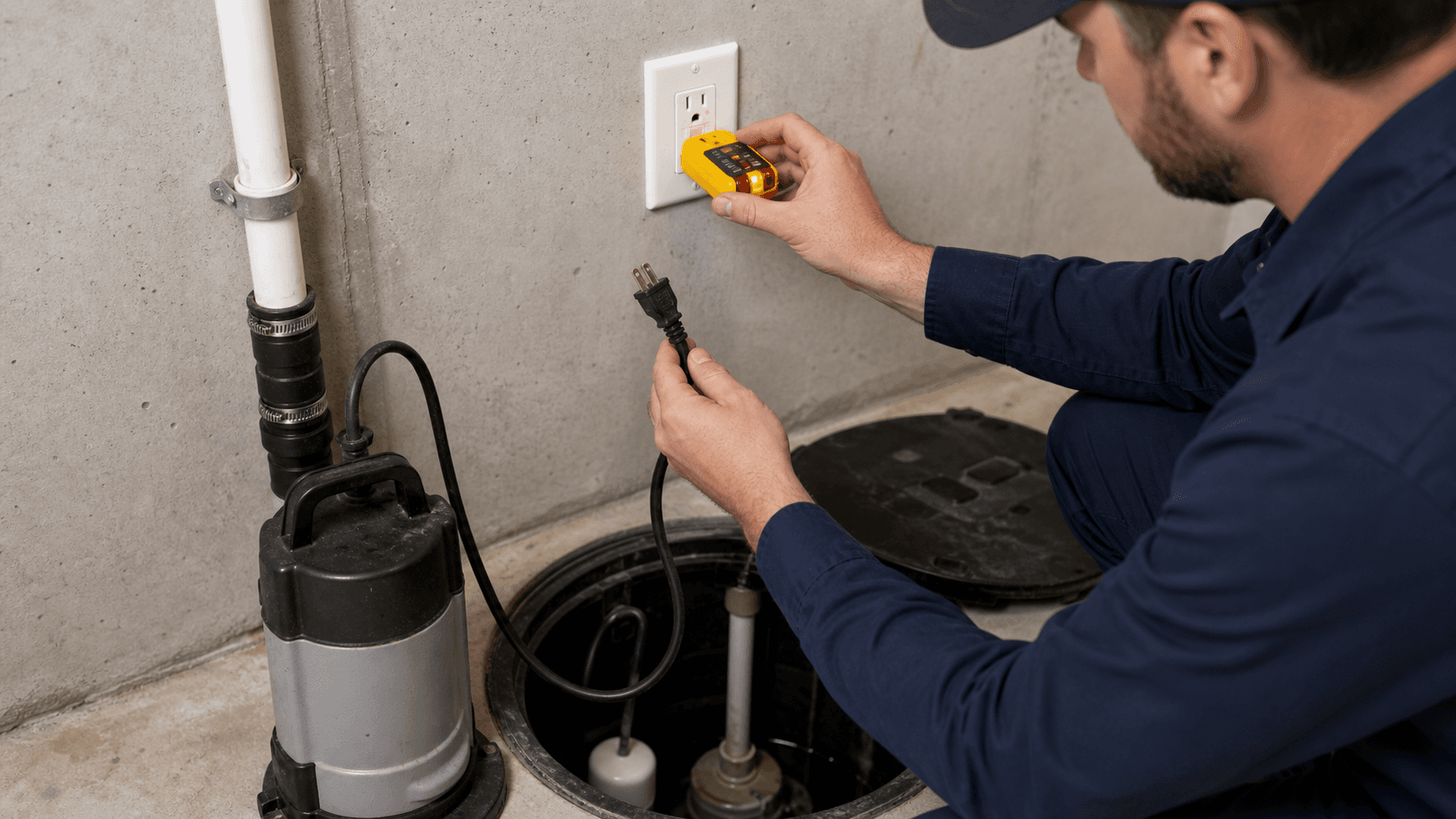
When the pump is completely silent during the bucket test — no hum, no buzz, no movement — the first suspect is power, and the checks are quick. Confirm the pump is actually plugged in, because a cord can be bumped loose during storage or cleaning around the pit. Then check the outlet: many sump outlets are GFCI-protected, and a tripped GFCI cuts power silently, so pressing its reset button can restore the pump in seconds. Finally check the breaker panel for a tripped breaker on the sump circuit.
The GFCI is worth understanding because it is both a safety feature and a common false-failure. A residual-current device cuts power the instant it senses current leaking to ground, which protects against shock around a wet pit, but it can also trip on moisture or a nuisance fault and leave a perfectly good pump dead with no obvious sign. A pump found silent with a tripped GFCI is often fixed by the reset alone — but a GFCI that trips repeatedly is signaling a real ground fault in the pump or wiring that needs to be diagnosed, not just reset again.
Current draw is the reason a marginal circuit can be the hidden cause. A common residential sump pump such as the Zoeller M53 draws about 9.7 amps at 115 volts when running, which is a substantial load, so a sump sharing a circuit with other loads, or fed by a long or undersized run, can trip its breaker under the startup surge. A pump that runs fine until a storm makes it cycle hard, then trips, can be hitting that limit rather than failing mechanically.
Power is the right first check precisely because it is the cheapest and most common, and it ties directly to the storm-season risk. The same winter windstorms that flood Eastside basements knock out grid power, so an AC-only pump can be perfectly healthy and still sit dead because the outlet has no power at all — which is the case the battery-backup guide addresses. If the outlet is live, the breaker is on, the GFCI is reset, and the pump is still silent, power is ruled out and the fault moves to the float or the motor.
No hum from the pump often means the problem is the outlet, breaker, or plug.
Sump pump float switch is stuck
A stuck float is the most common sump-pump failure: the float that should rise with the water hangs up against the pit wall, debris, or its own tether, so the pump never gets the start signal.
The float switch is the part that tells a sump pump when to run, and a stuck float is the most common single reason a pump fails to start. The float rides on the rising water and, at a set level, closes the switch that powers the motor; if the float cannot rise — because it is wedged against the pit wall, fouled by debris, or tangled on its own cord or tether — the switch never closes and the pump never starts, no matter how high the water gets. The pit fills and the pump sits there, fully powered but never told to run.
In the bucket test, a stuck float has an unmistakable signature: water rises but the float does not, and the pump stays silent. A tethered float can hang up on the pump body or the pit wall in a pit that is too narrow or cluttered; a vertical float can bind on its rod if grit works into the guide. Sediment and small debris that settle into the pit over time are a frequent culprit, gluing the float in place or jamming its travel so it no longer floats freely.
Freeing a stuck float is often the entire fix. Clearing debris out of the pit, repositioning the pump so a tethered float has room to swing, and untangling the float cord can restore normal operation with no parts at all. A float that is cracked and waterlogged, or a switch that no longer closes even when the float rises, is a worn switch that needs replacement — but a great many idle pumps are simply floats that hung up and need the pit cleared and the float given room.
Because the stuck float is both the most common failure and one of the cheapest to prevent, it is the strongest argument for testing the pump before the wet season rather than during it. A float fouled by a season's worth of sediment will fail silently the first time the pit fills in a storm, exactly when it is needed most. The bucket test catches it on a dry day; a pump whose float keeps sticking despite a clean pit, or whose switch has failed, is booked as sump pump service in Bellevue.
Sump pump hums but does not pump
A pump that hums but moves no water has a blocked flow path: a clogged intake screen at the bottom, or a jammed impeller — often the vortex impeller fouled by debris from the pit.
A sump pump that hums or buzzes but does not lower the water in the pit is energized but blocked — the motor is getting power, but the water cannot move through. The two places the flow path jams are the intake and the impeller. The intake screen at the base of the pump can clog with the silt, gravel, and debris that collect in the bottom of the pit, choking off the water before it ever reaches the pump body. A starved pump hums against a closed inlet and moves nothing.
The impeller is the other jam point, and on many submersible sump pumps it is a vortex impeller designed to pass small solids. Even so, a stone, a chunk of debris, or accumulated grit can wedge the impeller so it cannot spin, and a motor straining against a jammed impeller hums or buzzes without turning. This is a different failure from a clog at the screen, but it presents the same way in the bucket test — the pump makes noise and the water does not drop — and both trace to debris in the pit reaching parts that should stay clear.
Clearing the jam means getting to the blocked part, which on a submersible pump means lifting it out of the pit. With power off, the pump is removed and the intake screen cleared of the silt and debris choking it; if the screen is clean and the pump still jams, the impeller is checked for a stone or debris locking it. Keeping the pit clean of sediment is the prevention — a pit allowed to fill with grit feeds the very debris that clogs the screen and fouls the impeller.
The hum-without-pumping symptom is worth distinguishing from the silent failures, because it changes the suspect entirely. Silence points at power or the switch; a hum points at a mechanical block, the motor trying and failing to move water. If the screen is clear, the impeller spins freely, and the pump still only hums without pumping, the motor itself may be failing under load — which moves the diagnosis toward the burned-out motor below, where the fix is replacement rather than cleaning.
Failed check valve: water comes right back
If the pump empties the pit but water rushes back the moment it stops, the check valve has failed: the column of water in the discharge pipe drains back down through it, short-cycling the pump.
The check valve is a one-way valve in the discharge pipe just above the pump, and its job is to hold the lifted water up in the pipe so it does not fall back into the pit when the pump shuts off. When the pump stops, gravity pulls down on the column of water standing in the discharge line; a working check valve seals and holds that column, so the pit stays empty. A failed or missing check valve lets that whole column drain straight back down into the pit, refilling it the instant the pump quits.
The signature in the bucket test is water that comes right back: the pump runs, the pit empties, the pump shuts off, and then water rushes back in and the level climbs again on its own. To a homeowner this can look like a weak or failing pump that cannot keep up, but the pump is fine — it is pumping the same water repeatedly because the discharge column keeps falling back. The clue that distinguishes a check-valve fault from a true overload is that the refill happens the moment the pump stops, not from groundwater seeping in.
Short-cycling is the damage this does over time. A pump fed its own backflow starts, empties, stops, gets refilled, and starts again in a rapid cycle, which wears the motor and switch far faster than normal operation and can run a pump to an early death. A check valve that has failed therefore is not just an annoyance — it drives the kind of constant restarting that shortens the pump's life, which is one reason a pump that keeps running deserves a check-valve inspection.
Replacing a failed check valve is a contained fix on the discharge pipe and restores normal single-cycle operation. The valve is also where a system without one should gain one, because a discharge line with no check valve will always drain back and short-cycle the pump. A pump that empties the pit cleanly but cannot keep the water gone is pointing at the check valve, not the motor, and that fix is part of the work booked as sump pump service in Bellevue.
Burned-out motor: when the pump is dead for good
A sump-pump motor that has overheated, seized, or shorted is the terminal failure: most submersible pumps are sealed, oil-filled units with no serviceable internals, so a dead motor means replacing the pump.
When power is confirmed, the float moves freely, and the flow path is clear, but the pump still will not run or only hums and dies, the motor itself has failed. A sump-pump motor can burn out from overheating during a marathon storm run, from short-cycling against a failed check valve, or simply from age and wear, and a motor that has seized or shorted is the end of that pump. Unlike a stuck float or a clogged screen, a burned motor is not a fault to clear — it is a dead part at the heart of a sealed unit.
The reason it means replacement rather than repair is the construction of a submersible sump pump. These pumps are sealed, oil-filled units, with the motor encased to keep water out and run cool, and that sealed design that makes them reliable also makes them non-serviceable in the field — there is no practical way to open the housing, replace windings, and reseal it. When the motor of a sealed submersible is gone, the economical and standard answer is a new pump.
Distinguishing a burned motor from the recoverable faults is what the rest of the diagnosis is for. A pump that is silent with good power and a free float, or that hums briefly and quits with a clear intake and free impeller, has a motor problem rather than a clog or a switch problem. A burning smell, a tripped thermal cutoff that will not reset, or a pump that trips its breaker the instant it tries to start all point at the motor rather than at something blocking it.
Because the motor is the terminal failure, it is the one that turns a diagnosis into a replacement decision, and timing matters: a pump that dies mid-storm leaves the basement unprotected at the worst moment. A unit at or past its service life that has burned out is replaced rather than nursed, ideally before the wet season rather than during a flood. Sizing and installing the replacement — and confirming the discharge runs to a legal outfall, never the sanitary sewer — is booked as sump pump service in Bellevue.
Why sump pumps fail during Eastside windstorms
The winter windstorms that drive the most basement flooding are the same storms that knock out Puget Sound Energy power, so an AC-only pump can fail exactly when the rising water needs it most.
The cruel logic of sump-pump failure on the Eastside is that the conditions that need the pump are the conditions that kill it. The Puget Sound region's heaviest rain and the storms that saturate the ground and fill basement sump pits arrive in the winter, and those same systems are windstorms that bring down trees and lines and cut power across western Washington. Puget Sound Energy outages during major windstorms have left hundreds of thousands of customers without power for extended periods — the exact hours a sump pit is filling fastest.
An AC-only sump pump is helpless in that scenario. The pump can be perfectly healthy — float free, impeller clear, motor sound — and still sit dead because the outlet feeding it has no power. There is no fault to find in the pump itself; the failure is upstream at the grid, and a homeowner who checks the pump after a flood may find nothing wrong with it because nothing was wrong with it except that it had no electricity when the water rose.
This is the case that no amount of pump maintenance can solve, because the pump was never the problem. A clean pit, a free float, and a tested pump all assume the pump has power to run, and a windstorm removes that assumption at the worst possible time. It is why a single AC pump, however well maintained, is an incomplete defense in a climate where the wettest weather and the power outages coincide rather than alternate.
The answer to the windstorm scenario is a second, independent source of pumping — a battery backup that runs when the grid is down, covered in our sump pump battery backup guide. That backup is what turns a power outage from a flooded basement into a non-event, because it pumps on its own battery while the AC pump waits for power to return. The storm-and-outage overlap is the single strongest reason a Puget Sound basement with a sump pump should also have a backup.
Common questions about sump pumps not working
A pump that hums but won't pump is jammed; you can test it any day with a bucket; water coming back means the check valve; a tripped GFCI can stop it; a burned motor means replacement.
If your sump pump hums but does not pump, the flow path is blocked, not the motor dead. The hum means the motor has power and is trying to run, so the water is being stopped by a clogged intake screen at the base or a jammed impeller — often a vortex impeller fouled by a stone or grit drawn up from the pit. Lift the pump with the power off, clear the screen, and check the impeller spins freely; if it is clear and the pump still only hums, the motor is failing under load and the pump needs replacing.
Yes, you can test a sump pump any day without waiting for a storm — that is what the bucket test is for. Pour about five gallons of water into the pit and watch the float rise, the pump switch on, the water leave fast, and the pit stay empty. A failure at any of those four steps names the cause, and doing it on a dry day at the start of the wet season verifies the pump before the storm that will rely on it, rather than discovering a dead pump mid-flood.
If water comes back into the pit right after the pump runs, the check valve has failed. The column of water standing in the discharge pipe is draining back down through a dead or missing one-way valve, refilling the pit the moment the pump stops and making a healthy pump short-cycle. And yes, a tripped GFCI can absolutely stop a sump pump silently — pressing the reset button can revive it in seconds, though a GFCI that keeps tripping is flagging a real ground fault that needs diagnosis.
A burned-out motor is generally not worth repairing, because most submersible sump pumps are sealed, oil-filled units with no serviceable internals — a dead motor means a new pump. That makes timing the practical issue: a pump at or past its service life that has burned out should be replaced before the wet season, not nursed through it. New-pump sizing and a discharge that runs to a legal outfall rather than the sanitary sewer (Bellevue BCC 24.04.215) are handled as sump pump service in Bellevue.
Sources
Every fact in this guide cites a verifiable public source. If you find a number we got wrong, email dispatch@bellevueplumberpro.com.
Need help with this in your home? See our Sump pump service in Bellevue page for pricing, our diagnostic process, and how same-day service works across the Eastside.
One of five things: no power, a stuck float switch, a clogged intake or impeller, a failed check valve, or a burned-out motor — and each leaves a different clue, so diagnosis starts with what the pump does (silence, hum, or run-without-draining).
QUESTION02
How do I test my sump pump?
Pour about five gallons of water into the pit and watch: the float should rise, the pump should switch on, the water should leave fast, and it should not come back. No hum at all usually means power — a tripped GFCI, a tripped breaker, or a knocked-loose plug.