Why is my garbage disposal leaking?
Three zones: a top leak is the sink-flange mounting seal, a side leak is the discharge gasket or elbow, and a bottom leak generally means the unit's internal shaft seal has failed — which means replacement.
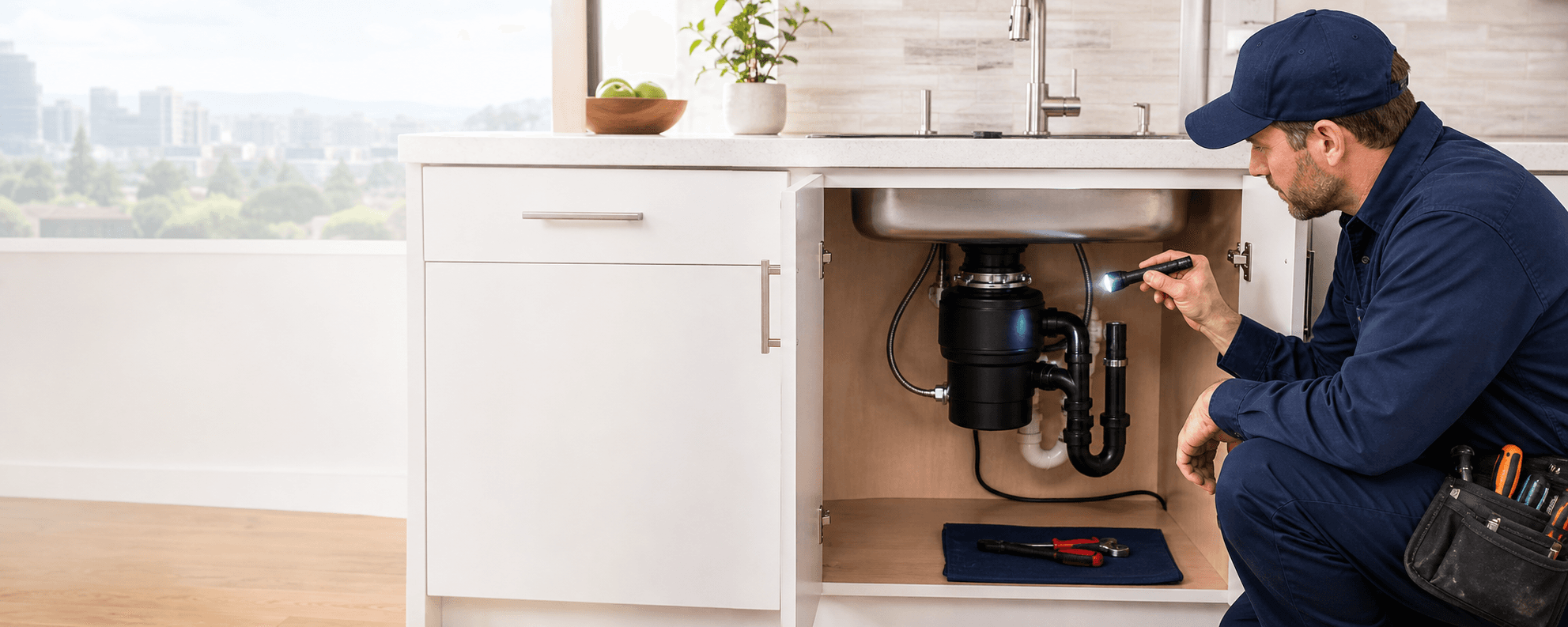
A leaking garbage disposal almost always leaks from one of three zones, and finding the zone is the whole diagnosis because each one has a different fix. A leak from the top is the sink-flange mounting and is re-sealed with fresh plumber's putty; a leak from the side is the discharge gasket or elbow and is fixed by tightening or replacing the gasket; a leak only when the dishwasher runs is the dishwasher inlet connection and is fixed at the clamp. A leak from the bottom of the unit is the exception: it means the internal seal between the motor and the grinding chamber has failed, there is no consumer-replaceable seal part, and the whole disposal gets replaced. This guide walks the paper-towel-under-the-cabinet test that pinpoints the zone, fixes each of the upper leaks, explains why Washington requires a dishwasher air gap rather than a high loop under King County code, and gives the replacement cost when a bottom leak ends the unit.
Last reviewed: 2026-06-04
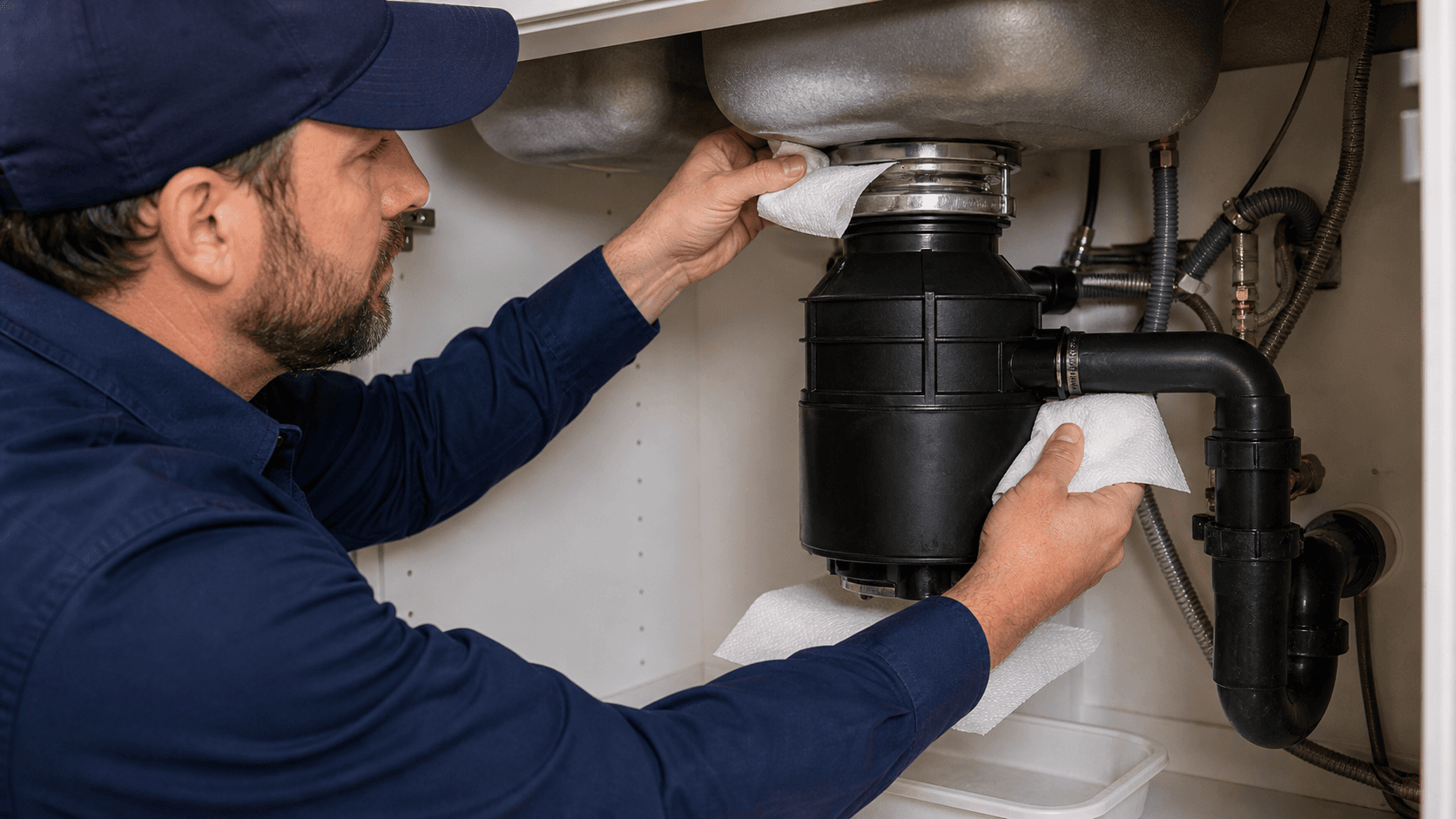
Dry everything, lay paper towels under the cabinet, and run the unit; the first spot to re-wet identifies one of three zones — top, side discharge, or bottom.
The fix depends entirely on the zone, so finding the source comes before any repair. Start by drying the whole unit and the cabinet floor — the top where the disposal meets the sink, the side discharge where it connects to the drain, the bottom of the housing, and the dishwasher inlet — so any new water is unambiguous. Lay paper towels across the cabinet floor and wrap a strip around the base of the unit, then run water and the disposal and watch what re-wets first and where.
The three zones each point at a different part. Wet at the top, where the disposal meets the sink, means the sink-flange mounting seal has failed. Wet at the side, where the discharge tube connects, means the discharge gasket or elbow is leaking. Wet at the very bottom of the housing, with the top and side dry, means the internal seal has failed and the unit itself is finished. A fourth pattern — wet only when the dishwasher runs — isolates the dishwasher inlet connection.
Timing sharpens the zone. A top-flange leak shows up when the sink basin holds standing water, because that is when the flange seal is under the most pressure; a discharge leak shows up while water is actively draining through the unit; a dishwasher-inlet leak shows up only during a dishwasher cycle. Noting when the water appears, not just where, often names the zone before the towels even confirm it.
Getting the zone right is what separates a ten-minute putty re-seal or a gasket swap from a full replacement, because three of the four patterns are repairable and only the bottom leak is terminal. The sections below take each zone in turn, top to bottom, and the bottom-leak section explains why that one cannot be patched.
This happening in your home right now? A licensed plumber can talk you through the next step on the phone — 24/7, and the call is free.
Call a plumberA top leak is the sink-flange mounting seal; fix it by tightening the mounting ring, evening the three mounting screws, and re-sealing the flange with fresh plumber's putty.
When water appears at the top of the unit where it meets the underside of the sink, the leak is at the sink flange — the fitting that seals the disposal's mounting assembly to the sink drain opening. This seal is most stressed when the basin holds standing water, so a flange leak often shows up only when the sink is full and disappears as it drains, which is itself a strong tell that the top mounting, not the discharge, is the source.
The first fix is mechanical: the disposal hangs from a mounting assembly held by a locking ring and typically three mounting screws or bolts. Over time these loosen from the vibration of the grinding motor, breaking the flange seal. Re-tightening the locking ring and evening up the three mounting screws so the flange seats squarely against the sink often closes a minor top leak without any disassembly at all.
If tightening does not stop it, the putty seal under the flange has failed and needs renewing. That means dropping the disposal off its mount, lifting out the sink flange, scraping off the old hardened plumber's putty, rolling a fresh rope of putty under the flange lip, reseating it, and remounting the unit so the putty compresses into a new watertight seal. Plumber's putty — not a gasket — is the correct sealant at the sink flange, which is the reverse of the discharge connection covered next.
A flange re-seal is a homeowner-reachable job but it requires dismounting and remounting the disposal squarely, and an uneven reseat just leaks again. If the flange is corroded, the mount is damaged, or the reseal will not hold, book garbage disposal repair and replacement in Bellevue rather than fighting a mount that no longer seats true.
A side leak is the discharge gasket or elbow; fix it by tightening the discharge nut and, if it still weeps, replacing the rubber gasket at the connection.
When water appears at the side of the unit where the discharge tube leaves it and joins the drain, the leak is at the discharge connection. Unlike the flange, this joint seals with a rubber gasket compressed by a bolted flange or a slip nut, and it leaks while water is actively draining through the unit rather than when the basin sits full. That active-drain timing distinguishes a discharge leak from a top-flange leak that only shows under standing water.
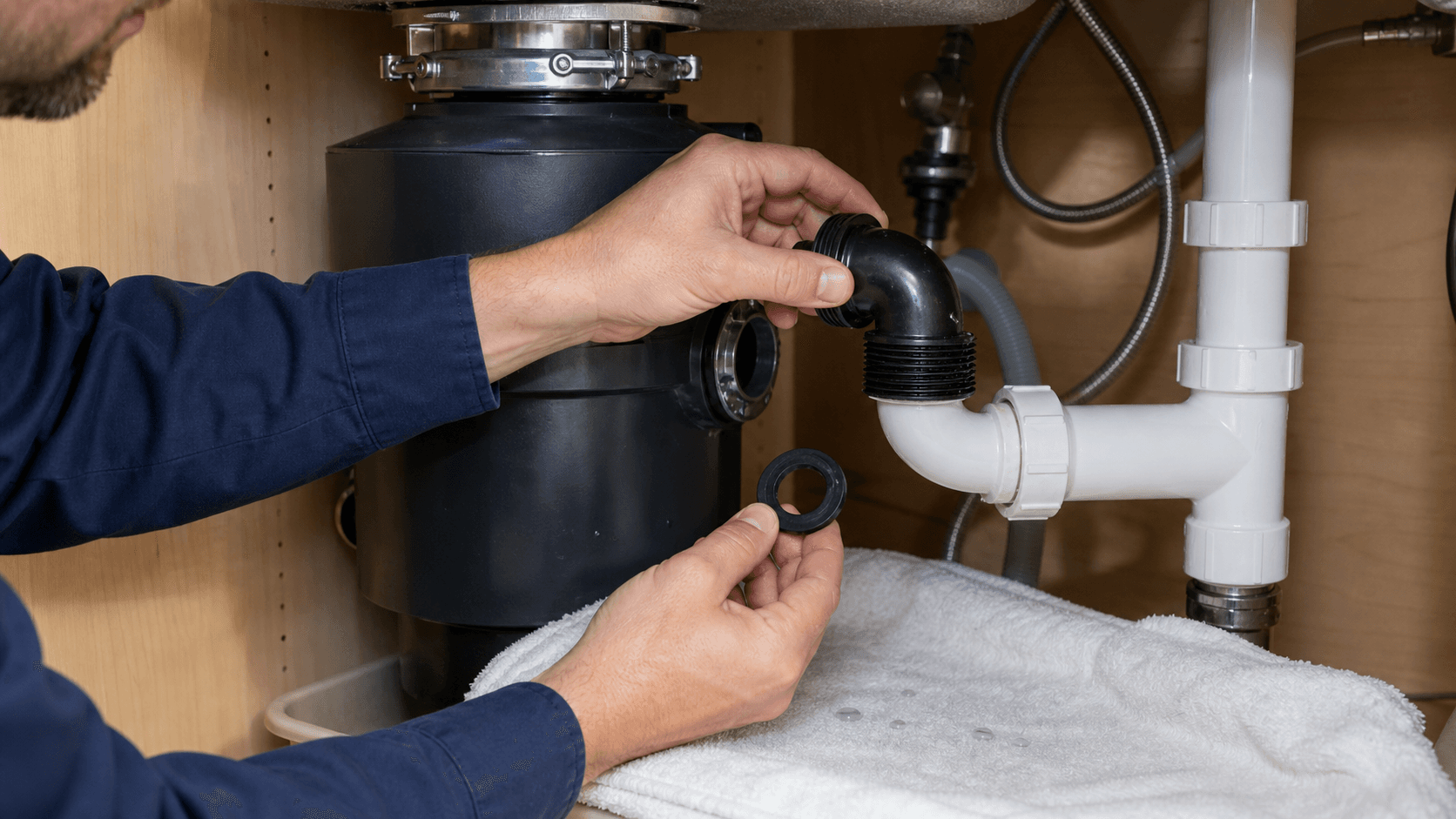
The first move is to tighten the discharge fitting. The discharge elbow bolts or threads to the side of the disposal over a gasket, and that connection loosens with motor vibration and thermal cycling. Snugging the discharge nut or the two flange bolts evenly often recompresses the gasket and stops a minor weep. Take care not to overtighten, which can crack a plastic elbow or split the gasket and make the leak worse.
If tightening does not stop it, the gasket itself has hardened or split and needs replacing. Disconnect the discharge elbow, pull out the old rubber gasket, seat a new one, and reassemble — a cheap part and a quick swap. A gasket, not putty, is the correct sealant here, which is the opposite of the sink flange above: putty seals the flange, a gasket seals the discharge. Mixing those up is a common cause of a leak that will not quit.
A discharge-gasket swap is squarely a homeowner job, but a cracked elbow, a stripped fitting, or a leak that persists after a fresh gasket points to something beyond the connection — possibly the unit itself. If the side connection will not seal after tightening and a new gasket, book garbage disposal repair and replacement in Bellevue.
A leak that appears only during a dishwasher cycle is the dishwasher inlet connection; tighten the hose clamp at the disposal's inlet, which Washington serves through a required air gap rather than a high loop.
If the disposal stays dry during normal sink use but leaks during a dishwasher cycle, the source is the dishwasher inlet — the smaller hose connection on the upper side of the disposal where the dishwasher drains into it. Because water only flows through that inlet when the dishwasher pumps out, the leak appears strictly during a cycle, which is a clean isolating tell that points at the inlet clamp and nothing else on the unit.
The fix is usually the clamp. The dishwasher drain hose attaches to the disposal's inlet nipple with a hose clamp that loosens over time, and snugging that clamp recompresses the hose onto the nipple and stops the weep. Confirm the hose itself is not cracked at the connection while you are there; a split hose end needs trimming back or replacing rather than just re-clamping.
The connection upstream of that inlet matters for code in Washington. King County Public Health requires the dishwasher drain to discharge through an air gap — the small fitting mounted on the countertop or sink deck — to prevent dirty drain water from siphoning back into the dishwasher. A high loop alone, the common shortcut elsewhere, does not satisfy Washington's requirement, so a Bellevue dishwasher should run through an air gap to the disposal inlet, and a missing air gap is a code defect, not just a leak risk.
Tightening a clamp is a simple homeowner fix, but a missing or improperly installed air gap is a plumbing-code correction worth doing right. When the inlet, hose, or air gap needs proper correction to meet Washington's requirement, book garbage disposal repair and replacement in Bellevue.
A leak from the very bottom of the housing means the internal seal between the motor and grinding chamber has failed; there is no consumer-replaceable seal part, so the whole unit gets replaced.
A leak from the bottom of the disposal housing is the one zone that cannot be repaired. Water emerging from the very bottom of the unit, with the top flange and side discharge both dry, means the internal seal that separates the motor from the grinding chamber has worn through and water is now leaking down into the motor housing. That seal is sealed inside the unit at the factory and is not offered as a consumer-replaceable part.
Because there is no seal kit to install, a confirmed bottom leak ends the unit's service life — the disposal is replaced, not repaired. This is the disposal equivalent of a corroded-through water heater tank: the failure is internal to the sealed body, and no external tightening, putty, or gasket reaches it. Confirm the source with the paper-towel test first, since a top or side leak can run down the housing and drip from the bottom while actually originating higher up; only water genuinely emerging from the bottom seam is the internal-seal failure.
Bottom-seal failure also tends to track age. A disposal leaking from its internal seal is usually a unit that has run its 10-to-12-year service life, the seal worn out alongside the rest of the mechanism. A young unit leaking from the bottom under warranty is a different conversation with the manufacturer, but most bottom-seal leaks land on units old enough that replacement is plainly the right call.
When the towel test confirms the leak is genuinely from the bottom, the next step is replacement rather than any attempted repair — book garbage disposal repair and replacement in Bellevue. The replacement-cost section below gives the range, and if the water is actually coming from the top or side, return to those sections, because those leaks are fixable and do not call for a new unit.
A garbage disposal replacement runs about $150 to $950 nationally per HomeAdvisor, averaging around $550 with $80-to-$200 labor — the right path only for a bottom-seal leak.
Replacement cost is documented at the national level, and we use that range rather than inventing a Bellevue-specific number. HomeAdvisor reports garbage disposal replacement at roughly $150 to $950, averaging about $550, with labor alone in the $80-to-$200 band. The spread reflects the horsepower and grade of the new unit and how much the existing mount and wiring need correcting; a straight like-for-like swap on an existing mount sits toward the lower, simpler end.
Replacement is the right answer only for the unrepairable leak — the bottom-seal failure. A top-flange leak re-seals with putty, a side-discharge leak fixes with a gasket, and a dishwasher-inlet leak fixes at the clamp, all for the cost of a few parts. Spending several hundred dollars to replace a unit that is actually leaking from a loose discharge nut is the avoidable mistake the paper-towel zone test exists to prevent.
Age sharpens the replace-versus-repair call. A unit near or past the 10-to-12-year service life that has developed a bottom-seal leak has reached normal end of life, and replacing it is sounder than any heroic repair attempt — there is no seal part to install anyway. A younger unit with a fixable top or side leak is worth the simple repair, since the rest of the mechanism has years left.
When the leak is the bottom-seal kind, or when a top or side leak will not seal after a proper attempt, book the swap through garbage disposal repair and replacement in Bellevue. Most replacements complete quickly on an existing mount, and matching the new unit's horsepower to the household keeps it from the chronic jamming covered in our guide on a humming, jammed disposal.
No, a bottom leak is not fixable — the internal seal has no consumer part, so the unit is replaced. Use putty at the flange and a gasket at the discharge, never the reverse.
No, a garbage disposal leaking from the bottom cannot be fixed, and the unit is replaced. A bottom leak means the internal seal between the motor and the grinding chamber has worn through, and that seal is sealed inside the factory-assembled body with no consumer-replaceable part to install. Confirm the source with a paper-towel test first, since a top or side leak can drip down and appear to come from the bottom; only water truly emerging from the bottom seam is the terminal internal-seal failure.
Use plumber's putty at the sink flange and a rubber gasket at the discharge — never swap the two. The top mounting seals to the sink with a fresh rope of plumber's putty compressed under the flange, while the side discharge seals with a rubber gasket compressed by the discharge nut or flange bolts. Trying to seal the flange with a gasket or the discharge with putty is a common reason a re-sealed connection keeps weeping, so matching each sealant to its correct joint is half the fix.
Garbage disposals last about 10 to 12 years before the kind of wear that produces leaks, and a bottom-seal leak in particular usually arrives at the end of that span as the internal seal wears out with the rest of the mechanism. A unit leaking internally near or past that age is at normal end of life and gets replaced — there is no seal part regardless — while a younger unit with a fixable top, side, or dishwasher-inlet leak is worth the simple repair. When replacement is the call, book garbage disposal repair and replacement in Bellevue.
Every fact in this guide cites a verifiable public source. If you find a number we got wrong, email dispatch@bellevueplumberpro.com.
Need help with this in your home? See our Garbage disposal repair and replacement in Bellevue page for pricing, our diagnostic process, and how same-day service works across the Eastside.
Related services: Drain Cleaning and Clog Removal.
Three zones: a top leak is the sink-flange mounting seal, a side leak is the discharge gasket or elbow, and a bottom leak generally means the unit's internal shaft seal has failed — which means replacement.
Dry everything, lay paper towels under the cabinet, and run the unit — the first spot to re-wet identifies the zone and therefore the fix.
That's the dishwasher inlet connection — tighten the hose clamp at the disposal's inlet. Washington code requires the dishwasher to discharge through an air gap, so check that path too.