Where is the garbage disposal reset button?
A small red button on the underside of the disposal, facing the cabinet floor, near the center of the unit's bottom.
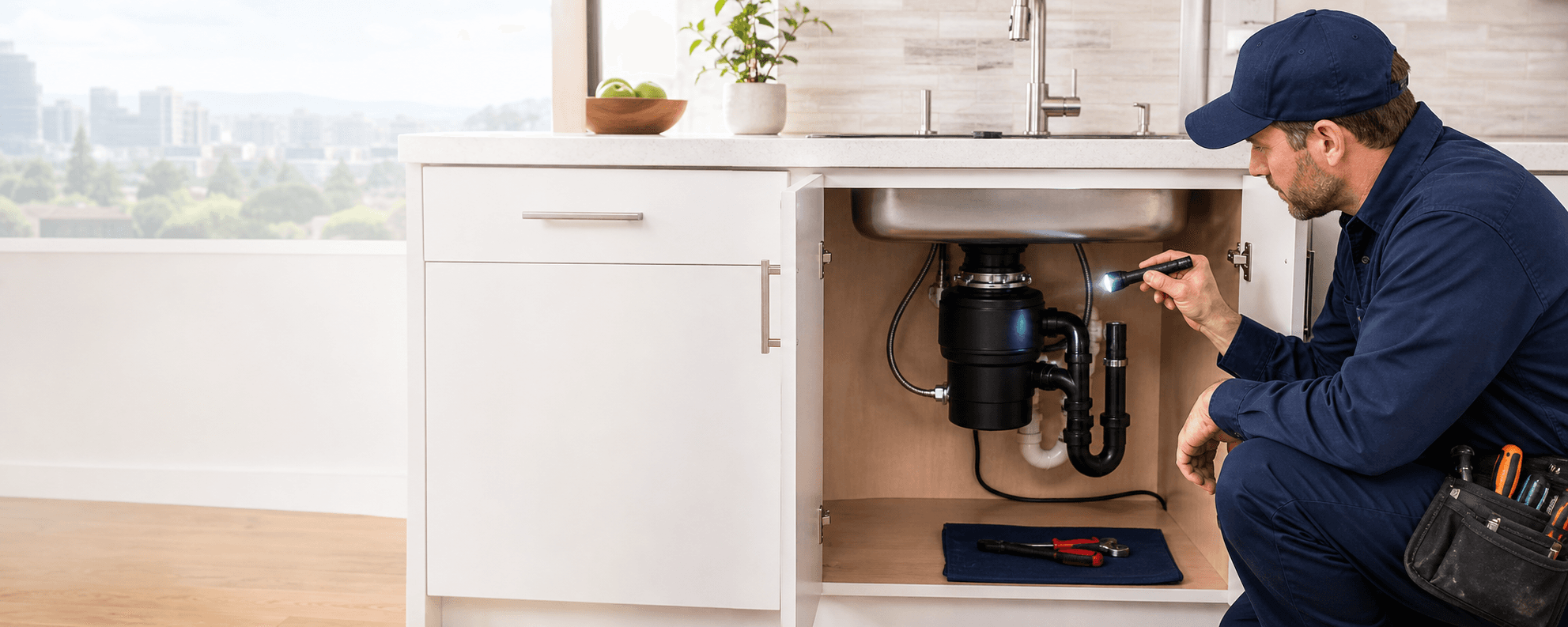
The reset button on a garbage disposal is the red button on the underside of the unit, and it is the single most common fix for a disposal that has suddenly gone dead. It is a thermal-overload protector: it trips and cuts power whenever the motor overheats from a jam or an overload, and pressing it back in re-arms the unit. The trick is using it correctly — switch the disposal off, let the motor cool, and press the button firmly until it stays in, waiting ten minutes if it will not hold and up to twenty on some air-switch or EZ Connect models. A button that will not stay set is reporting a real fault: usually a jam that must be cleared first, but sometimes a tripped breaker or GFCI upstream, or a failed motor. This guide locates the button, explains the thermal-overload mechanism, gives the reset procedure and the waiting times, separates the reset from the household breaker, and draws the line where a unit that will not reset has a dead motor and gets replaced.
Last reviewed: 2026-06-04
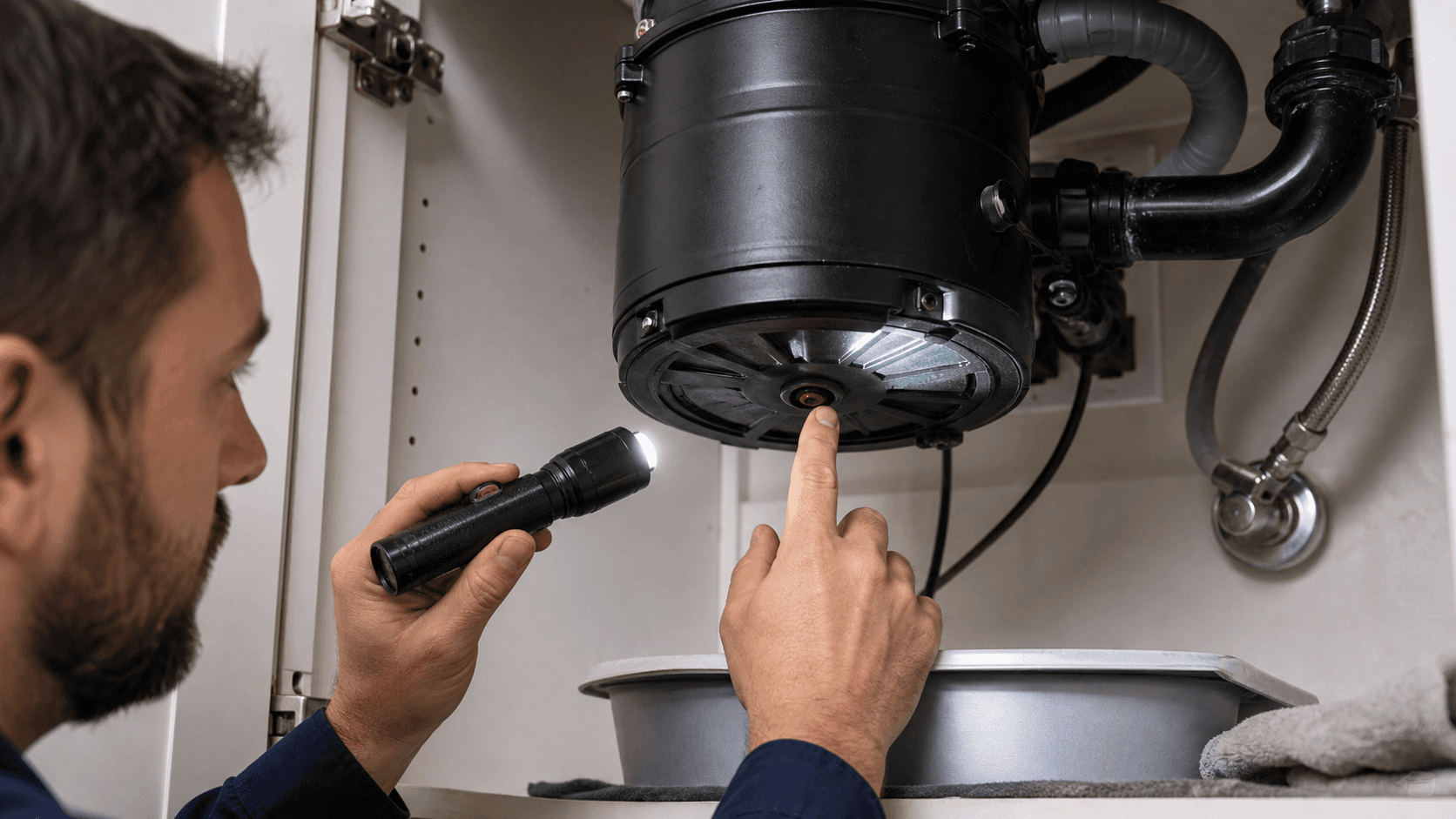
The reset button is a small red button on the underside of the disposal, facing the cabinet floor, near the center of the bottom of the unit.
Reach under the sink and feel the bottom of the disposal — the surface facing down into the cabinet. The reset is a small button, almost always red and occasionally black, set near the center of that underside. It sits flush or slightly recessed when the unit is running normally and pops out a short distance when it has tripped, so a protruding button is itself the sign that it has cut power.
Because the button faces the cabinet floor, finding it usually means getting down under the sink with a flashlight and clearing whatever is stored below. On a deep or tight install the bottom of the unit can sit close to the cabinet floor or back wall, so locate the button by feel at the center of the underside if you cannot get eyes directly on it.
Do not confuse the reset button with the hex hole that also lives on the underside of most disposals. The reset is a button that presses in; the hex hole is a recessed hex-shaped socket that accepts a 1/4-inch Allen wrench for freeing a jam. Both are part of the bottom service interface, and clearing a jam uses the hex hole while restoring power uses the reset — our guide on freeing a jammed garbage disposal covers the hex hole in detail.
Every standard residential disposal has this single reset on the underside; there is no second reset elsewhere on the unit. If a unit appears to have no bottom button at all, it may be a model with the protector integrated differently, but the overwhelming majority of units put one red thermal-reset button at the bottom center, and that is the button this guide is about.
This happening in your home right now? A licensed plumber can talk you through the next step on the phone — 24/7, and the call is free.
Call a plumberThe reset button is a thermal-overload protector; it automatically trips and cuts power when the motor overheats from a jam or overload, dropping out about a quarter inch when it does.
The reset button is the face of a thermal-overload protector built into the disposal. Its job is to protect the motor from burning itself out: when the motor overheats — most often because a jam has stalled it, or because it has been run too hard for too long — the protector trips, the button pops out about a quarter inch, and power to the unit is cut. A disposal that has gone suddenly and completely silent has very often simply tripped this protector.
This is why a jam and a dead unit are linked. When something locks the flywheel, the stalled motor heats up fast, the thermal-overload trips to save it, and the unit goes silent — so the same event that caused a hum a moment earlier leaves the disposal dead once the protector cuts in. The protector is doing exactly its job, sacrificing a few minutes of downtime to spare the motor from cooking itself.
The protrusion of the button is a useful diagnostic. A reset that has popped out roughly a quarter inch confirms the thermal-overload tripped, which tells you the cause was heat — a jam or an overload — rather than a power loss upstream at the breaker or GFCI. A button that is still flush, on a dead unit, points away from the disposal's own protector and toward the power chain feeding it.
Because the protector trips on heat, it also needs the motor to cool before it will hold a reset. Pressing a hot, tripped button immediately can fail because the protector is still sensing the overtemperature, which is why the procedure below builds in a cooling wait. Understanding that the button is a heat-triggered safety device, not just an on switch, is what makes the reset procedure work the first time.
Switch the disposal off, let the motor cool, then press the button until it stays in; if it will not hold, wait ten minutes — up to twenty on some models — and retry.
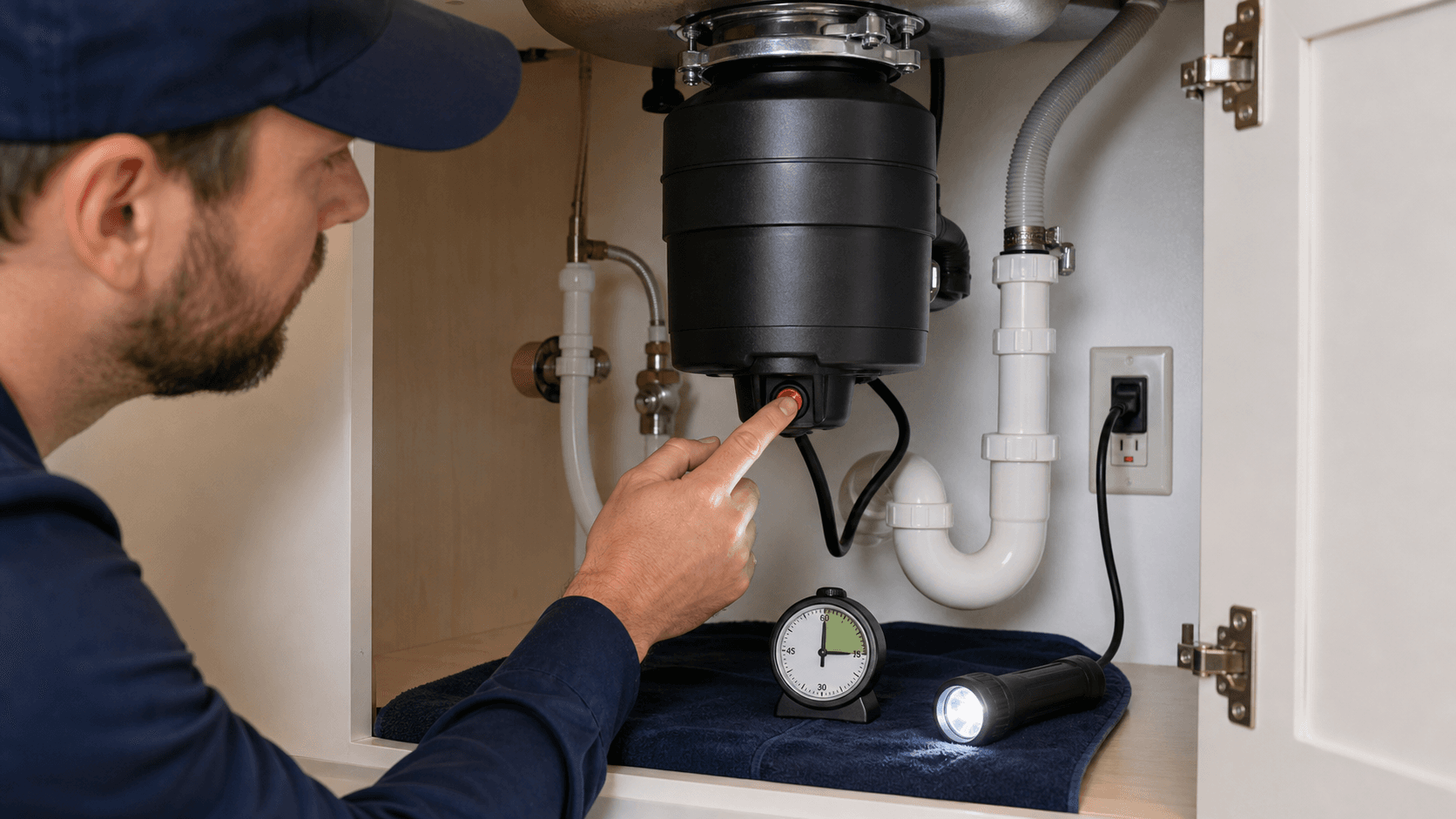
Start by switching the disposal off at the wall, so it cannot lurch to life the instant the reset re-arms power. Then give the motor a few minutes to cool, because the thermal-overload protector is heat-triggered and will not hold while the motor is still hot from whatever tripped it. Pressing the button on a hot unit is the most common reason a reset 'won't work' when nothing is actually wrong but the timing.
With the unit off and cooled, push the reset button firmly until it clicks and stays seated flush. If it holds, run cold water, switch the disposal on, and confirm it spins — a unit that runs was simply tripped on a prior overload, the single most common cause of a suddenly dead disposal. If the button seats and the unit runs, the fix is complete.
If the button will not stay in, give it more time to cool. Wait about ten minutes and try again; some units, particularly certain air-switch or EZ Connect models, need up to twenty minutes before the thermal-overload will reset. A button that finally holds after a longer cooling wait was simply still too warm on the earlier attempts, and patience, not force, is the fix.
If the button still will not stay in after a full cooling wait, the unit is not merely overheated — something is holding it tripped. The most common cause is a jam still locking the flywheel, which must be cleared before the reset will hold; the next section covers that and the other reasons a reset will not seat. Never force a button that repeatedly pops out, since it is reporting a real fault rather than being stubborn.
A reset that will not stay in usually means a jam is still locking the motor; clear the jam first, and rule out a tripped breaker or GFCI and a failed motor.
A reset button that pops back out the moment you press it, or refuses to seat at all, is reporting that the condition that tripped it is still present. The most common cause is a jam: if the flywheel is still mechanically locked, the motor cannot turn, so it would immediately overheat again, and the thermal-overload refuses to re-arm into that fault. The fix is to clear the jam first — cut the power, turn the flywheel free with a 1/4-inch Allen wrench in the bottom hex hole, remove the debris — and only then press the reset, as our guide on freeing a jammed garbage disposal details.
If the unit is silent rather than humming and the reset still will not hold, the problem may be upstream of the disposal entirely. A tripped breaker at the panel or a tripped GFCI outlet cuts power before it reaches the unit, and no amount of pressing the disposal's own reset restores power that is being interrupted upstream. The full upstream chain — reset, GFCI, breaker, outlet — is in our guide on a garbage disposal that will not work at all, and it is worth working when the reset alone does not solve a dead unit.
A reset that simply will not cool down and hold, with no jam present and power confirmed upstream, points toward the motor itself. A motor that has burned out or developed an internal fault can keep the thermal-overload tripping or fail to run even when the reset finally seats. That is the end-of-life case, and on a unit near its 10-to-12-year service life it means replacement rather than continued resetting.
The rule across all three causes is that a button which will not stay set is diagnostic information, not an inconvenience to override. Clear a jam, check the upstream power, and if neither restores the unit, the motor has failed and the disposal is replaced — book garbage disposal repair and replacement in Bellevue rather than wedging a button that keeps reporting a fault.
The reset and the breaker are separate devices: the reset is the disposal's own thermal-overload protector, while the breaker is the home's 120-volt, 15-to-20-amp circuit protection at the panel.
These two are easy to confuse because both cut power, but they sit in different places and protect against different things. The reset button is built into the disposal itself, on the underside, and it is a thermal-overload protector that trips on motor heat. The breaker lives at the home's electrical panel and protects the whole circuit from overcurrent, on a 120-volt circuit rated at 15 to 20 amps that the disposal shares with nearby kitchen receptacles.
They can both trip from the same event but in their own way. A bad jam that stalls the motor first heats it — tripping the disposal's thermal reset — and a severe overload can also pull enough current to trip the breaker at the panel. That is why a dead disposal is checked in order: press the unit's own reset first, then, if that does not restore it, look at the GFCI and the breaker upstream, since the power loss may be at the panel rather than at the unit.
Knowing which device tripped tells you where the fault is. A popped reset button points at motor heat — a jam or overload local to the disposal. A tripped breaker points at the circuit, and because the disposal shares that 15-to-20-amp circuit with other outlets, a tripped breaker often leaves nearby counter receptacles dead too, which is a clue the panel, not the unit, is the source.
The line that matters most is repetition at the breaker. A reset that trips occasionally on a jam is normal; a breaker that trips repeatedly the moment the disposal runs is reporting a sustained electrical fault — a shorted motor or a wiring problem — that re-arming will not fix and that belongs to an electrician. Repeated breaker trips are the signal to stop resetting and book garbage disposal repair and replacement in Bellevue rather than keep cycling a circuit that is protecting the home.
A reset that keeps tripping points to a recurring jam or a worn motor; the thermal-overload is catching real overheating, so stop re-arming it and find the cause.
A reset that trips once is a one-time overload; a reset that keeps tripping is a pattern, and the thermal-overload protector is catching genuine, repeated overheating each time. The most common cause is a recurring jam — the unit binds on the same fibrous or starchy food or a wedged object every time it runs, stalling the motor and overheating it until the protector cuts in again. Clearing that specific jam, and changing what goes down the disposal, breaks the cycle.
When there is no obvious jam and the reset still trips repeatedly, the motor itself is likely wearing out. An aging motor draws more current and runs hotter to do the same work, so it reaches the thermal-overload's trip threshold under loads it once handled easily. On a unit near or past its 10-to-12-year service life, a motor that keeps overheating is a worn-out motor, and repeatedly resetting it only postpones the inevitable replacement.
Re-arming a repeatedly tripping reset is the wrong response because the protector is doing its job — each trip is preventing the motor from burning itself out, and overriding it again hands the same overheat back to the safety device. The right response is to find the cause: clear and prevent the recurring jam, or recognize a worn motor at end of life. A reset that trips every few uses is reporting a fault that needs fixing, not a button that needs pressing.
If the trips trace to a clearable jam and a change in habits, the unit may have years left; if they trace to a worn motor on an aging unit, the disposal is replaced. Either way, repeated trips are the signal to diagnose rather than re-arm — our guides on freeing a jammed disposal and a disposal that will not work at all cover the jam and power sides, and a worn-out motor is a garbage disposal repair and replacement in Bellevue call.
When power is confirmed at the outlet, no jam is present, and the reset still will not restore the unit, the motor has failed and the disposal is replaced.
The replace decision is a process of elimination that ends at the motor. Confirm there is no jam holding the flywheel, confirm power is reaching the unit by testing the outlet with a known-good device, and confirm the breaker and GFCI are holding. When all of that checks out and the reset still will not restore a silent unit, the only remaining explanation is that the motor has burned out internally — and a dead motor is not a field repair.
Age makes the call straightforward. Garbage disposals last about 10 to 12 years, so a unit that has reached that range and now will not reset despite confirmed power has simply reached end of life. Replacing it is the sound choice rather than chasing a repair on a worn-out motor, especially since the motor is the costliest part of the unit and replacing it approaches the cost of a whole new disposal.
Replacement cost is documented nationally rather than locally: HomeAdvisor reports garbage disposal replacement at roughly $150 to $950, averaging about $550, with labor of $80 to $200. The range reflects the horsepower and grade of the new unit and how much the existing mount and wiring need correcting; a like-for-like swap on an existing mount sits toward the lower end. We use that national figure rather than inventing a Bellevue-specific number.
When the elimination ends at a dead motor, replacement is quick on an existing mount — book it through garbage disposal repair and replacement in Bellevue. Before concluding the motor is dead, though, make sure you have truly ruled out a jam and an upstream power loss, since both masquerade as a reset that will not hold and both are far cheaper to fix than a new unit.
No, the reset is not the same as the breaker — the reset is the disposal's own thermal protector, the breaker is the panel's circuit protection. Wait ten minutes, or up to twenty on some models.
No, the reset button is not the same as the household breaker. The reset is a thermal-overload protector built into the underside of the disposal that trips on motor heat, while the breaker is the home's circuit protection at the electrical panel that trips on overcurrent across the 120-volt, 15-to-20-amp circuit the disposal shares with nearby outlets. A dead disposal is checked in order — press the unit's own reset first, then look upstream to the GFCI and breaker — because the power loss can be at either place, and our guide on a disposal that will not work at all walks that full chain.
How long to wait before retrying a reset depends on cooling. Because the protector is heat-triggered, switch the unit off and let the motor cool a few minutes before pressing the button; if it will not hold, wait about ten minutes and try again, and on some air-switch or EZ Connect models allow up to twenty minutes before the thermal-overload will reset. A button that finally holds after a longer wait was simply still too warm earlier — patience resets it, not force. If it still will not hold after a full cooling wait, a jam is likely still locking the motor and must be cleared first, as our guide on freeing a jammed disposal explains.
Every fact in this guide cites a verifiable public source. If you find a number we got wrong, email dispatch@bellevueplumberpro.com.
Need help with this in your home? See our Garbage disposal repair and replacement in Bellevue page for pricing, our diagnostic process, and how same-day service works across the Eastside.
Related services: Drain Cleaning and Clog Removal.
A small red button on the underside of the disposal, facing the cabinet floor, near the center of the unit's bottom.
It's a thermal-overload protector: it trips and cuts power automatically when the motor overheats from a jam or overload, dropping out about a quarter inch.
Usually because a jam is still locking the motor. Clear the jam first, let the motor cool (ten minutes — up to twenty on some models), then retry. If it still won't hold, rule out a tripped breaker or GFCI, then a failed motor.