Why did my garbage disposal stop working?
A completely silent disposal has lost power — the reset button, a GFCI outlet, or a breaker. One that hums but won't spin has power and a mechanical jam. Silence versus hum is the diagnostic split.

A garbage disposal that will not work fails along one of two paths, and the sound it makes tells you which. A unit that is completely silent — no hum, no click — has lost electrical power, and the fix is a four-step power chain: the disposal's own reset button, the GFCI outlet, the breaker, then the outlet itself tested with another device. A unit that hums but will not spin has power but a mechanical jam, which is an entirely different repair. Sorting the symptom first keeps a homeowner from hunting for a jam on a unit that simply tripped its GFCI, or resetting a breaker on a unit whose flywheel is locked. This guide walks the full power chain in order, explains why older Bellevue kitchens trip GFCIs and lose disposal power more often, and draws the repair-versus-replace line by lifespan and by cost. Disposals last about 10 to 12 years, and a dead unit that still has confirmed power at the outlet has a burned-out motor and gets replaced rather than repaired.
Last reviewed: 2026-06-04
A garbage disposal that is completely silent has lost power and needs the reset-GFCI-breaker-outlet chain; one that hums but will not spin has power and a mechanical jam.
The first diagnostic is the sound, because it splits the problem cleanly in two. Flip the wall switch and listen: a disposal that makes no sound at all — no hum, no click, nothing — has no electrical power reaching the motor, and the entire fix is a power chain you can work yourself in a few minutes. A disposal that hums or buzzes but does not turn is the opposite case: power is reaching the motor fine, but the grinding plate is mechanically locked and the motor cannot rotate it. Those are different repairs, and confusing them wastes the most time on a disposal call.
The silent-unit path is the subject of this guide: the reset button on the bottom of the unit, the GFCI outlet it plugs into, the breaker at the panel, and the outlet itself, worked in that order from cheapest and most likely to least. Most no-power disposal calls resolve at the first or second step, because a tripped reset or a tripped GFCI is by far the most common cause and both re-arm in seconds. There is no reason to open a panel or pull out a meter before pressing the two buttons that fix the majority of cases.
The humming-unit path belongs to a jammed flywheel and is covered in full by our guide on why a garbage disposal hums but will not spin. The critical safety rule there carries over to any disposal work: never put a hand into the chamber, and cut the power before reaching anywhere near the grinding plate. A humming unit has live power by definition, which is exactly why the jam fix starts by killing that power first.
Reading the symptom correctly before touching anything is what turns a vague 'it won't work' into a specific next step. Silent means chase power; humming means clear a jam with the power off. Everything below assumes you have flipped the switch, confirmed the unit is silent rather than humming, and are working the power chain — if it hums instead, stop here and switch to the humming guide.
This happening in your home right now? A licensed plumber can talk you through the next step on the phone — 24/7, and the call is free.
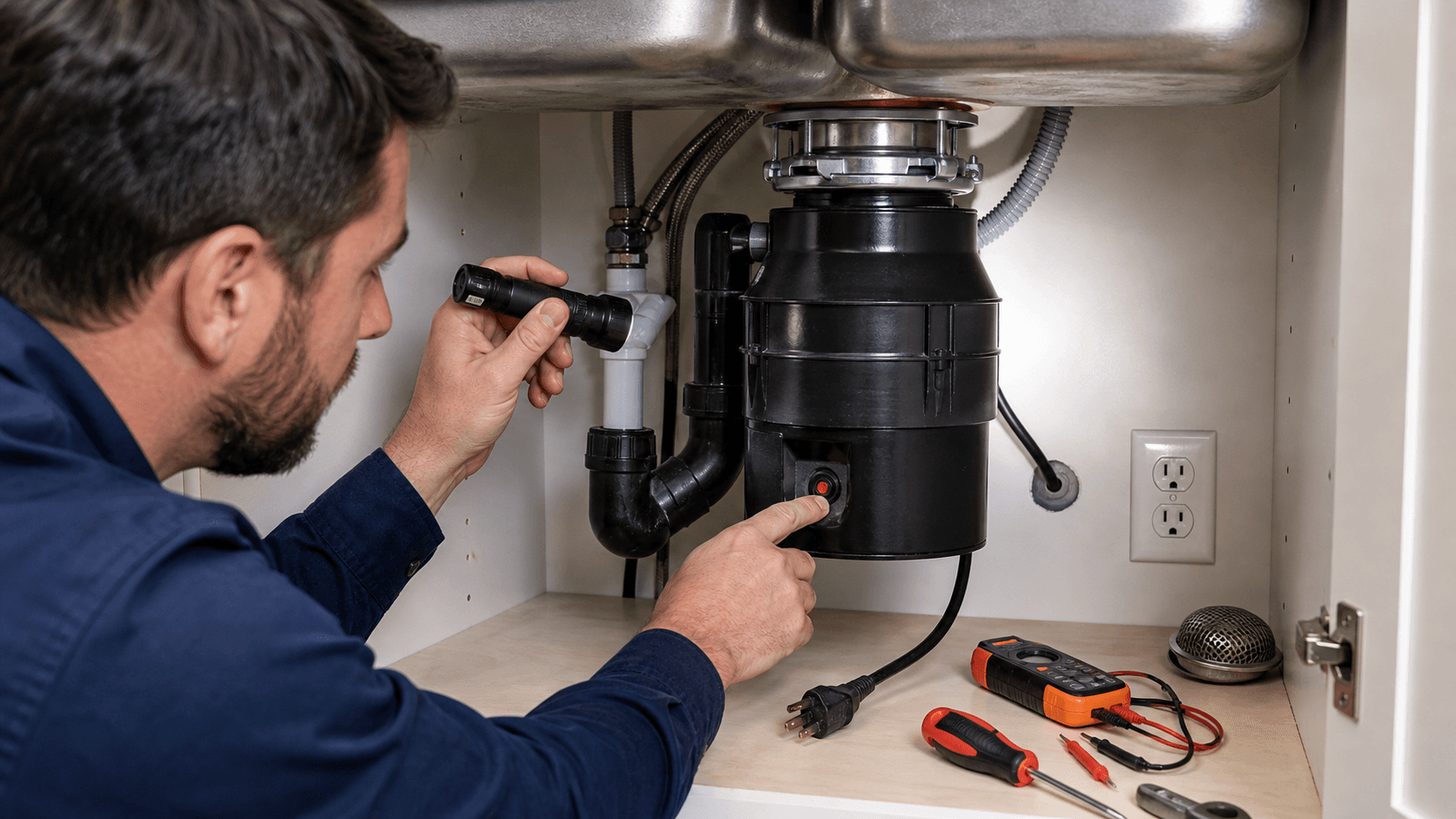
Call a plumberPress the reset button on the underside of the disposal first; if it had tripped on an overload, this single press restores power and is the most common fix.
Reach under the sink and feel the bottom center of the disposal for a small button — usually red, occasionally black — that sits flush or slightly recessed on the underside of the unit. This is the thermal-overload reset button, and it pops out to cut power whenever the motor overheats or stalls under load. When it has tripped, the disposal goes completely silent because the circuit inside the unit is open, so a silent disposal is exactly the symptom this button is meant to produce.
Make sure the wall switch is off, then push the button firmly until it clicks and stays in. If it had tripped, you will feel it seat with a distinct click; if it was already in, it does not move and the cause lies further down the chain. After pressing it, turn the water on, flip the switch, and listen — a unit that now runs was simply tripped on a prior overload, and that is the single most common reason a working disposal suddenly goes dead.
If the button will not stay in, or pops back out immediately, the unit is still overloaded or jammed and resetting it will not hold until the underlying cause is cleared. A reset that will not seat on a humming unit points to a jam; on a silent unit it can mean the motor has failed. Do not force it repeatedly — a button that refuses to stay set is reporting a fault, not a fluke, and the deeper reasoning is in our guide on the garbage disposal reset button.
If pressing the reset restores nothing and the unit stays silent, leave the button pressed in and move to the next step. A disposal that is still dead with the reset confirmed seated has lost power upstream of the unit itself — at the GFCI outlet, the breaker, or the receptacle — and the chain below finds it.
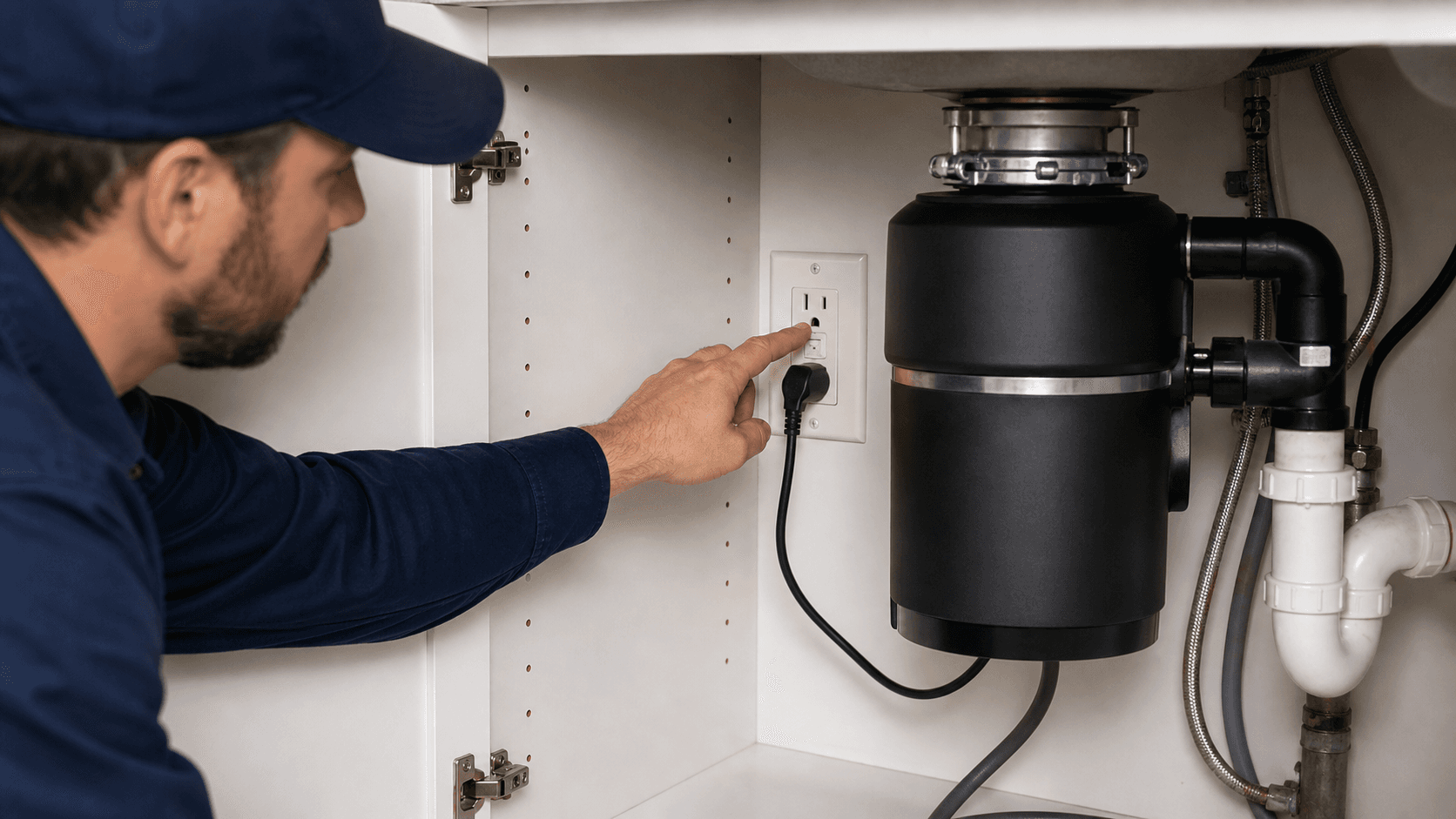
Find the GFCI outlet serving the disposal — under the sink or at a nearby kitchen counter receptacle — and press its RESET button; a tripped GFCI cuts power to the whole disposal.
Modern kitchens put the disposal on a ground-fault circuit-interrupter (GFCI), the residual-current device that cuts power the instant it senses current leaking to ground — a shock-protection requirement near sinks and water. When that GFCI trips, it kills power to everything downstream of it, including the disposal, so a silent unit whose reset button is already seated very often traces to a tripped GFCI rather than to the disposal at all.
The catch is that the GFCI is not always the outlet the disposal plugs into. It may be the receptacle under the sink, but it is just as often a counter-top kitchen outlet, a bathroom outlet, or a garage outlet wired upstream on the same protected circuit. Walk the nearby outlets and look for one with RESET and TEST buttons on its face; press RESET firmly until it clicks. If a counter outlet near the sink is also dead, that is a strong sign you have found the tripped GFCI feeding the disposal.
After pressing RESET, return to the disposal, run the water, and test the switch. A unit that now runs was simply downstream of a GFCI that tripped — a common event after a minor moisture intrusion, a power blip, or an overloaded motor pulling enough fault current to nuisance-trip the device. GFCIs also weaken with age and can trip more readily as they near the end of their own service life, which matters in older kitchens covered further below.
If you cannot find a tripped GFCI, or resetting it does nothing, move to the breaker. And if the GFCI trips again the moment the disposal runs, stop resetting it — a GFCI that re-trips under load is reporting a real ground fault in the disposal or its wiring, which is a genuine electrical hazard and a reason to book garbage disposal repair and replacement in Bellevue rather than keep re-arming it.
Open the electrical panel and look for a breaker sitting between on and off or fully tripped; flip it fully off, then back on, to restore a disposal that lost power at the panel.
If the reset and the GFCI both check out and the disposal is still silent, the next link is the breaker. At the main panel, scan for a breaker that has moved out of the firm on position — a tripped breaker often sits in a middle limbo between on and off rather than snapping fully to off, which makes it easy to overlook on a quick glance. The disposal may be on its own breaker or it may share one with other kitchen receptacles, so a dead counter outlet alongside the dead disposal is a clue the shared breaker tripped.
To reset a tripped breaker, push it firmly all the way to off first, then back to on — flipping it straight from the middle position back to on will not re-arm it. A disposal that comes back to life after this was drawing enough current at some point to trip the breaker, often from a stalled motor or a jam that overloaded the circuit before the unit's own reset could catch it. Knowing what tripped it matters: a one-time trip is a fluke, but a breaker that trips again is reporting a sustained fault.
A standard residential garbage disposal runs on a 120-volt circuit protected at 15 to 20 amps, the same circuit class that serves general kitchen receptacles. That rating is why a disposal and nearby outlets can share a breaker, and why a heavy jam can pull enough current to trip it. If the breaker trips repeatedly the moment the disposal runs, the unit or its wiring has a fault that re-arming will not fix.
Repeated breaker trips, like repeated GFCI trips, are diagnostic information rather than an inconvenience. A circuit that will not hold under the disposal's load points to a shorted motor, a wiring fault, or a unit drawing far more than its rated current, and chasing that down is electrician territory. If the breaker trips again after a full off-on cycle, stop and book garbage disposal repair and replacement in Bellevue rather than continuing to reset a circuit that is protecting the home from a real fault.
Plug a lamp or phone charger into the disposal's outlet; if that device has no power either, the receptacle or its wiring has failed, not the disposal.
By this step the reset is seated, the GFCI is reset, and the breaker is confirmed on — yet the disposal is still silent. The last thing to rule out before condemning the disposal itself is the outlet it plugs into. Many disposals are hard-wired, but a great many plug into a receptacle under the sink, and that receptacle can fail independently of everything upstream. Testing it isolates whether power is even arriving at the unit.
Unplug the disposal and plug a known-good device — a lamp, a phone charger, anything with an obvious on indicator — into the same outlet. If that device powers up, the outlet is live and the problem is the disposal itself, which by now means a failed motor. If the device stays dead, the outlet or its wiring has failed, and no amount of work on the disposal will help until the receptacle is fixed. That is an electrical repair, not a disposal repair.
A live outlet feeding a dead disposal is the decisive finding in the whole chain: power is confirmed all the way to the unit, the unit's own reset is seated, and it still will not run. That combination means the motor has burned out internally, and a burned-out disposal motor is not a field repair — the unit gets replaced. The next section covers that replacement decision and what it costs.
If the outlet is dead despite a good breaker and reset GFCI, the fault is in the receptacle or the wiring between it and the panel, which is work for a licensed electrician or plumber. Either way, the four-step chain has done its job: it has told you precisely where the power stops, which is the difference between a five-minute reset and a needless service call. When the conclusion is a dead motor or a wiring fault, book garbage disposal repair and replacement in Bellevue.
A disposal with confirmed power at the outlet that still will not run has a burned-out motor and gets replaced, especially past the typical 10-to-12-year service life.
The replace decision follows directly from the power chain. Once a known-good device proves the outlet is live, the reset is seated, and the breaker and GFCI are both holding, a disposal that still makes no sound has failed internally — the motor has burned out — and a burned-out motor is not economically repairable. Unlike a jam, which is mechanical and clearable, a dead motor on a confirmed-live circuit means the unit itself is finished.
Age tips the decision before cost even enters. Garbage disposals last roughly 10 to 12 years, so a unit that dies near or past that mark has reached normal end of life, and replacing it is the sound call rather than chasing a repair on a worn-out appliance. A disposal that fails young and still under warranty is a different conversation, but most dead-motor calls land on units old enough that replacement is plainly the better value.
Replacement cost is well documented at the national level: HomeAdvisor reports garbage disposal replacement running about $150 to $950, averaging around $550, with labor alone in the $80-to-$200 range. The spread reflects the horsepower and grade of the new unit and how much the existing mounting and wiring need correcting. We use that national range rather than an invented local figure, and a straight like-for-like swap on an existing mount is at the lower, simpler end.
When the chain ends at a dead motor, replacement is straightforward and usually quick on an existing mount. Book it through garbage disposal repair and replacement in Bellevue; if the unit is instead humming rather than silent, it is jammed, not dead, and our guide on freeing a jammed garbage disposal covers that fix before you ever consider replacement.
Older Bellevue kitchens lose disposal power more often because aging GFCIs nuisance-trip, retrofit wiring is marginal, and original 1960s-80s circuits sit close to their 15-to-20-amp limit.
Bellevue's housing stock skews toward the original 1960s-through-1980s Eastside builds, and the kitchens in those homes were rarely wired with a modern disposal in mind. Many disposals in older kitchens were added in a retrofit, sharing a general kitchen circuit rather than getting their own dedicated line, so a disposal here is more likely to be one load among several on a 120-volt, 15-to-20-amp circuit that has little headroom left when the motor draws hard under a jam.
Ground-fault protection compounds it. GFCI devices became standard kitchen requirements over the decades, and the ones retrofitted into older Bellevue kitchens are themselves aging — and GFCIs weaken with age and trip more readily as they near end of life. The practical result is that an older-kitchen disposal that goes dead is disproportionately a tripped GFCI rather than a failed disposal, which is exactly why the GFCI is step two of the power chain and worth checking carefully across every nearby outlet, not just the one under the sink.
Retrofit wiring adds its own failure points. A disposal added years after the house was built may sit on a receptacle that was itself spliced in, on connections that have loosened over decades of vibration from the grinding motor. Those marginal connections are why step four — testing the outlet with another device — matters more in an older kitchen: the receptacle or its wiring can fail independently while the breaker and GFCI both read fine, leaving a live-looking circuit that does not actually deliver power to the unit.
The reading for an older Bellevue home is to lean harder on the power chain before suspecting the disposal itself. Press the reset, hunt the full set of nearby GFCIs, cycle the shared breaker, and test the outlet — in an aging kitchen the fault is far more often somewhere in that chain than in the appliance. When the chain instead points at marginal wiring, a dead receptacle, or a circuit that keeps tripping, that is electrical work, and the safest path is garbage disposal repair and replacement in Bellevue rather than improvising on decades-old connections.
No, a disposal does not need its own breaker — it runs on a shared 120-volt, 15-to-20-amp circuit. Yes, a tripped GFCI stops it completely.
No, a garbage disposal does not require its own dedicated breaker. A standard residential disposal runs on a 120-volt circuit protected at 15 to 20 amps, the same circuit class that serves general kitchen receptacles, and it commonly shares that circuit with nearby counter outlets. That sharing is why a dead disposal and a dead counter outlet together point at one tripped shared breaker, and why a heavy jam can pull enough current to trip the whole circuit at once.
Yes, a tripped GFCI can stop a garbage disposal completely. The disposal sits downstream of a ground-fault circuit-interrupter that cuts all power the instant it senses current leaking to ground, so a tripped GFCI leaves the unit fully silent. The GFCI is not always the outlet the disposal plugs into — it may be a counter, bathroom, or garage outlet wired upstream on the same protected circuit — so finding and resetting it is step two of the power chain and one of the two most common fixes.
If the motor has burned out, the disposal is replaced, not repaired. The decisive test is power: when a known-good device confirms the outlet is live, the reset is seated, and the breaker and GFCI are holding, a disposal that still makes no sound has a failed motor, which is not a field repair. Replacement runs about $150 to $950 nationally per HomeAdvisor, averaging around $550 with labor of $80 to $200.
Repair versus replace comes down to age and the type of failure. A jam or a single tripped reset on a unit under its 10-to-12-year service life is a clear repair; a burned-out motor, a leaking unit, or any failure on a disposal near or past that lifespan is a replace. Work the power chain first to be certain which one you have, then book garbage disposal repair and replacement in Bellevue for the motor or wiring faults that are not homeowner fixes.
Every fact in this guide cites a verifiable public source. If you find a number we got wrong, email dispatch@bellevueplumberpro.com.
Need help with this in your home? See our Garbage disposal repair and replacement in Bellevue page for pricing, our diagnostic process, and how same-day service works across the Eastside.
Related services: Drain Cleaning and Clog Removal.
A completely silent disposal has lost power — the reset button, a GFCI outlet, or a breaker. One that hums but won't spin has power and a mechanical jam. Silence versus hum is the diagnostic split.
Press the reset button on the underside of the unit first — if it tripped on an overload, that single press restores power and is the most common fix. If that's not it, check the GFCI outlet under the sink, then the breaker.