What is CSST gas pipe?
Flexible corrugated stainless steel tubing used inside homes for gas distribution since the mid-1990s. Its thin walls are vulnerable to arc-induced puncture from nearby lightning strikes unless the system is properly bonded.
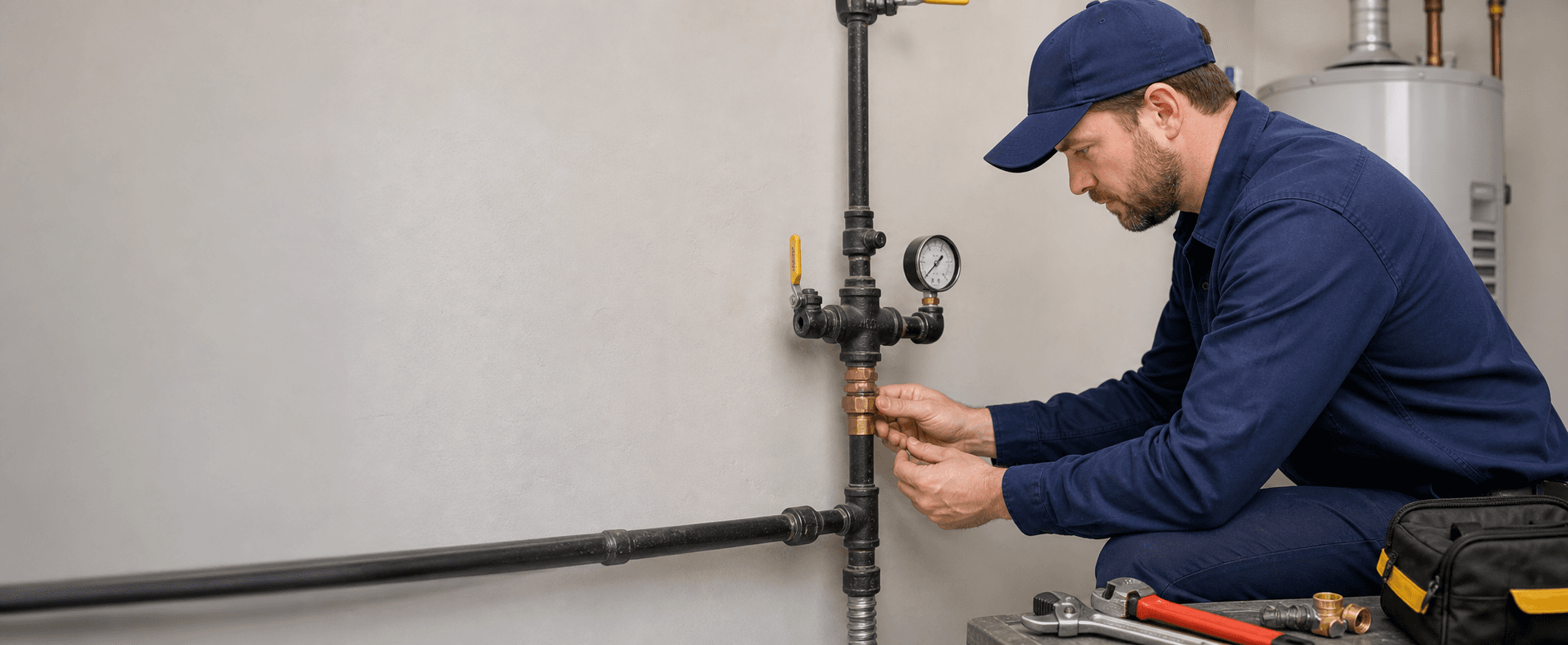
CSST — the flexible yellow-jacketed corrugated stainless steel tubing used for interior gas distribution in thousands of Bellevue homes built after the mid-1990s — is safe and durable under normal conditions. The hazard is indirect lightning. A nearby lightning strike induces a current on the gas piping system; if the CSST is not bonded to the home's electrical grounding system, this induced current can arc through the thin stainless steel wall and puncture the pipe, causing a gas leak or fire. Washington State adopted bonding requirements for CSST in 2009, but homes built or repiped between the mid-1990s and 2009 may have unbonded CSST. This guide explains what CSST bonding is, how to check if your system is bonded, and what bonding an existing system costs.
Last reviewed: 2026-06-14
CSST is flexible corrugated stainless steel gas pipe used inside homes for distribution runs. Its thin walls are vulnerable to electrical arc-induced puncture from nearby lightning strikes. Bonding connects the CSST to the home's electrical ground, providing a safe path for induced current.
Traditional black iron gas pipe is thick-walled threaded steel — a nearby lightning strike would need to produce a very large arc to pierce it. CSST's corrugated stainless steel wall is much thinner (in the range of 0.010–0.014 inches). An electromagnetic pulse from a lightning strike within several hundred feet of the home can induce enough current on the gas piping system to arc through that thin wall at a fitting or corrugation, creating a small hole. Gas escaping through that hole can ignite.
Bonding addresses this by connecting the CSST system to the home's grounding electrode system (the same ground that handles lightning protection for the electrical system). The bonding wire provides a lower-resistance path for induced current than the pipe wall itself, so the current takes the wire to ground rather than arcing through the pipe.
This is not a theoretical risk — there are documented house fires attributed to lightning-induced CSST puncture, primarily in unbonded installations. The bonding requirement was adopted nationally by NFPA 54 and the International Fuel Gas Code after these incidents, and Washington State incorporated it into the plumbing code in 2009.
This happening in your home right now? A licensed plumber can talk you through the next step on the phone — 24/7, and the call is free.
Call a plumberIf your home was built or had gas work done between the mid-1990s and 2009, it likely has CSST. Look for yellow flexible tubing at the gas connections behind appliances or in the utility room. Whether it is bonded requires a plumber to check.
CSST is identifiable by its yellow plastic jacket and corrugated flexible appearance. It runs in continuous lengths from a manifold or distribution point rather than the threaded black iron elbows and couplings you see in older homes. You may see it at the back of your gas dryer, water heater, or furnace, where a flexible section connects the appliance to the wall stub.
Bonding means there is a visible bonding wire (usually bare copper or green-jacketed wire) clamped to the CSST system at a fitting and running to the home's grounding electrode system or electrical panel ground bar. A licensed electrician or plumber can confirm whether bonding is present and whether it meets current code. If you do not see a bonding wire, it does not mean bonding is absent — it may be in the crawlspace or utility room — but it is worth having confirmed.
Adding a code-compliant bonding connection to an existing CSST system typically costs $195–$385, depending on access to the CSST manifold and the grounding electrode system.
The bonding connection itself is a clamp fitting that attaches to the CSST or its manifold, with a #6 AWG or larger copper bonding wire running to the grounding electrode system. The work is done by a licensed plumber (or in coordination with an electrician for the grounding side). In most Bellevue homes with accessible utility rooms or crawlspaces, this is a straightforward job.
Some CSST manufacturers (particularly Wardflex and TracPipe) have approved their own fittings and installation methods as 'equipment bonding' — meaning the fittings themselves provide arc-fault protection without a system-level bonding wire, if every CSST section terminates in one of these approved fittings. If your system uses these fittings throughout, a plumber can verify this and provide documentation that the installation is code-compliant.
Adding CSST bonding is typically done at the same time as a gas line inspection, a PRV inspection, or any other gas work that already has a plumber on site — it is a short add-on to an existing visit.
Every fact in this guide cites a verifiable public source. If you find a number we got wrong, email dispatch@bellevueplumberpro.com.
Need help with this in your home? See our Gas line installation and repair in Bellevue page for pricing, our diagnostic process, and how same-day service works across the Eastside.
We dispatch for this across Downtown Bellevue, Crossroads, Somerset, Newcastle, and Newport Hills — see your neighborhood page for local response times and recent jobs.
Flexible corrugated stainless steel tubing used inside homes for gas distribution since the mid-1990s. Its thin walls are vulnerable to arc-induced puncture from nearby lightning strikes unless the system is properly bonded.
If it was built or had gas work done between the mid-1990s and 2009, likely — look for yellow flexible tubing at gas connections behind appliances or in the crawlspace. Adding a code-compliant bonding connection typically costs $195–$385.