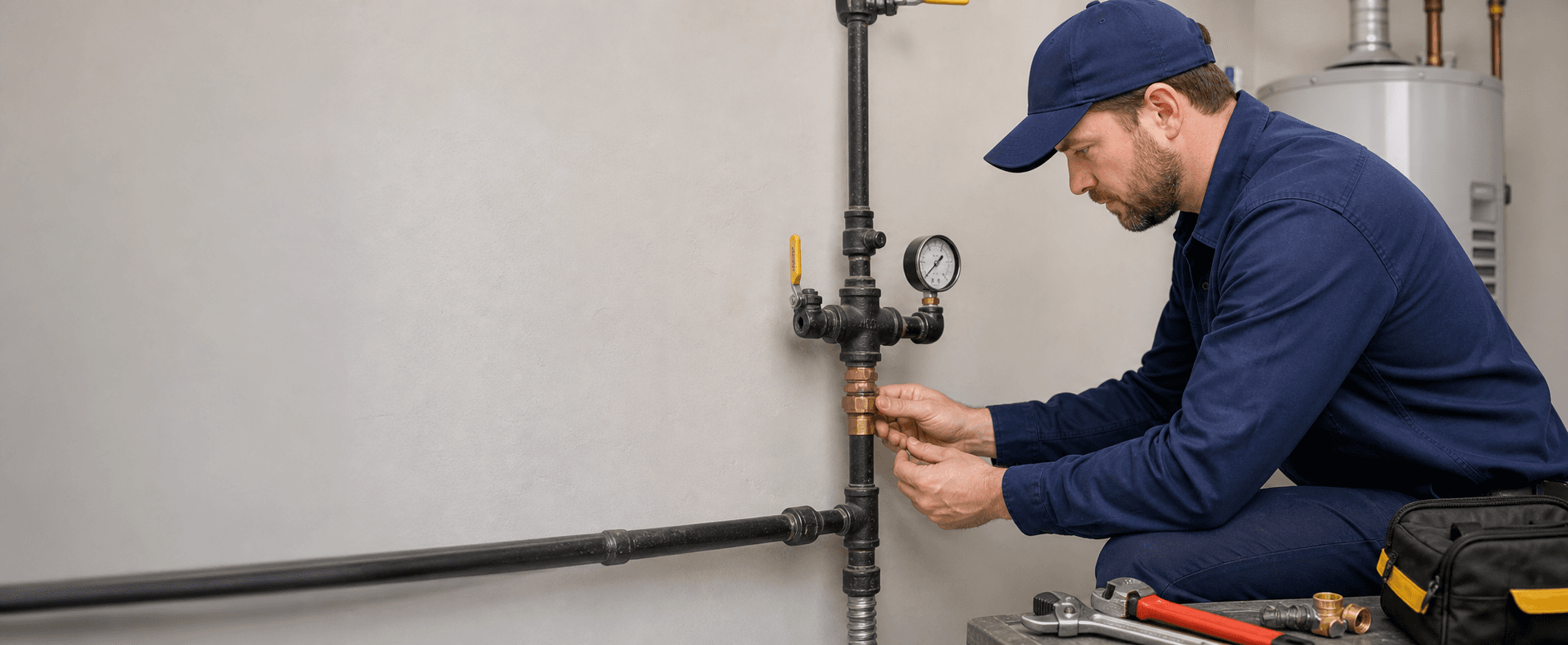
Gas lines and gas safety in Bellevue homes
Gas work sits in a different risk category from the rest of home plumbing: the failure mode is fire or asphyxiation, not water damage, so the rules are stricter and the line for safe DIY is much closer in. If you smell gas, the first move is to leave and call from outside — that is the whole decision, and this section opens with it. Beyond emergencies, adding a gas line for a range, dryer, fireplace, or generator is permitted work in Bellevue that requires correct pipe sizing and a pressure test, which is why it belongs with a licensed pro. This section covers the gas-smell response and what a code-compliant new appliance line involves.
Gas lines & safety
Gas line installation cost in Bellevue: ranges, permits, and what drives the price
What a new gas line actually costs to install in Bellevue — single appliance runs, whole-house systems, and generator or fire-pit lines — plus the City of Bellevue permit, the pressure test, and the five factors that move the price.
Read →I smell gas: what to do right now (and who to call in Bellevue)
If you smell gas, get everyone out without touching any switch or phone, then from outside call 911 or Puget Sound Energy at 1-888-225-5773. PSE responds free, 24/7. Gas line repair is always a licensed-pro job.
Read →Adding a gas line for an appliance in Bellevue: permits, sizing, and why it is a pro job
Adding a gas line for a range, dryer, or water heater is permitted, licensed, inspected work — not DIY. It needs a permit, code-based pipe sizing, a sediment trap where required, and a pressure test before the gas is turned on.
Read →Gas line inspection in Bellevue: when you need one and what the plumber checks
A gas line inspection is required before any new gas appliance connection and is strongly recommended when buying a home, after an earthquake, or when a line is more than 30 years old. Here is what the inspection covers and what it costs in Bellevue.
Read →CSST gas pipe bonding in Bellevue: the code requirement most homeowners don't know about
Homes with corrugated stainless steel tubing (CSST) installed before 2009 may not have the arc-fault bonding that Washington State now requires. An unbonded CSST system can be punctured by a nearby lightning strike. Here is what to check and how bonding is added.
Read →Other guide sections
Pipes & freezing
7 guides
Browse →Sewer lines
5 guides
Browse →Water heaters
14 guides
Browse →Water quality
5 guides
Browse →Cost and pricing
6 guides
Browse →Code and permits
4 guides
Browse →Plumbing emergencies
5 guides
Browse →Seasonal plumbing
4 guides
Browse →Drains and clogs
10 guides
Browse →Garbage disposals
4 guides
Browse →Toilets
7 guides
Browse →Water pressure
5 guides
Browse →Fixtures and faucets
5 guides
Browse →Sump pumps
6 guides
Browse →