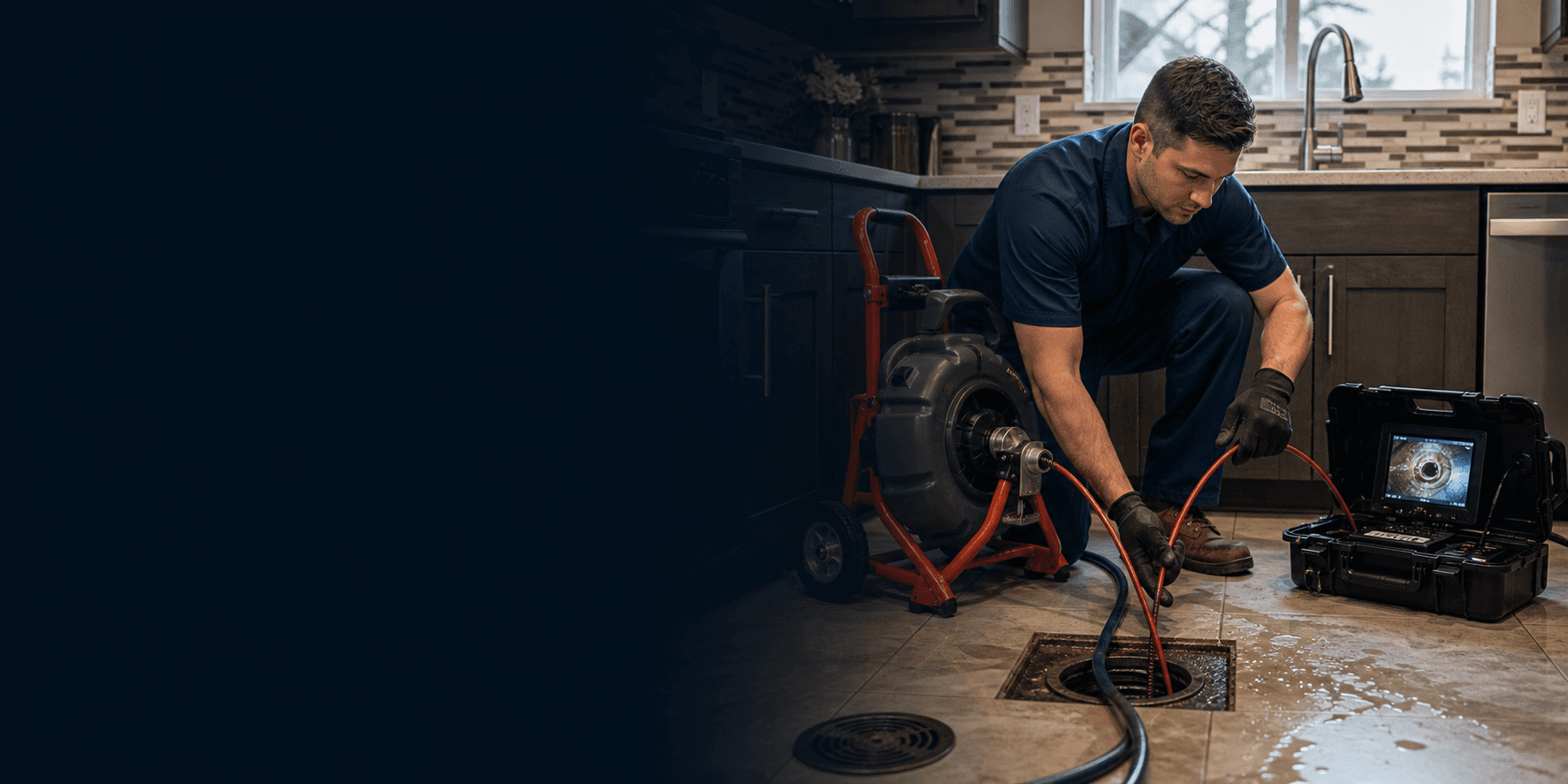
Bellevue hydro jetting: when it's worth it, what it costs, what it won't fix
Hydro jetting in Bellevue uses 3,500 to 4,000 psi pressurized water with forward-cutting and rear-scouring nozzles to clear root masses, hardened grease, and scale from residential sewer laterals and drain branches — but only after a sewer camera diagnostic and only when the pipe material is structurally sound enough to take it. We do not jet a line we have not inspected. Pre-1960 clay tile, deteriorated Orangeburg pipe, and rust-pitted cast iron may need step-down pressure or cabling instead. The full decision between hydro jetting and mechanical cabling for your specific pipe and clog is in our hydro jetting vs cabling in Bellevue: which one actually fixes it (and which is overkill) guide. For a recurring main-line root clog in an older Bellevue home, jetting plus a maintenance interval is usually the durable answer; for a single kitchen-branch grease clog, cabling at $189 is enough.
What we fix
- Compacted root masses in main sewer laterals (after a camera diagnostic confirms structural integrity)
- Heavy grease and FOG buildup in kitchen drain branches that cabling has cleared but not solved
- Mineral scale and tuberculation on the interior wall of aging cast iron drain stacks
- Recurring clogs that have been cabled twice in the same calendar year
- Pre-sale sewer scope clean-out for a clear post-jet camera before close
- Hydro-jet preparation pass before CIPP pipe lining (the liner only bonds to clean pipe wall)
- Sediment buildup in storm drains and yard drains during fall leaf season
How we work
Camera first.
We do not jet a line we have not inspected. The camera shows pipe material, clog type, structural condition, and whether jetting is appropriate at all.
Pipe-material assessment.
Pre-1960 clay tile with deteriorated joints, Orangeburg pipe, and rust-pitted pre-1970 cast iron may not survive standard 4,000 psi. We step pressure down to 1,500 to 2,500 psi or recommend cabling instead.
Cleanout access and equipment selection.
Standard 4-inch exterior cleanout fits the jet hose directly. If access requires a roof vent or pulled toilet, we factor the access setup into the quote before any work.
Forward and rear nozzle pass.
Forward jets bore through compacted material; rear-facing scour jets pull the head back through the line, cleaning pipe walls in both directions.
Post-jet camera.
We show you the cleared line on a phone or tablet. If the post-jet camera reveals damage that was masked by the clog (a crack, a belly, a collapse), we explain the repair options before we leave.
Cost of hydro jettingin Bellevue (2026)
Real prices for our most common hydro jetting jobs in Bellevue. Every quote is flat-rate and written on a tablet before we start.
Hydro jetting is the right answer for some clogs and wrong for others. A reputable Bellevue jetter cameras first and tells you when cabling at $189 is enough — and tells you when the pipe is too deteriorated for full pressure no matter what you'd pay. The differentiator is being honest about when it's the wrong choice.
What hydro jetting actually does inside the pipe
A jetter is a high-pressure pump (typically trailer or skid-mounted) pushing water at 3,500 to 4,000 psi through a 1/2-inch hose tipped with a specialized nozzle. Forward-facing jets bore through the obstruction; rear-facing jets scour the pipe wall in both directions as the head is pulled back through the line. The result is a pipe cleaned to bare wall — not just a hole punched through the clog.
The mechanical difference between cabling and jetting matters in practice. A drain cable spins a cutter head through the clog at 600 to 800 rpm, punching a channel through whatever is blocking flow. Water passes through the channel and the drain starts working again, but the residue — grease film, root remnants, hardened sediment — stays attached to the pipe wall. The clog comes back as new debris catches on the residue.
Hydro jetting clears the full pipe diameter. Forward jets bore through the obstruction; rear jets create a backward thrust that pulls the nozzle through the line while scouring the wall at 360°. Grease film, root mass, and mineral scale are sheared off the pipe interior. Re-accumulation to the pre-clean condition takes months to years instead of weeks.
The math on a typical Bellevue recurring main-line root clog: cabling at $345 every 18 months over a 6-year window is $1,380 and 4 service visits. A single jet at $995 plus light maintenance ($300 at month 36 and month 72) is $1,595 and 3 visits over the same window. Roughly even cost, but the jet-plus-maintenance path means fewer service interruptions and fewer drain backups in between.
Standard residential hydro-jet specifications
- Standard residential pressure: 3,500 to 4,000 psi
- Flow rate: 4 to 8 gallons per minute for residential, higher for commercial mains
- Pipe diameter handled: 2-inch branch through 8-inch main
- Run length cleared in a typical visit: up to 200 feet from cleanout access
- Pipe wall cleaned (not just channel cut) — the defining difference from cabling
Pipe age and material — when standard pressure is too aggressive
Bellevue's housing stock pre-1980 runs heavily on clay tile, cast iron, and Orangeburg sewer laterals. All three materials can fail under 4,000 psi if they're already deteriorated. A reputable jetter cameras first, identifies the material, assesses joint integrity, and either steps pressure down to 1,500 to 2,500 psi or recommends mechanical cabling instead. Standard pressure on a deteriorated line risks blowing joints, perforating thin pipe walls, and turning a clog into a collapse.
Clay tile sewer pipe was the residential standard in the US from roughly 1880 to 1960. Vitrified clay is strong under compression but brittle, with joints sealed by mortar or rubber gaskets that weaken over time. A 1955 Lake Hills clay lateral is now 71 years old. The pipe itself may be intact, but mortar joints between sections have softened. High-pressure jet impact at a weakened joint can separate the joint entirely — converting a treatable root intrusion into a $7,000 spot excavation.
Cast iron drain stacks and sewer laterals were standard from roughly 1900 through 1980. Cast iron corrodes from both directions: wastewater acids attack the interior, soil moisture attacks the exterior. A 1965 Bellevue cast iron lateral has been corroding for 60 years. Interior tuberculation (rust nodules) means the original 4-inch interior diameter is now closer to 3 inches in the worst spots. Pressure jetting can dislodge the tubercles cleanly (the desired outcome) or perforate the thinned pipe wall (the failure mode). The deciding factor is wall thickness at the perforation-risk points, which the camera can estimate by looking at how deep the rust pits go.
Orangeburg pipe — bituminized fiber, manufactured from the 1940s through 1974 — is a special case. The material softens with age, deforms (flattens) under soil pressure, and delaminates internally. There is no safe jetting pressure for failed Orangeburg. Once Orangeburg is identified on camera, the conversation moves from cleaning to replacement. Trying to jet failed Orangeburg accelerates the collapse and costs the homeowner the difference between a planned trenchless replacement and an emergency open-trench dig. The PNW root-intrusion patterns that make Orangeburg fail faster than the national average are covered in our cedar and Douglas fir roots in Eastside sewer lines: signs, repair, and prevention guide.
Modern PVC (1972+) and ABS handle full 4,000 psi without difficulty. The pressure-step-down conversation only applies to pre-1980 lines.
Pipe material × pressure decision
- Clay tile (1880-1960): camera-verify joint condition. Step down pressure on aged mortar joints
- Cast iron (1900-1980): assess wall thickness via tuberculation depth. Step down or cable if pits are deep
- Orangeburg (1940-1974): do not jet. Replacement is the only durable answer
- Galvanized steel (rare for sewers, common for older drain stacks): step down pressure; jet only for branch lines
- PVC / ABS (1972+) and HDPE / cast iron (post-1985): full 4,000 psi safe
When jetting is the right answer (and when cabling is enough)
Jetting earns its $595 to $1,200 premium when the clog involves roots, hardened grease across a long run, mineral scale on a cast iron interior, or any recurring blockage that cabling has already cleared at least once in the past 18 months. Cabling at $189 to $345 is the right answer for a single soft clog in a modern PVC line, a hair clog in a shower drain, or any first-time clog where the camera shows no structural pattern driving it.
Roots in a main sewer lateral are the textbook hydro jetting case. Cabling cuts a hole through a root mass; the root mass regrows from the remaining cellulose attached to pipe walls. Jetting shears the root mass off the pipe interior. Combined with a foaming root inhibitor flush after the jet pass, root regrowth pauses for 18 to 36 months instead of 4 to 8 months. The full PNW root pattern — western red cedar, Douglas fir, and bigleaf maple lateral root systems intersecting pre-1980 sewer laterals — is documented in the cedar-roots learn guide above.
Hardened kitchen grease in a horizontal drain run is the second clear jetting case. Grease cools and saponifies into a hard wax-like coating bonded to the pipe interior, particularly in 70s and 80s Bellevue ramblers with long horizontal kitchen drains. Cabling punches a hole; the grease wall remains. Jetting shears the coating off. After a single jet and 60 days of enzymatic maintenance, kitchen-branch clog recurrence drops from monthly to annual.
Mineral scale and tuberculation on aging cast iron is the third case, with the pressure caveat above. A 1970 cast iron drain stack in Lake Hills or Crossroads with interior corrosion eating into the 4-inch diameter benefits from a careful jet pass at 2,500 to 3,000 psi. Full restoration of original diameter is not realistic — the pipe wall has lost material — but removing scale and slowing future buildup is.
Cabling wins for soft single-point clogs: a hair-and-soap clog in a shower drain, a wet wipe lodged in a toilet trap, a food clog 3 feet into a kitchen line. The camera confirms the clog is local and the pipe upstream and downstream is healthy. Cabling at $189 clears it in 20 minutes. Hydro jetting the same fixture for $595 would also clear it — but at 3x the cost and with no durable advantage because there's nothing on the pipe walls to scour.
Red flags in a Bellevue hydro jetting quote
Five patterns that mean a quote is wrong: jetting quoted without a prior camera, recommended jet maintenance more often than every 12 months for a residential line, separate fees for camera + jet + report instead of bundled, no mention of pipe age or material in the assessment, and refusal to show camera footage on the spot. Any of these and you should get a second quote.
A jet quote without a camera is selling a guess. The whole point of hydro jetting is to do something specific to a known problem; quoting it without diagnostic is the same pattern as quoting a full sewer replacement without footage. A reputable Bellevue jetter will camera first (often free if you proceed with the jet) and the quote will reflect what the camera showed, not a generic flat rate.
Maintenance intervals of 6 months or less for a residential line are usually upsell. The published industry guidance for residential sewer-lateral jetting maintenance is 18 to 36 months, with 12 months only for the most aggressive root cases. A 6-month interval means the contractor is monetizing the relationship, not solving the problem. The underlying line either needs spot repair (one bad joint) or replacement (general failure), neither of which are addressed by more-frequent jetting.
Bundling matters because it's an integrity signal. The legitimate price components for a hydro jet are: equipment hour cost, water consumption (negligible), labor (1 to 3 hours), and the camera. Unbundling these into a $295 camera fee + $695 jet fee + $150 'report fee' is a Best Buy pricing pattern that ends with the homeowner paying $200 to $300 more than the comparable bundled service. Ask for one number.
Pipe age and material should be in the assessment in writing. 'Jet recommended for main lateral, 4-inch PVC visible in camera, no structural issues observed' is a quote you can act on. 'Jetting recommended' with no detail is a quote you cannot evaluate.
Camera footage on the spot. Modern residential jetter setups record digitally — the plumber should be able to play back the camera on a phone or tablet before quoting. If the answer is 'we'll send you the footage later' or 'the camera saves to the office computer,' assume the diagnostic is being optimized for upsell rather than for your decision. Reputable Bellevue plumbers walk you through what's on the screen while the camera is still in the pipe.
Hydro jet as preparation for trenchless lining
Cured-in-place pipe lining (CIPP) bonds an epoxy-saturated felt liner to the existing pipe interior, creating a new pipe inside the old one. The liner only bonds to clean pipe wall — which means a hydro jet pass is mandatory before any CIPP install. The jet pass is also when the installer takes final measurements for liner length and confirms the line is structurally sound enough to support a liner at all.
Trenchless sewer repair via CIPP is one of the highest-leverage repair options on the Eastside because it avoids open-trench excavation in landscaped yards, mature trees, driveways, and (most importantly) under structures or near setback boundaries. The full trenchless workflow including the regulatory and access constraints in Bellevue is covered on our Bellevue trenchless sewer repair: CIPP lining and bursting page.
Within the CIPP workflow, the hydro jet pass is step 2 of 5: camera assessment → hydro jet pass to clean pipe wall → measure and cut liner → wet-out resin and inversion install → cure and post-install camera. The jet pass is what makes the resin bond viable. If you skip the jet (or do an inadequate one), the liner bonds to grease, scale, and root debris instead of pipe wall, and the warranty is essentially void.
This is why a hydro-jet-only quote on an old line should sometimes prompt a CIPP-feasibility conversation. If the underlying pipe is 1960s clay with multiple bad joints, jetting clears the immediate clog but the line is going to fail again at the joints regardless. The honest conversation is whether jetting plus monitoring is the right path, or whether jet plus CIPP lining is the durable answer at a 5 to 7-year horizon.
Sources
Every fact in this guide cites a verifiable public source. If you find a number we got wrong, email dispatch@bellevueplumberpro.com.
- Angi — Bellevue and Seattle drain cleaning and hydro jetting pricing (2026)
- WA State Department of Labor & Industries — Plumbing Code Chapter 51-56
- RIDGID — SeeSnake sewer camera specifications
- NASSCO — Cured-in-place pipe (CIPP) installation guidelines for residential laterals
- City of Bellevue Development Services — Side-sewer permit requirements
From our guides
Deeper background on the issues this service addresses:
- Cedar and Douglas fir roots in Eastside sewer lines: signs, repair, and prevention
- Sewer camera inspection cost in Bellevue: what it shows, what you pay, and when you need one
- Hydro jetting vs cabling in Bellevue: which one actually fixes it (and which one is overkill)
- Hydro jetting cost in Bellevue: price ranges, when it beats cabling, and what drives the bill
Full overview of drain cleaning and clog removal in Bellevue — pricing, process, what we fix, and how same-day service works.