Why is my toilet leaking at the base?
Five causes: a failed wax ring, condensation on the bowl, loose closet bolts, a cracked or corroded closet flange, or a tank-to-bowl leak running down the outside of the bowl.
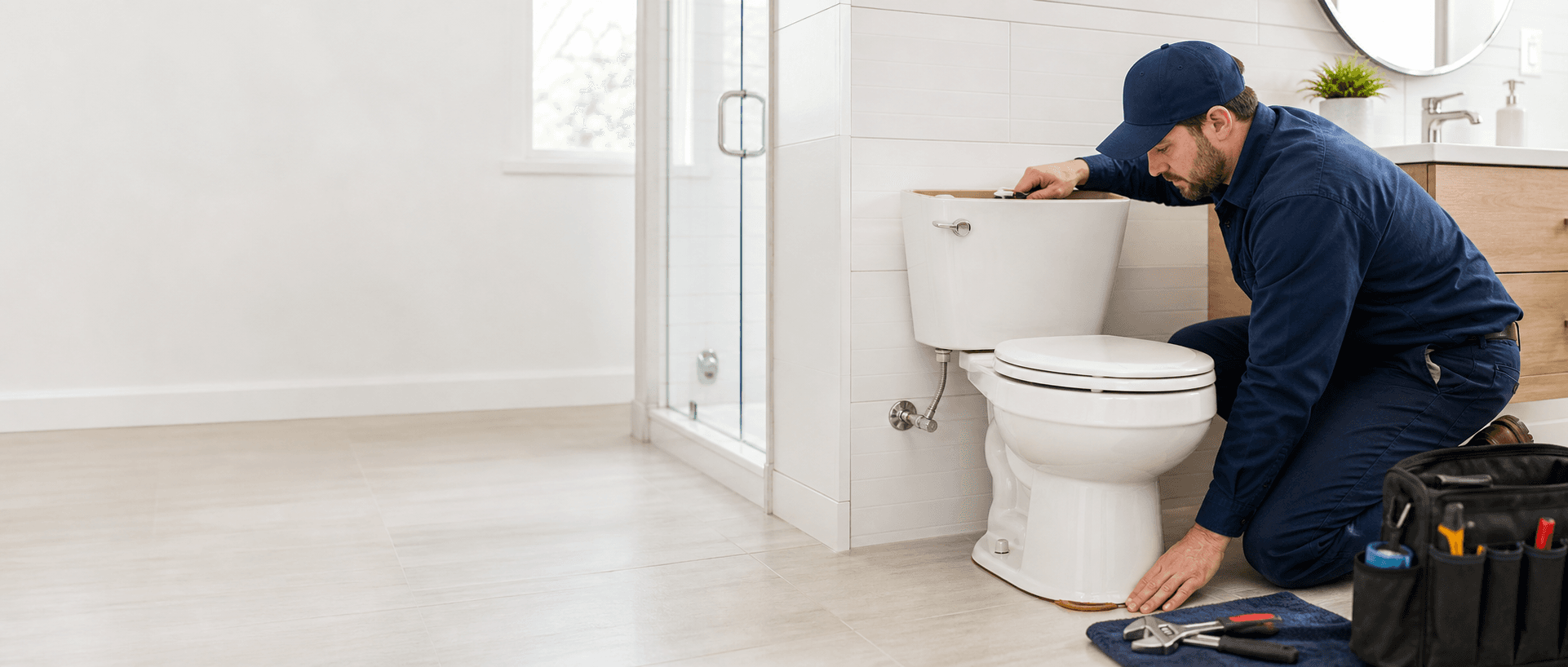
Water pooling at the base of a toilet has five common causes, and the timing of when the water appears narrows it down faster than anything else. A failed wax ring leaks only when the toilet is flushed, because that is when waste water passes through the seal; condensation wets the base continuously in humid weather with no flush involved; loose closet bolts let a rocking toilet break its own wax seal; a cracked or corroded closet flange — common under older Bellevue cast-iron — lets the toilet shift and weep; and a tank-to-bowl leak runs clean water down the back of the bowl that only looks like a base leak. This guide walks the paper-towel test that pinpoints the source, explains why a rocking toilet and an aging cast-iron flange so often go together in 1960s-80s Eastside homes, and gives the cost split between a five-dollar DIY wax ring and a professional reset. It also covers the real reason a base leak is not worth ignoring: the wastewater seeping under the flooring rots the subfloor and joists long before it shows on the surface.
Last reviewed: 2026-06-04
Five causes: a failed wax ring, condensation on the bowl, loose closet bolts, a cracked or corroded closet flange, or a tank-to-bowl leak running down the outside of the bowl.
The single most common cause is a failed wax ring — the wax-and-rubber seal compressed between the bottom of the toilet and the closet flange in the floor. When that seal fails, flush water escapes the connection and seeps out at the base, so a leak that appears only when the toilet is flushed points almost directly at the wax ring. The wax can fail from age, from a toilet that was set unevenly, or from a toilet that has been rocking on a loose mount and worked the seal loose over time.
Condensation is the cause people miss most, because it is not a leak at all. In humid weather, or when cold incoming water chills the porcelain below the dew point of the room air, moisture condenses on the outside of the tank and bowl and runs down to pool at the base. It wets the floor continuously, with no relationship to flushing, and no amount of resetting the toilet will stop it because the water is coming out of the air, not out of the seal.
The mechanical causes are loose closet bolts and a damaged closet flange. The two closet bolts anchor the toilet down onto the flange and hold the wax ring compressed; when they loosen, the toilet rocks, the wax seal cracks, and flush water escapes. A flange that is itself cracked or corroded — the failure mode in many older Bellevue homes with cast-iron flanges — lets the toilet shift no matter how tight the bolts are, because the part the bolts anchor into has failed.
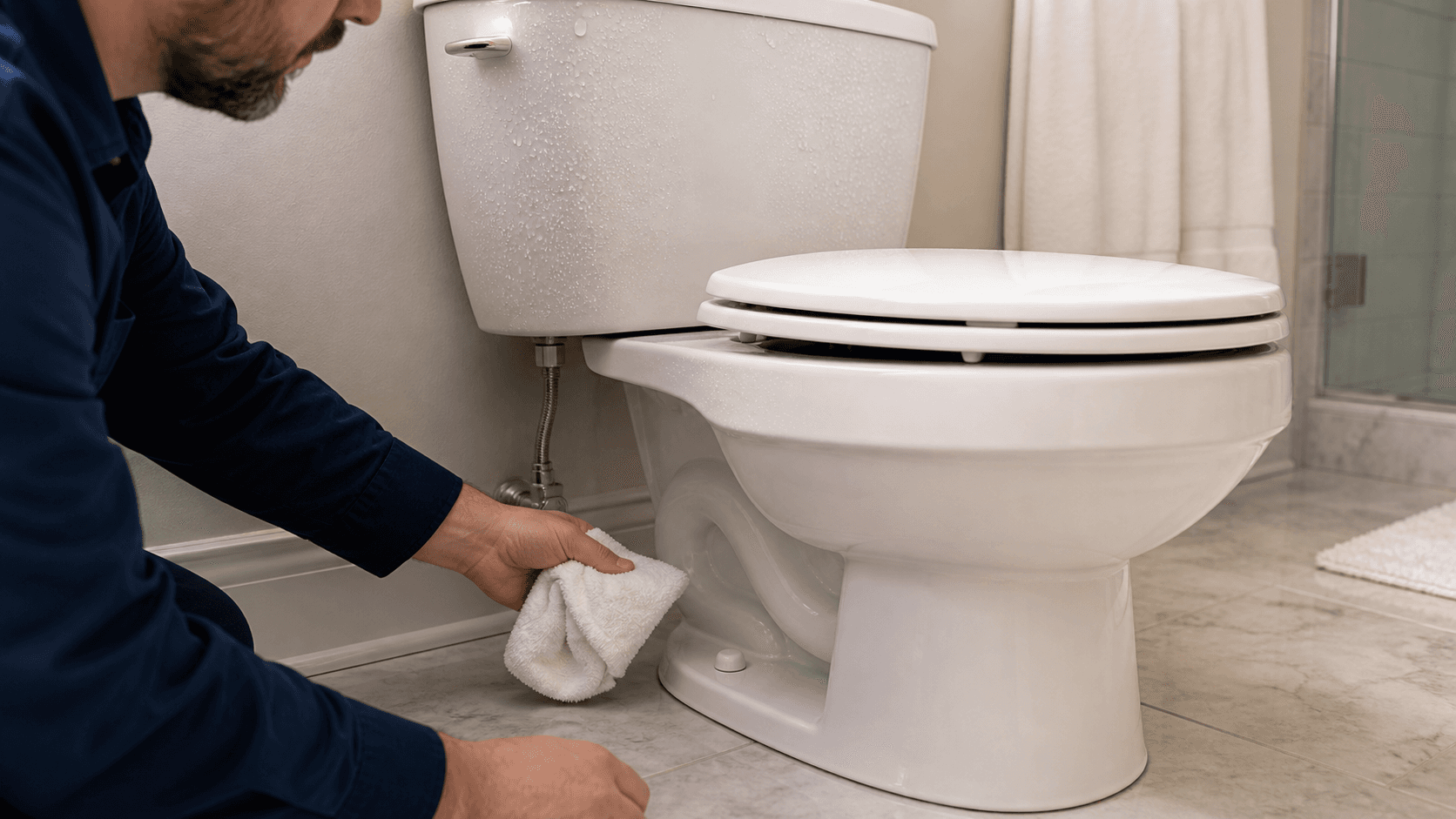
The fifth cause is a tank-to-bowl leak that only masquerades as a base leak. The gasket and bolts joining the tank to the bowl can weep clean water that runs down the back of the bowl and pools at the base, looking exactly like a seal failure from across the room. The tell is that the water is clean and traces to the back of the bowl rather than welling up from underneath, which the paper-towel test below confirms.
This happening in your home right now? A licensed plumber can talk you through the next step on the phone — 24/7, and the call is free.
Call a plumberWater only after a flush points to the wax ring; continuous wetness in humid weather is condensation; clean water down the back of the bowl is the tank-to-bowl gasket.
Before touching a tool, watch when the water shows up, because each cause has a distinct timing signature. Water that appears at the base only after a flush — and is gone or drying between flushes — is the classic wax-ring signature, because the seal only leaks while waste water is actually passing through the connection during and just after a flush. If you can dry the floor, flush once, and watch fresh water reappear at the base within a minute, the wax ring is the prime suspect.
Continuous wetness with no flush involved is condensation, especially if it tracks the weather. Condensation wets the base steadily on humid days, worsens in summer or in an unventilated bathroom, and forms visibly as droplets on the outside of the tank that run down to the floor. There is no surge after a flush and no link to use — the floor is simply damp whenever the room is humid and the porcelain is cold, which is a moisture problem, not a seal problem.
Clean water that traces to the back of the bowl points at the tank-to-bowl connection rather than the floor seal. Run a finger up the back of the bowl toward the tank: if the water originates high and runs down, the tank-to-bowl gasket or its bolts are weeping, not the wax ring. This water is clean rather than waste-tinged, which is another way to separate it from a true wax-ring failure that carries water from the flush path.
A leak that tracks with rocking — water that appears or worsens when someone sits or when the toilet is nudged — points at loose closet bolts or a failed flange underneath. The motion breaks the wax seal momentarily, so the leak is intermittent and movement-linked rather than tied purely to flushing. Sorting these timing patterns first means you confirm the cause with the paper-towel test below rather than guessing and pulling a toilet you did not need to pull.
If the base is wet continuously in humid weather with droplets on the outside of the tank and no surge after a flush, it is condensation, not a failed seal.
Condensation and a seal leak get confused constantly because both put water on the floor at the base of the toilet, but they have nothing to do with each other. Condensation forms when humid room air contacts porcelain chilled by cold incoming supply water, dropping the surface below the dew point so water vapor condenses out of the air onto the tank and bowl exterior. That water then runs down to the base — it never came from inside the toilet or its seal at all.
The distinguishing tests are timing and location. Condensation appears in warm, humid conditions and on the outside surfaces of the tank, visible as a film or beads of water you can wipe off the porcelain; it has no surge tied to flushing because it is weather-driven, not flush-driven. A seal leak, by contrast, is flush-linked and the water wells up from underneath the base rather than running down from the visibly wet tank exterior.
Confirming condensation matters because the fix is completely different. You do not reset the toilet or replace the wax ring for a sweating tank — you reduce the humidity or the temperature differential. Better bathroom ventilation, a dehumidifier, an insulating tank liner, or a mixing valve that warms the tank supply slightly all address condensation; pulling and resetting the toilet does nothing because the seal was never the problem.
If the base is dry between humid spells and only sweats when the room is warm and the water is cold, stop diagnosing a leak — it is condensation. If instead the water reappears after a flush regardless of weather, or wells up from beneath the porcelain, move on to the paper-towel test to pin the actual seal or flange failure.
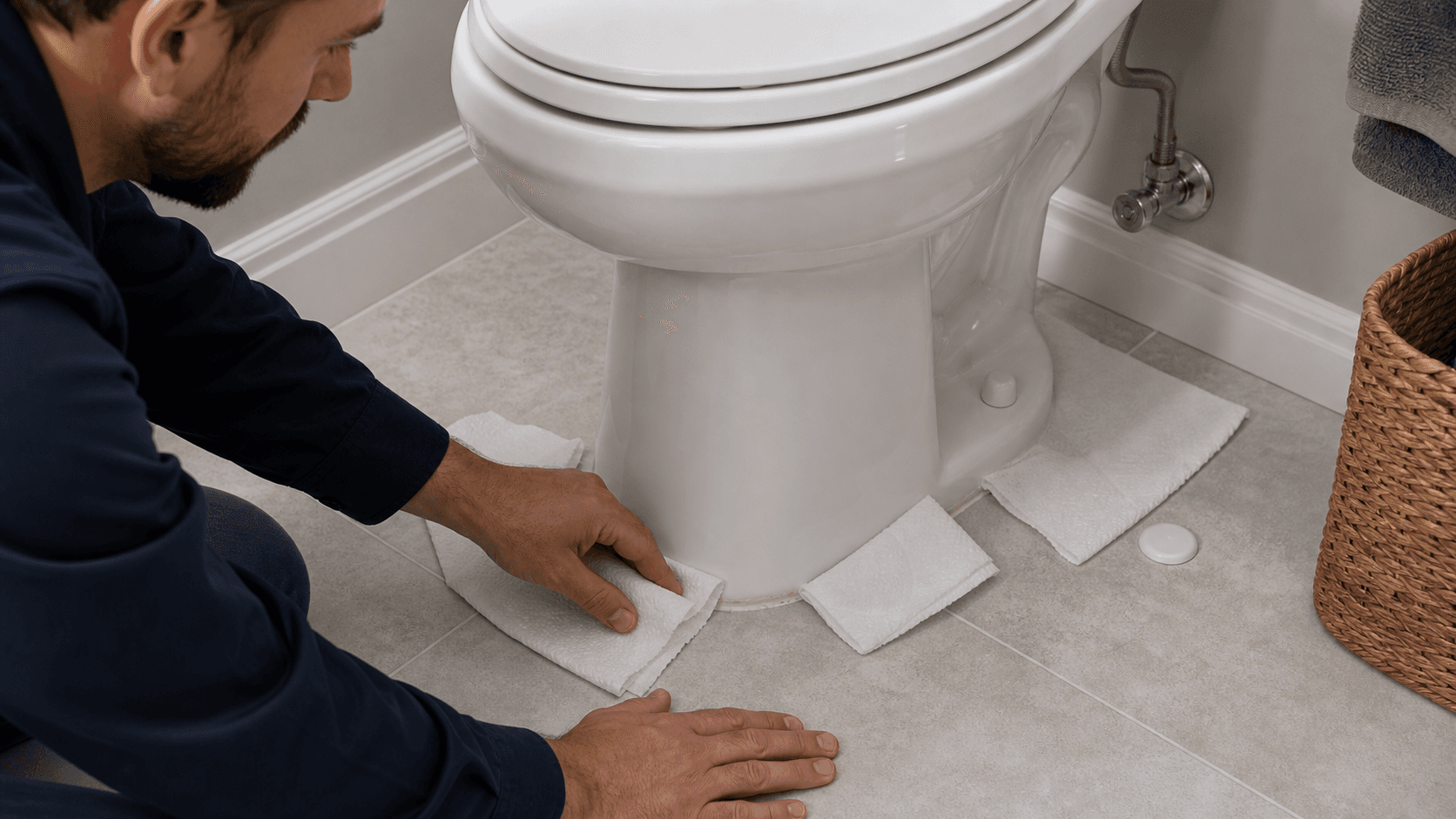
Dry the base completely, lay paper towels around it, then flush several times and watch where the towels re-wet first — at the base means the seal, high on the bowl means the tank.
The paper-towel test isolates the source the same way it does for any base leak: by drying everything first so any new water is unambiguous. Wipe the entire base, the floor around it, and the back and underside of the bowl bone dry, then lay a ring of paper towels flat around the base and press a strip against the back of the bowl where the tank meets it. With everything dry, the first towel to re-wet, and where, names the cause.
Now flush the toilet several times and watch. Towels that re-wet right at the base, welling up from the joint between porcelain and floor, point at the wax ring or the flange beneath it. Towels that re-wet high on the back of the bowl, with water running down from the tank connection, point at the tank-to-bowl gasket instead. If the towels stay dry through several flushes but the floor dampens again hours later in humid air, the source is condensation.
Adding a rocking test sharpens the flange-versus-wax distinction. With the towels in place, gently rock the toilet by hand or press on it as if sitting: if that motion produces fresh water at the base, the toilet is moving on a loose or failed mount, which means loose closet bolts or a cracked flange rather than a wax ring that simply aged out. A toilet that leaks only on motion is unstable underneath; a toilet that leaks on every flush while sitting solid is a seal that has worn.
Once the test names the zone, the fix follows directly: a base leak that tracks with flushing is a wax-ring reset, a base leak that tracks with rocking is bolts or flange, and a high leak is the tank gasket. If the test points to a moving toilet on an older Bellevue cast-iron flange, that is the harder repair covered below, and a job to book as faucet and fixture repair in Bellevue rather than to improvise on a corroded flange.
A toilet that rocks has loose closet bolts; the motion cracks the wax seal and leaks on flush. Snug the bolts evenly first, but a reset with a new wax ring is the real fix.
A toilet should sit rock-solid on the floor. When it rocks even slightly, the two closet bolts that anchor it to the flange have loosened, and that movement is what breaks the wax seal: every rock flexes the wax, cracks it, and opens a path for flush water to escape at the base. So a base leak on a toilet you can wobble by hand is very often a closet-bolt problem first and a wax-ring problem second, because the loose bolts are what destroyed the wax.
The first move is to snug the closet bolts evenly. Pop the caps off the two bolts at the base, and tighten the nuts a little at a time, alternating side to side so the toilet draws down square rather than tipping. Stop as soon as the toilet is firm — overtightening cracks the porcelain base, which turns a five-dollar fix into a new toilet. If snugging the bolts stops the rock and the leak, the wax may have survived and the job is done.
Often, though, the rocking has already cracked the wax beyond recovery, and tightening alone will not seal it. In that case the real fix is to pull the toilet, scrape off the old wax, set a fresh wax ring, and remount the toilet square on tight bolts so the new wax compresses into a clean seal. A toilet that rocked long enough to leak usually needs that full reset, because a cracked wax ring does not heal once flexed.
If the bolts will not draw the toilet tight — if they spin, pull up, or the toilet still rocks with the nuts snug — the problem is underneath, in the flange the bolts anchor into. That is the flange-failure case below, common in older Bellevue homes, and the point at which a homeowner reset turns into a faucet and fixture repair in Bellevue job rather than a quick bolt-tightening.
If the bolts will not tighten or the toilet keeps shifting, the closet flange itself is cracked or corroded — the common failure under older Bellevue cast-iron, and a repair to book a plumber for.
The closet flange is the ring that anchors the toilet to the drain pipe and holds the closet bolts; the wax ring seals against it, and the bolts thread into it. When that flange is cracked, corroded, or pulled loose from the floor, no amount of bolt-tightening will stabilize the toilet, because the part the bolts grip has failed. The signature is a toilet that keeps shifting or leaking even after the bolts are snug — the instability is below the bolts, not at them.
This is disproportionately a Bellevue problem because of the housing stock. Much of the Eastside's original 1960s-through-1980s building used cast-iron drainage, and cast-iron closet flanges corrode over decades of moisture exposure until the ring cracks or the bolt slots rust through. A flange that has lost its bolt slots cannot hold the toilet down at all, so the toilet rocks, breaks its wax seal, and leaks at the base no matter how carefully it is reset onto fresh wax.
Fixing a failed flange is more involved than a wax ring and is where the job crosses into professional territory. Depending on the damage, the repair ranges from a metal repair ring laid over the existing flange to cutting out and replacing a corroded cast-iron flange entirely — work that means pulling the toilet, dealing with old cast-iron, and resetting the toilet level and square afterward. Done wrong, the toilet leaks again within months, so the flange repair is worth getting right the first time.
If the paper-towel and rocking tests point at a flange rather than a wax ring — bolts that will not hold, a toilet that shifts on a solid-looking floor, visible corrosion at the base of an older toilet — book it as faucet and fixture repair in Bellevue. A corroded cast-iron flange is the kind of repair that rewards a plumber who has cut a hundred of them out, and it is the root cause that a homeowner reset on fresh wax cannot fix.
Wastewater seeps under the flooring and into the subfloor and joists, rotting them out of sight long before the damage shows on the surface — turning a cheap seal fix into structural repair.
A base leak is easy to dismiss because the volume is small and the floor often looks fine. The problem is where the water goes: it does not stay on the surface, it wicks under the flooring and into the subfloor around the toilet, soaking the wood and the framing where no one can see it. A wax-ring leak in particular carries waste water, not clean water, so the moisture under the floor is both rotting the structure and feeding mold.
The damage compounds quietly. Repeated flushes over weeks and months keep re-wetting the same patch of subfloor, and saturated wood softens, delaminates, and eventually rots through, often spreading to the floor joists beneath. By the time the surface shows it — a soft spot, a stain, a toilet that has begun to sink slightly — the subfloor underneath is already compromised, which is why a base leak that is trivial to fix early becomes a structural repair if ignored.
There is a moving-target element too. A leaking base softens the floor, the softening floor lets the toilet rock more, the rocking breaks the seal further, and the worsening seal leaks more water into the now-softer floor. That feedback loop is why a small base leak rarely stays small; left alone it accelerates, taking the subfloor and the toilet's mounting down with it.
The economic case for fixing it promptly is lopsided: a wax ring is a few dollars and a reset is a few hundred, while a rotted subfloor and joist repair is a far larger job that also still requires resetting the toilet at the end. Catching a base leak with the paper-towel test and resetting the toilet — or booking faucet and fixture repair in Bellevue when the flange is involved — is the cheap path, and the only one that stops the damage before it reaches the framing.
A wax ring runs $5 to $15 in parts for a DIY reset; a professional toilet pull-and-reset runs about $150 to $300, and a closet-flange repair adds roughly $85 to $350.
The cheapest scenario is a homeowner wax-ring replacement. The wax ring itself costs only about $5 to $15, and the job is mechanically simple in principle: shut the supply, drain and remove the toilet, scrape the old wax, set a new ring, and remount the toilet square on the bolts. For a confident DIYer with a stable flange and a one-piece toilet that is not too heavy to handle, this is a realistic afternoon repair at parts cost only.
The professional version of the same job — pulling the toilet and resetting it on a fresh wax ring — runs roughly $150 to $300 in the Bellevue market, covering the labor to safely lift and reseat the toilet, the new seal, and a square, leak-free remount. That is the price most homeowners pay, because the toilet is heavy and awkward, the reseat has to be dead level to seal, and an uneven reset just leaks again and wastes the effort.
Cost climbs when the flange is the real problem. A closet-flange repair adds on the order of $85 to $350 depending on whether it is a repair ring over an existing flange or a full replacement of a corroded cast-iron flange, on top of the toilet reset itself. That is the range where the older-Bellevue cast-iron cases land, and where the work most clearly belongs with a plumber rather than a homeowner.
The DIY-versus-pro line tracks the cause. A clear wax-ring leak on a solid flange is a reasonable homeowner job at a few dollars in parts; a rocking toilet, a corroded flange, a heavy two-piece or wall-hung toilet, or any uncertainty about the seal is a reason to book faucet and fixture repair in Bellevue. The reset has to be square and level to last, and the cost of doing it twice — plus the subfloor risk of a leak that returns — usually justifies the pro on anything past a straightforward wax swap.
No, you usually cannot just tighten the bolts — a cracked wax ring needs replacing. No, a wax ring does not reseal itself once it has failed.
No, you usually cannot fix a base leak by tightening the bolts alone. Snugging loose closet bolts is the right first move and occasionally seals a minor leak, but if the rocking has already cracked the wax ring — which is common by the time a leak appears — tightening cannot restore a seal the flexing destroyed. The lasting fix in that case is to pull the toilet and set a fresh wax ring, because a cracked wax seal does not recover. Overtightening also risks cracking the porcelain base, so bolts get snugged firm and even, not forced.
No, a wax ring does not fix itself. Wax rings are a one-time compression seal: once the wax has been flexed, cracked, or unseated by a rocking toilet, it stays failed and the toilet has to be pulled and a new ring set. There is no self-healing — a leak that comes and goes is the toilet rocking, not the seal recovering, and it will keep leaking until the ring is replaced and the mount is made solid.
Yes, a wax-free seal is a valid alternative to traditional wax. Rubber or foam waxless toilet seals are designed to be reusable and more forgiving of slight repositioning than wax, which can make them easier for a DIY reset, though a properly set wax ring remains a perfectly good seal. Either way, the seal is only as good as the flange beneath it and the squareness of the remount, so the seal type matters less than a solid flange and a level set.
A plumber reset of a leaking toilet typically runs about $150 to $300 in the Bellevue market, covering the labor to pull the toilet, replace the wax ring, and remount it square and level. If the closet flange is cracked or corroded, expect roughly $85 to $350 more for the flange repair on top — the older-cast-iron case in many Eastside homes. Book it as faucet and fixture repair in Bellevue when the flange is involved or the toilet will not sit solid on fresh wax.
Every fact in this guide cites a verifiable public source. If you find a number we got wrong, email dispatch@bellevueplumberpro.com.
Need help with this in your home? See our Toilet repair and replacement in Bellevue page for pricing, our diagnostic process, and how same-day service works across the Eastside.
Related services: Drain Cleaning and Clog Removal.
Five causes: a failed wax ring, condensation on the bowl, loose closet bolts, a cracked or corroded closet flange, or a tank-to-bowl leak running down the outside of the bowl.
Timing tells you. Water appearing only after a flush points to the wax ring; continuous wetness in humid weather is condensation; clean water running down the back of the bowl is the tank-to-bowl gasket.
A rocking toilet has loose closet bolts, and the motion cracks the wax seal — which then leaks on every flush. Snug the bolts evenly as first aid, but a reset with a new wax ring is the real fix.
The paper-towel test: dry the base completely, lay paper towels around it, flush several times, and watch where they re-wet first — at the base means the seal, high on the bowl means the tank.