Last reviewed: 2026-06-12
How do you unclog a toilet?
Use a flange plunger (the kind with the rubber sleeve extending from the cup), seat it so the flange enters the drain opening, press down slowly once to expel air, then plunge with firm vertical strokes for 15 to 20 seconds while keeping the seal. Most paper clogs clear in one or two rounds. If the bowl is near overflowing, wait 10 minutes or remove water first — never flush again to 'test' before the level drops.
The tool matters more than the effort. A flange plunger — the one with a soft rubber extension protruding from inside the cup — is shaped to seal a toilet's curved drain opening. The flat-bottomed cup plunger sitting under most bathroom sinks is designed for flat surfaces like tub and sink drains, and it loses its seal on a toilet, which is why so much frustrated plunging accomplishes nothing. If you own one plunger, own a flange plunger; it works on flat drains too with the flange folded in.
Technique: fold the flange out, lower the plunger at an angle so the cup fills with water rather than trapped air (air compresses and wastes your stroke), and seat the flange into the drain opening. Press down slowly the first time — a fast first plunge blasts the trapped air around the seal and can splash bowl water out at you. Then plunge with firm, fast, vertical strokes, maintaining the seal the whole time, for 15 to 20 seconds. The motion works in both directions: the push compresses, and the pull-back siphons. Most soft clogs release with an audible glug and the water level drops.
If the bowl is full to the rim, do not plunge yet and absolutely do not flush again — a second flush adds another tank of water to a bowl that has nowhere to put it, and that's how bathroom floors flood. Either wait ten minutes (a partial clog often lets the level seep down on its own) or bail water into a bucket until the bowl is about half full. Half full is the working level: enough water to keep the cup sealed, not enough to slosh over.
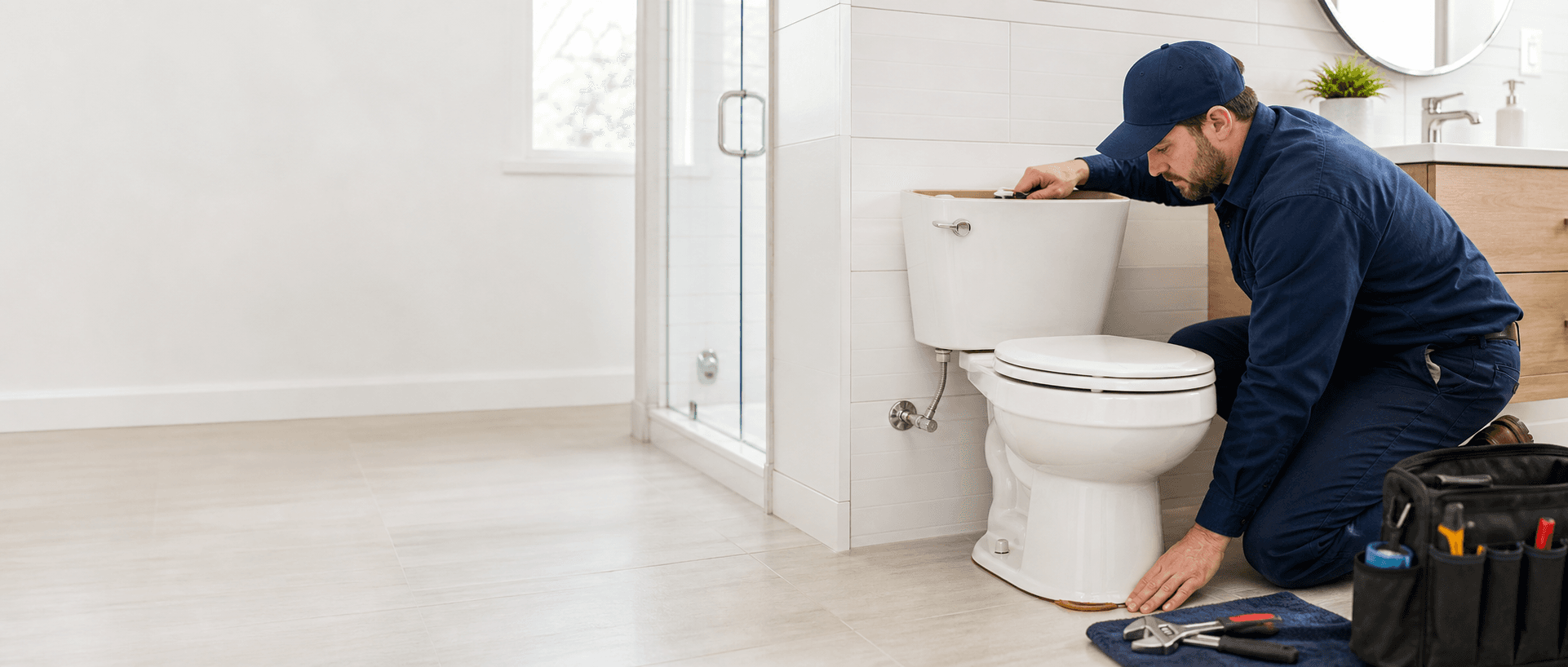
After the clog releases, flush once with the tank lid off and your hand near the flapper chain — if the bowl starts rising again you can stop the flush by pushing the flapper down. If it drains normally, run one more flush with a few squares of paper to confirm full flow. If plunging twice hasn't cleared it, escalate to the methods below or the deeper-problem signs further down rather than plunging for half an hour; a clog that survives proper plunging is usually past the toilet's trap.
This happening in your home right now? A licensed plumber can talk you through the next step on the phone — 24/7, and the call is free.
☎Call a plumberHow to unclog a toilet without a plunger
Pour a half cup of dish soap into the bowl, follow with a half bucket of hot (not boiling) water poured from waist height, and wait 10 to 15 minutes — this clears soft paper clogs more often than not. A toilet brush worked into the drain opening can substitute for a plunger in a pinch, and a wire coat hanger should stay in the closet; it scratches porcelain and rarely reaches the clog.
The dish soap and hot water method is the no-plunger workhorse. Squirt a generous half cup of dish soap (any kind) into the bowl and let it sink into the drain opening for a few minutes — soap lubricates the clog and the porcelain trap. Then pour about two gallons of hot tap water — hot, never boiling, because boiling water can crack the cold porcelain and a cracked toilet turns a $0 fix into a $400 replacement — from waist height into the bowl. The height adds force; the heat and soap soften the paper mass. Give it 10 to 15 minutes. This clears a majority of ordinary paper clogs.
Baking soda and vinegar is the gentler variant for slow-draining (not fully blocked) toilets: one cup of baking soda into the bowl, followed slowly by two cups of vinegar, fizz for 30 minutes, then hot water from waist height. It's less effective than soap on a full blockage but safe on everything, including septic systems.
The toilet brush method is the emergency stand-in for a plunger: angle the brush head into the drain opening and pump it in short strokes like a plunger. It's undignified and you'll want gloves and a follow-up bleach soak for the brush, but the hydraulic action is real and it has rescued many guest-bathroom situations. A wet/dry shop vacuum can also pull a clog out (set to liquid mode, wrap the hose end in a rag for seal, vacuum at the drain opening) — but never use a regular household vacuum, which isn't rated for liquids and becomes an electrocution risk.
Skip the coat hanger. An unwound wire hanger reaches about as far as your forearm, which is short of where most stubborn clogs sit, and the exposed wire end scratches the porcelain trap — those scratch grooves then catch paper and cause recurring clogs for the life of the toilet. If you're tempted by the hanger, the situation actually calls for a toilet auger (a $25 hardware-store tool with a protective sleeve, designed for exactly this) or the decision tree at the bottom of this page.
What not to pour in: chemical cleaners and 'flushable' fixes
Never pour Drano or other caustic drain cleaners into a toilet. They generate heat that can crack porcelain, they rarely reach a toilet clog (which sits in the trap, not a straight pipe), and a failed attempt leaves a bowl of caustic solution that someone — you or the plumber you call next — has to work in. So-called flushable wipes are also a leading cause of the clogs that plungers can't fix.
Caustic drain cleaners are designed for sink and tub lines — straight runs where the chemical sits directly on a hair or grease clog. A toilet's trapway is a curved siphon, and the chemical pools in the bowl and the first bend instead of reaching the blockage. Meanwhile the reaction generates heat: sodium hydroxide solutions reach temperatures that stress vitreous china, and a cracked bowl is a replacement, not a repair. The full chemistry of what these products do to pipes — including the older metal drains in many Eastside homes — is in our guide to what chemical drain cleaners do to your pipes.
The practical problem is worse than the chemical one: a Drano attempt that fails converts a routine clog into a hazmat situation. The next step after a failed chemical attempt is mechanical — plunging or augering — and now every splash is caustic. Plumbers charge for that reality; some shops add a surcharge when a drain has been dosed before the visit, and all of us work slower and more carefully, which on hourly work costs you money.
On 'flushable' wipes: they pass the flush, but they don't break down. Paper is engineered to disintegrate in seconds; wipes are engineered to stay intact while wet, and they do — all the way to your trap, your drain line, or the municipal pump station. Wipes, paper towels, cotton products, dental floss, and kitty litter are the recurring cast behind toilet clogs that survive plunging. If a household flushes wipes, the clogs will recur no matter how good the plunging technique is.
One more 'fix' to skip: repeated test flushes. Every flush commits a full tank of water to a bowl that may not drain it. The discipline that keeps a clog from becoming a flood is simple — after any unclogging attempt, watch the bowl level during exactly one flush, hand near the flapper, ready to stop it. The flapper, not the handle, is the off switch; pushing it down ends the flush instantly.
Three signs the problem isn't the toilet — it's the drain line
If plunging fixes the toilet but the clog returns within days, if other fixtures gurgle when the toilet flushes, or if the lowest drains in the house back up at the same time, the blockage is in the drain line or main line behind the toilet — and no plunger reaches it.
Sign one: the boomerang clog. A clog that clears with plunging but returns within days isn't being cleared at all — it's being pushed into a partial blockage further down the line, where it re-accumulates. Recurring clogs at the same fixture are a line problem, not a usage problem, and Bellevue's older neighborhoods have a specific version of this: decades of buildup in original drain lines, covered in our guide to recurring drain clogs in older Bellevue homes.
Sign two: the toilet talks to other fixtures. When a flush makes the shower drain gurgle, or the toilet itself bubbles when the washing machine drains, air is being pulled through water traps because the shared line is partially blocked and venting through the nearest opening. Gurgling is never normal — it's the drain system's early warning, and the patterns that distinguish a local blockage from a main-line problem are in toilet bubbling or gurgling: what it means and gurgling drains: when it means a sewer blockage.
Sign three: the house's lowest drains back up together. When flushing a toilet pushes water up a basement floor drain or a ground-floor tub, the main sewer line is blocked and everything upstream of the blockage is sharing one shrinking outlet. Stop running water entirely at that point — every gallon from any fixture is now heading for your lowest drain. On the Eastside the usual culprit is root intrusion in the sewer lateral; cedar and Douglas fir roots find aging pipe joints, and the pattern is covered in our cedar root intrusion guide.
Any of these three signs moves the job from a plunger to a cable or camera. A toilet auger reaches about six feet — past the trap, into the closet bend. Beyond that is drain-machine territory: a powered cable through the cleanout, or a camera inspection when the same line has clogged more than twice. That's not a DIY failure; it's a different problem than the one a plunger is built for.
When to call a plumber for a clogged toilet — and what it costs in Bellevue
Call when two rounds of proper plunging fail, when clogs recur at the same toilet, when other fixtures gurgle or back up, or when the cause is a hard object (toy, brush cap, air freshener clip). In Bellevue, a single-fixture cable runs $189; a main sewer line cable through the cleanout is $345; camera inspection is $295 to $345 and is bundled free with hydro jetting.
The decision rule is about information, not pride: a plunger fixes what a plunger can reach, and two failed rounds of correct plunging is strong evidence the blockage is past the trap. At that point the options are a $25 toilet auger from the hardware store (worthwhile if you're handy — the sleeve protects the porcelain, the cable reaches the closet bend) or a service call. Hard objects are the exception where DIY ends immediately: a dropped toy or air-freshener clip doesn't dissolve, plunging wedges it deeper, and retrieval sometimes means pulling the toilet — a routine job for a plumber, a miserable Saturday for anyone else.
Bellevue pricing, flat-rate and quoted before work starts: $189 for a single-fixture cable (the toilet and its branch line), $345 for a main sewer line cable through the cleanout, and $295 to $345 for a camera inspection with the footage emailed to you — bundled free if hydro jetting follows. A toilet pull-and-reset for object retrieval typically runs $285 to $385 including a new wax ring. Those numbers are why the chemical-cleaner gamble isn't worth it: the cable visit costs less than most people fear, and it actually fixes the line.
What the visit looks like: the plumber confirms where the blockage sits (toilet trap versus branch line versus main), cables the right segment, and runs water long enough to verify real flow rather than a punched hole in the clog that will close again in a week. If the same line has needed cabling twice in a year, expect an honest conversation about a camera inspection — repeat clogs have a cause, usually roots, grease, or a pipe defect, and treating the symptom a third time wastes your money.
If the toilet clogs constantly but never fully blocks — or flushes weakly even when clear — the problem may be the toilet itself rather than the line: mineral buildup in the rim jets, a partial flapper opening, or a 1990s low-flow design that never flushed well. That diagnostic path is in weak toilet flush: causes and how to fix it. And when you're ready to hand it off, our drain cleaning and clog removal in Bellevue page covers the full process, pricing, and same-day dispatch across the Eastside — (425) 800-0974, a real plumber answers.
Sources
Every fact in this guide cites a verifiable public source. If you find a number we got wrong, email dispatch@bellevueplumberpro.com.
Related guides