Why does my toilet bubble or gurgle?
Air trapped by a downstream blockage is forced back up through the toilet's trap and escapes as bubbles; the gurgle is negative pressure pulling air through the water seal.
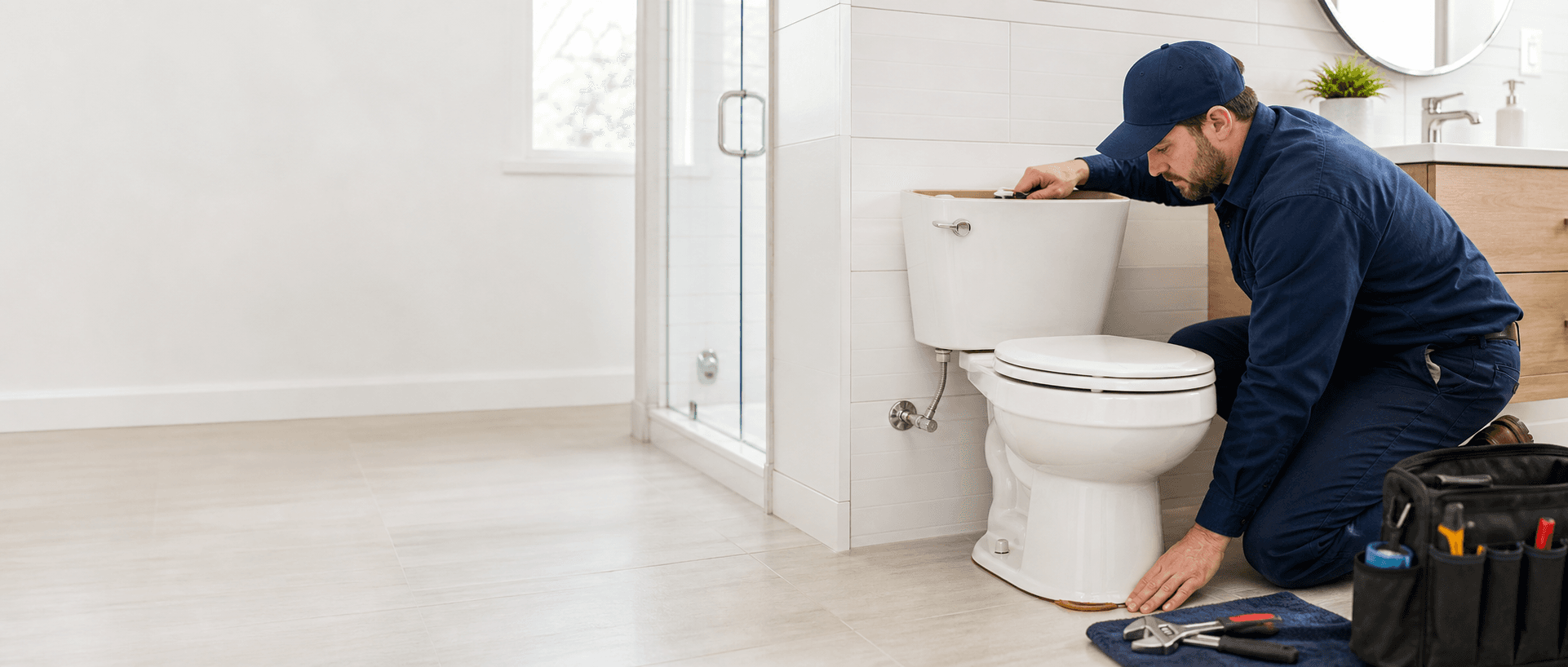
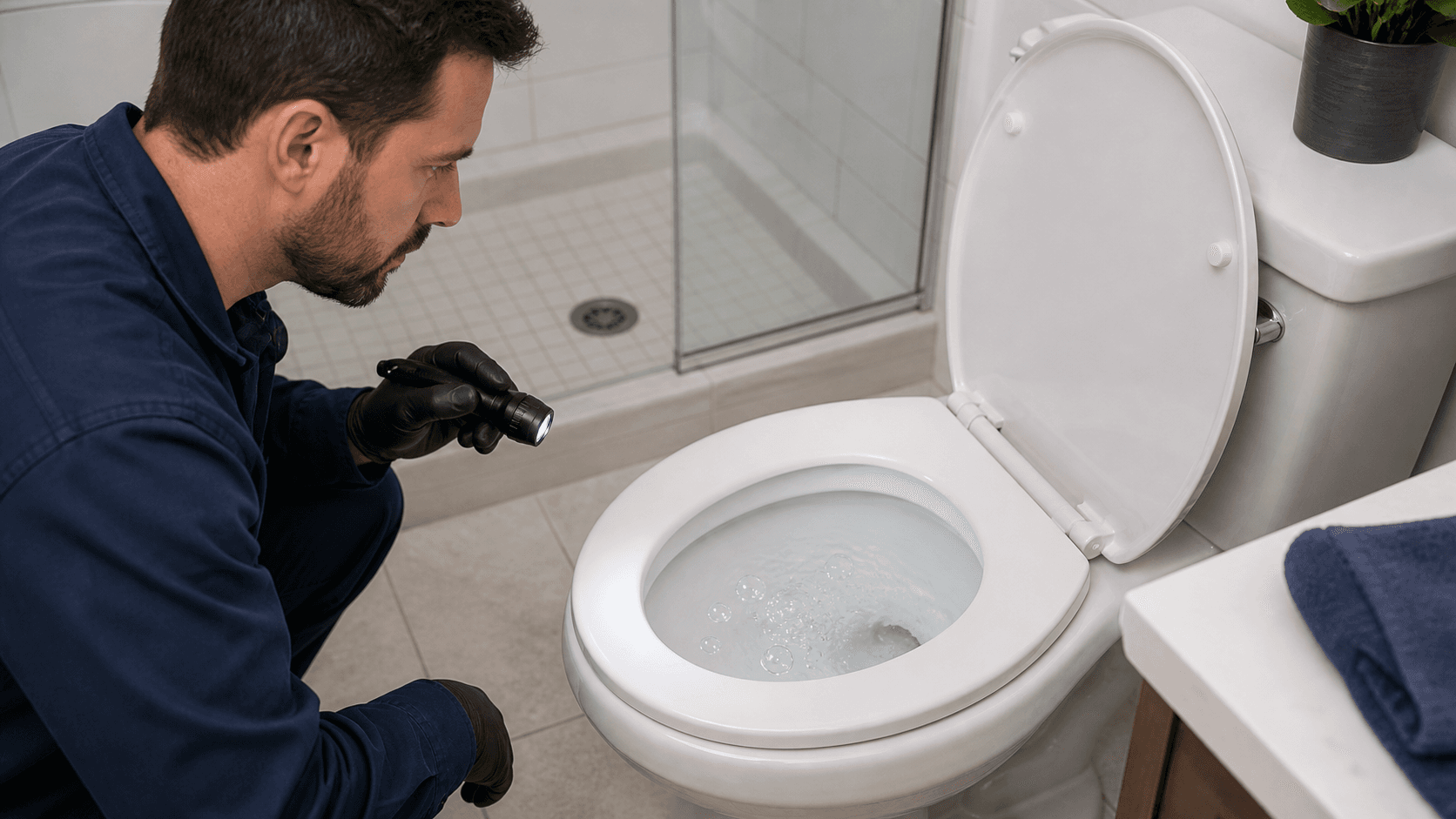
A toilet that bubbles or gurgles is air being forced back up through the trap because a blockage downstream is disrupting the drainage system's airflow. Where the blockage sits determines how serious it is. If only the toilet gurgles, the problem is local — a partial clog in that fixture's drain or a vent issue. If the toilet bubbles when other fixtures drain, especially the washing machine or shower, the blockage is in the shared main line, and gurgling across multiple fixtures is the classic early warning of a developing sewer-line backup. In Bellevue, the most common cause of a main-line blockage is tree-root intrusion, because the mature cedars and firs of the Pacific Northwest send roots into older clay and cast-iron sewer laterals. This guide explains the trap-and-vent physics, separates a one-fixture problem from a whole-house one, covers what the plumbing code requires of traps and venting, and lays out what to do right now when the gurgling comes with a sewer smell or a slow multi-fixture backup.
Last reviewed: 2026-06-04
Air trapped by a downstream blockage is forced back up through the toilet's trap, escaping as bubbles. The gurgle is negative pressure pulling air through the water seal.
A drainage system depends on air moving as freely as water. Every fixture has a trap — the curved section that holds a water seal to keep sewer gas out — and the system is vented so that as water drains, air can follow it without having to pull through the traps. A toilet gurgles when that airflow is disrupted: a blockage downstream forces air to find another path, and it pushes back up through the toilet's trap, bubbling through the standing water as it escapes.
The physics is a pressure imbalance. When a blockage restricts the drain or vent, draining water creates negative pressure (a partial vacuum) behind it, and that suction pulls air through the nearest water seal — often the toilet, because its large trap and standing water make the bubbling obvious. The gurgle you hear is air being dragged through the toilet's trap water by that pressure difference, a process called siphonage when it is strong enough to pull the trap seal down.
This is why a gurgle is always a symptom of something downstream, never a problem with the toilet itself. The toilet is simply the place where the disrupted air finds its escape; the actual fault is a blockage or a venting problem somewhere past the fixture. Treating the toilet — replacing parts, plunging the bowl — does nothing if the cause is a clog in the branch drain, the vent, or the main line beyond it.
Because the gurgle reports a downstream airflow problem, the diagnostic question is how far downstream. A blockage close to the toilet affects only that fixture; a blockage in the shared main line affects the whole house and makes several fixtures interact. The next sections use exactly that distinction — one fixture or many — to locate the blockage.
This happening in your home right now? A licensed plumber can talk you through the next step on the phone — 24/7, and the call is free.
Call a plumberIf only one toilet gurgles, the blockage is local to that fixture's drain or vent. If multiple fixtures gurgle or back up, the blockage is in the shared main line.
The single most useful diagnostic is whether the gurgling is isolated to one toilet or shows up across multiple fixtures. A blockage in the branch drain serving just one toilet, or a vent problem local to that fixture, produces gurgling at that toilet alone while every other drain in the house behaves normally. That points the search at the toilet's own drain line and vent, a comparatively contained problem.
When more than one fixture is involved, the blockage has to be in plumbing they share — and the only thing they all share is the main line that carries everything to the sewer. If the toilet gurgles when you run the bathroom sink, or the shower backs up when you flush, or several drains across the house act up together, the obstruction is downstream of where those fixtures join, in the main drain or the sewer lateral.
The reason this works is the tree structure of a drainage system: individual fixtures branch off into larger drains that combine into the building main and then the sewer lateral. A clog only affects fixtures upstream of it, so the set of fixtures acting up brackets where the blockage sits. One fixture misbehaving means the clog is near that fixture; many fixtures misbehaving together means the clog is at or below the point where they all converge.
This single distinction sets the stakes. A one-fixture gurgle is usually a local clog or vent issue you can often clear; a multi-fixture gurgle is a main-line problem that, in Bellevue, frequently turns out to be root intrusion and is a genuine pre-backup warning. The next sections follow the multi-fixture path, because that is the one that escalates.
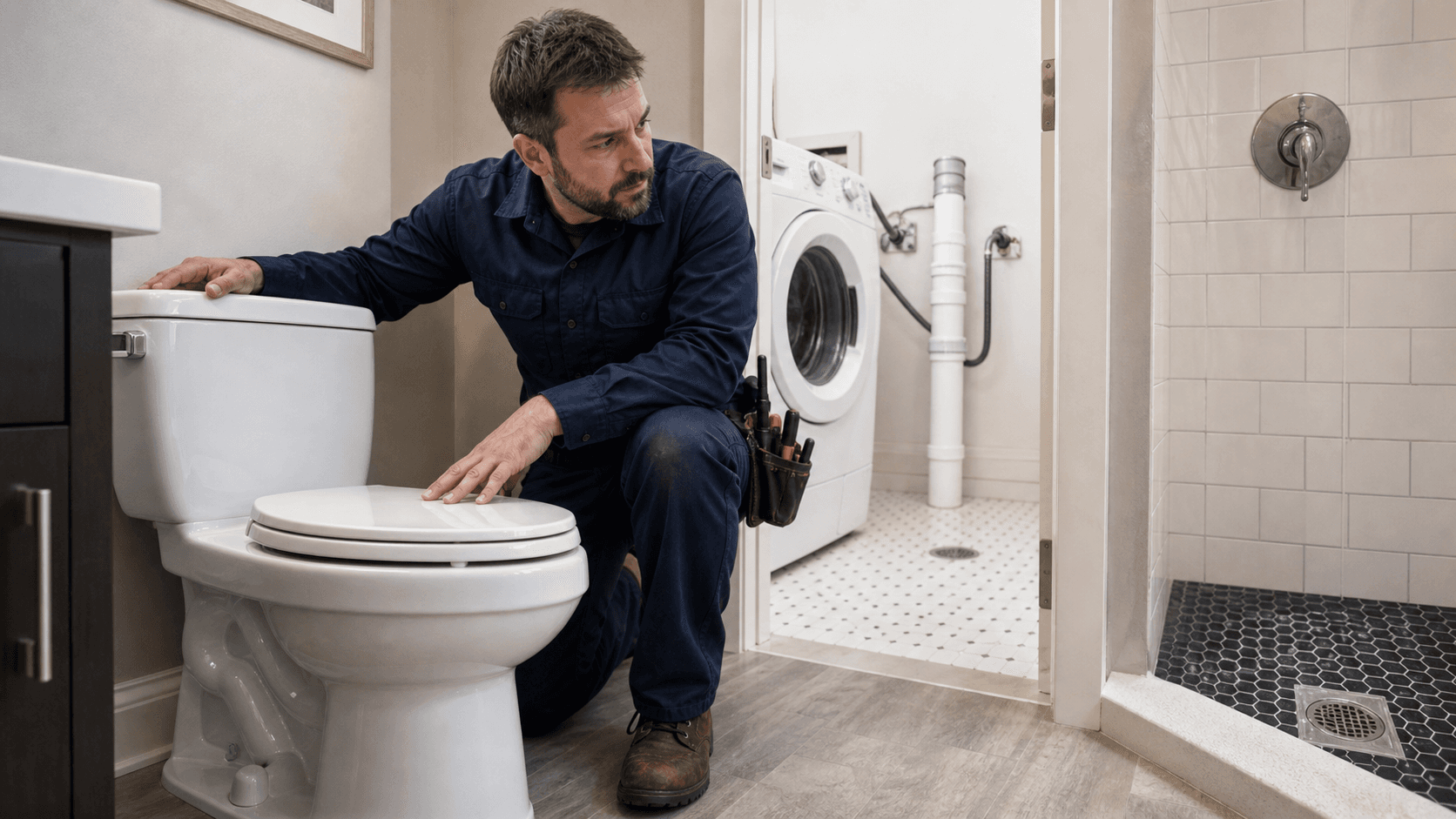
A toilet that bubbles when the washing machine or shower drains is a main-line signal — those high-volume fixtures push enough water to reveal a shared blockage downstream.
The washing machine and the shower are the fixtures most likely to expose a main-line blockage, because they dump a large volume of water fast. When a washer pumps out or a shower runs, that surge of water hits a partial main-line obstruction and has nowhere to go quickly, so it forces air and sometimes water back up through the path of least resistance — frequently the toilet, whose big trap bubbles audibly. A toilet that gurgles specifically when the washer drains is close to a textbook main-line symptom.
The interaction is the giveaway. In a healthy system, draining the washer or running the shower has no effect on the toilet, because each fixture vents and drains independently down to the main. When those events do affect the toilet — gurgling, bubbling, the bowl water rising or dropping — the fixtures are communicating through a shared, restricted main line. The high-volume fixture is essentially pressure-testing the main and finding it blocked.
This pattern matters because it changes the diagnosis from a fixture problem to a sewer problem. A toilet that gurgles only on its own flush might be a local clog or a vent; a toilet that gurgles when an entirely separate fixture drains is reporting that the obstruction is downstream of both of them, in the main line or the lateral. That is the line between a plunger-and-snake situation and a main-line service call.
When the washer-and-toilet or shower-and-toilet interaction shows up, the next questions are whether it is a vent problem or an actual main-line blockage, and in Bellevue specifically whether tree roots are the cause. The following sections take those in turn, because a multi-fixture gurgle that keeps worsening is heading toward a full backup if the main-line cause is not found.
Possibly — a blocked roof vent disrupts the airflow the drains rely on and makes fixtures gurgle. A leaf-clogged or frozen vent stack is a common, fixable cause of bubbling.
Not every gurgle is a clog in the drain itself; sometimes the airflow side of the system is the problem. Every drainage system has vent pipes — typically running up through the roof — that let air into the pipes so water can drain smoothly without pulling air through the traps. If that vent stack is blocked, the system cannot breathe, draining water pulls air through the fixture traps instead, and the result is gurgling and slow drains even though the drain pipes themselves are clear.
Roof vents block in predictable ways. Leaves, debris, a bird's nest, or a small animal can plug the vent opening, and in cold snaps the stack can frost or freeze partly shut. The symptom is gurgling across fixtures with no actual clog — drains that are slow and noisy but not backing up with sewage — because the problem is missing airflow rather than blocked flow. This is one of the more benign causes of a gurgling toilet and is fixable by clearing the vent.
Distinguishing a vent problem from a drain blockage comes down to what is backing up. A blocked vent causes gurgling and sluggish draining but does not push sewage or wastewater back up into fixtures, because the pipe below is still open. A blocked main line, by contrast, causes water and waste to actually rise into low fixtures. Gurgling with no backup leans toward a vent; gurgling with water rising in tubs or floor drains leans toward a main-line clog.
Clearing a roof vent is sometimes a homeowner task with a garden hose from a safe roof position, but a vent that is hard to reach, frozen, or simply not the cause is a reason to call a plumber rather than risk a roof. If clearing the vent does not stop the gurgling, or the gurgle comes with any backup or sewer smell, the cause is more likely a main-line blockage — the case the rest of this guide addresses, and one to handle as sewer line repair and replacement in Bellevue.
The Uniform Plumbing Code requires every fixture trap to be protected by a vent and limits the trap-arm length so the vent keeps the trap seal intact; gurgling signals that protection is compromised.
The reason traps and vents come up together is that the plumbing code treats them as a pair. Under the Uniform Plumbing Code, every fixture trap must be protected by a vent, and the code limits how far the trap can sit from its vent — the trap arm — so that draining water cannot siphon the trap's water seal away. The trap holds back sewer gas; the vent keeps the trap full by equalizing pressure. Remove or block the venting and the trap seal becomes vulnerable.
The trap-arm distance limit is the specific mechanism. The UPC requires the trap arm — the horizontal run between the trap and the vent — to stay within a maximum length tied to the pipe diameter, with the developed length generally not exceeding the limits the code tables set per pipe size. If the trap is too far from its vent, or the vent is blocked, draining water in the line creates the suction that pulls the trap seal down, which is exactly the siphonage that produces gurgling and can break the seal that keeps sewer gas out.
Gurgling, in code terms, is the audible sign that this protection is not working. Either the vent is blocked so the trap cannot be kept full, or a main-line blockage is creating pressure swings the venting was never meant to absorb. In both cases the trap seal is being stressed — pulled on by negative pressure — and the bubbling is air finding its way through the seal that the code's venting rules are designed to keep stable.
For a homeowner the takeaway is not the code numbers but their implication: a gurgling toilet means the trap-and-vent system is compromised somewhere, whether by a blocked vent or a downstream main-line obstruction overwhelming it. Diagnosing which requires looking at the vent and the main line, and a persistent or multi-fixture gurgle is properly a plumber's job — handled as sewer line repair and replacement in Bellevue when the main line is implicated.
Multi-fixture gurgling with slow drains often means a main-line blockage, and in Bellevue the leading cause is tree-root intrusion into older clay or cast-iron sewer laterals.
When the gurgling spans multiple fixtures and the drains are slowing across the house, the blockage is in the main line or the sewer lateral, and in Bellevue the single most common cause of that is tree roots. The Pacific Northwest's mature cedars and firs send aggressive root systems toward the steady moisture and nutrients inside a sewer pipe, and they exploit any joint or crack in older clay and cast-iron laterals to grow inside and choke the line.
Root intrusion produces exactly this gurgling-then-backup progression. Roots enter at a joint, form a mesh that catches paper and waste, and gradually restrict the line — so the first symptom is intermittent gurgling and slow drains as the partial blockage disrupts airflow, escalating toward full backups as the root mass grows. The pattern of a multi-fixture gurgle that worsens over weeks is characteristic of a root mass tightening rather than a sudden object clog. Our cedar root intrusion guide covers why Eastside trees target sewer laterals and how the intrusion develops.
The age and material of Bellevue's sewer laterals make this prevalent. Many Eastside homes from the original 1960s-through-1980s building era — and older — have clay or cast-iron laterals whose joints and corrosion give roots their entry points, which is why a gurgling toilet here is more likely a root problem than it would be on a newer PVC line. The roots do not need much of a gap; a hairline joint is enough to start the intrusion.
When the signs point at the main line — multiple fixtures gurgling, slow drains everywhere, the washer-and-toilet interaction, or any sewage backing up — this is a sewer-line diagnosis, not a fixture repair. It is the point to stop plunging and book sewer line repair and replacement in Bellevue, because clearing and assessing a root-blocked lateral takes a camera and the right cutting or jetting equipment, covered next.
A plumber runs a sewer camera down the line to see the blockage directly, then clears it by cabling or hydro-jetting depending on whether roots or grease are the cause.
The definitive way to find why a toilet is gurgling at the main-line level is a camera inspection. A plumber feeds a waterproof video camera on a flexible cable down the sewer line through a cleanout and watches the live feed, which shows exactly what is in the pipe — a root mass, a grease blockage, a collapsed section, or a belly holding water — and where it sits along the line. That removes the guesswork that surface symptoms leave, and our Bellevue camera inspection guide walks what the inspection shows and how it is run.
Seeing the blockage determines how to clear it, because roots and grease need different tools. A root intrusion is typically cut out with a mechanical cable (cabling or augering) that shears the roots, or cleared and scoured with high-pressure water; a grease or sludge blockage is better dissolved and flushed by hydro-jetting. Choosing the wrong method wastes the trip — cabling barely touches a grease-caked line, and jetting alone may not finish dense roots. Our guide on hydro-jetting versus cabling in Bellevue lays out which method fits which blockage.
The camera also distinguishes a clear-and-done blockage from a structural problem. If the line is simply blocked by roots or grease, clearing it restores flow; if the camera shows a cracked, collapsed, or root-shattered pipe, the line needs repair or replacement, not just cleaning, because roots will return through the same breach. That distinction is exactly why the inspection comes before the repair decision rather than after.
For a gurgling toilet that has been traced to the main line, the camera inspection is the step that turns symptoms into a plan: it confirms the cause, locates it, and sets the clearing method. Book it as part of sewer line repair and replacement in Bellevue, because a main-line gurgle in an older Eastside home with mature trees is a problem to see inside before it becomes a full backup.
If multiple fixtures gurgle or back up and you smell sewer gas, stop running water immediately and call a plumber — that combination signals an imminent main-line backup.
The immediate triage depends on whether this is one fixture or many. If only the one toilet gurgles and everything else drains normally, the problem is local; you can try clearing that fixture's drain or checking for a blocked vent, and it is not an emergency. But if several fixtures gurgle, drains are slowing across the house, and you notice a sewer smell, that combination is a main-line warning and the response changes.
When the signs are multi-fixture, stop adding water to the system. Every flush, shower, load of laundry, and dishwasher cycle sends more water at a main line that cannot clear it, which is what turns a gurgle into sewage backing up into tubs and floor drains. Holding off on water use buys time and prevents a backup from flooding the lowest fixtures in the house while you arrange a plumber.
A sewer smell with the gurgling raises the urgency further. The odor means trap seals are being pulled down or wastewater is sitting in the line where it should not, both signs the blockage is significant and close to overwhelming the system. Gurgling plus smell plus any fixture backing up is the pre-backup signature — the point to treat it as urgent rather than wait and see whether it clears on its own, because root and main-line blockages do not clear themselves.
The right action at that point is to stop water use and call for help, escalating to emergency plumbing in Bellevue if water is actively backing up into the home, or booking sewer line repair and replacement in Bellevue for the camera inspection and clearing if it is gurgling without an active flood. What you should not do is keep running water hoping it resolves, or pour chemical drain cleaner at a main-line root blockage, which it cannot clear.
It is an emergency only if multiple fixtures back up with a sewer smell — otherwise it is an urgent main-line warning. Gurgling when the washer runs points squarely at the main line.
A gurgling toilet is an emergency when it comes with multiple fixtures backing up and a sewer smell, because that combination means a main-line blockage is close to flooding the home with wastewater — stop using water and call for emergency plumbing in Bellevue. A single toilet gurgling on its own flush, with everything else draining fine, is not an emergency; it is a local clog or vent issue you can address without panic. The dividing line is how many fixtures are affected and whether anything is backing up.
A toilet that gurgles when the washing machine runs is a main-line signal. The washer dumps a large, fast volume of water that hits a shared downstream blockage and forces air back up through the toilet's trap, so the two fixtures interacting means the obstruction is below where they join — in the main line or sewer lateral, not in either fixture. That pattern warrants a main-line look, not a fixture repair.
Yes, tree roots are a leading cause in Bellevue. The Pacific Northwest's mature cedars and firs send roots into older clay and cast-iron sewer laterals through joints and cracks, forming a mesh that gradually blocks the line and produces exactly the gurgling-then-backup progression — detailed in our cedar root intrusion guide. A multi-fixture gurgle in an older Eastside home with big trees is a strong root suspect.
No, you usually should not try to unclog a vent yourself if it means going onto the roof, and no, you should not wait out a multi-fixture gurgle. A worsening main-line gurgle is heading toward a backup, and it needs a camera inspection to find the cause — handled as sewer line repair and replacement in Bellevue. A backup that is already coming, with water rising into fixtures, is the point to escalate to emergency plumbing in Bellevue rather than keep diagnosing.
Every fact in this guide cites a verifiable public source. If you find a number we got wrong, email dispatch@bellevueplumberpro.com.
Need help with this in your home? See our Sewer line repair and replacement in Bellevue page for pricing, our diagnostic process, and how same-day service works across the Eastside.
Related services: Faucet and Fixture Installation, and Drain Cleaning and Clog Removal.
Air trapped by a downstream blockage is forced back up through the toilet's trap and escapes as bubbles; the gurgle is negative pressure pulling air through the water seal.
That's a main-line signal. High-volume fixtures push enough water to reveal a shared blockage downstream — the problem is in the main line, not the toilet.
Possibly. A blocked roof vent disrupts the airflow drains rely on, and a leaf-clogged or frozen vent stack is a common, fixable cause of bubbling across fixtures.
Yes — one gurgling toilet means the blockage is local to that fixture's drain or vent; multiple fixtures gurgling or backing up means the shared main line is blocked.