What causes a weak toilet flush?
Four common causes: a tank water level set too low, a partial clog in the trap or drain, mineral-clogged rim and siphon jets, or a flapper that closes before the tank empties.
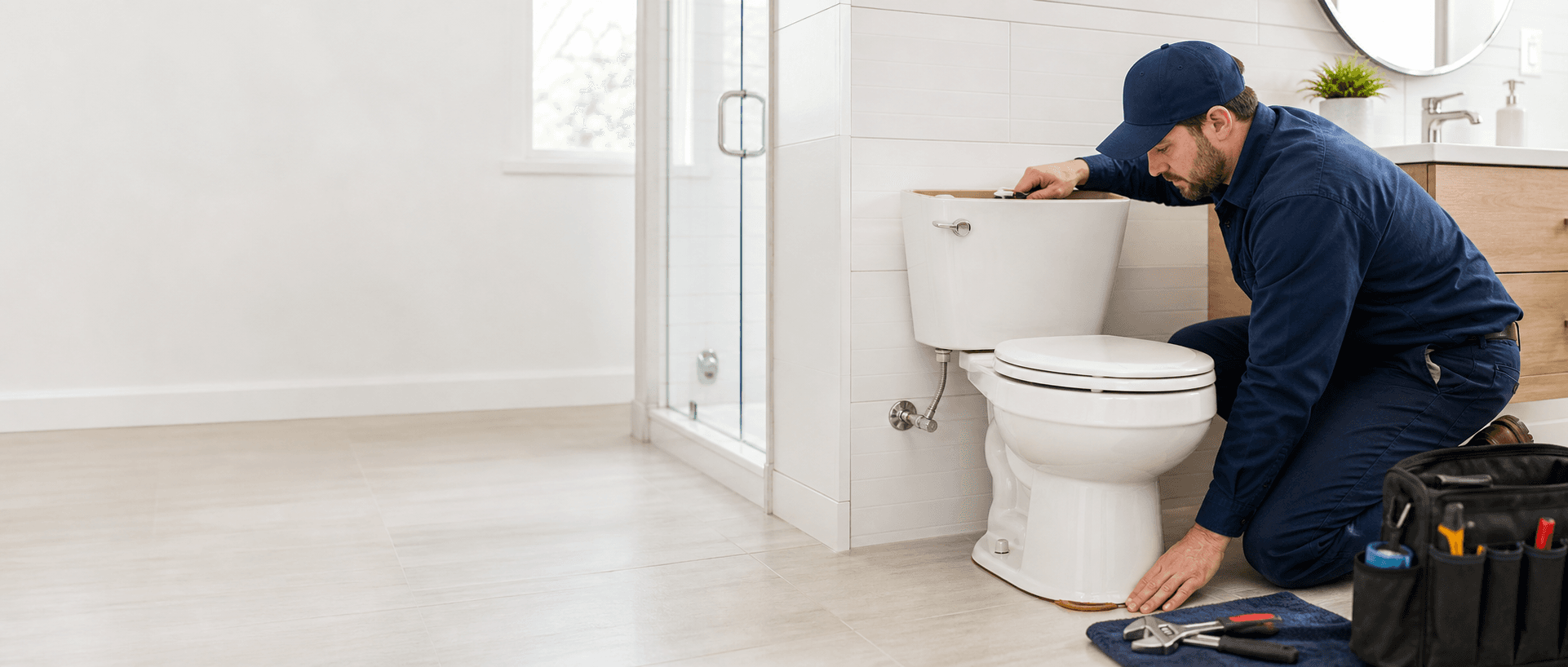
A weak toilet flush — water that swirls lazily instead of clearing the bowl decisively — comes from one of a handful of causes, and they are worth checking cheapest-first. A tank water level set too low starves the flush of volume; a partial clog in the trap or drain restricts the outflow; mineral-clogged rim and siphon jets weaken the water entering the bowl; and a flapper that closes too early cuts the flush short before the tank empties. Setting the tank level back to about an inch below the overflow tube is free and fixes a surprising share of weak flushes. This guide walks the checks in order, explains why clogged jets are rarer in soft Bellevue water, and addresses the case where the toilet is simply an old, weak first-generation low-flow model — the mid-90s 1.6-gallon units that flushed poorly, versus the pre-1994 3.5-to-5-gallon water hogs. It closes with the repair-or-replace math: a modern WaterSense toilet that passes the MaP 350-gram test flushes far better and saves more than $170 and about 13,000 gallons of water per household each year.
Last reviewed: 2026-06-04
Four common causes: a tank water level set too low, a partial clog in the trap or drain, mineral-clogged rim and siphon jets, or a flapper that closes before the tank empties.
A flush works by dumping a tank of water into the bowl fast enough to create a siphon that pulls the contents down the drain. Anything that reduces the volume or the speed of that water weakens the flush. The most common and cheapest cause is a tank water level set too low: if the tank holds less than the toilet was designed to flush with, there simply is not enough water to drive a strong siphon, and the bowl clears sluggishly.
A partial clog is the next suspect. A toilet that flushes weakly and slowly, especially one that nearly clogs on normal use, may have a partial obstruction in the trap or the drain downstream that restricts how fast water can leave the bowl. The flush is not weak at the source — it is being throttled at the exit, so the bowl fills and drains slowly even though the tank dumped a full charge of water.
Clogged jets are the third cause. Water enters the bowl through small rim holes under the bowl lip and through the larger siphon jet at the bottom front of the bowl; if mineral deposits partly block those jets, the water enters weakly and off-pattern, so the flush loses the swirl and force it needs. This is a hard-water problem more than a soft-water one, which matters in Bellevue, as covered below.
The fourth cause is a flapper closing too early. The flapper has to stay open long enough to let the full tank dump; a flapper that is warped, waterlogged, or has too much chain slack drops shut partway through, cutting the flush short before the tank empties. The result is a weak, half-volume flush even though the tank level and the jets are fine. The sections below check these in the cheap-first order.
This happening in your home right now? A licensed plumber can talk you through the next step on the phone — 24/7, and the call is free.
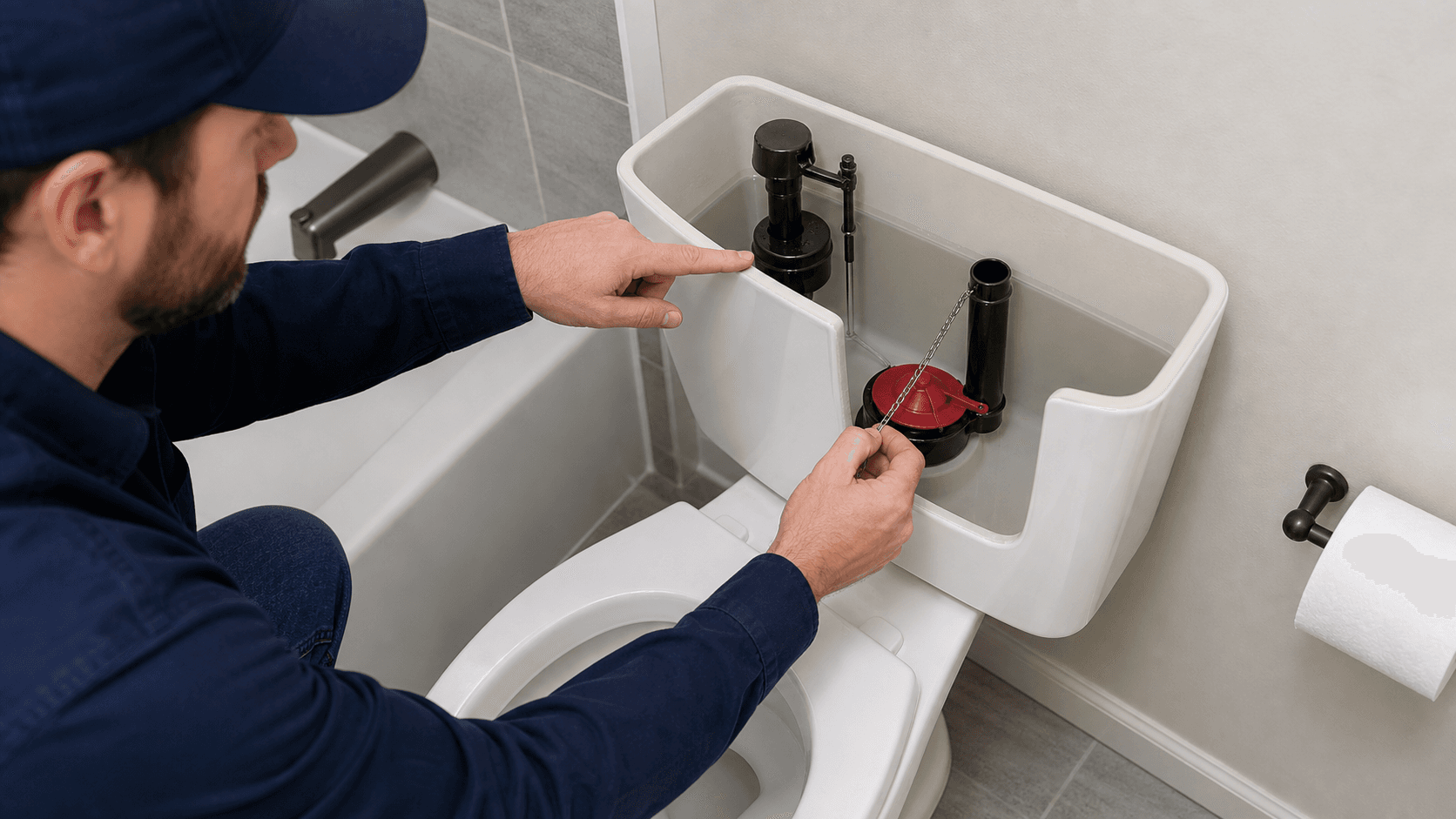
Call a plumberTake the lid off and check the level — it should sit about an inch below the top of the overflow tube. A level set too low starves the flush and is free to correct.
The first thing to check is also the cheapest, because it costs nothing: the tank water level. Lift the tank lid and look at where the water sits relative to the overflow tube. The correct level is roughly an inch below the top of the overflow tube — high enough that the tank holds a full flush charge, low enough that water does not spill into the tube. A level sitting well below that line means the toilet is flushing with less water than it was designed for, which directly weakens the flush.
Correcting it is a free adjustment at the fill valve. On a modern float-cup fill valve, raise the float by adjusting the clip on the rod or turning the adjustment screw to bring the shut-off level up; on an older float-arm ballcock, bend the float arm up gently. Set the level to about an inch below the overflow tube and flush — a toilet that was flushing weakly purely from a low tank level often returns to full strength with this single adjustment.
It is worth confirming the level is genuinely low and not just being lost. If you set the level correctly and it drops again on its own between flushes, the tank is leaking — a flapper not sealing — which is the running-toilet problem covered in our toilet keeps running guide. A tank that cannot hold its set level flushes weakly because it is partly empty by the time you flush, so a leak masquerades as a weak-flush problem.
Checking the level first follows the cheapest-first logic that applies to every weak flush: confirm the free fix before buying parts or scrubbing jets. If the level is correct and the flush is still weak, move to the jets and the flapper; if the level will not hold, fix the leak first. Only after the level is verified does it make sense to suspect the bowl jets or the bowl itself.
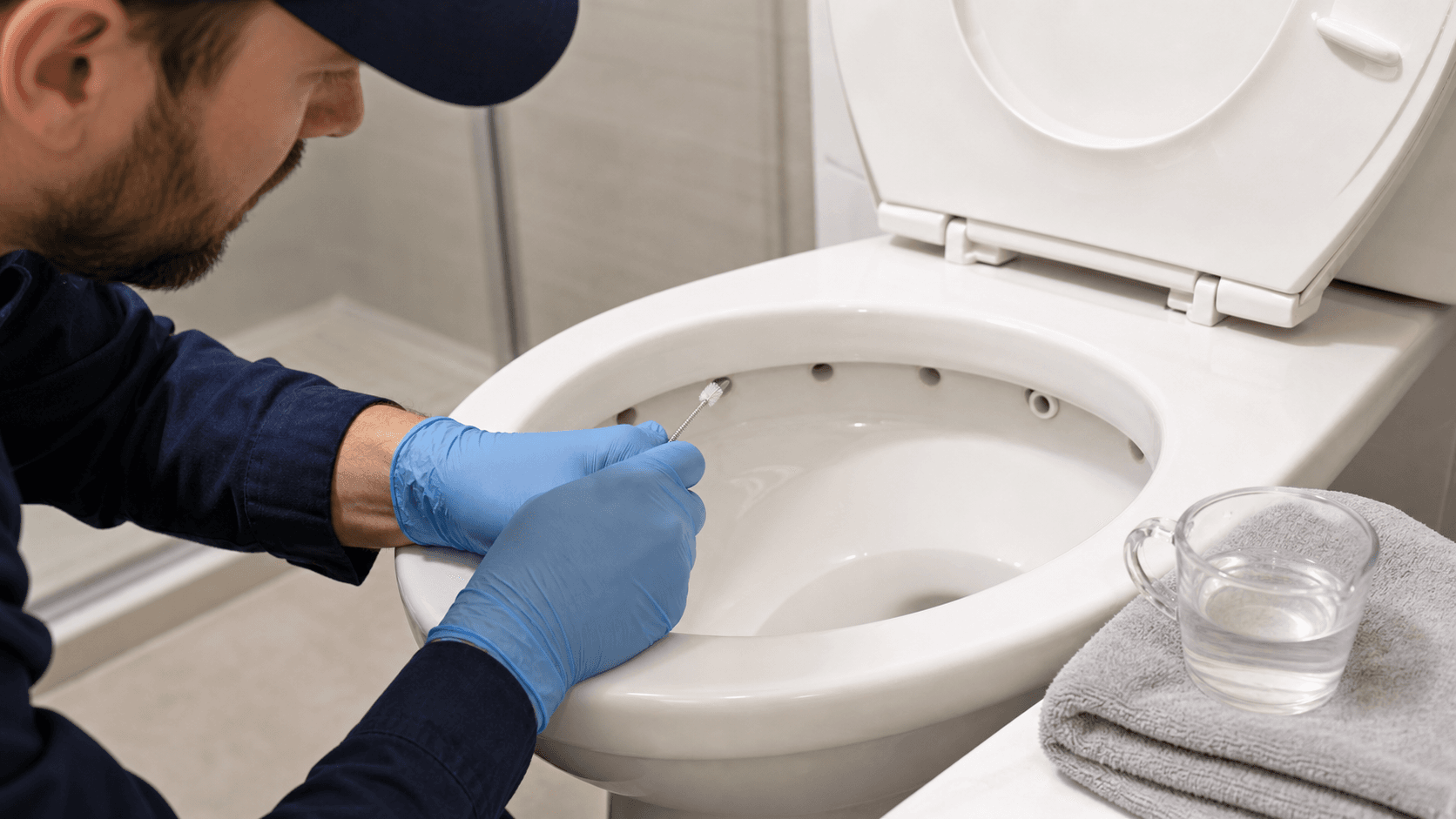
Pour 2 to 4 cups of white vinegar down the overflow tube to clear rim jets, or use a lime remover like CLR for 15 to 30 minutes, then scrub the holes clear.
If the tank level is correct but the flush is weak and the water enters the bowl unevenly, the rim and siphon jets are likely clogged. The rim jets are the ring of small holes under the bowl's rim that wash the bowl, and the siphon jet is the larger hole at the bottom front that drives the siphon; mineral deposits narrow these openings over time, so the water dribbles in weakly instead of entering with force and creating a strong swirl.
The standard cleaning is acid that dissolves mineral scale. Pour roughly 2 to 4 cups of white vinegar down the overflow tube in the tank so it runs through the rim jets, let it sit to dissolve the deposits, then flush and scrub the rim holes. For heavier buildup, a commercial lime-and-calcium remover such as CLR left in contact for about 15 to 30 minutes does the same job more aggressively. A small mirror and a bent wire or a thin brush help clear the individual rim holes and the siphon jet of loosened scale.
The improvement after clearing the jets is often dramatic, because the flush depends on the water entering in a fast, directed pattern. Open rim jets restore the rinsing swirl around the bowl, and an open siphon jet restores the downward force that starts the siphon; together they turn a lazy, incomplete flush back into a strong one. This is purely a cleaning fix — no parts, just removing the scale that throttled the water.
If clearing the jets restores a strong flush, the cause was mineral buildup and periodic cleaning will keep it strong. If the jets were already clear and clean — which is more common in Bellevue's soft water, as the next section explains — then jet scale was never the problem and the cause lies in the flapper timing or the age of the toilet itself.
Clogged rim and siphon jets come from mineral scale, so the Eastside's soft water at roughly 1.4 to 1.5 grains per gallon makes that cause far less likely here than in hard-water regions.
Clogged jets are fundamentally a hard-water problem. The scale that narrows the rim holes and the siphon jet is precipitated mineral — mostly calcium and magnesium — left behind as water evaporates and dries in the jets. In a hard-water region, that buildup accumulates steadily and is a leading cause of a weakening flush. The more minerals the water carries, the faster the jets crust over.
Bellevue and the Eastside are served by soft water, on the order of 1.4 to 1.5 grains per gallon, which carries little of the mineral that forms jet scale. So a weak flush in a Bellevue home is less likely to be clogged jets than the same complaint would be in a hard-water area, simply because there is far less mineral available to deposit in the rim holes and siphon jet. Our Eastside water hardness guide covers the local supply in more detail.
That shifts the diagnosis here toward the other causes. With jet scale relatively unlikely, a weak flush in Bellevue more often traces to a low tank level, a flapper closing early, a partial clog, or — frequently — an old, inherently weak toilet. It is still worth a glance at the jets, since soft water is not no minerals and old buildup can accumulate over many years, but jet cleaning solves fewer Bellevue weak-flush cases than it would elsewhere.
The practical effect is to spend the diagnostic effort where it pays off locally. In Bellevue, check the tank level and the flapper, and weigh the age of the toilet, before assuming scale. If the jets do turn out to be lightly scaled even in soft water, the vinegar or CLR cleaning above clears them; but on the Eastside, a persistently weak flush more often points at the toilet's design or its tank parts than at mineral buildup.
Yes, if the flapper drops shut before the tank empties, the flush is cut short. A warped or waterlogged flapper, or too much chain slack, ends the flush early and weakens it.
The flapper has to stay open for the full duration of the flush. When you press the handle, the flapper lifts and should remain up until the tank has dumped its charge, then drop to reseal; if it closes early, it cuts off the water mid-flush and the bowl gets only a partial volume — a weak flush even with a correct tank level and clear jets. So a toilet that flushes weakly with everything else checking out is often a flapper-timing problem.
Flappers close early for a few mechanical reasons. A flapper that has warped or hardened with age loses its buoyancy and float characteristics and sinks back too soon. A flapper that has become waterlogged drops faster than it should. And too much slack in the lift chain means the flapper only opens partway or falls shut before the tank empties. Any of these shortens the open time and starves the flush.
Diagnosing it is a matter of watching the flush with the lid off. Press the handle and watch the flapper: it should rise and stay up until the tank water has dropped to near empty, then settle. If it drops back down while there is still substantial water in the tank, it is closing early, and the flush ends prematurely. Adjusting the chain to remove excess slack sometimes fixes it; a warped or waterlogged flapper needs replacing.
Replacing a flapper is the same inexpensive job as for a running toilet — a $5-to-$15 part matched to the flush valve. If a new, correctly sized flapper holds open for the full flush and the bowl now clears strongly, the early-closing flapper was the cause. If the flush is still weak after the level, jets, and flapper are all addressed, the issue is likely the toilet itself — the old-low-flow case below — and at that point a fixture pro can confirm it as part of faucet and fixture repair in Bellevue.
Early 1990s low-flow toilets often flush weakly by design, while pre-1994 toilets used 3.5 to 5 gallons per flush; both are candidates for replacement rather than repair.
Sometimes the weak flush is not a fault to fix but the toilet's original design. The first generation of low-flow toilets, introduced in the mid-1990s after the 1.6-gallon-per-flush standard took effect, were notorious for weak, incomplete flushes — manufacturers had cut the water volume to 1.6 gallons without yet redesigning the bowl and trap to flush well at that volume, so early 1.6-gallon toilets often needed double-flushing and clogged easily. A toilet of that vintage may simply be a weak flusher by design.
The other end of the age range is the opposite problem. Toilets made before the 1994 federal standard used 3.5 gallons per flush, and older models used as much as 5 gallons or more. Those flush forcefully because of sheer volume, but they waste enormous amounts of water — so an old high-volume toilet is not a weak-flush problem to fix, it is a water-waste problem to replace. Either way, the toilet's age and rated flush volume tell you a lot about its behavior.
Knowing which generation a toilet belongs to frames the repair-or-replace decision. A mid-90s first-generation 1.6-gallon unit that flushes weakly is working as it was (poorly) built, and no amount of cleaning jets or swapping flappers will make it flush like a modern toilet, because the bowl and trap geometry were never engineered to flush strongly at low volume. A pre-1994 high-gallon toilet flushes fine but wastes water on every use.
In both cases the fix is not a part but a new toilet. Modern toilets flush far better at low volume than the first-generation low-flow units did, and they use far less water than the pre-1994 models — which is the upgrade case the next section lays out, with the MaP flush-performance test and the WaterSense water savings that make replacement the sound call for an old, weak, or wasteful toilet.
Replace an old or weak toilet with a WaterSense model that passes the MaP 350-gram test; it flushes better and saves over $170 and about 13,000 gallons per household each year.
When the weak flush is the toilet itself — an old first-generation low-flow unit or a pre-1994 water hog — replacement beats repair, and modern toilets solve both the performance and the water-use problem at once. Today's high-efficiency toilets are engineered to flush strongly at 1.28 gallons or less, having fixed the bowl-and-trap geometry the first-generation 1.6-gallon units got wrong, so a new toilet flushes more decisively than the weak old one while using less water.
Flush performance is no longer a guess, because of the MaP test. The Maximum Performance (MaP) test measures how much solid waste a toilet can clear in a single flush, and a well-performing modern toilet clears 350 grams or more — a benchmark to look for when choosing a replacement so you do not trade an old weak flusher for a new one. Note that the MaP 350-gram figure is MaP's flush-performance standard, not an EPA number; it is the metric that tells you a low-flow toilet actually flushes well.
The water savings are documented by the EPA's WaterSense program and are substantial per household. Replacing old, inefficient toilets with WaterSense-labeled models saves the average household more than $170 per year on water and sewer costs and about 13,000 gallons of water per year — figures stated per household, which is why an old high-volume toilet is genuinely worth replacing on the water bill alone, before counting the improved flush.
On cost, the toilet itself is a modest part and the labor is the variable. A homeowner can buy a flapper or fill-valve part for $5 to $15 for a repair, but a toilet replacement is a $150-to-$400 professional install in the Bellevue market once the old unit is hauled, the new one set on a fresh wax ring, and the connection leak-tested. For an old, weak, or wasteful toilet, that install pays back through water savings and a flush that finally works — book it as faucet and fixture repair in Bellevue.
A weak flush that is not clogged is usually a low tank level or an early-closing flapper. Clean rim jets by running vinegar down the overflow tube and scrubbing the holes.
A toilet that flushes weakly but is not clogged is most often a low tank water level or a flapper closing too early. Check the level first — it should sit about an inch below the overflow tube and is free to adjust — then watch the flapper to see whether it drops shut before the tank empties. In soft-water Bellevue, a weak flush is more likely one of these than scaled jets, since there is little mineral to clog the jets in the first place.
To clean rim jets, run acid through them and scrub. Pour 2 to 4 cups of white vinegar down the overflow tube so it flows through the rim holes, or use a lime remover like CLR for 15 to 30 minutes, then scrub the rim holes and the siphon jet clear with a brush or bent wire. Open jets restore the swirl and force the flush needs, though this fixes fewer weak flushes in Bellevue's soft water than in hard-water regions.
Yes, a new toilet flushes noticeably better than an old weak one. Modern WaterSense toilets are engineered to clear the bowl strongly at 1.28 gallons or less and many pass the MaP 350-gram flush test, unlike the first-generation 1.6-gallon units from the mid-90s that flushed poorly. A replacement also saves the average household over $170 a year and about 13,000 gallons, so an old weak toilet is worth replacing for both reasons.
To tell a partial clog from a low tank level: a clog makes the bowl fill and drain slowly and may nearly overflow, while a low tank level makes the flush weak from the start with normal drainage. And yes, soft Bellevue water helps in the sense that it keeps the jets from scaling — but it does not strengthen a flush weakened by a low level, an early flapper, or an old toilet. For an old or persistently weak toilet, book faucet and fixture repair in Bellevue.
Every fact in this guide cites a verifiable public source. If you find a number we got wrong, email dispatch@bellevueplumberpro.com.
Need help with this in your home? See our Toilet repair and replacement in Bellevue page for pricing, our diagnostic process, and how same-day service works across the Eastside.
Related services: Drain Cleaning and Clog Removal.
Four common causes: a tank water level set too low, a partial clog in the trap or drain, mineral-clogged rim and siphon jets, or a flapper that closes before the tank empties.
Check the tank level first — it should sit about an inch below the top of the overflow tube, and correcting it is free. If jets are clogged, pour 2–4 cups of white vinegar down the overflow tube (or use a lime remover for 15–30 minutes) and scrub the holes clear.
A warped or waterlogged flapper — or too much chain slack — drops shut before the tank empties, cutting the flush short. Replacing the flapper or adjusting the chain to a half-inch of slack restores full flush volume.
Less often than elsewhere. Clogged jets come from mineral scale, and the Eastside's soft water (about 1.4–1.5 grains per gallon) makes that cause far less likely here than in hard-water regions.