Home/Learn/Toilets/Toilet keeps running: the flapper, float, and fill valve fix
Toilets
Toilet keeps running: the flapper, float, and fill valve fix
A toilet that keeps running — the phantom flush that refills on its own, or the constant hiss of a stuck fill valve — wastes water continuously, and the cause is almost always one of three inexpensive tank parts: a worn flapper that no longer seals the flush valve, a float set too high so water spills into the overflow tube, or a fill valve that fails to shut off. A dye test in the tank pinpoints which one in about ten minutes. The water waste is not trivial — the EPA estimates household leaks waste nearly one trillion gallons nationally each year, the average home loses more than 9,300 gallons annually, and the worst 9 percent of homes leak 50 or more gallons a day. A small flapper leak alone can pass roughly 30 gallons a day and a medium one about 250. This guide walks the dye test, the flapper, float, and fill-valve fixes with parts costs and the correct water level, explains why even soft Bellevue water still ages flappers out, and draws the line where a corroded flush-valve seat or a tank-to-bowl gasket turns a DIY job into a plumber call.
Three parts cause nearly every running toilet: a worn flapper that will not seal, a float set too high that overflows into the tube, or a fill valve that will not shut off.
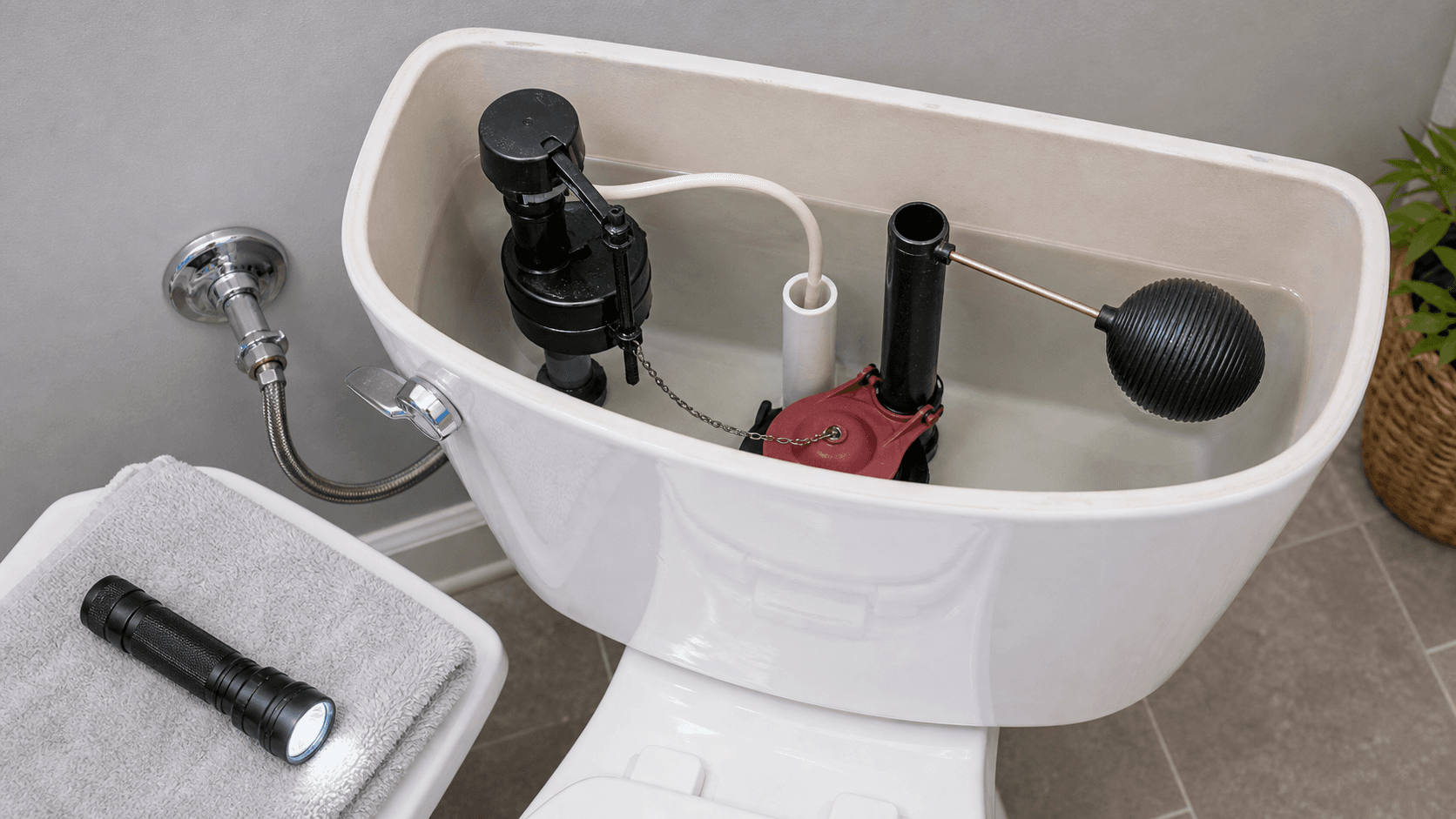
A toilet runs continuously when water keeps moving from the tank into the bowl, or from the supply into the tank, instead of stopping after the tank refills. Three tank parts govern that cycle, and a failure in any one of them produces a running toilet. The flapper is the rubber seal at the bottom of the tank that lifts to flush and drops to seal the flush valve afterward; when it no longer seals, tank water leaks down into the bowl and the fill valve keeps topping the tank off forever.
The float is the second culprit. The float rides on the water level and tells the fill valve when to shut off; if it is set too high, the tank fills past the top of the overflow tube and water spills continuously down that tube into the bowl. The fill valve never sees a 'full' signal because the water just keeps draining out the overflow, so it runs without end. This is the cause where the water is going down the overflow tube rather than past the flapper.
The fill valve itself is the third. Even with a good flapper and a correct float, a fill valve with a worn diaphragm or trapped debris may fail to close fully, trickling water into the tank — and out the overflow — indefinitely. A fill valve that hisses or cycles on its own without a flush has failed internally, independent of the flapper and float.
Sorting which of the three is at fault is the whole job, because each has a different, inexpensive fix. The flapper is a five-to-fifteen-dollar swap, the float is a free adjustment, and the fill valve is a ten-to-twenty-five-dollar replacement. The dye test in the next section tells you which one you are dealing with before you buy a single part.
The flapper, float, and fill valve account for nearly every running-toilet call.
This happening in your home right now? A licensed plumber can talk you through the next step on the phone — 24/7, and the call is free.
Put dye or food coloring in the tank, wait 10 to 15 minutes without flushing, and check the bowl — color in the bowl means the flapper is leaking past the flush valve.
The dye test is the fastest way to separate a flapper leak from the other causes, and it is the test the EPA itself recommends for finding silent toilet leaks. Drop a few drops of food coloring or a dye tablet into the tank water — not the bowl — and then leave the toilet completely alone for 10 to 15 minutes without flushing. The dye colors the tank water so you can see whether any of it migrates where it should not.
After the wait, look in the bowl. If colored water has appeared in the bowl without a flush, the flapper is not sealing — tank water is leaking past the flush valve into the bowl, which is the single most common cause of a running toilet. A clean, clear bowl means the flapper is sealing fine and the problem lies elsewhere, almost always at the float or the fill valve up at the top of the tank.
If the dye test comes back clean, watch the water line instead. Take the tank lid off and look at where the water sits relative to the overflow tube: water spilling over the top of the overflow tube means the float is set too high or the fill valve will not shut off, both of which let water run down the tube into the bowl continuously. The mark to aim for is water that stops roughly an inch below the top of the overflow tube.
Between the dye result and the water-line check, the diagnosis resolves cleanly. Color in the bowl is a flapper; water over the overflow is the float or fill valve; a fill valve that hisses or refills on its own with a sealing flapper and correct float has failed internally. Each maps to one of the fixes below, so the ten-minute test saves you from replacing parts that were never the problem.
How much water does a running toilet waste?
A lot: the EPA estimates U.S. household leaks waste nearly a trillion gallons a year, the average home over 9,300 gallons annually, with a small flapper leak alone near 30 gallons a day.
The national numbers from the EPA put the scale in perspective. Household leaks across the United States waste nearly one trillion gallons of water every year, the average home loses more than 9,300 gallons annually to leaks, and the worst-leaking 9 percent of homes waste 50 gallons or more every single day. A running toilet is one of the largest single contributors to that household leak figure, because it can run unnoticed around the clock.
Per-toilet figures sharpen it further. A small, slow flapper leak can pass on the order of 30 gallons a day, and a medium flapper leak roughly 250 gallons a day, according to Express Sewer's breakdown of flapper-leak rates. At the medium rate, a single running toilet wastes more water in a few days than many households use in a week — and unlike a dripping faucet, a tank leak is silent and invisible unless you run the dye test.
The reason the waste compounds is that the fill valve faithfully replaces whatever leaks away. Every gallon that slips past a bad flapper or down an overflow tube is immediately refilled from the supply, so the meter runs continuously with no pause. A toilet that 'phantom flushes' — refilling on its own every few minutes — is doing exactly this, cycling the fill valve to replace water lost past the flapper.
That steady, metered loss is why a running toilet shows up on the water bill even though no one sees the water move. A leak rate of 30 to 250 gallons a day, billed continuously, turns a five-dollar flapper into a real line item, which is the practical case for running the dye test the moment a toilet sounds like it will not stop. The fixes below stop the loss for a few dollars in parts.
A small flapper leak can waste water all day without making much noise.
How to fix it: flapper, float, and fill valve
Replace a worn flapper ($5-15) if dye reaches the bowl; lower the float so water stops about an inch below the overflow; replace a failed fill valve ($10-25) if it will not shut off.
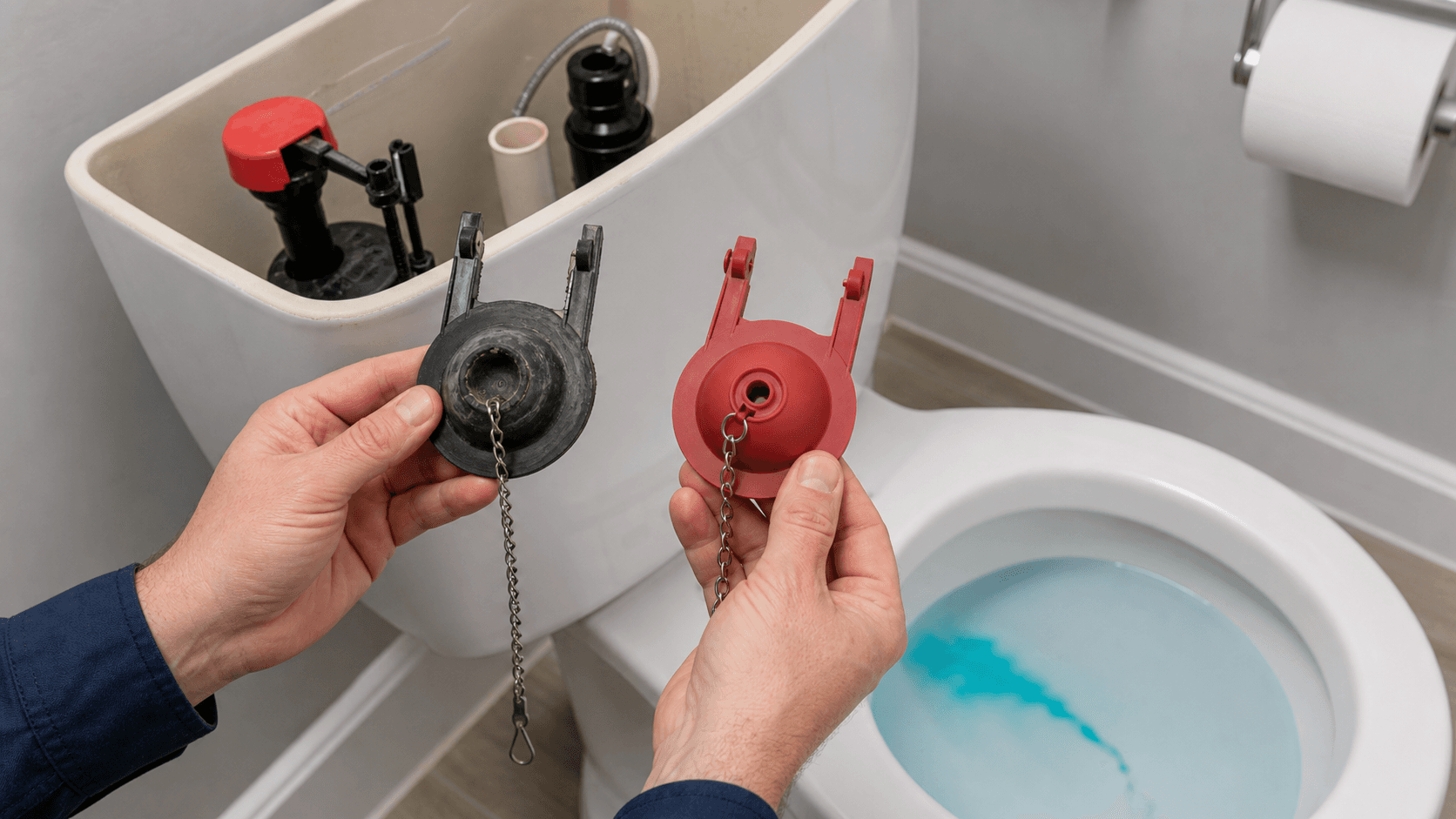
If the dye test put color in the bowl, replace the flapper. Shut the supply at the stop valve, flush to empty the tank, unhook the old flapper from the flush-valve ears and the chain from the handle, and clip on a matching new one — a job of a few minutes with a part that costs about $5 to $15. Match the flapper size and style to the flush valve, since a mismatched flapper will not seal and the toilet will keep running on a brand-new part.
If water was spilling over the overflow tube, adjust the float. On a modern float-cup fill valve, pinch the clip on the adjustment rod or turn the screw to lower the cup; on an older float-arm ballcock, bend the arm down gently. Set it so the fill valve shuts off with the water stopping about an inch below the top of the overflow tube — high enough to flush well, low enough that nothing spills into the tube. This costs nothing and fixes every float-too-high case.
If the fill valve hisses, cycles on its own, or will not shut off even with a good flapper and a correct float, replace the fill valve. Shut the supply, drain the tank, sponge it dry, disconnect the supply line and the valve's locknut underneath, lift the old valve out, set the new one to the correct height, and reconnect — a part that runs about $10 to $25 and installs in well under an hour. A new fill valve cures the internal-failure case the float adjustment cannot.
Across all three, the target is the same: a tank that fills, shuts off cleanly with the water about an inch below the overflow tube, and stays silent until the next flush. If you replace the flapper and fill valve and the toilet still runs, the problem is below the parts — a corroded flush-valve seat or a tank-to-bowl issue — which is the plumber-call case below, best handled as faucet and fixture repair in Bellevue. For the fill-valve replacement specifically, our toilet fill valve replacement guide walks every step.
Why soft Bellevue water still wears out flappers
Flappers wear out from rubber aging, chlorine, and constant flexing — not from scale — so even the Eastside's soft water at roughly 1.4 to 1.5 grains per gallon does not spare them.
It is tempting to assume that soft water means toilet parts last forever, but flappers do not fail from mineral scale the way a water heater or a showerhead does. Flappers are rubber, and they wear out primarily from age, from chlorine in the municipal supply attacking the rubber, and from the simple mechanical fatigue of flexing open and shut on every flush for years. None of those mechanisms depends on hard water, so soft water does not meaningfully extend a flapper's life.
Bellevue and the broader Eastside are served by soft water — on the order of 1.4 to 1.5 grains per gallon — which genuinely spares fixtures from scale buildup elsewhere in the house. But that softness is irrelevant to the flapper's failure mode: a soft-water flapper still hardens, warps, and loses its seal on roughly the same timeline as one in hard water, because it is the chlorine and the flexing, not the minerals, that degrade it. You can read more on the Eastside's soft supply in our Eastside water hardness guide.
What soft water does change is the other direction: the flush-valve seat the flapper seals against stays cleaner, without the mineral crust that can hold a flapper off its seat in hard-water regions. So in Bellevue a running toilet is more likely to be a simply worn flapper than a flapper held open by scale — which actually makes the flapper swap the more reliable fix here, since you are usually replacing a tired part rather than fighting a mineralized seat.
The practical takeaway is to treat the flapper as a wear item regardless of water quality. A flapper that has hardened, curled, or developed a rough sealing edge after several years is at the end of its life whether the water is hard or soft, and a $5-to-$15 replacement restores the seal. Soft Eastside water is a reason your fixtures scale less, not a reason your flapper will not eventually need replacing.
When to call a plumber for a running toilet
Call a plumber when a new flapper and fill valve do not stop it — that points to a corroded flush-valve seat or a failing tank-to-bowl gasket below the easily replaced parts.
Most running toilets are fixed with the flapper, float, and fill valve, all of which are homeowner-reachable parts. The signal to bring in a plumber is when those fixes do not hold: you have installed a correctly sized new flapper, set the float, and replaced the fill valve, and the toilet still runs or still fails the dye test. At that point the problem is below the swappable parts, in the flush valve or the tank-to-bowl connection.
A corroded or pitted flush-valve seat is the most common deeper cause. The seat is the rim the flapper seals against, molded into or mounted on the flush valve at the bottom of the tank; if it has corroded rough or cracked, no new flapper will seal against it because the sealing surface itself is damaged. Repairing it means either a seat-repair kit or replacing the entire flush valve, which on a two-piece toilet requires pulling the tank off the bowl.
The tank-to-bowl gasket is the other deeper culprit, and it overlaps with the base-leak symptoms in our toilet leaking at the base guide. A failing tank-to-bowl gasket or its bolts can let water weep between the tank and bowl, which both wastes water and can mimic or accompany a running toilet. Replacing it means removing the tank, swapping the gasket and bolts, and resetting the tank square — more involved than a tank-top parts swap.
Both of those repairs — a flush-valve seat and a tank-to-bowl gasket — mean separating the tank from the bowl and resetting it leak-free, which is where the job crosses into professional territory for most homeowners. If new tank-top parts have not stopped the running, book it as faucet and fixture repair in Bellevue rather than buying a third flapper for a seat that cannot seal.
Common questions about a running toilet
A phantom flush — the toilet refilling on its own — is a slow flapper leak. Check the bowl for dye first: color there means flapper, water over the overflow means float or fill valve.
A phantom flush is a slow flapper leak. When a toilet refills on its own every few minutes without anyone touching it, tank water is leaking past the flapper into the bowl until the level drops enough to trigger the fill valve, which tops the tank back up — the cycle you hear as a brief, unprompted refill. The fix is almost always a new flapper, confirmed first with the dye test; color in the bowl after a 10-to-15-minute wait nails it as the flapper.
To tell a flapper problem from a fill-valve problem, look at where the water goes. Dye that reaches the bowl with no flush means the flapper is leaking down through the flush valve. Water that spills over the top of the overflow tube — with a clean dye test — means the float is set too high or the fill valve will not shut off. A fill valve that hisses or runs with a good flapper and a correct water level has failed internally and needs replacing.
Yes, a running toilet raises your water bill, often noticeably. A small flapper leak can pass about 30 gallons a day and a medium one about 250, billed continuously because the fill valve replaces every lost gallon, and household leaks nationally waste the EPA's near-trillion gallons a year with the average home losing over 9,300 gallons. A silent running toilet is one of the biggest invisible contributors to a high bill, which is why the dye test is worth running at the first odd sound.
Yes, flappers wear out, and yes, soft Bellevue water still lets them fail. Flappers degrade from age, chlorine, and constant flexing rather than from mineral scale, so the Eastside's soft water at roughly 1.4 to 1.5 grains per gallon does not extend their life. Set the water level about an inch below the top of the overflow tube after any fix; if a new flapper and fill valve still do not stop the running, book faucet and fixture repair in Bellevue for the flush-valve seat underneath.
Sources
Every fact in this guide cites a verifiable public source. If you find a number we got wrong, email dispatch@bellevueplumberpro.com.
Need help with this in your home? See our Toilet repair and replacement in Bellevue page for pricing, our diagnostic process, and how same-day service works across the Eastside.
Three parts cause nearly every running toilet: a worn flapper that no longer seals, a float set too high so water overflows into the tube, or a fill valve that won't shut off. Identifying which of the three is the whole diagnosis.
QUESTION02
How do I tell which part is making my toilet run?
The dye test: put dye or food coloring in the tank, wait 10–15 minutes without flushing, and check the bowl. Color in the bowl means the flapper is leaking past the flush valve — the most common culprit.
QUESTION03
How much water does a running toilet waste?
A lot. The EPA estimates the average home loses over 9,300 gallons a year to leaks, and a small flapper leak alone can waste around 30 gallons a day.
QUESTION04
How much does it cost to fix a running toilet?
The parts are cheap — a flapper runs $5–$15 and a fill valve $10–$25. Bellevue soft water (about 1.4–1.5 grains per gallon) doesn't spare flappers, which wear from rubber aging, chlorine, and flexing rather than scale.