Why does only my shower have low water pressure?
Low pressure at only the shower points to a local part — a clogged showerhead or a worn valve cartridge — not the house. A whole-house problem would weaken every fixture at once.

When only the shower has weak pressure and the rest of the house is fine, the cause is a local part, not a whole-house supply problem. The two leading culprits are a showerhead clogged with mineral scale and a worn pressure-balancing cartridge in the shower valve. Soaking the showerhead in a 50/50 white-vinegar solution clears mineral buildup and resolves a large share of cases for free. The flow restrictor is rarely the real problem and removing it is usually unwarranted: WaterSense-labeled showerheads are required to maintain at least 60 percent of their flow at 20 psi, so a 2.0 gpm head still delivers at least 1.5 gpm under low pressure by design. When cleaning the head does not help, a worn pressure-balancing cartridge that has begun to restrict flow is the next suspect; cartridges run about $10 to $85 in parts, with a professional replacement around $100 to $250. This guide gives the why-only-the-shower logic, the vinegar soak, the restrictor truth, the cartridge fix, and a step-by-step diagnosis.
Last reviewed: 2026-06-04
Low pressure at only the shower points to a local part — a clogged showerhead or a worn valve cartridge — not the house, because a whole-house problem would weaken every fixture at once.
The most useful fact in a shower-pressure complaint is whether the weakness is isolated to the shower or shared by the whole house. If the kitchen faucet, the bathroom sink, and the other fixtures all run with normal pressure and only the shower is weak, the problem cannot be the supply, the main valve, or the pressure-reducing valve, because those feed everything and would weaken everything. The fault has to be somewhere between the shower valve and the showerhead — a local part on that one fixture.
That logic narrows the suspect list immediately. A whole-house cause such as a failed PRV, a partly closed main valve, or corroded supply piping produces low pressure everywhere at once, so confirming that other fixtures are fine effectively rules those out and points the search at the shower's own components. It is the same isolate-the-fixture reasoning used for any single-fixture problem, and it saves a homeowner from chasing a supply problem that the evidence already excludes.
Within the shower itself, two parts account for most cases. The showerhead can clog with mineral scale that builds up in and around its small spray holes, choking the flow at the very last point in the line; and the shower valve's cartridge — on a modern pressure-balancing valve — can wear and begin to restrict flow internally. Both produce weak shower pressure with a normal house, and the rest of this guide separates them, starting with the cheaper and far more common showerhead.
Confirming the shower-only pattern first is what keeps the fix cheap. A homeowner who checks two or three other fixtures, finds them strong, and concludes the problem is local can move straight to soaking the showerhead — a free fix that resolves a large share of cases — instead of testing pressure at the main or suspecting the supply. The single most important diagnostic step is simply establishing that it really is just the shower.
This happening in your home right now? A licensed plumber can talk you through the next step on the phone — 24/7, and the call is free.
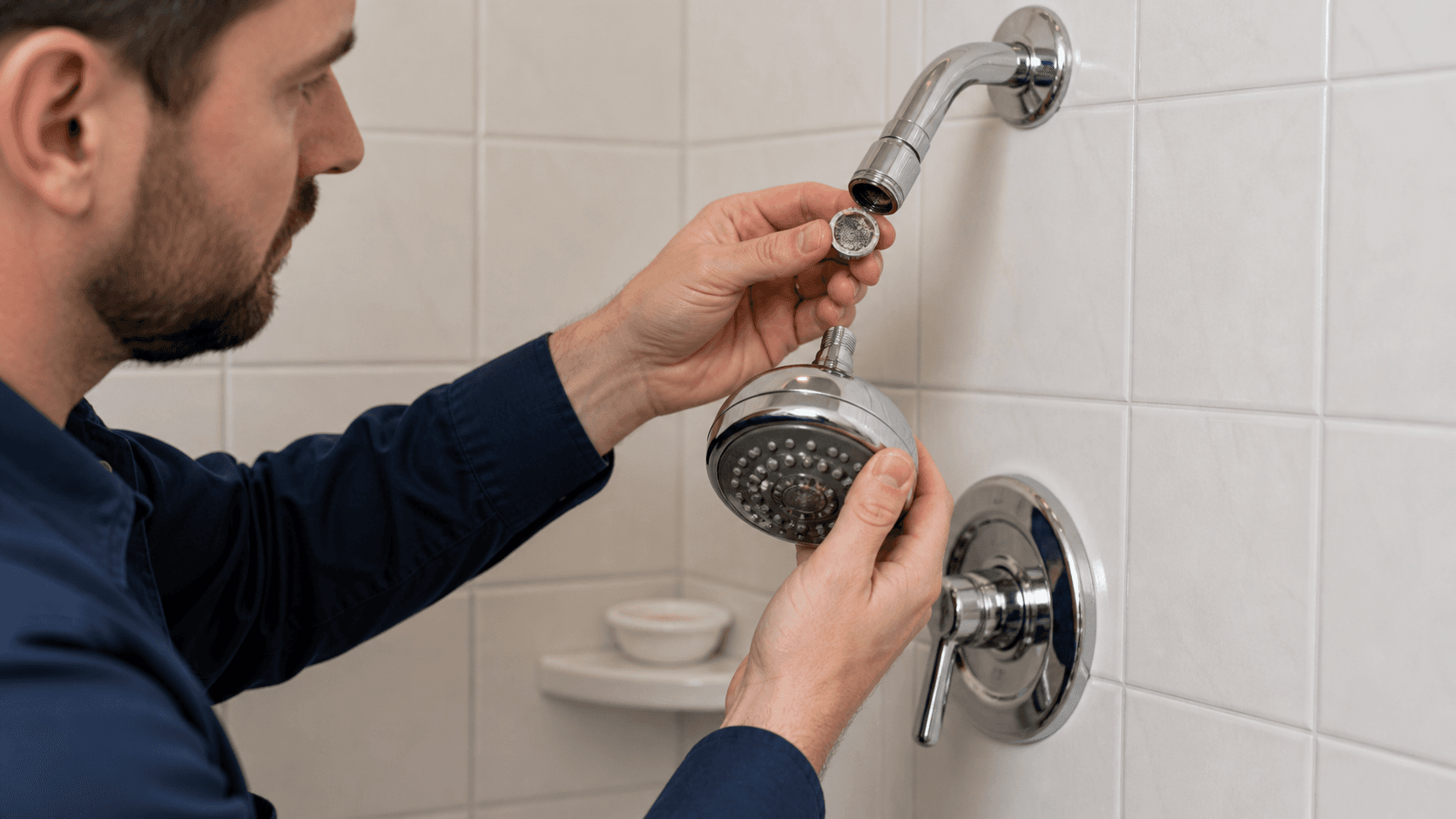
Call a plumberSoak the showerhead in a 50/50 mix of white vinegar and water for several hours to dissolve the mineral scale clogging its spray holes, then scrub the holes and flush it clear.
A clogged showerhead is the most common cause of weak shower pressure and the easiest to fix, because the clog is mineral scale that vinegar dissolves. White vinegar is mildly acidic, and the limescale and mineral deposits that accumulate in a showerhead's spray holes dissolve in it over a few hours of contact. The standard method is a 50/50 solution of white vinegar and water, with the showerhead fully submerged so the solution reaches the internal passages as well as the face.
The simplest version is to fill a bag or container with the vinegar solution and submerge the head. If the showerhead unscrews easily, remove it and soak it in a bowl of the 50/50 mix; if it does not, tie a plastic bag of the solution around the head so the spray face is immersed in place. Let it soak for several hours — overnight for heavy buildup — so the acid has time to break down deposits that have hardened over months or years of use.
After soaking, the deposits need to be cleared mechanically as well. Scrub the spray face with an old toothbrush to dislodge loosened scale, and work the individual nozzles — many rubber-tipped heads let you rub the nozzles to pop the deposits free. Then run the shower to flush the dissolved and dislodged material out of the head, which clears the passages the soak loosened and restores the flow the scale was choking.
If the vinegar soak restores the pressure, the diagnosis is complete and the fix cost nothing but time. If it does not — if the head is clean and the pressure is still weak — the problem is upstream of the showerhead, in the shower valve and its cartridge, which is the next suspect. Cleaning the head first is the right order precisely because it is free, common, and rules the cheapest cause in or out before any part is removed or replaced.
Usually no — the restrictor is rarely the problem. A WaterSense head must keep at least 60 percent of its flow at 20 psi, so a 2.0 gpm head still delivers at least 1.5 gpm.
The flow restrictor gets blamed for weak shower pressure far more often than it deserves. A restrictor is a small insert that limits the showerhead's maximum flow rate, and removing it is a popular piece of internet advice, but it is rarely the actual cause of a genuine pressure problem. A showerhead that is weak because its nozzles are scaled shut, or because the valve cartridge is restricting flow, will not be fixed by pulling the restrictor — the restriction is somewhere else.
The performance standard behind WaterSense showerheads is the reason the restrictor is usually not the culprit. The EPA's WaterSense specification requires a labeled showerhead to deliver at least 60 percent of its rated flow at a low supply pressure of 20 psi, so the head is engineered to hold up its flow even when pressure is poor. A 2.0 gpm head meeting that spec still delivers at least 1.5 gpm at 20 psi by design, which means a WaterSense head is built specifically not to feel starved at low pressure — the opposite of what removing the restrictor is meant to cure.
That design margin reframes the whole restrictor question. If the shower feels weak, the WaterSense engineering says the head should still be moving a usable flow even at low supply pressure, so a head that feels far weaker than that is more likely clogged or fed by a restricting cartridge than over-restricted by its insert. Pulling the restrictor on a scaled head treats the wrong cause and leaves the actual clog or worn cartridge in place.
There are narrow cases where removing a restrictor is reasonable — typically an older, high-flow head a homeowner deliberately wants to run wide open — but it should be the last consideration, not the first, and it does nothing for the common causes. The better order is to soak the head for scale and check the cartridge for wear before touching the restrictor, because those are the parts that actually produce a single-shower pressure complaint. Removing the restrictor also simply uses more water for the same wash, against the WaterSense intent.
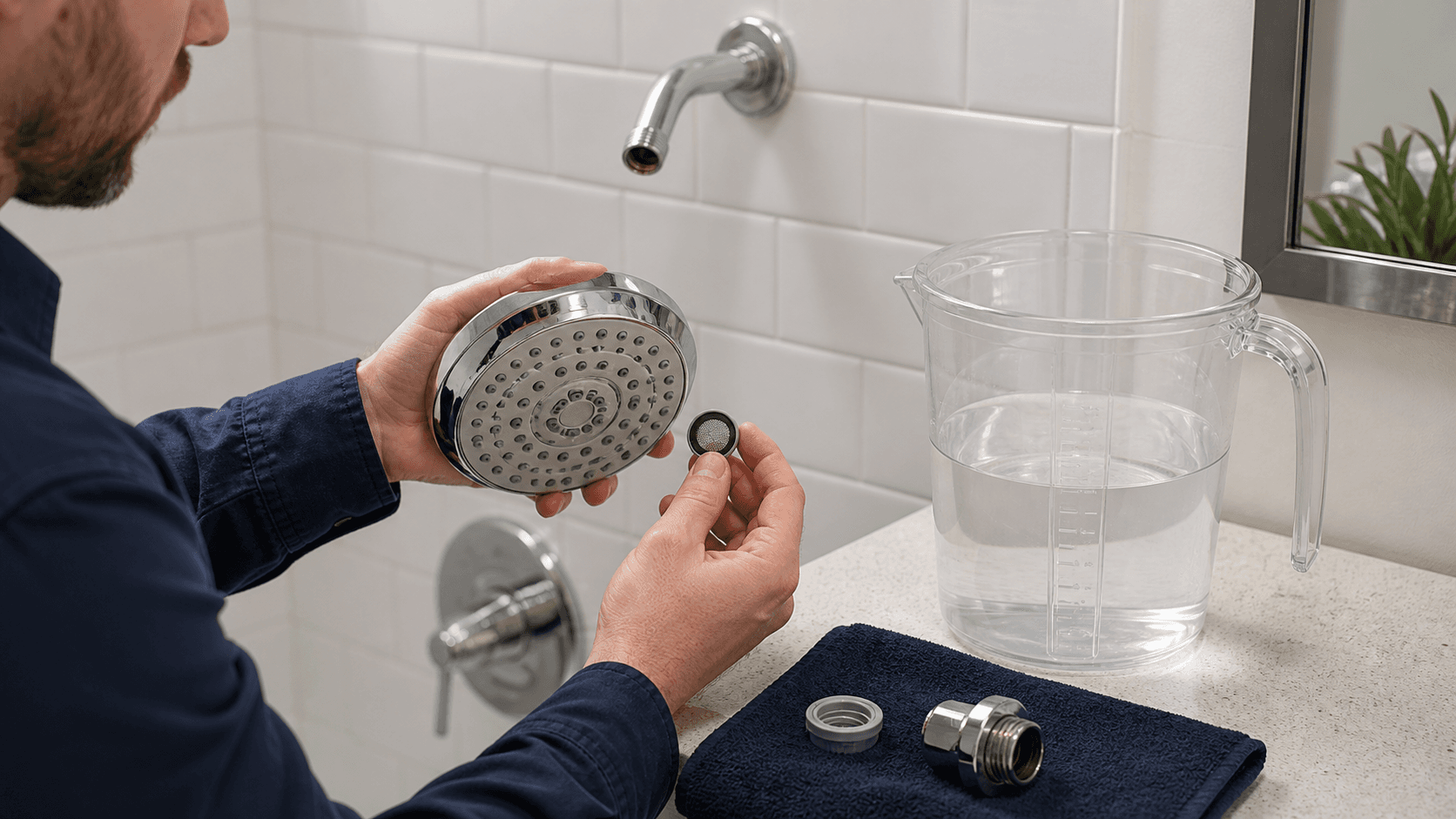
Yes — a worn pressure-balancing cartridge in the shower valve can restrict flow internally and weaken the shower, and it is the leading cause once a clogged showerhead is ruled out.
Modern shower valves are pressure-balancing valves, and at their heart is a cartridge that mixes hot and cold and holds the temperature steady when another fixture draws water. Inside that cartridge is a balancing mechanism — typically a piston or spool that shifts to keep the hot-cold ratio constant — and as the cartridge wears, scales, or seizes, it can begin to restrict the flow passing through it. The result is weak pressure at that shower even though the supply feeding the valve is fine.
This is why the cartridge is the prime suspect once the showerhead is ruled out. If the head has been soaked clean and the shower is still weak, the restriction has to be upstream of the head, and the cartridge is the part in that path most prone to wear-related flow loss. A cartridge that is restricting flow can also show other symptoms — temperature that drifts, difficulty getting full hot or cold, or pressure that changes when another fixture runs — which together point at the balancing mechanism rather than at the head.
Mineral content accelerates cartridge wear and scaling, so the cartridge cause is worth taking seriously even though Bellevue's water is relatively soft. Scale and grit work into the cartridge's moving parts and seats over years of use, gradually stiffening and restricting it, which is the slow path by which a once-strong shower weakens. The This Old House guidance on pressure-balancing valves describes how a worn balancing cartridge restricts flow and is the common fix for a shower that has lost pressure with a clean head.
Confirming the cartridge as the cause sets up the repair. When the head is clean, the rest of the house is fine, and the shower is still weak — especially with temperature symptoms alongside — the diagnosis lands on the cartridge, and the fix is to replace it. That replacement is the next section, and it is the point where a single-shower pressure problem crosses from a free vinegar soak into a parts-and-labor repair best handled as faucet and fixture repair in Bellevue.
Shut the water, pull the handle and trim, extract the old cartridge, and seat a matching new one; cartridges run about $10 to $85 in parts, with a professional replacement around $100 to $250.
Replacing a shower cartridge is a defined sequence, but it depends on getting an exact-match part. The water is shut off — ideally at integral stops on the valve or otherwise at the main — and then the handle and trim plate are removed to expose the cartridge held in the valve body, usually by a retaining clip or nut. The old cartridge is pulled straight out, the new one is seated in the same orientation, and the trim and handle go back on before the water is restored and the shower tested for flow and temperature.
The catch is matching the cartridge to the valve. Pressure-balancing cartridges are brand- and model-specific, so the replacement has to match the existing valve exactly, which usually means identifying the valve maker and model or taking the old cartridge to match it. A mismatched cartridge will not seat or seal correctly, so identifying the right part is the step that makes or breaks an otherwise simple swap. A cartridge that is mineral-seized in the valve body can also resist removal and require a puller, which is a common point where the job gets harder than expected.
On parts cost, a shower cartridge runs roughly $10 to $85 depending on the valve brand and model — basic cartridges at the low end, premium pressure-balancing units at the high end. That makes the part itself inexpensive relative to the improvement, which is part of why a worn cartridge is worth replacing rather than living with a weak shower. The variation in price tracks the valve manufacturer more than anything else, so the figure firms up once the valve is identified.
On labor, a professional cartridge replacement runs about $100 to $250, covering the labor to shut down the water, pull the trim, extract a possibly seized cartridge, fit the correct new one, and confirm flow and temperature. A confident DIYer with the right matching part and integral stops can do the swap themselves; a seized cartridge, an unfamiliar valve, or no integral stops are reasons to book it as faucet and fixture repair in Bellevue, where matching the cartridge and freeing a stuck one is routine.
Confirm only the shower is weak, soak the showerhead for scale, leave the restrictor alone, then descale or replace the cartridge if a clean head does not restore the flow.
The diagnosis runs cheapest-first. Step one is to confirm the problem is shower-only by checking two or three other fixtures: if the kitchen and bathroom sinks run strong and only the shower is weak, the cause is a local part and the whole-house suspects — supply, main valve, PRV — are ruled out. Establishing the shower-only pattern is what justifies skipping a pressure gauge at the main and going straight to the showerhead.
Step two is to soak the showerhead in a 50/50 white-vinegar solution for several hours, then scrub and flush it. This clears the mineral scale that is the single most common cause of weak shower pressure, and it costs nothing. If the soak restores the flow, the diagnosis is done; if the head is now clean and the shower is still weak, the restriction is upstream and the search moves to the valve.
Step three is to resist removing the flow restrictor, because it is rarely the real cause. A WaterSense head is engineered to keep at least 60 percent of its rated flow at 20 psi — a 2.0 gpm head still delivering at least 1.5 gpm at low pressure — so a head that feels far weaker than that is clogged or fed by a restricting cartridge, not over-restricted by its insert. Pulling the restrictor treats the wrong cause and only raises water use.
Step four is the cartridge: with a clean head and a still-weak shower, descale or replace the pressure-balancing cartridge, which wears and restricts flow over time and is the leading cause once the head is ruled out. Cartridges run about $10 to $85 in parts and around $100 to $250 for a professional replacement, and a seized cartridge or an unfamiliar valve is the point to book faucet and fixture repair in Bellevue. It is also worth checking the diverter on a tub-shower, since a failing diverter can starve the showerhead — covered in our shower diverter guide.
If only the shower is weak, it is a local part — soak the showerhead in 50/50 vinegar first. A worn cartridge can cause it; leave the restrictor alone and replace the cartridge by symptom.
If only the shower has low pressure and the rest of the house is fine, the cause is a local part — a clogged showerhead or a worn valve cartridge — not the supply, because a whole-house problem would weaken every fixture. Confirm by checking a couple of other fixtures; strong pressure elsewhere rules out the main valve, the PRV, and the supply piping and sends the fix to the shower itself. That isolate-the-fixture step is what keeps the repair cheap.
To clean the showerhead, soak it in a 50/50 mix of white vinegar and water for several hours, scrub the spray holes with an old toothbrush, and flush it. The vinegar dissolves the mineral scale clogging the nozzles, which is the most common cause of weak shower pressure, and the fix costs nothing. Overnight soaking handles heavy buildup, and if a clean head restores the flow the diagnosis is finished.
Yes, a worn pressure-balancing cartridge can cause low shower pressure, and it is the leading cause once a clean showerhead is ruled out — the cartridge wears and restricts flow internally, often alongside temperature drift. No, you generally should not remove the flow restrictor: a WaterSense head keeps at least 60 percent of its rated flow at 20 psi, so a 2.0 gpm head still delivers at least 1.5 gpm under low pressure by design, and pulling the restrictor treats the wrong cause.
There is no fixed interval for replacing a shower cartridge — you replace it by symptom, not on a schedule. A cartridge that has begun to restrict flow, drift in temperature, or stick is at the end of its useful life regardless of its exact age, and a cartridge that is still working fine does not need preemptive replacement. Parts run about $10 to $85 and a professional swap about $100 to $250; a seized cartridge or an unfamiliar valve is the point to book faucet and fixture repair in Bellevue.
Every fact in this guide cites a verifiable public source. If you find a number we got wrong, email dispatch@bellevueplumberpro.com.
Need help with this in your home? See our Faucet and fixture repair in Bellevue page for pricing, our diagnostic process, and how same-day service works across the Eastside.
Related services: Water Main Repair, and Leak Detection and Pipe Repair.
Low pressure at only the shower points to a local part — a clogged showerhead or a worn valve cartridge — not the house. A whole-house problem would weaken every fixture at once.
Soak the head in a 50/50 white vinegar and water mix for several hours to dissolve the mineral scale clogging the spray holes, then scrub the holes and flush clear. Removing the flow restrictor is rarely the answer — WaterSense heads must keep at least 60% of flow at 20 psi.