Home/Learn/Water pressure/Water pressure regulator (PRV): what it does, code, settings, and cost in Bellevue
Water pressure
Water pressure regulator (PRV): what it does, code, settings, and cost in Bellevue
A pressure-reducing valve (PRV) is the spring-loaded brass valve installed on the water main where it enters the house, and its job is to take whatever pressure the municipal supply delivers — which in higher-elevation Bellevue zones can run well past 80 psi — and reduce it to a safe, steady household level around 50 psi. The Uniform Plumbing Code requires a PRV wherever static street pressure exceeds 80 psi and mandates that it reduce the pressure to 80 psi or below, with a strainer ahead of it. Because a PRV closes the system to the street, code also pairs it with a thermal-expansion tank so heating water has somewhere to expand. This guide explains what the valve is, when code requires one, what pressure it should be set to under both the UPC and Washington's minimum-pressure rule, why the expansion tank is mandatory, how to adjust the valve with a gauge, the signs of a failed-open or failed-closed PRV, how it is diagnosed and replaced, and what the job costs on the Eastside — roughly $200 to $700, around $400 typical.
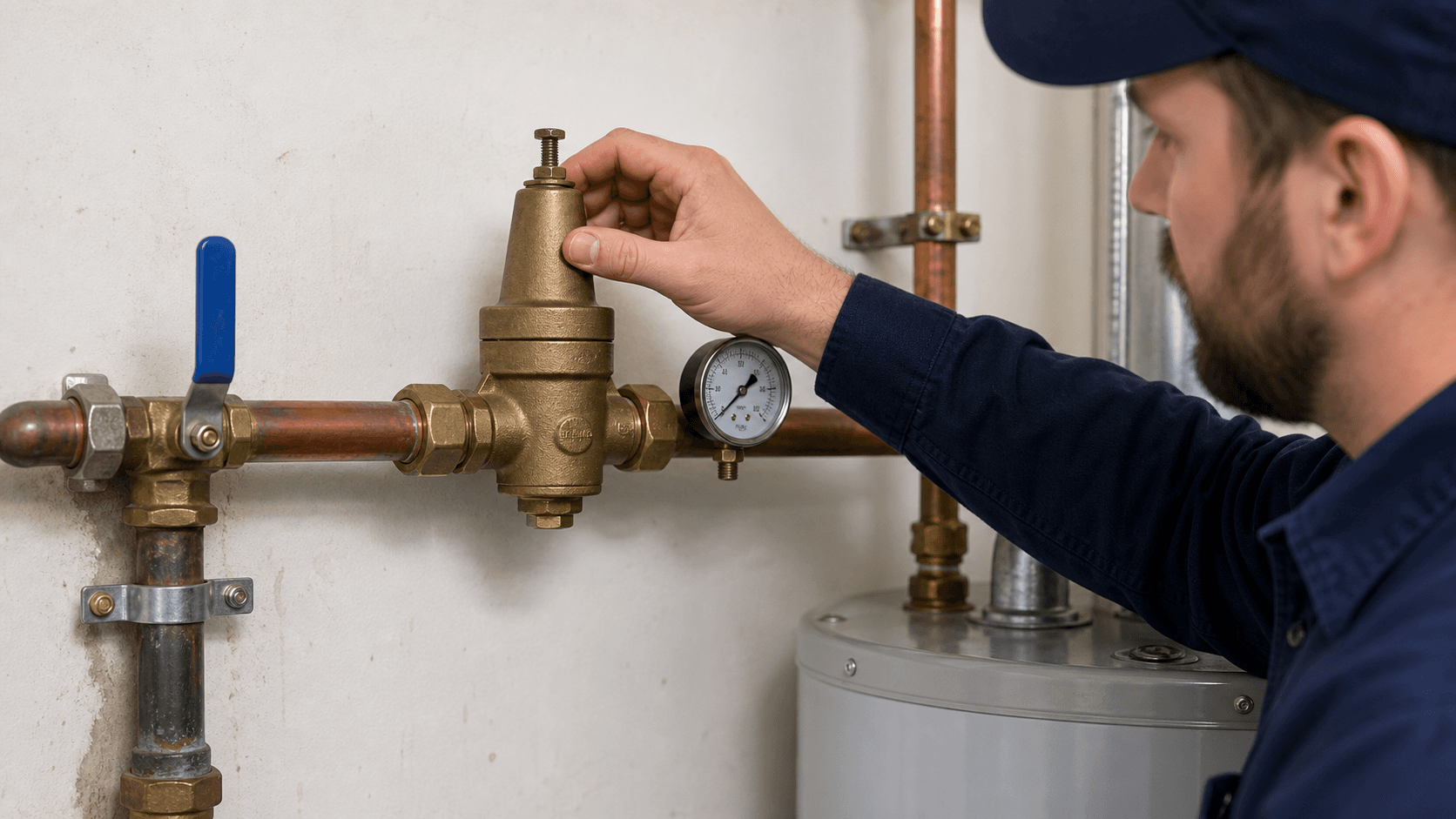
A PRV is a spring-loaded brass valve installed on the water main at the house, and it drops high incoming street pressure down to a steady household level of about 50 psi.
A pressure-reducing valve, or PRV, is a bell-shaped brass fitting plumbed into the water main right where the supply line enters the house, usually just past the main shutoff and the meter. Inside is a spring-loaded diaphragm: the incoming street pressure pushes against a spring whose tension you set, and the valve throttles flow until the downstream pressure matches the spring setting. The result is that no matter how high the municipal pressure climbs, the water delivered to the home's fixtures stays at the level the spring is calibrated for, typically around 50 psi.
The reason a PRV exists is that municipal water mains are often pressurized far higher than a house should see. Utilities run high pressure in the mains to reach high-elevation customers and to keep fire-flow capacity, and that same high pressure arrives at every connected home. Without a regulator, a house in a high-pressure zone takes the full street pressure directly onto its pipes, fixtures, appliance valves, and water heater — pressure that the plumbing inside the home was never meant to hold continuously.
Mechanically the PRV is a self-contained automatic valve, not something you operate day to day. Once the spring is set to the target downstream pressure, the valve regulates on its own: when household demand drops and downstream pressure would otherwise rise, the diaphragm closes the valve further; when fixtures open and pressure falls, the valve opens to let more through. The single adjustment screw on top changes the spring tension and therefore the pressure the valve holds, which is how the set pressure is dialed in.
Because the PRV sits at the boundary between the city main and the entire house, it is one of the highest-leverage parts in a residential plumbing system — every fixture downstream depends on it. That position also means that when a PRV fails, the symptom is rarely local; it shows up as a whole-house problem, either too much pressure everywhere or too little. That whole-house signature is what separates a PRV fault from a single clogged fixture, and it is why the regulator is the first suspect in a house-wide pressure complaint.
A PRV controls the pressure delivered to every fixture downstream of the main line.
This happening in your home right now? A licensed plumber can talk you through the next step on the phone — 24/7, and the call is free.
The Uniform Plumbing Code requires a PRV wherever static street pressure exceeds 80 psi, and the valve must reduce the pressure to 80 psi or below, with a strainer installed ahead of it.
The governing rule is UPC section 608.2, which sets the 80 psi line. Where the static water pressure supplied to a building exceeds 80 pounds per square inch, the code requires an approved pressure-reducing valve, and that valve must reduce the pressure to 80 psi or less to the building's water-distribution system. The 80 psi ceiling is not a suggestion — it is the maximum the code allows on the household side, because pressure above that level stresses fixtures, supply lines, and appliance connections.
The same section requires a strainer ahead of the regulator. The PRV's diaphragm and seat are precision parts, and grit or sediment carried in the supply will lodge in the seat and prevent the valve from closing cleanly, so UPC 608.2 calls for an approved strainer installed on the supply side of the pressure-reducing valve to catch debris before it reaches the regulator. A PRV without an upstream strainer is more likely to fail by hanging open on a piece of trapped grit.
Whether a given Bellevue house needs a PRV therefore comes down to its measured static pressure. The City of Bellevue's water system is split into pressure zones tied to ground elevation, and the published pressure-zone data shows household service pressures ranging from roughly 30 psi up to 100-plus psi across those zones. Homes sitting in the higher-elevation zones commonly see static pressures above the 80 psi code threshold, which is exactly the condition UPC 608.2 addresses by requiring a regulator.
The practical test is a gauge reading, not a guess. A static pressure measured above 80 psi at an outdoor hose bib means the house is in PRV territory under the code, whether or not one is currently installed; a reading comfortably below 80 psi means the code does not compel one. Because the higher Bellevue zones can deliver well over 80 psi, a house there without a working regulator is running its plumbing above the code limit, and confirming the static pressure is the first step in deciding whether a PRV is required.
What pressure should a PRV be set to?
Most PRVs ship preset near 50 psi and adjust over roughly 25 to 75 psi; Washington requires a minimum of 30 psi at the meter and never below 20 psi under demand.
A common residential regulator such as the Watts LF25AUB-Z3 ships with a factory preset of 50 psi and an adjustable range of approximately 25 to 75 psi, which brackets the band most homes want. Around 50 psi is a comfortable, fixture-friendly target: high enough for strong showers and fast fills, low enough to protect supply lines, appliance valves, and the water heater from the wear that high pressure causes. Setting the valve well below 80 psi also leaves margin under the UPC 608.2 ceiling rather than riding right at it.
The lower bound is set by Washington's water-system rules, not just by comfort. Under WAC 246-290-230, the public water system must maintain a minimum pressure, and the standard the code holds is a minimum of 30 psi measured at the meter under normal conditions, with the pressure never allowed to fall below 20 psi during periods of high demand or fire flow. Those numbers describe what the supply must deliver, and they frame the bottom of the range a household regulator should be set within — there is no reason to dial a PRV down near those floor figures.
Putting the two together gives the working window. The household side must stay at or below 80 psi to satisfy UPC 608.2, and the supply must stay at or above the WAC 246-290-230 minimums of 30 psi normal and 20 psi under demand, so a typical regulator set around 50 psi sits comfortably in the middle of that band. That mid-band setting delivers good flow at the fixtures while keeping the system clear of both the code ceiling above and the regulatory floor below.
Choosing an exact number within the comfortable 45 to 60 psi range is a balance of preference and protection. Higher within that band gives a stronger feel at showers and hose bibs; lower within it is gentler on the plumbing and reduces the volume lost to any small leaks. What matters most is that the set pressure is verified with a gauge after adjustment rather than assumed, because a regulator's dial is not a calibrated readout and the only way to know the delivered pressure is to measure it downstream.
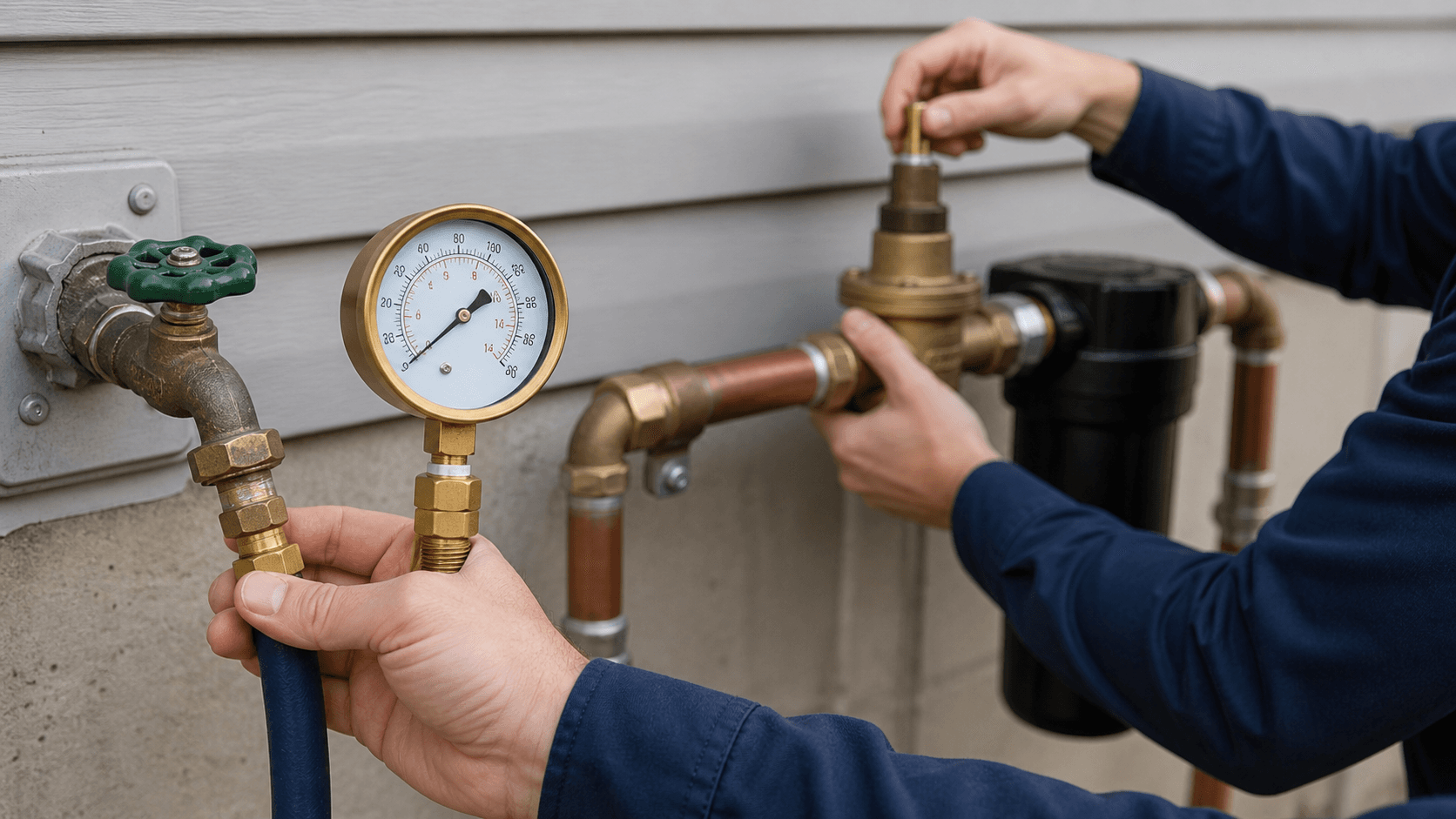
A PRV setting is only real after the downstream pressure is checked with a gauge.
Why is an expansion tank required with a PRV?
A PRV closes the system to the street, so when the water heater heats and the water expands, the pressure has nowhere to go — an expansion tank absorbs that surge.
A pressure-reducing valve generally acts as a one-way device: it lets water flow into the house but does not let the house's water push back out to the street main. That makes the home a closed plumbing system. In an open system, the small volume increase that occurs every time the water heater warms its tankful of water can relieve itself back toward the main; in a closed system, that escape path is gone, so the expanding water has nowhere to go.
Water expands measurably when heated, and a storage water heater does exactly that on every recovery cycle. With the system closed by the PRV, that thermal expansion has no outlet, so the pressure inside the home's pipes spikes each time the heater fires. Those repeated pressure surges stress fixtures, supply lines, and the water heater itself, and they are the reason a temperature-and-pressure relief valve on the heater may begin to weep on a closed system — it is relieving the expansion pressure the PRV has trapped.
The expansion tank solves this by giving the expanding water a place to go. It is a small steel tank with an air-charged bladder; when heating pushes the system pressure up, water pushes into the tank and compresses the air cushion, absorbing the surge instead of letting it spike the whole system. As fixtures are used and pressure drops back, the cushion pushes that water back into the lines. The Uniform Plumbing Code (UPC 608.3) requires a thermal-expansion tank or equivalent device whenever the supply is closed by a device such as a PRV, check valve, or backflow preventer.
Because of this, a PRV installation and an expansion tank are properly a matched pair, not two separate decisions. Adding a regulator to a house that did not have one closes the system, which is exactly when the expansion tank becomes code-required, so a compliant PRV job includes verifying or adding the expansion tank at the water heater. Skipping it leaves the new closed system with no way to absorb thermal expansion, which is what drives the T&P-valve dripping that owners often misread as a failing water heater.
How do you adjust a PRV?
Loosen the lock nut on top, turn the adjustment screw — clockwise to raise pressure, counter-clockwise to lower it — then confirm the result with a gauge on a hose bib before re-tightening the nut.
Adjusting a PRV is a matter of changing the spring tension behind its diaphragm, and the mechanism is a single screw on top of the valve held by a lock nut. The first step is to back off that lock nut so the adjustment screw can turn freely; with the nut loose, turning the screw clockwise compresses the spring and raises the downstream pressure, while turning it counter-clockwise relaxes the spring and lowers the pressure. Small turns matter — the pressure changes several psi per turn, so adjustments are made a little at a time.
The adjustment is only meaningful with a gauge in the loop, because the valve has no readout of its own. Thread an inexpensive water-pressure gauge onto an outdoor hose bib — ideally one close to where the main enters — and read the downstream pressure as you go. The correct method is to turn the screw a small amount, then open and close a fixture to let the downstream pressure settle to the new setting, then read the gauge again, repeating until the gauge shows the target around 50 psi.
Reading the gauge correctly means watching both static and flowing pressure. Static pressure is what the gauge shows with all fixtures off; that is the number to set against the roughly 50 psi target and to keep under the 80 psi code ceiling. It also helps to open a fixture briefly and watch the gauge to confirm the pressure does not collapse, which would point to a valve that is restricting flow rather than simply regulating it. Once the static reading sits at the target, the setting is correct.
When the target pressure is dialed in and verified on the gauge, hold the adjustment screw still and re-tighten the lock nut against it so the setting cannot drift. If turning the screw produces no change in the gauge reading — the pressure will not come down, or will not come up — the valve is not responding to its own adjustment, which is a sign of a failed PRV rather than a setting that needs more turns, and the diagnosis moves to replacement covered below.
What are the signs of a bad PRV?
A failed-open PRV lets pressure creep above 80 psi; a failed-closed one drops or fluctuates pressure. Water hammer, running toilets, and dripping relief valves are common downstream signs.
A PRV fails in one of two directions, and the symptoms are opposite. A failed-open regulator stops holding back the street pressure, so the household pressure creeps up over time and the gauge reads above the 80 psi code ceiling even though the valve is set lower. The downstream signs are the signs of high pressure generally: water hammer banging in the walls when valves close, faucets that surge, toilets that run or refill on their own, and a water-heater relief valve that begins to weep as the over-pressure relieves through it.
A failed-closed regulator does the reverse, choking the flow so the household pressure drops or swings. The symptom is weak pressure across the whole house — thin showers, slow fills — and often a pressure that fluctuates as the failing diaphragm hunts instead of holding a steady setting. Because this presents as low pressure everywhere at once rather than at a single fixture, a failed-closed PRV is one of the prime suspects in a whole-house low-pressure complaint, alongside corroded supply piping and a partly closed main valve.
Fluctuating or creeping pressure is the signature that points specifically at the regulator rather than at the supply. A gauge left on a hose bib that shows the static pressure slowly climbing past the set point over minutes indicates the valve is no longer sealing and is letting street pressure bleed through — a classic failed-open creep. Pressure that reads fine at one moment and weak the next, with no change in demand, points at a diaphragm that is no longer regulating cleanly. Grit lodged in the seat from a missing or clogged strainer is a common reason a PRV hangs open this way.
These symptoms also explain why a PRV problem is worth chasing rather than living with. A failed-open valve runs the whole house above the code-limit pressure, accelerating wear on every fixture, supply line, and appliance valve and driving the water hammer and running-toilet complaints; a failed-closed valve starves the house of usable pressure. Either way the fix is at the valve, and confirming it is the valve — rather than a supply or piping problem — is done with the gauge-first diagnosis below.
How is a PRV diagnosed and replaced?
Diagnose with a gauge first to confirm the pressure is out of range and the valve is not responding; replacement cuts the failed PRV out of the main and is permitted plumbing work in Washington.
Diagnosis starts at the gauge, not the valve. Thread a pressure gauge onto an outdoor hose bib and read the static pressure with everything off: a reading well above 80 psi on a house that has a regulator points to a failed-open PRV, while a low or fluctuating reading on a house with a regulator points to a failed-closed one. The confirming test is to adjust the screw and watch the gauge — a valve that will not move the downstream pressure in response to its own adjustment is no longer regulating and needs replacement rather than another turn.
Before condemning the PRV, the gauge also rules out the look-alikes. A whole-house low reading can come from a partly closed main or meter valve rather than the regulator, so confirming the main shutoff is fully open is part of the workup; a high reading with a regulator present is much more specifically a PRV failure, because the valve's whole job is to keep that number down. Sorting these with the gauge first prevents replacing a sound valve for a problem that was actually a half-closed shutoff or aged supply piping.
Replacement means cutting the failed valve out of the water main and fitting a new one, which is real plumbing on the home's primary supply line. The main is shut off, the line is opened, the old PRV is removed from between its unions or cut out of the pipe, and a new regulator — with the required upstream strainer — is installed and the spring set to target with a gauge. Because the work is on the main and is permitted plumbing work in Washington, it is the kind of job that gets pulled and inspected rather than improvised on the home's incoming supply.
The expansion tank belongs in the same job. Since the PRV closes the system, a replacement is the moment to verify the thermal-expansion tank required by UPC 608.3 is present and functioning at the water heater, and to add one if the house never had it. A regulator swapped in without confirming the expansion tank leaves the closed system with no way to absorb thermal expansion. Work on the main supply and its regulator is best booked as water main repair in Bellevue rather than handled as a casual DIY cut into the incoming line.
What does a PRV cost in Bellevue?
A pressure-reducing valve replacement runs roughly $200 to $700 installed on the Eastside, with about $400 typical, depending on the valve, the existing plumbing, and whether an expansion tank is added.
The installed cost of a PRV replacement falls in a roughly $200 to $700 range, with about $400 a typical figure for a straightforward swap. That spread covers the regulator itself, the labor to shut down the main and cut the new valve in, and the upstream strainer the code requires. The position of the valve on the main — accessible in a garage or basement versus buried in a tight crawlspace or at a meter pit — is one of the main reasons a given job lands at the low or high end of the range.
Several factors push a particular job within that band. The grade of valve matters, as a basic residential regulator costs less than a higher-flow or lead-free premium model; the condition of the surrounding pipe matters, since corroded or galvanized supply piping at the connection adds labor; and whether the job also adds a code-required thermal-expansion tank that the house lacked adds parts and time. A simple like-for-like replacement on accessible copper sits near the typical figure, while a difficult location plus added expansion tank moves it toward the top.
Set against the alternative, the cost is modest for what it protects. A failed-open PRV runs the entire house above the 80 psi code limit, and that sustained over-pressure accelerates wear on every fixture, supply line, appliance valve, and the water heater, while driving water hammer and running toilets. Spending a few hundred dollars to restore proper regulation is small next to the cumulative cost of high pressure chewing through the home's fixtures and connections over time.
Because the work is on the home's main supply line, is permitted plumbing in Washington, and should be verified against the expansion-tank requirement, it is a job to book with a plumber rather than improvise. Booking it as water main repair in Bellevue gets the valve sized and set correctly, the strainer and expansion tank handled to code, and the static pressure verified on a gauge afterward — which is the only way to confirm the new regulator is delivering the target pressure it was set for.
From gauge reading to verified pressure: how a PRV job runs
Five steps: a gauge reading at a hose bib establishes the static pressure, the diagnosis separates a failed PRV from other whole-house causes, a flat-rate written quote covers valve, strainer, and any expansion tank, the main is shut and the valve swapped with the system drained, and a final gauge reading verifies the delivered pressure before the plumber leaves.
"The gauge goes on before the wrench does," says the water-pressure lead on our network. "A $10 reading tells us whether this is a $400 valve job or a free adjustment — anyone who quotes a PRV without gauging first is guessing."
What the visit looks like:
Static gauge reading at an outdoor hose bib with all fixtures off — the number that decides everything.
Diagnosis — failed-open (high pressure everywhere), failed-closed (low pressure everywhere), or a different whole-house cause entirely.
Flat-rate written quote covering the valve, the code-required upstream strainer, and the expansion tank if the house lacks one.
Main shut, system drained, old PRV cut out, new valve and strainer sweated or threaded in.
Final gauge verification of the set pressure under static and flow conditions — the proof the job worked.
Common questions about water pressure regulators
You can adjust a PRV with a gauge, but a failed one needs replacing. It is field-typical to last 10 to 15 years, and an expansion tank is required because the valve closes the system.
Yes, you can usually adjust a PRV yourself, as long as you confirm the result with a gauge. Loosen the lock nut, turn the adjustment screw a little at a time — clockwise to raise pressure, counter-clockwise to lower it — and read the static pressure on a gauge threaded onto a hose bib until it settles near 50 psi, then re-tighten the nut. What you should not do without a gauge is set it blind, because the dial is not a calibrated readout and the only way to know the delivered pressure is to measure it. If the screw will not move the pressure at all, the valve has failed and needs replacing, not adjusting.
Whether you need a PRV in Bellevue depends on your measured static pressure. Under UPC 608.2 a regulator is required wherever static street pressure exceeds 80 psi, and the City of Bellevue's pressure-zone data shows service pressures ranging from roughly 30 psi to over 100 psi across the system by elevation, with homes in the higher zones commonly above 80 psi. The way to know is to measure the static pressure at a hose bib: above 80 psi means a PRV is called for, comfortably below means it is not.
A PRV is field-typical to last on the order of 10 to 15 years, which is a practitioner's rule of thumb from how these valves age in service rather than a manufacturer datasheet figure. Like any spring-and-diaphragm valve it wears, and grit from a missing or clogged upstream strainer shortens its life by lodging in the seat, so the figure is a planning expectation, not a guarantee. A regulator that has started to creep, fluctuate, or stop responding to its adjustment has reached the end of its useful service regardless of its exact age.
The expansion tank is required because the PRV closes the plumbing system to the street. With no path back to the main, the volume increase from the water heater heating its tank has nowhere to go, so the pressure spikes on every cycle unless an expansion tank absorbs it — which is why UPC 608.3 requires one whenever a PRV, check valve, or backflow preventer closes the supply. That is why a regulator and an expansion tank are a matched pair, and why a PRV job should always verify the expansion tank. Work on the main and its regulator is best booked as water main repair in Bellevue.
Sources
Every fact in this guide cites a verifiable public source. If you find a number we got wrong, email dispatch@bellevueplumberpro.com.
Need help with this in your home? See our Water pressure repair in Bellevue page for pricing, our diagnostic process, and how same-day service works across the Eastside.
Water pressure regulator (PRV) — questions homeowners ask
QUESTION01
What does a water pressure regulator do?
A PRV is a spring-loaded brass valve on the water main where it enters the house. It drops high incoming street pressure down to a steady household level of about 50 psi, protecting fixtures, hoses, and supply connections from constant over-pressure.
QUESTION02
When does code require a pressure reducing valve?
The Uniform Plumbing Code requires a PRV wherever static street pressure exceeds 80 psi, and the valve must bring pressure down to 80 psi or below — with a strainer installed ahead of it.
QUESTION03
Why does a PRV need an expansion tank?
A PRV closes the house system off from the street. When the water heater heats water and it expands, that pressure has nowhere to escape — the expansion tank absorbs the surge and protects the water heater and connections.
QUESTION04
How do I adjust my water pressure regulator?
Loosen the lock nut on top, turn the adjustment screw clockwise to raise pressure or counter-clockwise to lower it, then confirm with a gauge on a hose bib before re-tightening. Keep at least 30 psi — never below 20 psi under demand.