What causes low water pressure in the whole house?
Five causes: a failed pressure-reducing valve, corroded galvanized supply pipe, a partly closed main or meter valve, low municipal supply pressure, or clogged distribution lines.
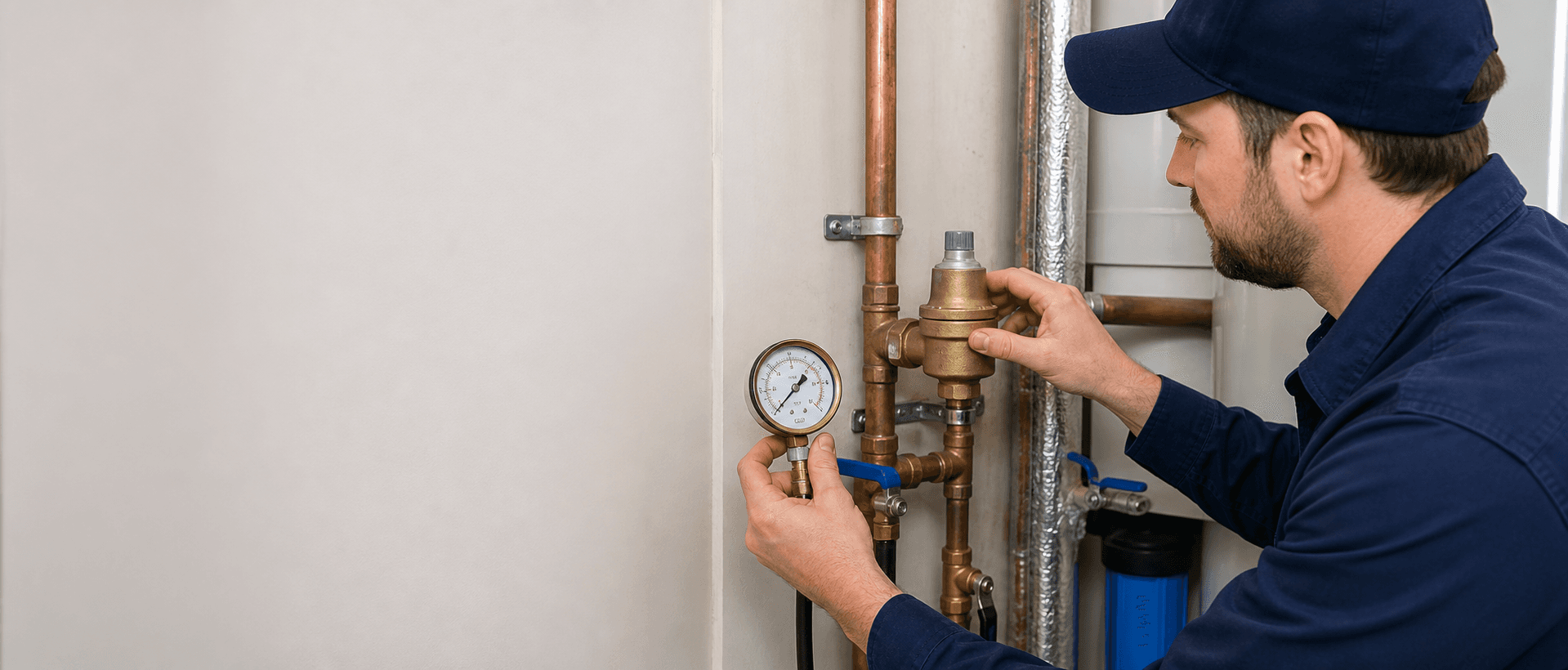
Low water pressure across the whole house — as opposed to at a single fixture — has a short list of causes: a failed pressure-reducing valve, corroded galvanized supply piping, a partly closed main or meter valve, low pressure from the municipal supply, or clogged distribution lines. A ten-dollar gauge on an outdoor hose bib tells you the static pressure in seconds and starts the diagnosis. Normal household pressure is 40 to 80 psi, and Washington's WAC 246-290-230 requires the supply to hold at least 30 psi under normal conditions and never fall below 20 psi under demand. In older Bellevue homes the leading cause is galvanized-steel supply piping that has corroded and tuberculated internally, narrowing the bore until flow chokes — and because the City of Bellevue's pressure zones range from roughly 30 to over 100 psi by elevation, a home in a lower zone starts with less margin to begin with. This guide gives the normal range, the gauge test, the five causes, a step-by-step diagnosis, the older-Bellevue galvanized angle, and what the fixes cost.
Last reviewed: 2026-06-04
Normal household water pressure is 40 to 80 psi; Washington requires the supply to hold at least 30 psi under normal conditions and never drop below 20 psi during high demand.
The comfortable working range for residential water pressure is 40 to 80 psi. Below about 40 psi, showers feel weak and fixtures and appliances fill slowly; above 80 psi, the pressure starts stressing supply lines, fixture valves, and the water heater, which is why the Uniform Plumbing Code caps the household side at 80 psi and requires a pressure-reducing valve above that. So 'normal' is bounded on both ends — too little is a flow complaint, too much is a code and wear problem — and most homes are dialed to sit comfortably in the middle, often around 50 psi.
The regulatory floor in Washington comes from WAC 246-290-230, which governs what the public water system must deliver. The rule holds the distribution system to a minimum of 30 psi measured at the meter under normal operating conditions, and requires that pressure never fall below 20 psi during periods of high demand or fire flow. Those figures describe the supply's obligation, not a comfortable household target — a house delivering only 30 psi to its fixtures would feel weak even though the supply is technically meeting its minimum.
The distinction between the comfortable range and the regulatory minimums matters for diagnosis. A house reading 50 to 60 psi static at the hose bib is in good shape; a house reading in the 30s feels low even though the supply may be within its WAC minimum, which points the search toward something inside the house — a regulator set low, a partly closed valve, or corroded piping — rather than toward the utility. Knowing the normal band turns a vague 'low pressure' complaint into a measurable target to test against.
Pressure also is not uniform across Bellevue, because the city's water system is divided into pressure zones tied to ground elevation. The City of Bellevue's pressure-zone data shows service pressures spanning roughly 30 psi to over 100 psi across those zones, so a home in a lower-elevation zone simply starts with less pressure than one in a higher zone before any in-house problem is considered. That zone context is the backdrop for reading a gauge result: the same 40 psi means something different in a low zone than in a high one.
This happening in your home right now? A licensed plumber can talk you through the next step on the phone — 24/7, and the call is free.
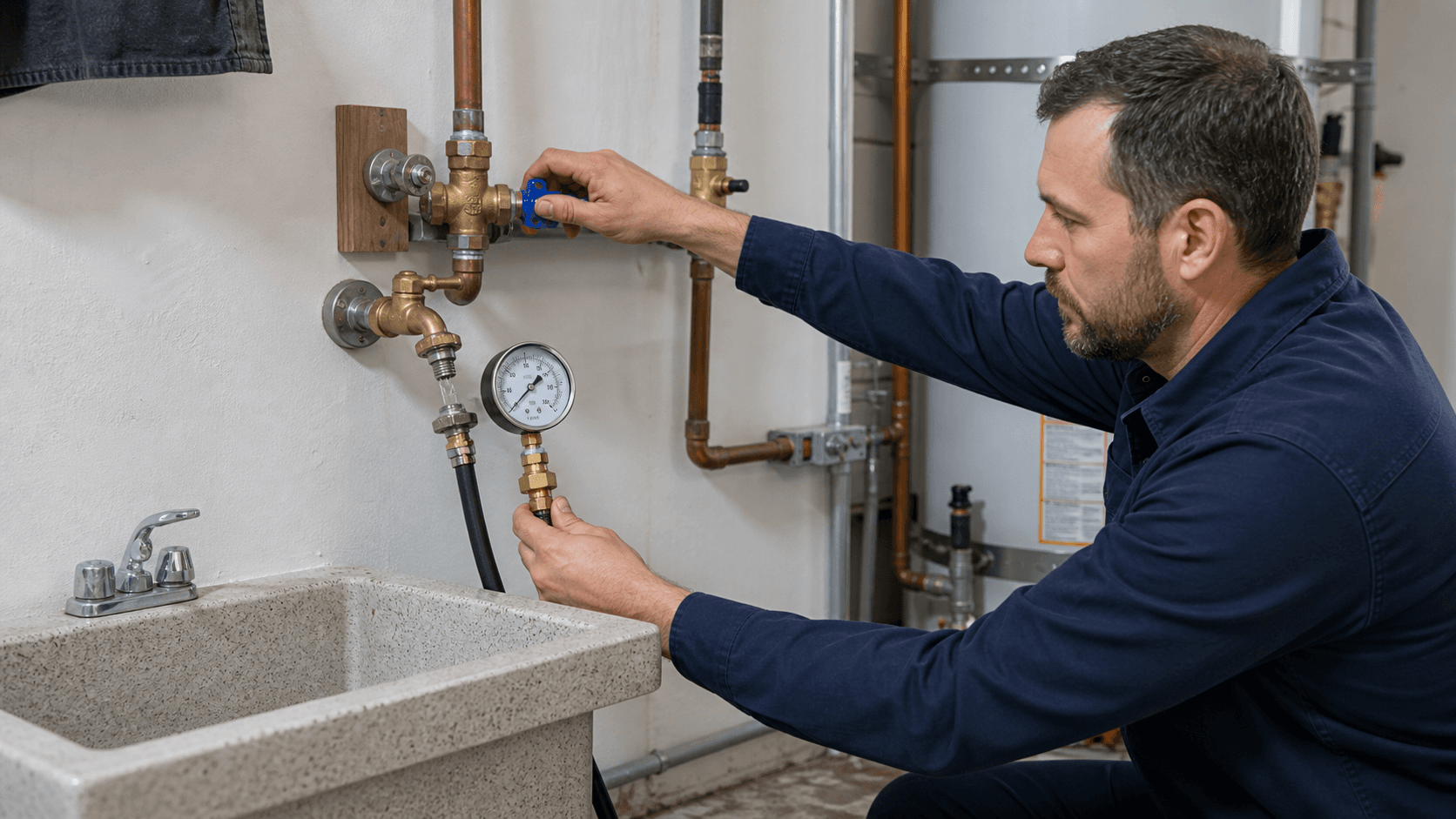
Call a plumberThread an inexpensive water-pressure gauge onto an outdoor hose bib, turn off all fixtures, and read the static pressure — a $10 gauge gives the whole-house number in seconds.
The single most useful tool for a pressure complaint is a water-pressure gauge that costs around $10 at any hardware store. It threads directly onto an outdoor hose bib — the standard garden-hose thread fits the gauge — and reads the pressure in the supply line at that point. Because the hose bib is usually close to where the main enters the house and ahead of most of the distribution piping, the reading there is a good measure of the pressure the house is actually receiving.
Reading static pressure is the key measurement. Turn off every fixture and water-using appliance in the house so nothing is drawing, then open the hose bib fully and read the gauge: that is the static pressure, the pressure with no flow, and it is the number to compare against the 40 to 80 psi normal range and the 80 psi code ceiling. A static reading is repeatable and unambiguous in a way that 'the shower feels weak' is not, which is why the gauge turns the whole diagnosis from subjective to measured.
It is also worth watching the gauge with a fixture running. Open a tub spout or a couple of fixtures and read the gauge again: this flowing pressure will be lower than static, but if it collapses dramatically — static fine but flow pressure crashing — that points at a restriction such as corroded piping or a failing regulator choking the flow rather than a simple low supply. The gap between the static and flowing readings is itself a diagnostic clue about where the problem sits.
Comparing the gauge result to the expected range frames everything that follows. A static reading in the 50s with reasonable flowing pressure is a healthy house and sends the search toward a single clogged fixture instead; a static reading in the 30s, or a flowing reading that collapses, is a genuine whole-house problem and starts the cause list below. Taking the reading first, before opening any valve or replacing any part, is what keeps the diagnosis from becoming guesswork.
Five causes: a failed pressure-reducing valve, corroded galvanized supply pipe, a partly closed main or meter valve, low municipal supply pressure, or clogged distribution lines.
The first cause is a failed pressure-reducing valve. On a house that has a PRV, a regulator that has failed closed chokes the flow and drops the household pressure everywhere at once, and a failing diaphragm can make the pressure fluctuate as well as sag. Because the PRV sits on the main and feeds the whole house, its failure produces exactly the house-wide low-pressure signature being diagnosed, which is why it is near the top of the suspect list on any home equipped with one.
The second cause is corroded galvanized supply piping, and it is the dominant one in older homes. Galvanized-steel pipe corrodes and tuberculates on the inside over decades, building up a rough internal scale that narrows the effective bore until flow is badly restricted, so a house plumbed in original galvanized loses pressure as the pipes age. This is the older-Bellevue cause covered in its own section below, because so much of the Eastside's original housing stock was plumbed in galvanized steel.
The third and fourth causes sit at the boundary with the street. A partly closed main shutoff or meter valve restricts flow into the whole house and is one of the most common and easily missed causes — a valve left only partway open after some prior work throttles the entire supply. And low municipal supply pressure, especially for a home in one of Bellevue's lower-elevation pressure zones, simply delivers less to start with; the city's zones range from roughly 30 to over 100 psi by elevation, so a low-zone home has less margin before a problem shows.
The fifth cause is clogged distribution lines downstream of the main, which overlaps with the galvanized story but also includes sediment and scale accumulating at branch lines and fittings over time. Sorting which of these five is responsible is the job of the step-by-step diagnosis below, because several of them produce the same weak-everywhere symptom and only a methodical check — gauge, then valves, then PRV, then pipe age — separates a free fix like opening a throttled valve from a major one like a repipe.
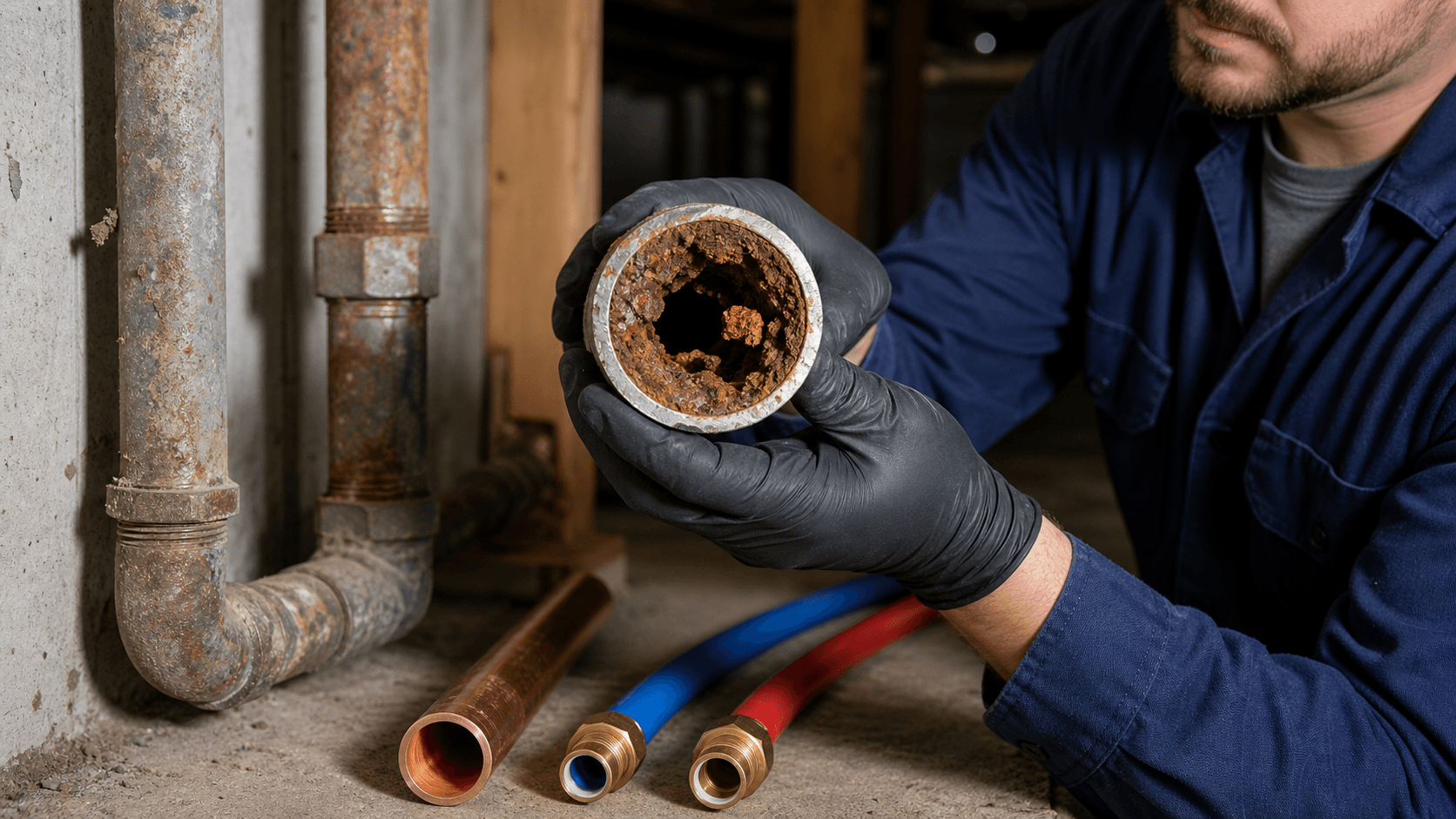
A sudden drop usually means a valve, not the pipes — a main or meter valve left partly closed, or a pressure-reducing valve that just failed; corroded-pipe loss comes on gradually instead.
Timing is a strong diagnostic clue, because the causes split cleanly into sudden and gradual. A pressure loss that appears all at once — fine yesterday, weak today — almost always points to something that changed state, and the two things that change state are valves and a regulator. Corroded piping, by contrast, narrows over years and produces a slow decline that no one notices day to day, so a sudden onset effectively rules the slow causes out and focuses the search on the fast ones.
A partly closed main or meter valve is the classic sudden cause. If a shutoff was operated recently — after a repair, a meter swap, an appliance install, or work elsewhere on the line — and left only partway open, the whole house loses pressure the moment it is throttled. This is the first thing to check on a sudden drop because it is both common and free to fix: a valve that simply needs to be opened fully restores the pressure with no parts and no plumber.
A pressure-reducing valve failing is the other sudden cause. A PRV that fails closed can drop the household pressure abruptly rather than gradually, choking the flow the instant the diaphragm gives way, and a failing valve can also make the pressure swing. On a house with a regulator, a sudden whole-house drop that is not explained by a throttled valve points strongly at the PRV, which the gauge-and-adjustment test in the regulator guide confirms.
Distinguishing sudden from gradual therefore reorders the whole diagnosis. A sudden drop says check the main and meter valves first, then the PRV — the fast-changing parts — and largely skip the corroded-pipe path; a gradual decline over months or years says the opposite, pointing at galvanized corrosion and accumulating scale as the pipes age. Establishing which pattern the homeowner is seeing is the fastest way to narrow five causes down to the one or two worth testing first.
Read the gauge first, then confirm the main and meter valves are fully open, check the PRV, consider the pipe age, and compare with neighbors to separate a house problem from a supply problem.
The diagnosis runs in a fixed order that moves from cheapest to most involved. It starts with the gauge: thread it onto an outdoor hose bib, shut off all fixtures, and read the static pressure against the 40 to 80 psi normal range. A reading in the normal band with weak flow at one fixture means the problem is local, not whole-house; a low static reading or a flowing pressure that collapses confirms a genuine house-wide problem and sends the diagnosis on to the valves.
The second step is to confirm the main shutoff and the meter valve are fully open, because a throttled valve is the most common and cheapest cause to find. Trace the supply from the meter to the house, find the main shutoff, and make sure both it and the meter valve are open all the way rather than left partway from prior work. This step costs nothing and resolves a large share of sudden-onset cases outright, which is why it comes before touching the regulator or considering the pipe.
The third step is the PRV, on any house that has one. With the gauge still on the hose bib, check whether the static pressure is out of range and whether adjusting the regulator's screw moves it; a valve that will not respond to its own adjustment has failed and is the cause. The fourth step is to consider the pipe age and material — a house plumbed in original galvanized steel that has lost pressure gradually points at internal corrosion, the older-Bellevue cause below, rather than at a valve.
The fifth step reaches past the house to the street: ask whether neighbors have the same problem. If nearby homes on the same supply also have low pressure, the cause is the municipal supply or the pressure zone rather than anything inside this house; if only this house is affected, the cause is internal — a valve, the PRV, or the piping. That neighbor comparison is what cleanly separates a supply problem, which the utility owns, from a house problem, which the homeowner owns. Work that turns out to be on the main or its regulator is booked as water main repair in Bellevue.
Older Bellevue homes plumbed in galvanized steel lose pressure as the pipe corrodes and tuberculates internally, narrowing the bore; galvanized supply lines have a field-typical service life of about 40 to 50 years.
The reason older Bellevue homes are disproportionately affected is the supply piping they were built with. Much of the Eastside's original housing used galvanized-steel supply lines, and galvanized pipe corrodes from the inside as the protective zinc coating is consumed and the underlying steel rusts. That corrosion does not just thin the wall — it builds up rough mineral and rust deposits called tuberculation on the inside of the pipe, and that buildup progressively narrows the bore the water has to flow through.
Tuberculation is what turns corrosion into a pressure problem. As the internal scale thickens, the effective diameter of the pipe shrinks, and a narrower pipe carries less flow at the same supply pressure, so the house experiences the loss as weak flow that worsens over the years. The decline is gradual rather than sudden, which is its signature: a galvanized house does not lose pressure overnight, it slowly chokes as the deposits accumulate, until showers and fills that were once fine have become noticeably weak.
The age math explains why this surfaces now. Galvanized supply piping has a field-typical service life on the order of 40 to 50 years, and the original galvanized in Bellevue's older homes is well into or past that window, which is why pressure complaints cluster in the older housing stock. The broader failure pattern — and why a partial fix on galvanized often just moves the problem downstream — is covered in our galvanized pipe in older Bellevue homes guide. The pressure-zone backdrop compounds it: the City of Bellevue's zones run roughly 30 to over 100 psi by elevation, so a galvanized home in a lower zone starts with less margin and feels the corrosion sooner.
Because the restriction is the pipe itself, the lasting fix is not at a valve but in the piping. Cleaning or clearing tuberculated galvanized rarely restores flow durably, so the real solution is to replace the corroded supply lines — typically a repipe in cross-linked polyethylene (PEX) or copper — which restores the full bore and the pressure with it. That makes a galvanized-driven pressure loss a different category of fix from a throttled valve or a failed PRV, and the one most likely to point toward a repipe rather than a quick adjustment.
The fix depends on the cause: opening a throttled valve is free, a failed PRV runs a few hundred dollars, and a galvanized repipe in PEX is the major fix for corroded pipe.
The fixes span an enormous cost range because the causes do, and the diagnosis is what tells you which one you are facing. At the cheap end, a main or meter valve left partly closed is fixed for free by simply opening it fully — no parts, no plumber, often the entire resolution of a sudden-onset complaint. Confirming the valves are open is the first fix to try precisely because it is the one that costs nothing and resolves a large share of cases.
A failed pressure-reducing valve is the mid-cost fix. Replacing a PRV runs roughly $200 to $700 installed on the Eastside, around $400 typical, and restores proper regulation to the whole house when the regulator is the cause. Because the PRV sits on the main and closes the system, that job also verifies the code-required expansion tank, and it is the fix when the gauge shows the regulator out of range and unresponsive to adjustment rather than a valve simply throttled.
The major fix is a repipe, and it is the answer when corroded galvanized supply piping is the cause. Because tuberculated galvanized cannot be durably cleared, the lasting solution is to replace the corroded lines, typically with cross-linked polyethylene (PEX) or copper, which restores the full pipe bore and the pressure with it. A repipe is a far larger project than a valve or a regulator, which is exactly why the diagnosis matters — confirming corroded pipe as the cause before committing to it, rather than repiping a house whose real problem was a throttled valve.
Matching the fix to the cause is the whole point of testing before spending. A gauge reading, a valve check, a PRV test, and a look at the pipe age separate the free fix from the few-hundred-dollar fix from the repipe, so no one replaces a regulator on a house whose valve was half closed or repipes a house whose PRV simply failed. When the cause is on the main supply or its regulator, the work is booked as water main repair in Bellevue; when it is failing galvanized throughout the house, it points toward the repipe path in our galvanized pipe guide.
Normal pressure is 40 to 80 psi, tested with a $10 gauge on a hose bib. A sudden drop is usually a valve; gradual loss in an older home is corroded galvanized pipe.
Normal house water pressure is 40 to 80 psi, and you test it with an inexpensive gauge threaded onto an outdoor hose bib with all fixtures off. That static reading is the number to compare against the normal band and the 80 psi code ceiling; a reading in the 50s is healthy, a reading in the 30s feels weak even if the supply is meeting Washington's WAC 246-290-230 minimum of 30 psi normal. Bellevue's pressure zones run roughly 30 to over 100 psi by elevation, so a home in a lower zone starts with less to begin with.
A sudden pressure drop is usually a valve, not the pipes. A main or meter valve left partly closed after some prior work throttles the whole house instantly, and it is free to fix by opening it fully, so it is the first thing to check on a sudden complaint; a pressure-reducing valve that just failed closed is the other sudden cause. Corroded-pipe loss comes on gradually over years instead, so a sudden onset effectively points at the fast-changing parts rather than the plumbing.
Yes, a partly closed meter or main valve is a real and common cause, and yes, galvanized pipe reduces pressure as it ages. The valve case is the cheap one to rule out first; the galvanized case is the older-Bellevue one, where decades of internal corrosion and tuberculation narrow the pipe bore until flow chokes, on a field-typical 40 to 50 year service life — detailed in our galvanized pipe guide. A gradual decline in an older home plumbed in galvanized points squarely at the pipe.
Who to call in Bellevue depends on what the diagnosis finds: a throttled valve you can open yourself, but a failed PRV or corroded supply piping is plumbing on the main and the distribution system. If neighbors share the low pressure, the cause is the municipal supply and belongs to the utility; if only your house is affected, it is internal and is booked as water main repair in Bellevue for the regulator and main, or assessed for a repipe when failing galvanized is the cause. Running the gauge-and-valve checks first is what tells you which call to make.
Every fact in this guide cites a verifiable public source. If you find a number we got wrong, email dispatch@bellevueplumberpro.com.
Need help with this in your home? See our Water pressure repair in Bellevue page for pricing, our diagnostic process, and how same-day service works across the Eastside.
Related services: Leak Detection and Pipe Repair.
Five causes: a failed pressure-reducing valve, corroded galvanized supply pipe, a partly closed main or meter valve, low municipal supply pressure, or clogged distribution lines.
Thread an inexpensive pressure gauge onto an outdoor hose bib, turn off all fixtures, and read the static pressure. Normal is 40–80 psi; a $10 gauge gives the whole-house answer in seconds before anyone quotes a fix.