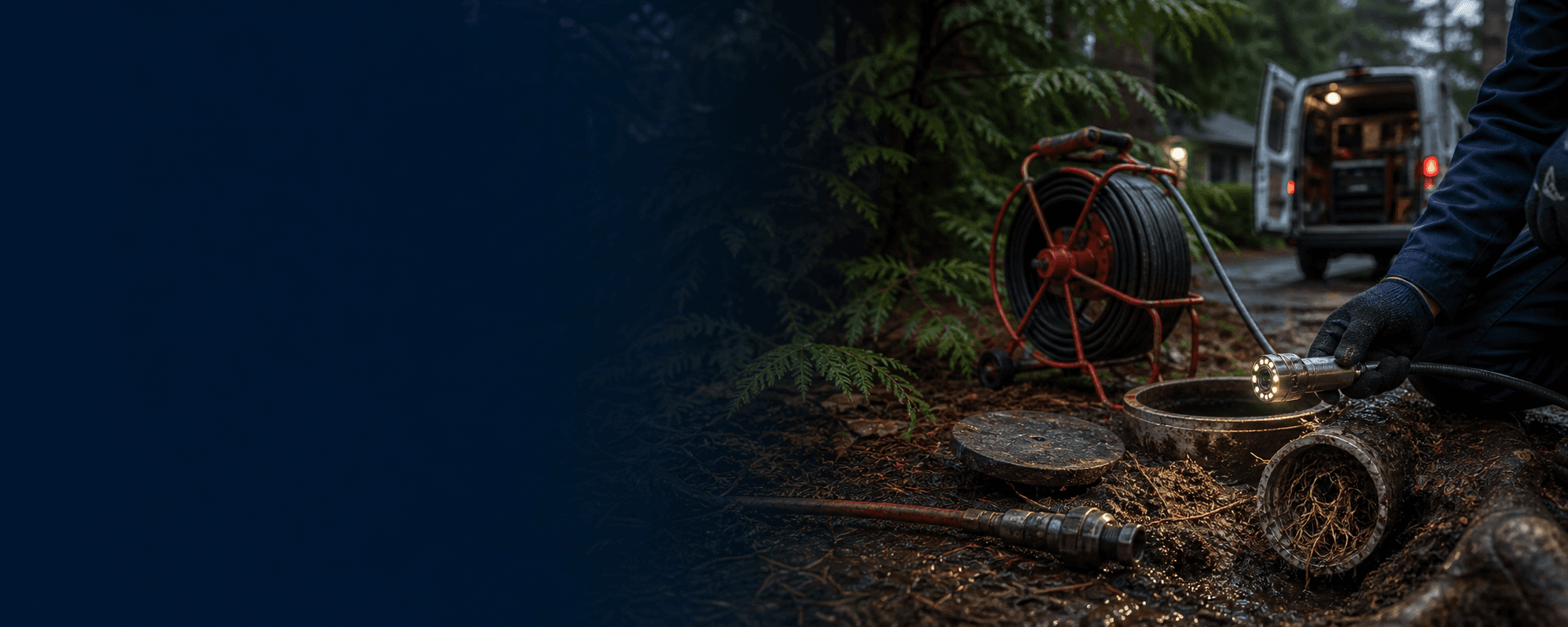
Side sewer in Bellevue: what it is, who owns it, what it costs when it fails, and what the permit requires
The City of Bellevue uses the term 'side sewer' for what most of the country calls a sewer lateral — the underground pipe connecting a building's plumbing to the public sewer main. In Bellevue, the side sewer is the homeowner's property and financial responsibility, from the foundation to the connection at the city main. This guide covers the terminology Bellevue's permit office uses, the ownership boundary, permit requirements, the most common failure patterns by housing era, cost ranges for every repair option, and how to find your cleanout.
Last reviewed: 2026-06-16
What is a side sewer in Bellevue?
A side sewer is the underground drain pipe that carries sewage from a building's drain-waste-vent system to the city's sanitary sewer main in the street or alley. In Bellevue, 'side sewer' is the official term used by the City's Development Services department — it's the same pipe the rest of the country calls a sewer lateral or building sewer.
The pipe runs from the foundation of the house — where the interior building drain exits through the foundation wall at or below grade — to the connection point at the public sewer main. In most Bellevue residential properties, that run is 30 to 120 feet long, 4 to 6 inches in diameter, and buried 4 to 8 feet underground. Exact depth depends on grade, construction era, and where the main is relative to the house.
The side sewer is a gravity-flow system — waste flows downhill by slope, typically 1/4 inch of drop per foot of run (a 2% grade minimum). The slope is established at installation. Inadequate slope produces standing water in the pipe, which allows solids to accumulate and causes recurring blockages regardless of how often the line is cleaned.
Side sewer vs. sewer lateral vs. sewer line: are these the same thing?
Yes. In Bellevue, 'side sewer,' 'sewer lateral,' 'building sewer,' and 'sanitary sewer connection' all describe the same pipe. The City of Bellevue and King County use 'side sewer' in their permit documentation; real estate agents and national sources use 'sewer lateral.' A plumber quoting 'sewer line work' typically means the same thing in a residential context.
Knowing the local term matters because Bellevue's permit system, inspection forms, and Development Services documents all use 'side sewer.' If you're applying for a permit, requesting an inspection, or searching the City's records for your connection documentation, you'll need the local term. The City's Side Sewer Permit Application, connection fee schedule, and inspection procedures are all indexed under 'side sewer.'
One useful distinction: 'main sewer' or 'public main' refers to the city-owned pipe in the street right-of-way. Your side sewer connects to it. The main is the city's responsibility; your side sewer is yours. In Bellevue, the standard is that the homeowner is responsible from the building foundation all the way to and including the connection fitting at the main.
Who owns the side sewer in Bellevue, and who pays when it fails?
The homeowner owns the side sewer and is financially responsible for all repair and maintenance — from the foundation of the building to the connection at the public main. The City of Bellevue owns the public sewer main; it does not repair or pay for side sewer failures.
This ownership boundary is documented in Bellevue's utility code and is consistent across Washington State — the side sewer serving a private property is a private utility, not a public one. When the side sewer backs up, collapses, or needs replacement, the homeowner contracts with a licensed plumber or sewer contractor and pays. The city's role is limited to requiring a permit and conducting an inspection.
If a backup occurs, the City of Bellevue will not send a crew to your property. Call a licensed sewer contractor directly. If you believe the backup originates from a problem in the public main — very rare — you can call Bellevue Utilities at 425-452-6900 to request a main check, but have your side sewer camera-inspected simultaneously so you're not waiting on a city response while sewage stands in the house.
Bellevue side sewer ownership and responsibility
The most common side sewer failures by Bellevue housing era
Three pipe materials define Bellevue's side sewer failure landscape: clay tile in pre-1960 homes, cast iron in 1960s–1975 homes, and PVC in homes built after 1980. Clay and cast iron are at or past end of service life in Bellevue's older neighborhoods.
Bellevue's pre-1960 construction (Wilburton, older Crossroads sections, Downtown-adjacent neighborhoods) used clay tile sewer pipe standard in US residential construction since the 1880s. Clay tile has a service life of 50–80 years under ideal conditions; at 65–75 years old, Bellevue's clay laterals show root intrusion, joint offset, and pipe collapse.
The 1960–1975 wave of tract housing (Lake Hills, Crossroads, Newport Hills, Woodridge, Phantom Lake, Bridle Trails) used cast iron sewer pipe. Cast iron corrodes from the inside (waste acids) and outside (soil moisture). A cast-iron side sewer installed in 1965 has been corroding for 61 years. Active failures include through-wall rust pits, longitudinal cracks, and scale buildup that narrows the bore to less than half design capacity.
Homes built after 1980 (Somerset, Lakemont, newer Eastgate, most new construction) used PVC sewer pipe — joint-sealed with solvent weld and far less vulnerable to root entry. PVC side sewers in good condition have a 75–100 year service life.
Side sewer pipe materials by Bellevue construction era
Why do Bellevue's soils make side sewer failure worse?
Bellevue sits on glacial till — a dense, clay-rich soil left by the Vashon glacier. It swells when saturated in winter and shrinks in summer, and that seasonal movement shears the mortar joints of clay and cast-iron pipe. Every cracked joint then leaks moisture into the surrounding soil, which is what draws tree roots to the pipe in the first place.
Glacial till holds water and moves with it. Bellevue's wet winters saturate the clay fraction and it expands; the dry summer stretch pulls that moisture back out and it contracts. A buried side sewer cycles through that swell-and-shrink twice a year, and the stress concentrates at the rigid points — the mortar-sealed joints of clay tile and the bell-and-spigot connections of cast iron. Those joints were never engineered to flex, so they shear, offset, and open gaps.
An open joint is not just a structural problem — it is a moisture beacon. Sewage carries warmth and nutrients, and a leaking joint releases both into the surrounding subgrade. Tree roots grow toward that gradient: cedar, Douglas fir, maple, and the mature conifers that define neighborhoods like Bridle Trails, Newport Hills, and Phantom Lake send fine root hairs along the moisture trail and into the gap. Once inside, the root sits in a continuous water-and-nutrient supply and thickens into a mass that catches solids and blocks flow.
This is why the same clay pipe lasts 80 years in a dry climate but fails at 65 in Bellevue, and why root intrusion recurs even after cleaning — the cleaning removes the root mass but not the open joint or the soil movement that opened it. On a pipe with active soil-driven joint failure, the durable fix is replacement, not repeated cabling. A camera inspection distinguishes a one-time root clog from a joint that the ground is actively pulling apart.
What does side sewer repair or replacement cost in Bellevue in 2026?
A hydro jet cleaning to clear root or grease blockage runs $795–$1,200. A spot repair for a single broken section costs $2,800–$4,800. Trenchless replacement (CIPP lining or pipe bursting) for a full lateral runs $6,000–$14,000. Open-trench replacement runs $8,000–$22,000 depending on depth, length, and site conditions.
The right repair depends entirely on what a camera inspection shows. Roots without structural damage: clean the line and establish a preventive maintenance schedule. A single bad joint or localized crack: spot repair. Root intrusion across multiple joints combined with pipe deterioration: full replacement. For full trenchless cost detail, see our trenchless sewer repair cost guide for Bellevue and our sewer line replacement cost breakdown.
Cost in Bellevue is driven by three variables: pipe length (the run from foundation to main), depth (deeper pipes cost more per linear foot to excavate), and site conditions (landscaping, concrete flatwork, retaining walls, and grade all add cost). Somerset and Newport Hills homes with deep slab construction, mature landscaping, and long laterals routinely see quotes at the top of these ranges.
Side sewer costs, Bellevue 2026
Does the City of Bellevue require a permit for side sewer work?
Yes. The City requires a Side Sewer Permit for any repair, replacement, new connection, or alteration of a side sewer — including trenchless methods. Drain cleaning and camera inspection are exempt. The permit triggers a city inspection before the trench is backfilled.
Side sewer permits are issued by Bellevue Development Services. The application includes the property address, scope of work, and the contractor's Washington State registration number. Permit fees range from $200–$500 depending on scope. The online application and requirements are available at the City of Bellevue's Development Services portal.
The inspection is critical: a city inspector must view the repair before the trench is backfilled. A contractor who backfills before inspection can be required to re-open the trench. We coordinate the permit application and inspection scheduling on every side sewer job — it's included in the project price, not an add-on.
Unpermitted side sewer work creates problems at resale. A pre-purchase sewer scope sometimes reveals unpermitted repairs that require retroactive permitting or re-doing the work. Our Bellevue plumbing permit guide covers the retroactive permit process for inherited unpermitted work.
How do you find your side sewer cleanout?
The cleanout is a capped 4-inch pipe installed vertically with its cap at or near grade. In most Bellevue homes, look outside the foundation on the uphill or street-facing side of the house, within 5 feet of the foundation wall.
Finding the cleanout matters because it's the access point for camera inspection, cabling, and hydro jetting. A plumber can't camera your side sewer without cleanout access — or must use the toilet and run additional cable, which is slower and less accurate. If your cleanout is buried under landscaping or covered by a patio, locate it before a backup emergency.
Three ways to find a missing cleanout: (1) pull City of Bellevue sewer connection permit records for your address through the permit portal — these often include a sketch showing cleanout location; (2) have a plumber run a camera with a locator that marks the cleanout position on the surface; (3) probe the soil 3–5 feet from the foundation in the direction of the street, where most Bellevue cleanouts are installed.
Some pre-1960 Bellevue homes don't have a standard 4-inch cleanout — access is through a crawlspace clean-out or a toilet. If your cleanout is missing or buried, adding one during sewer work saves one to two hours on every future service call and is worth the add-on cost.
When does a real estate transaction require a side sewer scope?
A side sewer scope is not legally required in Washington State for a residential sale, but most Eastside agents now recommend it for any home built before 1985. A $250–$400 scope that finds a deteriorated lateral before closing is worth far more than the $8,000–$22,000 discovery after it.
Washington does not mandate sewer scope inspections as part of a residential sale. However, Eastside real estate practice has shifted: buyer's agents routinely recommend a scope as an additional inspection item for any home built before the mid-1980s, when PVC sewer laterals became standard. The scope is ordered during the inspection contingency period alongside the general home inspection.
What a pre-purchase scope typically finds in Bellevue's older neighborhoods: root intrusion (very common in Lake Hills, Newport Hills, Bridle Trails, Phantom Lake, and Woodridge), pipe belly or low spots that hold standing water (common in Crossroads and Eastgate), and in a small percentage of cases, active collapse that will require replacement within 1–2 years of purchase.
A documented sewer problem found during due diligence creates a negotiating point: the buyer can request a repair credit, require the seller to make repairs before closing, or renegotiate. A problem discovered after closing is entirely the buyer's cost. Our side sewer and sewer line repair in Bellevue page has more context on what a full scope and repair process looks like.
Sources
Every fact in this guide cites a verifiable public source. If you find a number we got wrong, email dispatch@bellevueplumberpro.com.
- City of Bellevue — Side sewer permit information
- King County Wastewater Treatment Division — Private sewer issues
- Washington State Plumbing Code — WAC 51-56
Need help with this in your home? See our side sewer and sewer line repair in Bellevue page for pricing, our diagnostic process, and how same-day service works across the Eastside.
We dispatch for this across Lake Hills, Bridle Trails, Newport Hills, Eastgate, Crossroads, and Somerset — see your neighborhood page for local response times and recent jobs.
Related services: Drain Cleaning and Clog Removal.
Related guides
- Trenchless sewer repair cost in Bellevue: lining vs bursting, price ranges, and when it beats digging
- Cedar and Douglas fir roots in Eastside sewer lines: signs, repair, and prevention
- Sewer camera inspection cost in Bellevue: what it shows, what you pay, and when you need one
- Sewer smell in the house: causes, dangers, and how a plumber finds the source
- Sewer line cleaning in Bellevue: when to do it, what it costs, and what method is right
- Sewer scope inspection before buying a house in Bellevue: what it reveals, what it costs, and why Eastside agents require it
- Basement floor drain backing up in Bellevue: causes, cleanup steps, and the sewer line problem behind it
- Flushable wipes and Bellevue sewer backups: what happens inside the pipe and how to prevent it